*** START OF THE PROJECT GUTENBERG EBOOK 78506 ***
Pilgrims of the Night
PILGRIMS OF THE NIGHT
A Study of Expelled Peoples
by
RT. REV. EDWARD E. SWANSTROM
with a foreword by
HIS EMINENCE FRANCIS CARDINAL SPELLMAN
SHEED and WARD
New York ··· 1950
Copyright, 1950, by Sheed & Ward, Inc.
MANUFACTURED IN THE UNITED STATES OF AMERICA
Foreword
The Holy Year of Our Lord, 1950, comes at mid-century
of an era of anguish for the children of men.
The precious blood of millions of men, women and
little children of nearly every country has been
spilled in a world still torn by suffering and strife,
and other millions of maimed, sick and destitute
still roam homeless throughout lands disfigured by
wounds of war.
Monsignor Swanstrom has personally visited many
of these lands and been witness to the grief and
sufferings of many of these misery-ridden peoples.
Of them and their desolation and agony he writes
with understanding and compassion, and I pray that
those who may be fortunate pilgrims to the Shrines
of the Apostles during the Holy Year, and all who
live in our blessed land of liberty and bounty, will
remember with prayers and active charity God’s
pitiful pilgrims who, with heart-rending truth, have
been called, “Pilgrims of the Night.”
Archbishop of New York
Cardinal’s Residence
452 Madison Avenue
New York 22
It was shortly before the halfway point in this our
twentieth century that I drove through thousands
upon thousands of tons of rubble, the undifferentiated
remains of an ancient city. What were once
the homes of man, his houses of worship, all the
gathering-places of a city that had sheltered the
spirits and bodies of men down through the ages,
were now anonymous and monstrous heaps of ruin.
As I drove to the home of His Eminence, Cardinal
Frings, the Archbishop of Cologne, I realized more
vividly than ever the effects of total war on the inarticulate
people of the many nations; on the men
who were obliged to take part in this organized killing,
on the women, mothers of families, and on their
children, whose bodies moulder under the broken
stones of so many towns and villages of an old continent.
I felt about the violent half-century already
drawing to a close (five decades of the most intensive
destruction yet seen on the planet), as the poet
had felt about an earlier era: “May it rest in peace,
as it has lived in war.”
When Cardinal Frings received me, I thought he
might make a point of the necessity of rebuilding a
destroyed country, or of finishing the repairs on the
[Pg 2]ancient, partly bombed Cologne Cathedral. But his
concern was for a more urgent problem, that of the
living temples of the Holy Ghost, who have been
herded into the ruins of Germany since May 1945,
when the shooting war ended. War Relief Services-National
Catholic Welfare Conference, as the official
agency of the Bishops of America for relief to devastated
countries, has done all in its power to ease
the lot of these late refugees, but despite the earmarking
of the majority of relief shipments for these
dispossessed peoples, the problem is still staggering
in its immensity. The Holy Father appointed Cardinal
Frings as Special Protector of all these refugees
within the borders of Germany.
As a result of a special agreement reached at Potsdam,
the Germanic groups living in Poland, Czechoslovakia
and Hungary, were to be sent back within
the borders of Germany in “an orderly and humane
manner.” The Allies only took responsibility for the
expulsion. German welfare organizations, both public
and private, were to take care of all housing, food
and other needs of the expellees. German authorities
were told to expect an influx of 6,000,000 people.
However, the idea of mass expulsion, so much
used by the Nazis during the course of the war, now
took hold of the Councils of the Allies, and before
long, the Yugoslav citizens of German origin who
had settled in certain sections by special invitation
more than three hundred years before were gathered
into camps or driven across the border into
Austria. Groups of people were likewise expropriated
in Rumania and driven into Austria and Germany.
Native Germans living in East Prussia, in Pomerania
[Pg 3]in Silesia, were also driven from their homes, while
those who had fled before the Russian armies in
what they thought was a temporary exodus were
forbidden to return to their businesses, their homes
and their well-kept farms.
With its welfare set-up weakened and without
adequate resources, with its housing already damaged
or destroyed by 40 per cent, with all social life
in chaos, ‘rump Germany’ accepted a flood of nearly
12,000,000 men, women and children. They were
destitute, carrying with them hardly more than the
clothes on their backs. Leaving behind as barren
deserts the areas that became productive because of
their agricultural and productive skills, these unfortunates
brought increased chaos and greater want
into the areas that had to accept them.
These new Refugees are known as the Expellee
Group. Their problems are not as well-known as
those of that other homeless, exiled group, the Displaced
Persons, because the DPs rightly became the
concern of the Allied Nations and are being resettled
under the direction of IRO (International Refugee
Organization).
Since 1943, War Relief Services-N.C.W.C. has
followed and cared for the exiles thrown off by a
world at war. The Catholics of the United States
have, through their delegates, been at the side of the
Polish exiles who escaped after their unspeakable
sufferings in Siberia and Asiatic Russia. Priests and
lay Catholics from the United States went to such
areas as Iran, India, North and East Africa, Mexico
and British Isles to set up more than 250 welfare
centers for those deported and exiled peoples.
[Pg 4]
As soon as it was possible to serve the Poles,
Ukrainians, Lithuanians and other groups liberated
from the Nazi yoke, a wholehearted program of aid
was initiated. Now nineteen offices staffed by American
directors serve the DPs throughout Germany,
Austria and Italy. Thousands upon thousands of
Catholic DPs are being resettled in new homes in
the United States and other countries through the
emigration programs of the N.C.W.C.
At this moment, about 300,000 DPs remain, out of
the enormous total of 1,500,000 which UNRRA took
over after the war. The donations of the Catholics
of America in the Bishops’ Laetare Sunday collection
have made it possible to give these important services
and also to approach a final solution of the DP
problem.
The IRO has been an expression of international
concern for DPs and has been the means of coordinating
emigration plans and providing transportation
to lands of resettlement. This specialized agency
of the United Nations is now planning with private
charitable agencies for the welfare of those DPs who
cannot emigrate, the so-called “Hard Core.”
But no international agency has protected the
millions of expellees. No group of governments has
banded together to solve this problem which was,
after all, internationally created.
The Expellees have been solely the concern of
local German agencies, including the public welfare
agencies, private welfare agencies, notably Caritas,
the Catholic Charities of Germany, and the Evangelical
or Lutheran Aid Society.
It was for these, the Expellees, that Cardinal
[Pg 5]Frings pleaded, like a father pleading for helpless
stricken children. He told me that the relief supplies
of War Relief Services-N.C.W.C. had saved countless
lives among this almost forgotten group, and he
expressed his most earnest wish that we would not
consider the problem solved and withdraw our help.
He told me how heavily the problem of the Diaspora
Catholics (those expelled Catholics who live in the
northern areas of Germany without churches or
schools) lay on the heart of each and every Catholic
Bishop. For this reason a special Catholic
Study Committee has been set up to find ways to
meet the problem.
I told the Cardinal that I planned to see with my
own eyes, as a means of giving a firsthand report to
the Bishops of the United States, how these Diaspora
Catholics lived in dioceses where one out of two
Catholics is a homeless, destitute expellee.
The problem of expellees was not new to me, since
I had been in Germany in 1945, right after the end
of hostilities. I had come to set up a program for the
Displaced Persons, innocent men and women and
even children who had been impressed into slave
labor for the Nazi war machine, or who had fled
from such areas as the Baltic States before the second
arrival of the armies from the East.
I had seen the cattle cars come into various towns
of Germany. I had been present when these first
transports were opened up, and the weary people,
from aged grandmothers to little babies in their
mothers’ arms, emerged into the daylight, into the
ruins of railroad stations. I had stood with other
witnesses as the dead and the dying were carried
[Pg 6]from the cars, and I had seen nameless expellees die
right before my eyes on the cold stone of the station
floor. These mass expulsions were the result of a
theory of mass guilt, a theory which makes every
single human being, in a given group, responsible
for the actions of the leaders of the group. Thus even
babies and little children are punished as guilty entities,
in the same way as Hitler killed even little
Jewish children as members of a race that he, in the
obscenity of his racial hatred, considered guilty as a
whole.
The Bishops of the United States spoke up against
these mass expulsions in no uncertain terms. In
1946, when the deportations were at their height,
and few voices were heard in defense of a recent
enemy, the Administrative Board of N.C.W.C., in
the name of the Bishops of the entire United States,
made the following statement:
“Something has been happening in Europe which is new
in the annals of recorded history. By agreement among the
victors, millions of Germans who for centuries have lived in
Eastern Europe are being forced from their homes, without
resources, into the heart of Germany. The sufferings of these
people in their weary travels, the homelessness of them, and
the hopelessness, make a sad story of the inhumanity of their
transplantation. Had there prevailed in the councils of the
victor nations a right appreciation of the dignity of man, at
least arrangements would have been made for transplanting
these people in a humane way. We boast of our democracy,
but in this transplantation of peoples we have perhaps unwittingly
allowed ourselves to be influenced by the herd
theory of heartless totalitarian political philosophy.
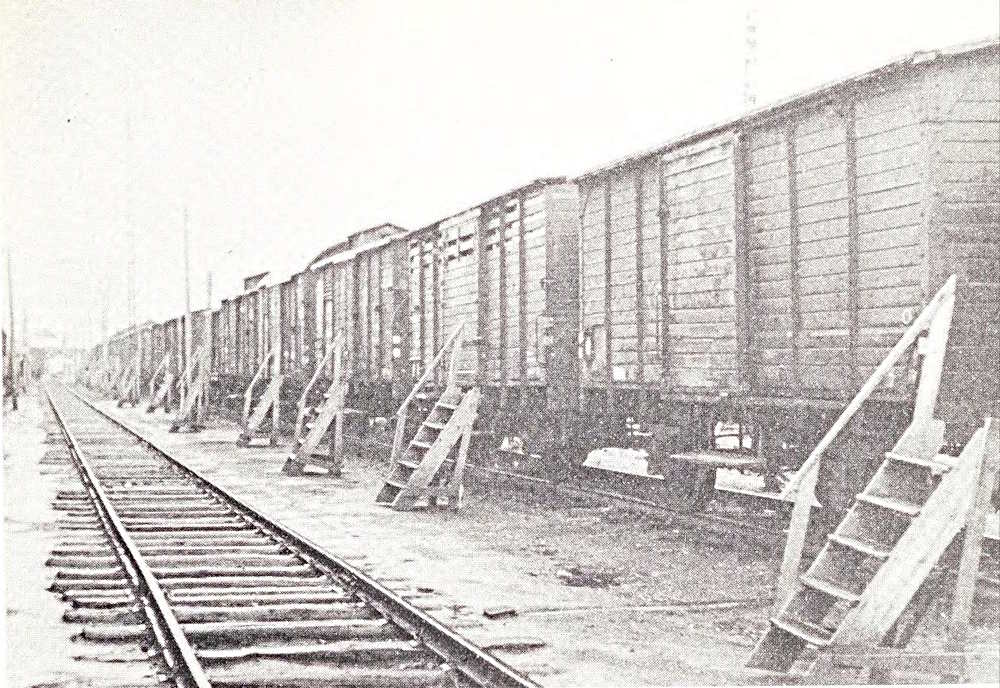
In the first days of peace they were locked in
the cattle cars. Here the steps are placed against
the locked cars so that the people can emerge
into exile.
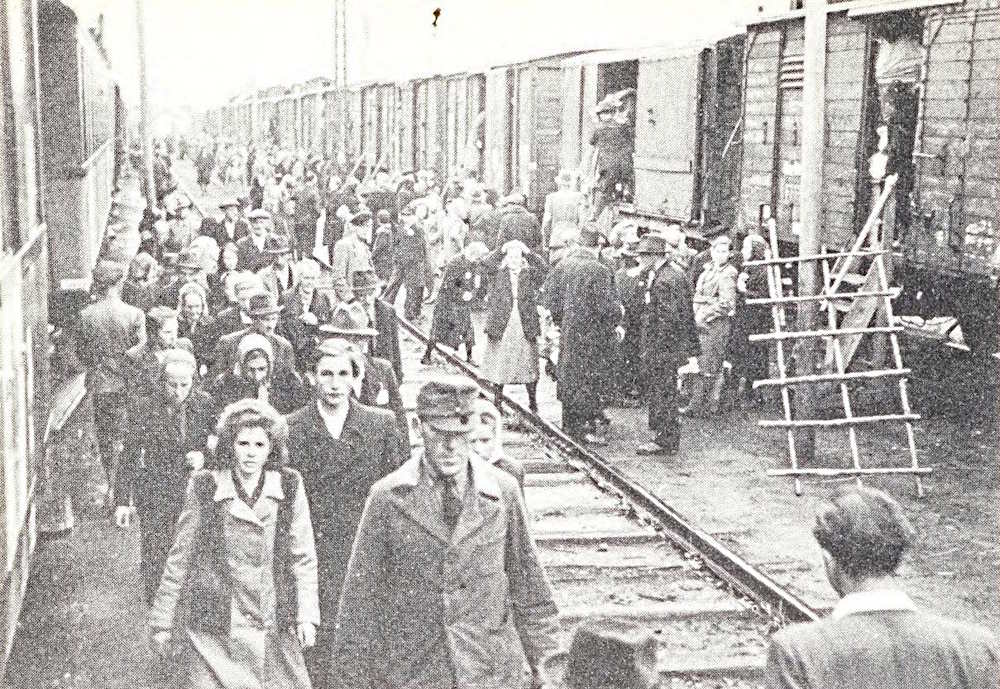
Owning only the clothes on their backs, the
Expellees walk into the night of homelessness
and destitution.
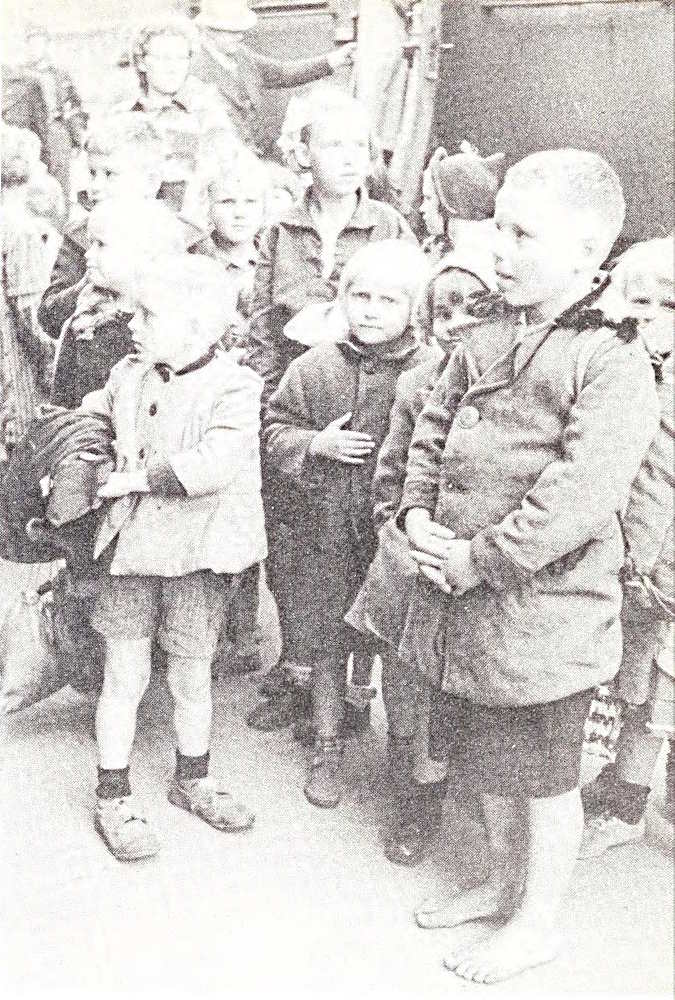
Child Expellees, thrust across frontiers, descend
from a transport.
Some, mostly the helpless aged and the helpless
young, died on the way; others arrived like this
and died later.
The reports of the deportation of thousands in areas of
Soviet aggression to remote and inhospitable regions just
because they cannot subscribe to Communism tell of a cruel
[Pg 7]violation of human rights. These men are men and have the
rights of men. Our sympathy also goes out to the technicians
and skilled workers in enemy countries who have been seized
and forced to work for the strengthening of the economy of
victorious nations. It is not in this way that peace is made
and the nations are united in mutual cooperation. No lasting
good can ever come from the violation of the dignity of the
human person.”
In the same year, the World Protestant leaders
made a moving protest in these words:
“The Provisional Committee of the World Council of
Churches is persuaded that this policy, aggravated as it is by
the compulsory transfer of large numbers of people from
other countries into a smaller Germany, ought to be re-examined,
lest, by condemning millions of Germans either
to be fed by charity for an indefinite period or to die from
starvation until the population fits the new frontier, it bring
ruin, not only upon Germany, but on Europe.”
The Catholic Bishops of America, as Fathers of
the Poor, spoke out for all the poor—and who could
be more poor than those driven like herds of cattle
across frontiers without homes, or bread? They denounced
the deportations of Eastern Europeans to
Siberia, and of conquered peoples to slave labor in
Nazi Germany, and of masses of Germanic Europeans
to post-war Germany, in exactly the same
terms—as a violation of the rights of man. These
same Bishops had supported the war effort of the
United States precisely because our country, in company
with its Allies, was fighting a war to vindicate
the common humanity of all men of all races.
They had called for the utmost sacrifice in the
country’s service so that the bestiality of aggressive
warfare, of extermination camps, of mass expulsions,
[Pg 8]could be erased from our generation. Their whole
denunciation of persecution, and call to retribution,
was based on the principle that men have rights
that are inviolable, and they included in the category
of men, all our enemies.
A man’s moral principles are put to the test, not
so much in his treatment of his friends, of those he
loves, as in his treatment of his enemies. All the
qualities of forbearance, of respect for human personality,
of obedience to strict justice, are strained
when he has in his charge those who have been or
are his enemies. This is equally true of nations. If
there is any general acceptance of the thinking that
the innocent men and women and children among
the Expellees deserved their fate because of their
racial stock, then it would seem that a moral catastrophe
has come upon those who fought in the name
of moral principles.
There are those who, unconsciously sharing the
un-Christian concept of mass guilt, do not press for
help to the expellees, or for a solution of the immense
problems. Because of lack of full information,
many people do not yet realize the crucial importance
to the recovery of Europe of an organized approach
to the whole matter of integration and resettlement
of the millions of expellees now living in
camps and barracks, airless bunkers and barns. It is
not yet understood that this group hangs like a dead
weight to impede the recovery of all of Western
Europe. Many Catholics do not appreciate the moral
and religious implications of the problems.
Sometimes it is easier to make a vivid and realistic
picture of a problem if we describe it in terms of our
[Pg 9]own environment. The impact of the Expellee problem
on a Germany reduced to three quarters of its
former size, bombarded almost to a standstill, deprived
of millions of its manpower by death and
detention in Eastern Europe, would work out like
this if it were applied to the United States. Suppose,
God forbid, that one quarter of the wheat-producing
and industrial territory of our country were ceded
away, and that the greater part of our larger cities,
including Detroit, Chicago, and all the port cities,
were battered by bombs. Suppose that millions of
men of active arms-bearing age were detained for
years as Prisoners of War in other areas of the world.
And then, suppose that all the populations of Canada
and Mexico were driven into the United States as
destitute refugees, having been forced to surrender
their homes, their businesses, their farmlands, without
compensation. It is easy to imagine the sufferings
of so great an army of the dispossessed if they came
wandering the roads of our nation, and it is easy to
see how many of them might perish of cold, of hunger
in the desolation of their enforced exile.
It is just such a situation that I shall write
about in Europe. It is a situation from which our
leaders and people alike have tended to turn away
their heads. But no solution can ever be found unless
we force ourselves to face problems in their
reality—whether that reality be pleasant or not. By
this time, the Expellees who could not survive the
terrors of the road or cattle car, or the rigors of the
first years of being homeless, have already perished.
Estimates generally agree on the figure of a mortality
of fifteen percent during the first year of expulsion.
[Pg 10]Now, the situation has settled down to a
struggle for existence on the part of the Expellees—a
struggle that would have resulted in death for
many more were it not for the fact that charity still
exists as a moving force in the world.
In the darkness of their bitter exile, their homelessness,
their abandonment, in the hopelessness of
their outlook toward the future, these Expellees,
driven so heartlessly across frontiers, are, in the
words of the old hymn, “Pilgrims of the Night.”
I shall try in a few short chapters to penetrate the
terror and sorrow of their night of exile and to
delineate for you a few of the experiences of these
silent, joyless pilgrims. I shall record my visits to the
various areas where the expellees live, and shall
attempt to picture from these visits and from the
special reports of various workers of our relief
agency, the plight of little children, of women, of
men, of priests, and even of Bishops, who make up
this vast army of pilgrims of the night.
[Pg 11]
CHAPTER II Men and Work
“Extraordinarily frightening,” says the New York
Times in examining the German refugee problem in
an editorial that appeared early in 1950:
“About one-fourth of the population of the Federal German
Republic is composed of refugees from the provinces now
occupied by Poles, from the Eastern Soviet Zone, the Czech
Sudetenland and a few other scattered places....
“There are now more than 8,500,000 registered refugees in
the Western Zones, and at least another 1,000,000 who are
drifters and live by begging, scavenging and thieving like so
many gypsies, without permits to work or settle down. Something
like 40,000 refugees are coming in monthly from the
Soviet Zone. What can be done with them?...
“It is an example of how extraordinarily frightening German
problems can be when one stops to think about them.”[1]
This sensation of alarm was with me when I came
close to the lives of these refugees, or Expellees, in
an industrial center in and around Salzgitter.
Here during the war years, the Nazi conquerors
brought hundreds of thousands of workers, mostly
slave laborers, who occupied the rows upon rows of
desolate barracks that stretched out over the flat
countryside as far as the eye could see. Not long
[Pg 12]after the barracks had been vacated through the
liberation of the slave laborers, they were filled again—this
time with destitute families and parts of families
who had been expelled from their homes by the
Allies. In a gigantic movement of population known
as “Operation Swallow” millions of men, women and
children were dumped into this and other areas of
a destroyed nation after Silesia and part of East
Prussia (formerly part of Germany itself) were given
to the Provisional Administration of a regime imposed
on an unfree Poland.
Sixty thousand of these Expellees were clustered
in the infamous slave labor camps of Salzgitter when
I visited them recently. I visited one barrack which
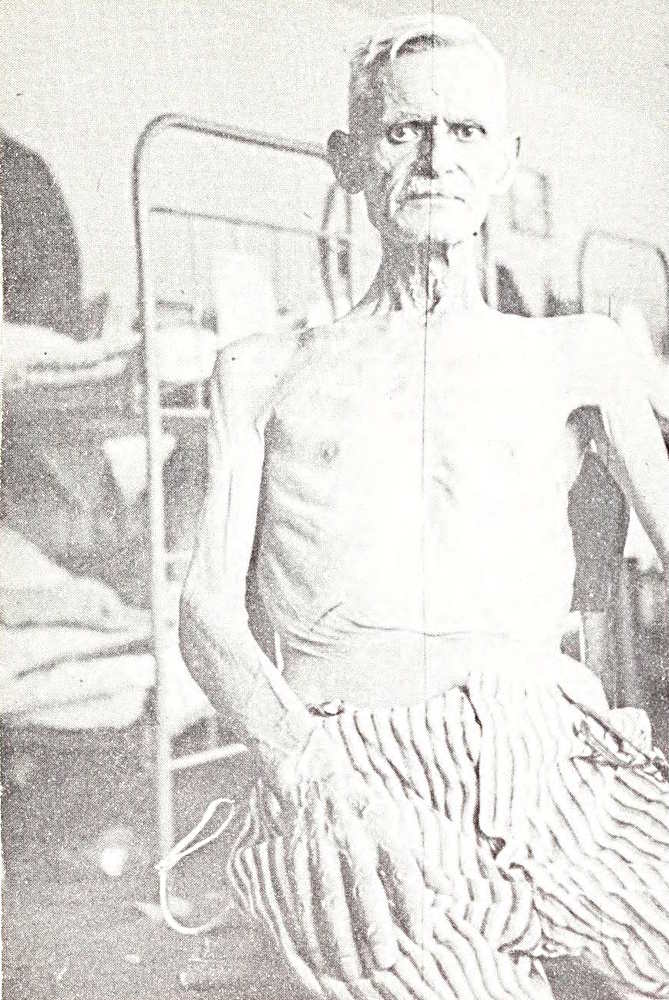
served as a provisional hospital for the aged and
infirm among the Expellees. I was told that more
than 400 old people, weakened by the deportation
and the consequent hunger and lack of care, had
died in this barrack-hospital in the days of the
“Operation Swallow.”
In the meantime, the men among the Expellee
group had found work in some sections of the Reich
Steel Works, a great war-born industry.
I knew that many of the industrial plants in the
area had already been dismantled as producers of
materials that could be turned to war purposes. No
protest had accompanied these dismantlings, since
no working people anywhere wanted a repetition
of the holocaust of blood and broken steel and stones
that they knew in World War II.
However, part of the steel works, which use the
large deposits of ore found in the area of Salzgitter,
are still operating, and more particularly the railroad
[Pg 13]repair shops. The Allies decided, after dismantling a
great rolling mill and crating it for shipment to Yugoslavia
as reparations, that three out of four smelting
furnaces could continue working, in order to make
use of the special smelting process necessary for the
particular type of ore mined in the vicinity. Coal
was needed from the Ruhr, and as not enough was
shipped, only one smelting furnace was actually in
operation.
Work was the precious thing that these dispossessed
heads of families had found here as a result
of the fact that the furnace had not closed down.
Workers all their lives, they still had their self-respect
because they could buy the bread and potatoes
that kept their families alive. Other men, released as
prisoners of war from Russia and Poland, found that
their families had already been resettled in the slave
labor barracks in the “Operation Swallow.” They
also came here, and many of them were able to use
their industrial skills in the steel works.
What amazed me when I visited these desolate
barracks on a damp and overcast day was the lack
of complaint at the obvious want of decent comfort
and privacy in their lives. In one medium-sized
room, I found four families living. Their quarters
were separated by blankets hung on ropes. One
primitive stove served the four families. Some of the
men and one of the women (together with her
daughter) had known from months to years of slave
labor in Eastern Europe since the end of the war.
They felt that this freedom in the west, though it
was a freedom bounded by blanket partitions and
barracks built for Hitler’s slave labor, was a beautiful
[Pg 14]thing. “We are grateful to God to be here,” this
woman told me. “I am glad that my daughter and
husband are alive. I’ll make no complaint.”
But with the men, I could feel a corroding fear.
They discussed the fear with Dr. Adalbert Sendker,
who accompanied me on my visit. As Director of
Charities, and member of a local Commission for
Expellees, Father Sendker struggles daily to meet
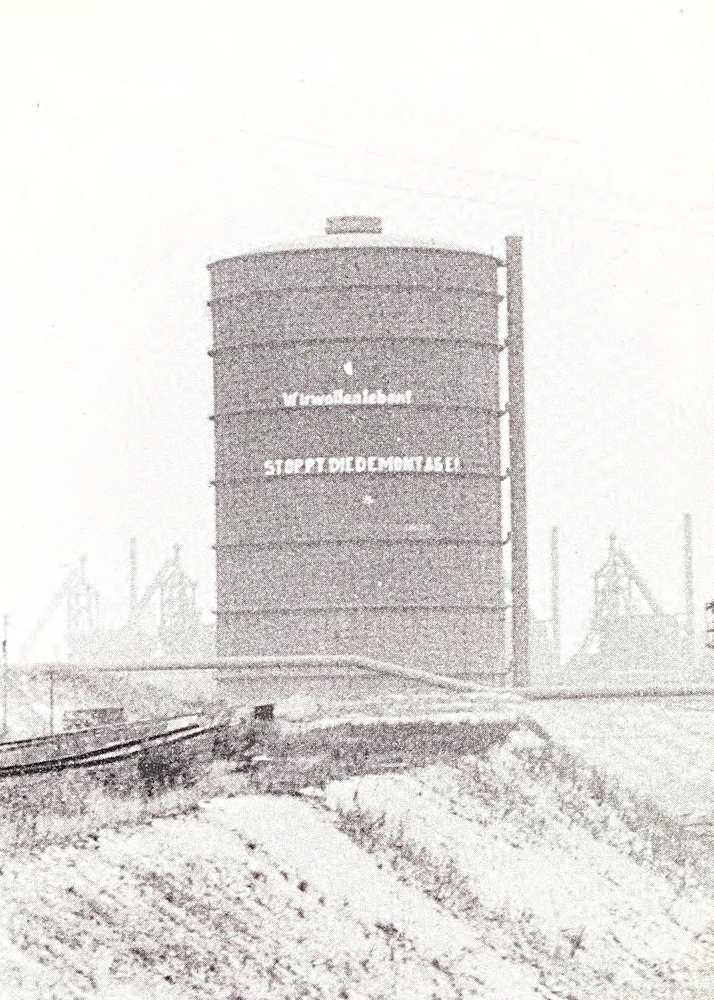
the needs of these dispossessed people. They pointed
to the tremendous lettered message, painted in
white on a great gas tank that dominates this woebegone
community of rows upon rows of rough
wooden barracks, WE WANT TO LIVE. STOP THE DISMANTLING.
One of the men explained: “We want to
support our families—even if we can hardly buy the
few things that are listed on the ration card. Now
most of us who work only have jobs because we are
dismantling. Every day, we destroy our own livelihood.
What will become of us all when there is nothing
more to dismantle? Before long everything will
be as still as the grave.”
I looked for confirmation to Dr. Sendker. “That is
true,” he said. “We fear that before long all will be
still here. Only about 800 men will have work in the
ore mines, which will then send the ore to the Ruhr.”
The sign “WE WANT TO LIVE. STOP THE DISMANTLING”
stared at me wherever I went in this community
of desperate people. I am not competent to
judge the question of dismantling in its larger aspects.
Any steps to prevent another war should be
taken at the earliest possible moment. There is here,
however, the problem of nearly 60,000 Expellees
from Upper and Lower Silesia in a much larger
[Pg 15]native population. These heads of families have
found a livelihood for themselves and their families
in works that have been turned to peacetime uses.
Now, at one stroke, they will all be rendered paupers,
exiled paupers who will depend on the pittance
of the local public welfare set-up and the local religious
welfare agencies. Already, Caritas of the
diocese of Hildesheim, the local Catholic Charities,
is spending 85 percent of its budget and of its donations
from the outside to meet the needs of the
hundreds of thousands of Expellees in its area.
This, then, is undoubtedly a social and human
problem that goes far beyond the realm of politics.
Those who agreed to the creation of this double
problem must have an answer adequate to meet it.
So far, there has been no hint of an adequate answer,
nor have sufficient serious studies been made
which give much hope for the future. Whether
the Salzgitter Steel Works were dismantled or not
would have little importance if plans were afoot
to resettle, either in Europe or beyond Europe’s
frontiers, the more than 60,000 uprooted human
beings who have found a refuge and bread there.
The latest report of the High Commissioner’s Office
for Germany says, on the subject of Expellees:
“The influx of refugees is primarily a German problem and
the care and maintenance of these groups until they can be
assimilated by the West Zone economy is primarily a German
Government responsibility.”
When, several years ago, I studied the waterfront
labor problem in a great Eastern port, I found
many intricate and involved problems, but to each
[Pg 16]one there was the possibility of a solution—whether
or not any steps were taken toward that solution.
Here in Salzgitter, turn which way I would, I could
see no solution, because in making overall decisions
of an economic and political character, the human
material has been completely ignored. That human
material faced me as I walked among the rows of
slave labor barracks—the men, with their grey, worn
faces, the women, with their pathetic attempts at
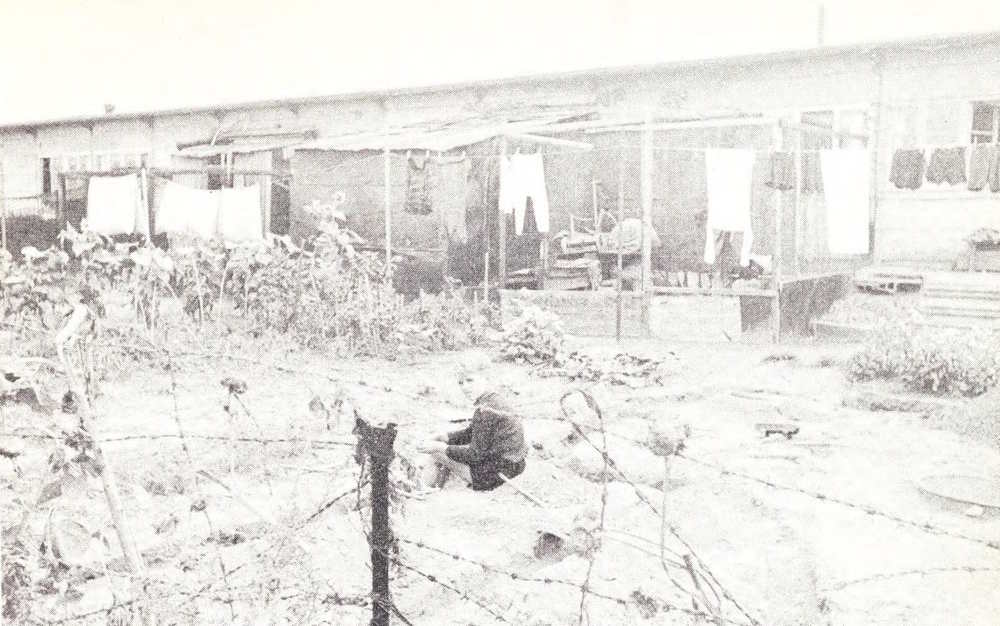
homemaking, the children playing in the mud inside
the barbed wire enclosures.
Up to now only local German agencies, and the
Protestants and Catholics of the United States, have
been active in trying to salvage the human material
of the mass expulsions, of the mass misery and unemployment.
War Relief Services-N.C.W.C. has been
sending large quantities of food and clothing to
answer the desperate appeals of the German Catholic
Charities for continued help. Some help has come
from England, particularly for expelled priests and
forsaken parishes.
Eight expelled priests, who lost their parishes
when they and their flocks had to take to the road,
serve the Catholics among the Expellees around
Salzgitter. These men, dressed like workmen, bicycle
around from barracks to barracks, instructing, comforting,
consoling.
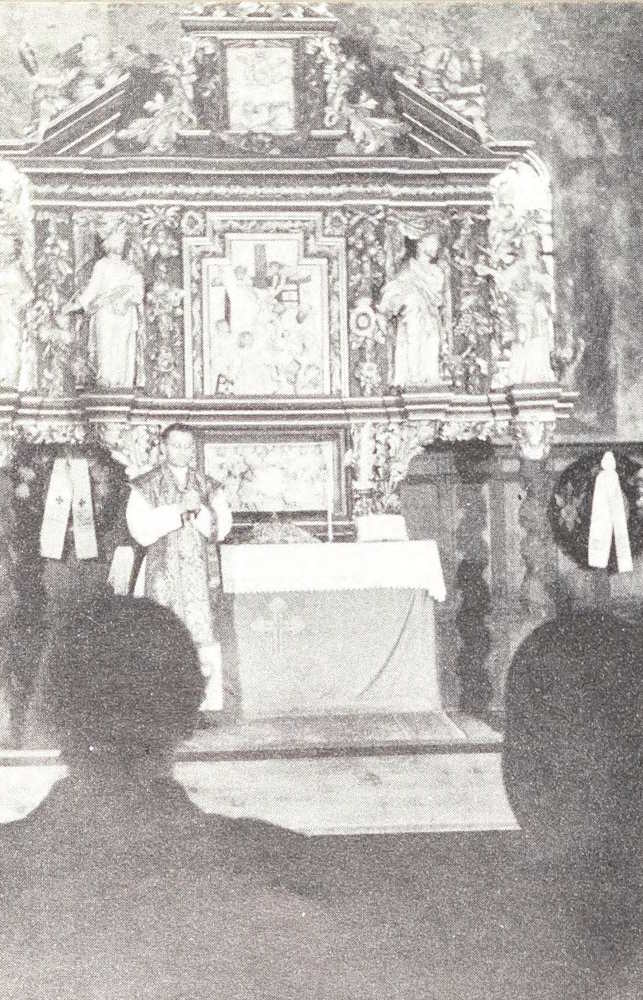
They have set up a church in a great old cow barn
and celebrate Mass there regularly, often while the
rain drips in through the ancient and unrepaired
roof. Animals are still kept in annexes to the barn.
At night these men return home to rented rooms;
one to a sleeping room in a kitchen, a group of several
[Pg 17]to a small rented apartment with borrowed furniture.
They are much heartened by any little help
they receive in their difficult ministry.
In a special program to relieve their most urgent
needs, English Catholics have collected help from
their own slender resources to send to the priests
of the area. Active in the work are the members of
the St. Vincent de Paul Society of the Diocese of
Nottingham, England. One sees in the putting aside
of old enmities, the real beginning of peace.
Salzgitter, with its thousands of desperate men,
first rendered destitute and homeless, and now
rendered unable to earn the bread for their families,
is a meeting place of the burning social problems
of Europe as a whole. America and the Allies can
only ignore this problem at their peril, because these
forgotten men with their expelled destitute families
are becoming a dead weight on the spiritual and
material revival of western Europe.
Since I visited the area of Salzgitter, there have
been mass meetings, demonstrations, and even riotings
by the local population against the progress of
the dismantling project. It was finally decided to
retain a large portion of the Reich works in activity.
The men who so feared complete idleness will now
continue working. Present plans call for the utilization
of the plant for the manufacture of mining
machinery, castings for railway rolling stock, ceramic
products and pig iron castings.
The impossibility of providing a livelihood for
uprooted people who form a quarter of the population
of the Federal Republic of western Germany is
better understood when one adds to such problems
[Pg 18]as that described above, the inescapable fact that
two industrial and mining areas have been effectively
detached from Germany proper, Silesia in
the East, and the Saar, bordering France. The
economy of The Ruhr, the third and largest industrial
and mining concentration, is operating at a
reduced level because of the effectiveness of Allied
air raids on war plants, and because of subsequent
dismantlings.
And yet, the already swollen population of these
western areas grows at a monthly rate of about
40,000, as the Times editorial pointed out, owing to
the continuous flight of people from the People’s
Republic of Germany behind the Iron Curtain.
Nothing could give a clearer view of the tragedy
of uprooted people than a visit to the transit camps
where are lodged the unfortunates who flee from the
Eastern zone of Germany. During a twelve-month
period, 1,300,000 persons crossed illegally. Many of
these are Expellees who were dumped into the
Soviet Zone and who have fled to the West, hoping
for freedom if not security.
One of the largest transit camps is at Uelzen,
located inside the British Zone of Germany, not far
from the Iron Curtain. This same camp crowded
with ugly barrack structures was the scene of the
Operation Swallow mentioned above, by means of
which hundreds of thousands of the former inhabitants
of Silesia were concentrated briefly into Uelzen
and then distributed all over the British Zone of
Germany, including Salzgitter and vicinity. Operation
Swallow, as callous a bit of human engineering
as the post-war west can boast, was notable for the
[Pg 19]skeleton-like appearance of so many starved men,
women and children.
A great number of those who now come to Uelzen
through the forests are men, fleeing from service in
the People’s Police. Large groups of young men
present themselves at Uelzen stating that they are
fugitives from enforced labor in the uranium mines
near the Czech border. For the teenagers among
these groups, and they number untold thousands,
Caritas has founded several homes and training
centers, such as will be described in a later chapter.
A board of German experts representing the various
government departments, or Lander, sits at the
Uelzen camp, and examines the pitiful stories of
the newcomers and also their potentialities for work.
If the new refugees cannot prove political persecution
in their last residence, or have crossed only for
economic betterment, they are immediately turned
out of the Uelzen camp and given railroad tickets
for the return journey to the Soviet Zone. If political
persecution can be proved, the man is provided by
one of the representatives of the Land governments
with the promise of a job, a ration card and transportation.
If he has a family with him, he can take
them with him, or can leave them in the Uelzen
camp for a stated period.
The Uelzen transit camp receives between 300
and 1,000 fugitives every day, of whom only a small
percentage can be provided with jobs. The others
are turned out into the roads, because no other provisions
can be made for them. Lutheran Aid Service
has a skilled staff of social workers to take care of
emergency cases such as pregnant women, the sick,
[Pg 20]the aged and those who are looking for relatives.
Caritas also has social work aid, while the Labor
Welfare Committee maintains a fulltime nursery
for the tired and worn children of the men and
women who trek westward.
The camp is a seething overcrowded mass of
desperate human beings fighting for a ration card,
a bunk on which to sleep, for the right to life itself.
But outside on the roads around Uelzen, the scene
is worse. Here are the refugees for whose problems
no solution could be found.
As we drove up and down the road in the neighborhood
of the camp, we saw the men standing,
dazed and tired, their packs on their backs, trying
to beg rides from passing cars and trucks. Others
sat by the roadside as though too weary to go any
further, and many were lying stretched out fast
asleep, their knapsacks serving as pillows.
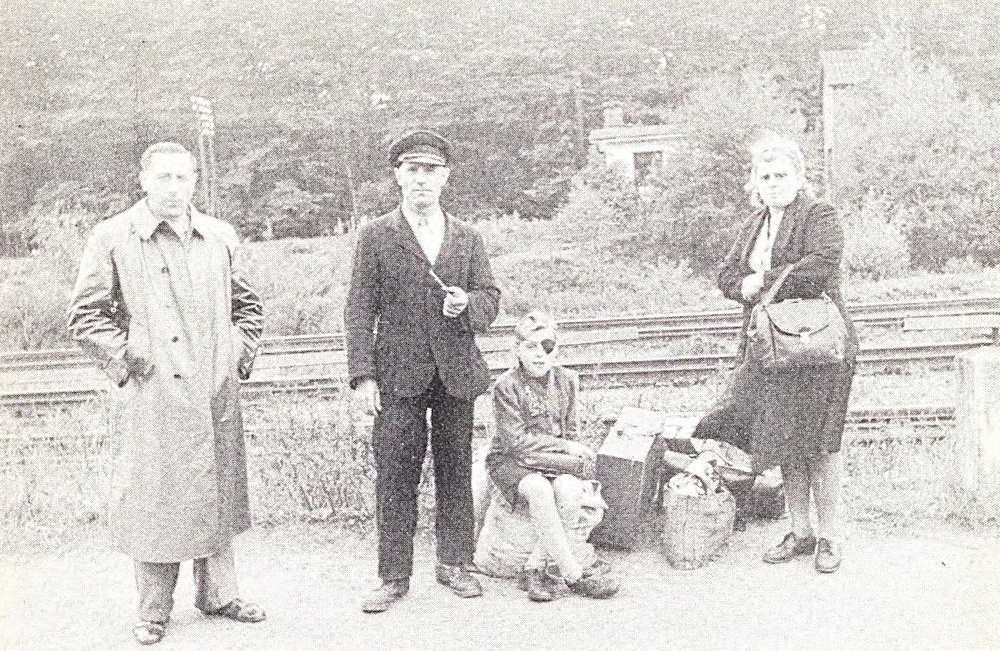
One of our delegates approached a group of such
fugitives. There were two men, a child with a bandaged
eye, a woman with a distraught and agonized
expression. On being approached by an American,
they were willing to talk. They had just been turned
out of the Uelzen camp, turned out into the road of
a destroyed country. They could not prove political
persecution, so there were no jobs, no ration cards,
no chance of shelter. In their pockets were a few
East marks, each one worth only about 20 per cent
of a West German mark. One man was alone, but he
was consulting with the other man, who had a wife
and child, as to what they could do next. The lone
man told his story. Before the war, he had been a
policeman, but he had been drafted into the German
[Pg 21]Army for duty on the Russian front. Captured by the
Russians, he had served more than four years as a
slave laborer. When he was released in early 1949,
he had gone back to his old town, and was returned
to the police force. It was required of him that he
join the People’s Police, and that he carry out political
rather than judicial arrests. “If you do what you
are told, you can have a good life in the People’s
Police,” he explained. “I know well what slave labor
is. How could I do the things they wanted me to
do, arrest innocent people, when I am a Christian?
So I am here. I could not prove that I am a political
refugee—but I will never go back there,” and he
pointed east.
“Well, what will you do now?” he was asked.
“We thought we would try to get to Hamburg.
This man thinks that someone might give his wife
and boy temporary shelter there—and there might
be some kind of work.”
The other man told his story. He had always been
a minor civil servant in a town, and only decided to
flee with his wife when he could no longer carry out
the orders given him. He had thought that perhaps
they would recognize his claims to help in the
Western Zone, and seemed dazed when he and his
wife and son were turned out of the transit camp
without any help or advice, except the railroad
ticket to return to his place of origin. “They were
going to arrest me before, because I did not carry
out all the orders I was given; they would surely
arrest me if I went back now. Even if we starve in
Hamburg, we will keep on going.”
Enough money was found for this desperate group
[Pg 22]to get them to Hamburg, and to take care of them
for a reasonable time. After that they would join
the ranks of the drifters, who manage to keep alive
from day-to-day by the Providence of God and the
local and Church agencies of welfare. But all along
the roads were the others, the tired, the disheartened,
the desperate men, the disheveled women,
the uprooted children, for whom no emergency help
was forthcoming. And as they leave the roads, and
disappear into the teeming life of some half-destroyed
city of the West, their places are taken by
the next wave of those who have fled, and who will
not return. Never in history have there been so many
wanderers on the roads as in our decade just past,
and perhaps the trek has been accentuated in the
past four years of the peace. We can well echo the
query of the thoughtful editorial of the New York
Times. “What can be done with them?”
Thus the problems of men and work cannot yet
be resolved, owing to the stream of people who are
constantly being added to the potential labor force,
the millions of Expellees whose precarious livelihood
is threatened by dismantling, and the lowered
production schedules which result from Ruhr inactivity
and the detachment of other centers of industry
from the body of Germany.
“We want to live! Stop the dismantling!”—Reich
Works Salzgitter-Wattenstedt.
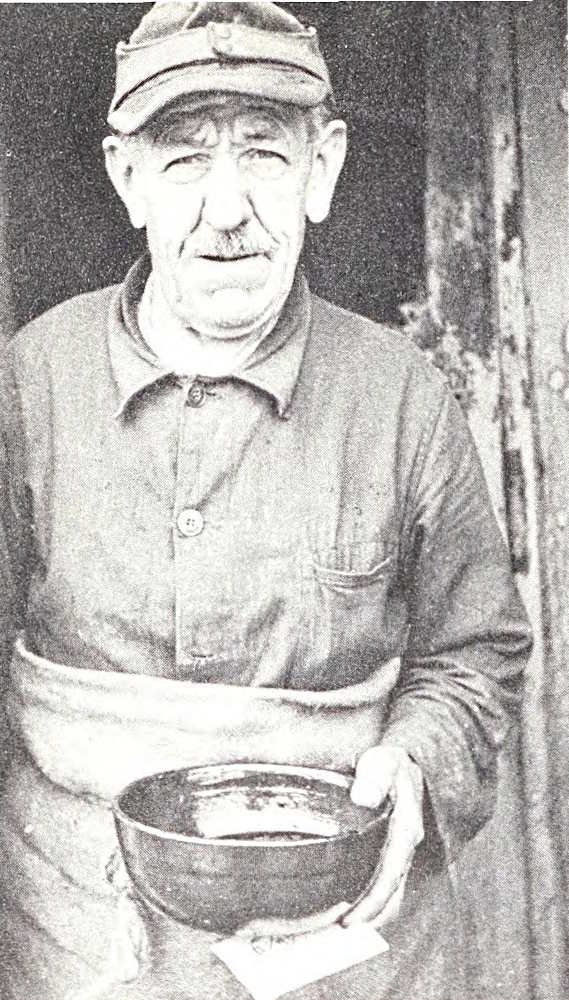
“Now most of us who work, only have jobs because
we are dismantling. Every day we destroy
our own livelihood. What will become of us all
when there is nothing more to dismantle? Before
long everything will be as still as the grave.”
“We thought we would try to get to Hamburg
... there might be some kind of work.”
After fleeing through the forests they arrive at
the transit camp at Uelzen. This bleak haven is
all their hope, but they are so often turned out
to scrounge in a shattered economy.
Another aspect of the condition of Expellee men
and their work is the fact that it often happened
that transports of people from farming areas landed
in industrial centers, and thousands of human beings
from towns were herded into the agricultural areas.
Men are separated for years from the work in which
their skill could be productive of much good. They
[Pg 23]have no security in this temporary adjustment, nor
can they give any sense of security to a family living
in a half or a quarter of a barracks room. It is evident
that no social peace can come out of such conditions.
It is in the hope that some solution moving
toward social stabilization of the Expellees can be
found that this study is being written.
There is a large camp near the center of Germany,
close to the demarcation line between the Western
and Eastern Republics of that divided nation, where
the men held in slave labor by the Soviet Government
are turned over once again to their families,
to freedom. This collection of barracks is known as
Camp Friedland, or Land of Peace. For some time,
the Russian authorities have liberated between
twenty and thirty thousand men every month
through Friedland. In general, the men returned recently
are adequately dressed and have received
more or less the same food as Russian workers. Their
appearance is vastly different from that of the skeleton-like
creatures with bloated heads and feet that
used to be returned in trainloads to their home
country.
The day that I visited Friedland, there was no
homecoming, so I had time to look at the installations
of the camp—notably the Search Service. This
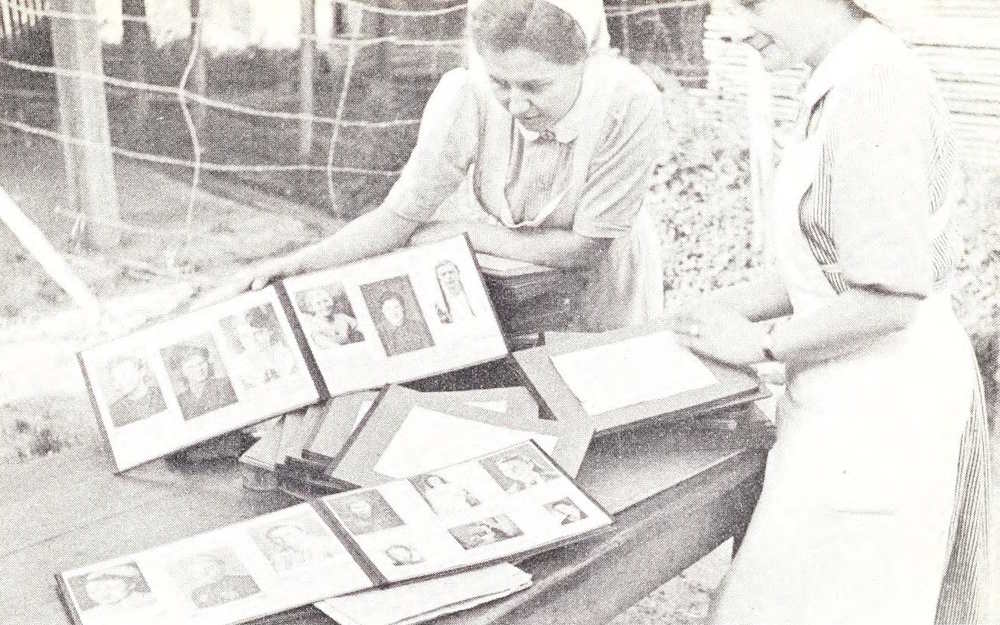
is a Red Cross Service to help these men, often
separated from their families for anywhere from four
to seven years, to locate them again. The Search
Service is located in a large Red Cross barracks,
whose walls are decked with pictures of the missing.
[Pg 25]One picture showed a gang of slave laborers rebuilding
a city of Eastern Europe. One man was facing
the camera, and his features could be clearly distinguished.
A notation underneath read:
“This is my husband. I have had no word from him for
four years. Does anyone know where he is now or whether
he is still among the living?”
Evidently no one had word of the fate of this man,
and in the country where he is held for forced labor,
communication with families is forbidden. I saw
many other such appeals, mostly printed by the
family of the lost man, and carrying a copy of his
picture. These appeals are attached to walls and
gathering places wherever former Prisoners of War
congregate, and are a pathetic testimony to the
power of human beings to hope against all hope.
One picture would show an ordinary middle-aged
man, and underneath would be such a notice:
“This is our father. He wrote to us from the Eastern front
and his comrades say he was captured near Orel. Our mother
has died. Write to us if you have seen our Father. Greta and
Johann Moschle.”
Then follows the address of the children.
Another such flimsy poster carried a picture of a
young man and an appeal from a mother:
“My son Gerhard Foerster was never reported dead, but
some of his comrades say he was taken prisoner at Rostov.
Has anyone seen him in any mine or camp in Russia? He is
my only child. He was born in 1926.”
The returned Prisoners of War scan these pictures,
and if they have knowledge of the persons’ whereabouts,
or of their death in captivity, they use the
[Pg 26]Red Cross Services to notify the families. Even a
death notice is far better than the day-to-day anguish
of waiting and not knowing. The Red Cross
Search Services, as well as the Search Services of the
Catholic and Lutheran Churches, all of which are
integrated by exchange of cards, operate on a scientific
basis. Every returned prisoner, after giving the
number of the regiment in which he served, must go
to the file where all men missing from that regiment
are listed. He will then give information to a trained
Red Cross worker about every one of the missing
men he has seen at any time during his captivity.
This information is annotated, and the family is
informed without delay.
The room that is of the most urgent concern to
the returned prisoner is that busy room with the
teletype machine. Many of the men just returned
do not know the precise addresses of their families,
since so many were bombed-out during the war or
expelled since the end of hostilities. As the men
searching for their loved ones enter the teletype
room, the information they have listed on a form is
relayed to the Red Cross Headquarters in Hamburg.
Here at Headquarters is the master file of all expelled
families, unified with the files handed in by Caritas
(Catholic) Search Service, and by the Lutheran
Service. In as little as three hours, a man whose
family has been expelled from Silesia, or the Sudetenland
of Czechoslovakia, Danzig, East Prussia, Hungary,
Rumania, or Yugoslavia, may hear the joyful
news of their new address—even though this new
address is clearly that of a barracks settlement.
But for many men, there is no news at all. They
[Pg 27]know that their families have been expelled. They
sometimes learn that a daughter or a son has died
in some place or another. But some wives or sons
or daughters have died en route, or shortly after
arriving, and have left no trace. In the terrible chaos
of the great waves of expulsions, no listings of the
dead and missing were possible. The men then wait
around in the camps while additional searches are
made, and finally if no news comes through, they
wander back into an empty world and try to take
up life again. Many, moreover, are sick. These are
gathered into special homes for sick POW’s. Caritas
in the diocese of Hildesheim has such a convalescent
home, as has the diocese of Paderborn—as have most
of the areas of Germany. This is the last bitter end
of the double tragedy of expulsion and slave labor—two
of the things for whose obliteration we entered
the war in the first place.
There are many such men in hospitals, and it is
hard to meet the misery of their eyes. They tell how
they wrote to their old address in Silesia, Czechoslovakia,
Yugoslavia or Poland proper, and how the
letter was returned, or how no answer came back at
all. Among this group there is a well of misery whose
depths no one can plumb—a misery only equalled
by that monstrous suffering inflicted by the Nazi
regime on innocent people during the years of the
war.
In Friedland that day there were some of these
men—men who had been lost four or five years in
the depths of Russia, and now upon liberation were
doubly lost, because life had taken away all trace of
those who were dear to them, even their children.
[Pg 28]The Caritas Director translated their stories for me,
stories that in any other age would have been so
extraordinary that the teller would have been
doubted by his fellows, but today have become the
everyday tales of drafted, deported, dispossessed
and brutalized humanity.
One, I remember, was a young man in his twenties.
He was drafted from his home in Silesia. After being
captured on the Eastern front, he was put to work
in a Soviet mine even while the war was going on.
The food, he said, was indescribably bad those first
years, but it was similar to the food of the Russian
miners themselves. In 1946 and 1947, as conditions
in Russia improved, so did the food served to the
slave laborers in the mines. The working hours were
shortened, and life became more bearable physically.
All the weaker among the forced laborers died
during the first three years of captivity, he explained.
Men dropped on all sides of him, and no one was
informed of their deaths. Those who survived the
first two years were the hardiest and the toughest.
The hope of being reunited with their families, of
seeing again their native villages, helped these men
to cling to life in the most desolate hours.
For this young man there was no return to his
native village, since it had already changed hands.
Ever since the day of his return, the Red Cross had
been trying to locate his mother and father and
sister, but not a trace of them had been found anywhere.
The whole village had been evacuated, and
other Expelled families from the same area were
listed with the Search Services.
As his parents were rather old, they might have
[Pg 29]perished anonymously as did so many older people,
during the hard days of the flight of the millions
from the East to the West. As for his sister, she also
had vanished without trace. There had been at that
time, many transports of women towards the East,
and perhaps this man’s sister was one of the thousands
of women of the vanquished who had been
carried off almost like the booty that pagan barbarian
armies carried off after battle so long ago.
It was hard to say anything to this young man,
because words of comfort would sound unreal. He
is one of many who, after each transport of returnees,
wait behind for word that does not come,
for reunions that will never happen.
I asked a delegate of War Relief Services to meet
one of the large transports of Heimkehrer (returnees)
at Friedland. I received a short report of the
human aspect of the event:
“We had been told to expect the release of the
1,700 POW’s at 11 o’clock in the morning. I was at
Camp Friedland in time to see Father Krahe set
up his supplies—cigarettes, cakes (given by citizens
of the localities nearby), cocoa, bread, and such
prized amenities as soap and shaving cream.
“Father Krahe always meets the men of the transports
as they come past the barrier into the Western
zones, and he told me that many men were already
informed in Moscow that a priest would be stationed
there to greet them. Actually, Father Krahe is not
“stationed” there in the strict sense of the term. He
has volunteered for this job because his own locality
suffered little during the war years, and as a young
priest, he wanted to be of some service to the seething
[Pg 30]mass of humanity displaced since the peace. He
has set up a very practical barracks chapel decorated
by a striking painting of Our Lady protecting by her
mantle the dispossessed and the homeless. Father
Krahe gives real service to the “Hard Core” of returned
prisoners—those whose families are missing.
“A message came through from the Soviet barrier
that the men would not be released until three
o’clock in the afternoon. We toured the Camp and
inspected the Red Cross Search Service and at
three P.M. we were ready at the barrier for the men
to start streaming through. Camp Friedland is several
miles from the barrier where the men are set free.
“Between the Soviet and Western Zones of Germany
there is a No-Man’s Land, the width of about
two city blocks. The road is blocked off by sentry
boxes and by wooden barriers at each end of the
No-Man’s Land.
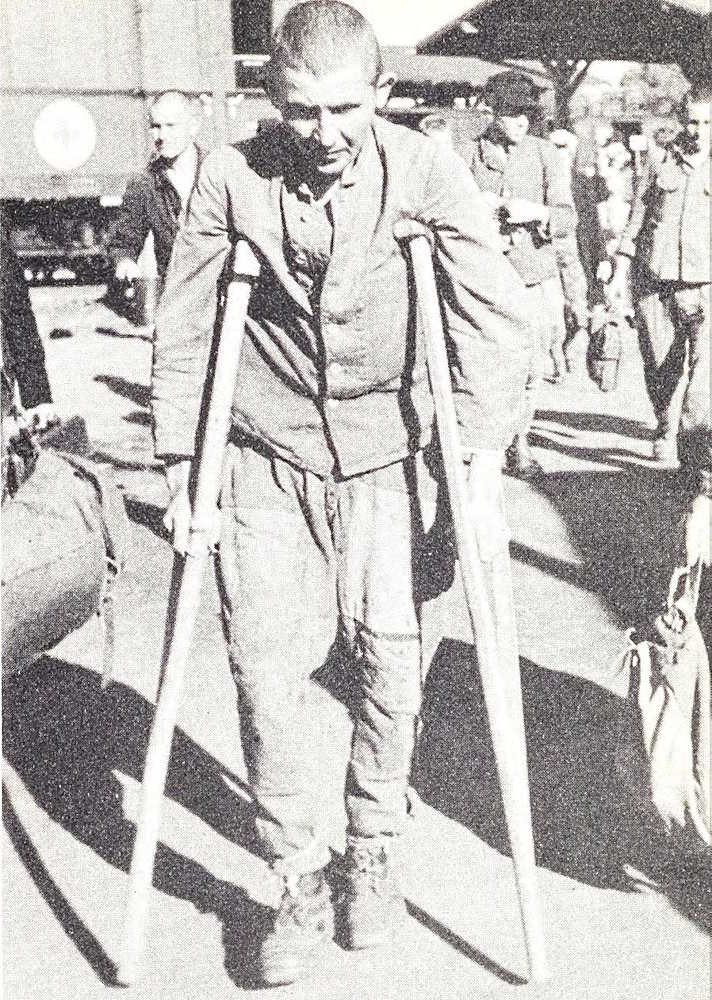
They came back from slave labor in Russia
broken in body, embittered in spirit.
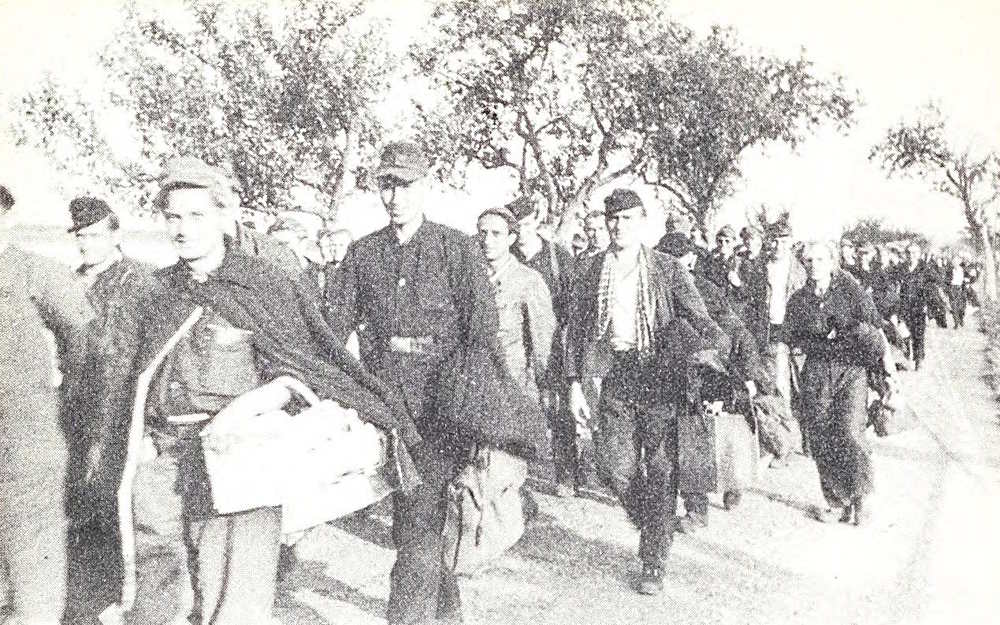
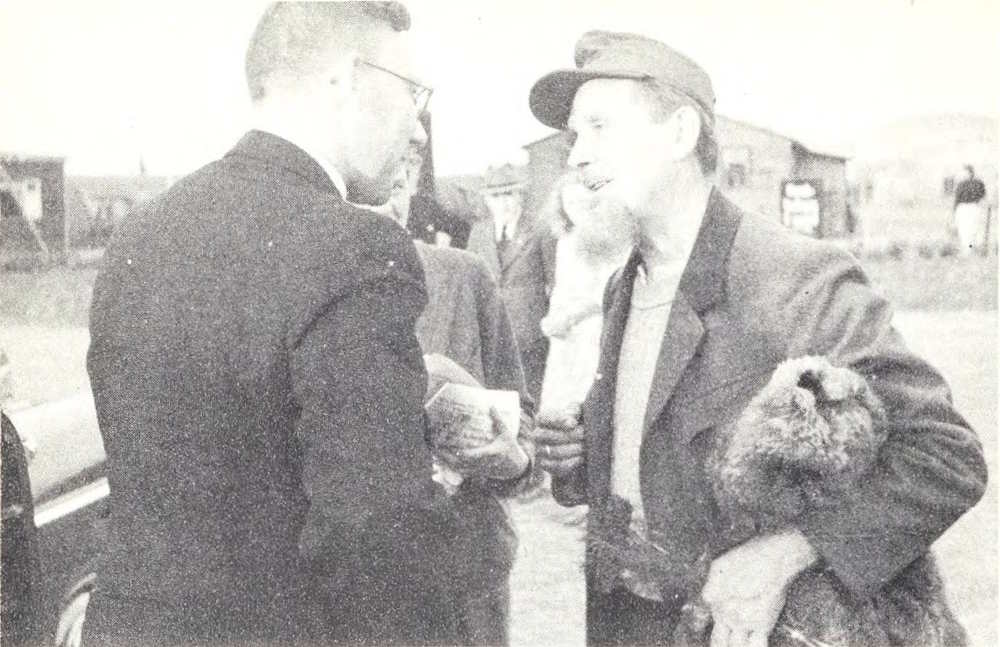
Camp Friedland. The men began to stream
through. They were dressed in remnants of
Wehrmacht uniforms four years after.
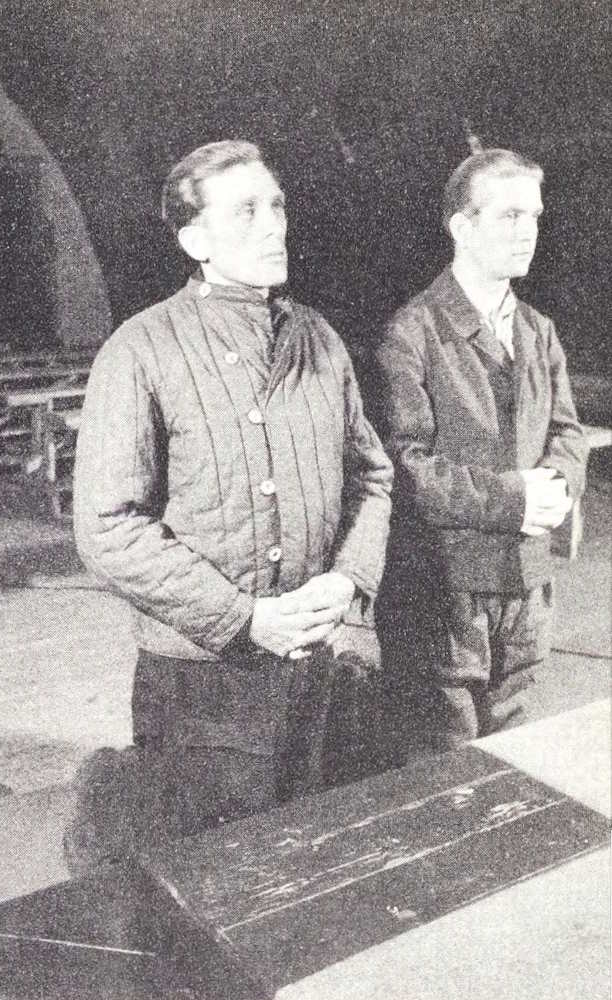
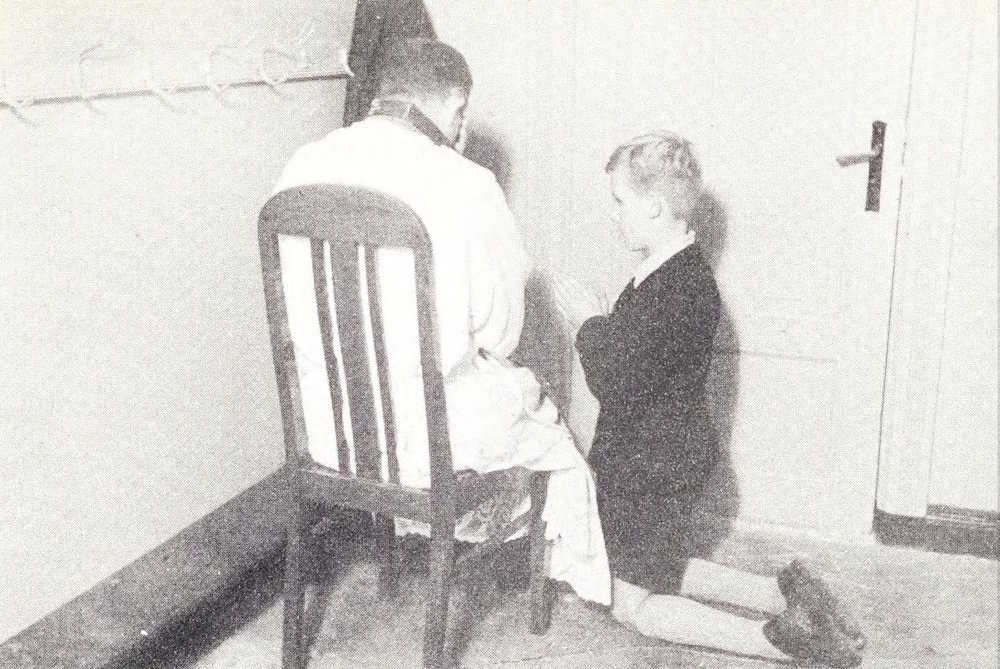
Camp Friedland. The boy at the right is 21 and
has known five years of slave labor. He kneels
with a comrade to thank God for deliverance.
The doctor, so tired from the return journey that
he could hardly walk, was the one who had to
give the news of the death of a 25-year-old
prisoner during the trip.
“At three o’clock we saw the men lined up beyond
the Soviet Zone barrier. They made no sound, and
stood quite still. It was not until nearly six o’clock
that evening that the barrier was raised on the Soviet
side. I stationed myself inside the No-Man’s Land
and the men began to stream through. They were
dressed in remnants of old torn Wehrmacht uniforms,
four years after. Many of them had a sort of
blue outfit, with Russian type padded jackets. Under
their arms or on their back they carried shapeless
bundles, or wooden valises. For more than half an
hour they trudged by, and as they came they cried
out many things. One young man yelled: “Now
after five years, we can laugh again!” Many, seeing
a priest standing at the barrier in the Western zone,
[Pg 31]called out the Catholic greeting “Gruss Gott,” and
some shouted, “God be thanked that we are here.”
An old man and his daughter who were waiting
at the side of the road suddenly entered the line
and put their arms around a young prisoner. Until
that moment, he had marched like anyone else,
but he was so overcome with the joy of seeing
them, that they had to help him walk the rest of
the way. Sobs broke out from him, and the sister
and father wept with him as they walked along.
“Lastly came the sick, who were transferred from
Soviet trucks to waiting ambulances, and last of all
came an old bearded man. He was a doctor who had
been taken prisoner, and he was so tired that he
could hardly walk. His wife, who had been waiting
for him, saw him just as he left the Russian barrier,
and she ran all the way to the Russian side to greet
and support him. He had been in captivity five years,
and he was worn and ill.
“As he came slowly up the highway in the No-Man’s
Land leading to the barrier, I could see how
heavily he leaned on his wife.
“All this time, a tired thin man had been sitting on
the grass on the opposite side of the road from me.
He had taken off his shoes, as though he had walked
a long way to get to Camp Friedland.
“When the doctor finally reached the barrier, this
man got up, and with his shoes still in his hand,
approached him to find out if there were any more
men on the transport. The doctor explained that he
was the oldest, and the last. All the sick had preceded
him.
“The inquirer explained that he had come to Camp
[Pg 32]Friedland because his son, a young man of 25, had
been able to notify him that he would be released on
this special transport. The doctor asked for the young
man’s name. Then the tired old doctor performed
his last sad duty of the return journey, a journey
that had taken 14 days in all, including the trip in
rough, wooden coaches from Moscow. The young
man, he explained, had died on the train, before
loving arms could welcome him home.
“The father, who had waited so quietly and patiently
all the day long, and for the years preceding
this day, walked quietly back to where he had been
sitting and sank down on the grass, his face grey.
“Back in Camp Friedland the men who were well
enough were lining up for their first meal as we
drove in. The sick were being served in the barracks
hospital. Even the men who look well often have
serious internal disorders, especially heart and kidney
diseases.
“They did not mind our photographing them outside
the sickrooms, or on the food line. They made
many jokes, and told us how grateful to God they
were for being liberated from Paradise.
“Meanwhile, a few men gathered quietly in the
Catholic Chapel. The greater part of the transport,
however, was composed of Protestant men from the
northwestern sections of Germany.
“One young man with a child’s face knelt quietly
in the chapel. He was just twenty-one and had endured
five years of slave labor in the Soviet mines.
He had been impressed into the Wehrmacht at the
age of sixteen. He was serene and composed, partly
because he had been in touch with his parents during
[Pg 33]his captivity by means of the special Postcard service
permitted in some forced labor areas. He was to go to
his home the very next day, right after his registration
and his checking of the file of men still missing from
his unit.”
There are uncounted men still held in slave labor.
Some maintain that 1,500,000 men have died in
Soviet camps and mines and that their deaths have
been unreported, thus leaving a labor pool of 400,000
men still in Russian hands. Some of these, who are
classified as war criminals, will not be freed, but it
was expected that all ordinary drafted soldiers,
whose actions of attack and defense were substantially
the same as those of any drafted soldier, would
be released in the regular transports.
The figures, however, are hard to reconcile, as
this excerpt from a New York Times release will
show:
“One year ago the Western allies recapitulated the situation
according to communiques issued on the Russian side
during the war. The total of 3,730,995 prisoners mentioned
differed sharply from Deputy Premier Vyacheslav Molotov’s
figure of 890,532 still in the Soviet Union in March, 1947.
Prisoners repatriated from Russia to March 1, 1948, totaled
252,395 by Mr. Molotov’s reckoning. That would have left
3,478,600 still detained there by Western reckoning. Even
after deducting 500,000 for possible Austrians and ‘Volksdeutsche,’
almost 2,000,000 Germans would still have been
awaiting discharge.” (New York Times, Jan. 11, 1950.)
These figures do not include the approximately
80,000 Italian soldiers still listed as being held in
Russia, nor the Hungarians, Rumanians, or other
men captured in war and never released.
A sizeable percentage of the men released from
[Pg 34]forced labor are dispossessed and homeless, and
find their expelled families in one-room homes in
wooden barracks, or even in mass quarters in old
castles and hotels. But the return of these men is
the signal for the family to take heart again and to
begin a new life with the increased strength of the
family unit. Each father who returns home decreases
the bitterness of some among the millions of German
children who knew their fathers were slaves, and
whose resistance to teachings of democracy stemmed
from a knowledge that the democratic nations of the
West had given their name to slave labor at Yalta.
Reparations in blood was not one of the ways to
erase the crimes of the warring German nation.
Mass homecomings such as the one described
above are now no more. The Soviet authorities have
made an announcement that has caused a pall to
descend over hundreds of thousands of homes
throughout the length and breadth of Germany—the
simple announcement that repatriation of German
prisoners of war from the Soviet Union has been
concluded. The mothers, the wives, the children who
hoped against hope for an eventual reunion have
gone into mourning. The fate of a vast host of men
is unknown.
There are so many who are still held in the far
reaches of Siberia and Soviet Asia in forced labor,
not only Germans captured in war, but Austrian and
Hungarian soldiers and unnumbered innocent civilians
from Poland and the Baltic States, that we who
can help in no other way must at least join in the
great prayer of the Vicar of Christ for the Holy
Year:
[Pg 35]
“May the Holy Year be for all men ... the year of the
great return and of the great pardon.... Grant, O Lord, to
the Refugees and Prisoners a homeland, and to all men, Thy
grace.”
[Pg 36]
CHAPTER IV The Women
If there is not complete moral chaos and nihilism
among the Expellees of Western Europe, I would
give most credit to the tremendous spiritual strength
and homemaking capacity of the women and mothers
in the Expellee group.
After they—with their children, with the old people
of the family, and with or without their husbands—were
thrust out of their homes and farms in such
sections as the Sudeten area of Czechoslovakia,
Silesia, and East Prussia, these women found themselves
unloaded into almost uninhabitable barns,
half-destroyed hotels, or barracks, often temporary
structures put up for unfortunate prisoners of war
or slave laborers in Germany. The world knows that
for these slave laborers, there was little comfort or
sanitary convenience from their Nazi overlords; and
it was because of this that so many of them died or
came out broken in health at the end of hostilities.
It is hard to imagine that in time of peace, innocent
families, including millions of women and children
and old people, were crowded obscenely into
these same slave labor and PW barracks which were
the shame of the Nazi regime. Having been thrust
into the left-over shelters in Western Germany, forty
[Pg 37]per cent of whose housing had already been destroyed
or damaged by bombing, these families were
made the care of already overburdened local welfare
agencies.
I saw these swarms of people in the camps
right after they came out of the cattle cars
that brought them from their ancestral homes. I
saw the agony of the mothers as they tried to keep
alive the spark of life in dying babies, or as they
sat over the straw bed of a feverish boy or girl. In
those days the homes of the Expellees were called
“Lagers” (camps).
Again in 1949, five years later, I visited the Lagers
and found the same people living in these same
buildings that should never have housed human beings.
I referred to their quarters as Lagers, and I was
told, “These are now barracks-homes” (Wohnungs-Baracken).
In my visits I found out why that name
had been changed. There was far less mass living
than before, because of the almost superhuman
efforts of men and women who had often no income
and no supplies, but merely the unquenchable desire
to preserve family life. Partitions consisting of all
types of brown paper, of waste wood, of blankets
were put up in the large barrack halls so that each
little family could live in its own orbit. When the
camps were located in rural areas men and women
got permission to chop down trees, and out of these
they made regular walls that divided the long barracks
into completely separate rooms. This meant
that ten or more door openings had to be made so
that the family could come and go through its own
private entrance. The skilled carpenters among the
[Pg 38]expellee men made these door openings and doors
so that in some camps there is no more mass living,
and each family has its own separate home though
that home be only one room that serves as bedroom,
kitchen, living room, and wash room.
Over and over again I was amazed at what the
women were able to do with these rooms. Paint
brightened the rough, unfinished walls, and pictures
were placed strategically to cover cracks or unsightly
defects. Wooden lamp stands were brightened
by homemade lamp shades of painted paper.
Frankly, I wouldn’t know how a woman keeps a
room tidy when its furniture consists of seven beds
(two-and three-decker), a table, a primitive stove,
a couple of chairs, and clothing boxes for each member
of the family. I suppose it merely meant that the
woman worked all day and every day to tidy up
after the children washed, ate and did their studies.
The drabness of these rooms, whose beds are almost
all covered with the same grey or olive-drab blankets,
is lightened only by the bright table cloth or
the few pictures on the wall. However, the very
transformation from camp living to home-barracks
is a proof of the unquenchable spirit of the women
of the expellees to preserve the integrity and the
unity of their homeless, abandoned and often broken
families in the face of a world which has meted out
to them a terrible, though unofficial, punishment.
Tracing Service of Red Cross still tries to locate
the more than 100,000 women taken for forced
labor and never returned.
For so many the end of their wandering is not in
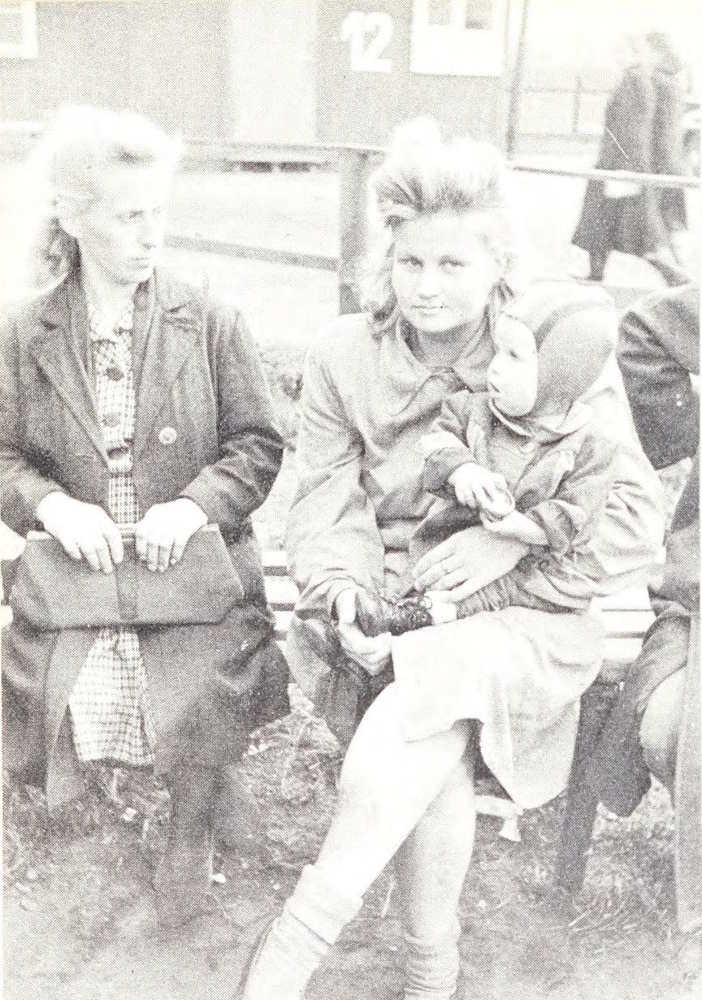
sight. These dishevelled women by the roadside
try to find a place of safety for their children
after fleeing with them westward through the
forests.
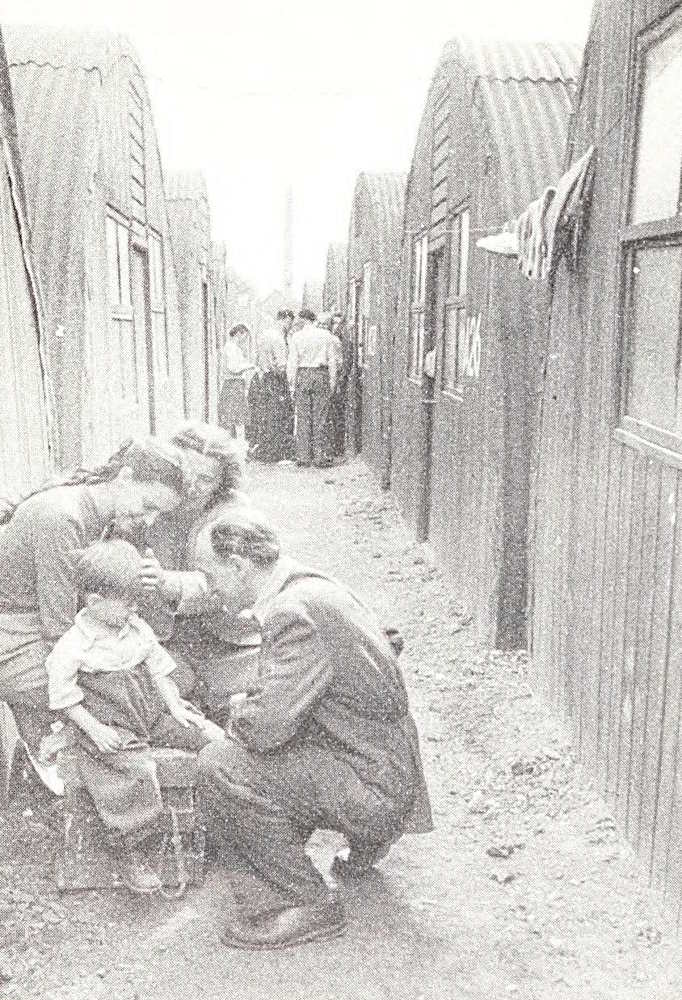
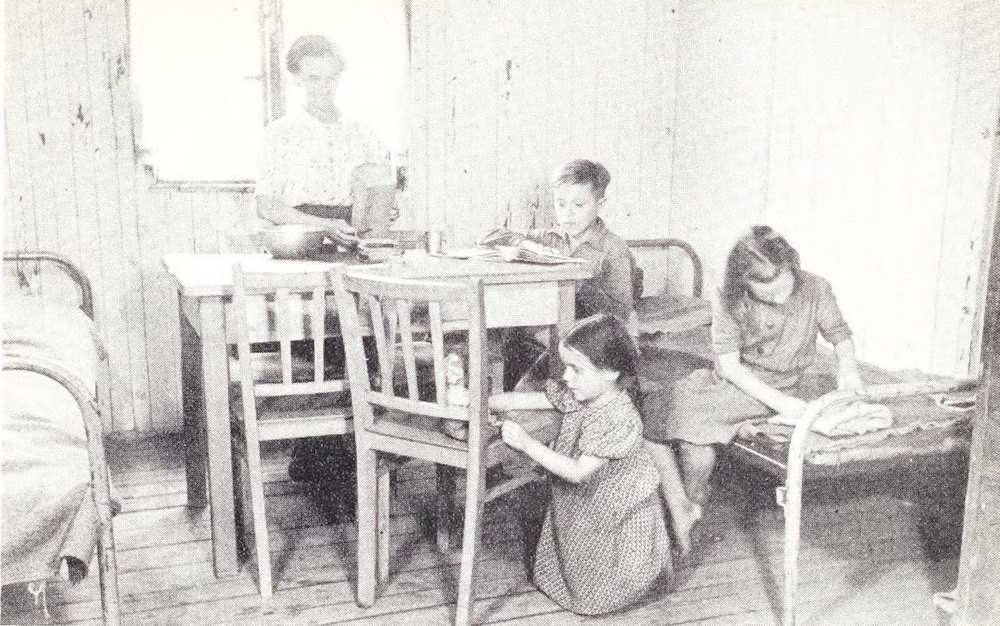
A one-room home for an Expellee family is bare,
but bright and shiny.
A valiant woman of today—she saved her
eight children in a flight that took her across a
continent.
There are some expellee centers where the conversion
to separate dwellings is not at all possible.
These are the hotels and old castles with forty-foot
ceilings. For four years hundreds and hundreds of
[Pg 39]people have tried to make homes out of such centers
as the sixteenth century castle in Eutin, Schleswig-Holstein.
It is a common thing in such centers as
these to see four women share the same cooking
arrangements. The stove, over which someone is
hovering all the day long, becomes not a center of
peace and warmth, but rather a source of strife and
bickering. Tired and harassed mothers find that this
sharing of cooking facilities, year in and year out, is
a sore strain on already overtaxed nerves.
Though a camp is the easiest place to see at a
quick glance the many problems of the women
among the expellees, one can only know the whole
picture when one realizes that millions of them are
also dispersed among the populations in the towns.
Our delegates have gone out to visit these families
and have found women making homes for their loved
ones in the cellars of partly destroyed homes. Others
are able to rent one room of an apartment, with the
privilege of sharing a kitchen. All over such towns
as Kiel, the expellee women have set up housekeeping
for their homeless families in these one-room
arrangements. As rebuilding proceeds slowly, this
one-room living goes on for years and brings on, in
some cases, grave social and moral problems.
The material tragedy of living for four, going on
to five, years in such conditions is quickly seen and
easily understood by anyone who visits the expellee
centers. It is only by talking with individual expellees
in and out of camp that one sees into the almost
unbelievable tragedies that these women have faced
in their personal lives since that great mass expulsion
[Pg 40]began in 1945, after the Potsdam declaration
of the heads of the three greater allies. Let us take
as an example a young girl from East Prussia.
A young girl
Her name is Margarita Kopsky and she lived with
her parents in the lower section of East Prussia.
After this area changed hands, the new regime put
her aged mother and father along with hundreds
and hundreds of other helpless people into a former
munitions factory near Bromberg. Hunger raged
over all of Europe in 1945, but it raged particularly
in camps such as this one near Bromberg where
former enemies, guiltless or guilty, who were marked
for expulsion, were temporarily kept. When Margarita
came to claim her parents so that they could
all cross the border together into Western Germany,
she found that they had both died of hunger along
with an untold number of other people whose deaths
were never announced. Margarita now works as a
catechist to help an expelled priest bring Christ’s
message to the children among his uprooted flock.
A mother of eight children
One group of unfortunates whose expulsion was
so complete that little trace is left of it was
the Volga Germans who lived in a whole section
of the Ukraine. These descendants of Germanic
stock were only in Russia because their ancestors
had been invited to settle and work the soil of that
area. These industrious people lived in scores of
villages where they preserved their dialect and their
special traditions. Almost all of these people, whether
[Pg 41]men, women or children, were deported to Asiatic
Russia and Siberia in one of the first mass deportations
that marked the last days of the war. I visited
a woman who escaped these mass deportations by
leaving her native village with her eight children
and walking by stages to Poland in the confusion that
accompanied the retreat of the German army. She
did this because she knew her husband had already
been deported to Siberia, and she wanted to save
her boys and girls from a similar fate. Let us call
her, for the sake of her family’s safety, Mrs. Barbara
Walt. She, with her eight youngsters, now lives in
a one room home-barracks in an expellee camp in
the diocese of Paderborn. When she reached Poland,
Mrs. Walt was expelled into Germany and found
herself, with her children, in the Russian sector of
Berlin. She was spotted immediately as a Russian
citizen and found that she was marked for another
deportation, this time back to some unknown destination
in Russia. Fleeing with her eight children
into the British sector, she persuaded the military
authorities to accept her as a political refugee. And
wonder of wonders, she and her eight children were
loaded on to an army plane and taken into the
British zone of Germany.
I think that in all my life I have never seen a more
industrious family. The diocese of Paderborn had
immediately given to Mrs. Walt some of the clothing
donated to War Relief Services by the National
Council of Catholic Women. Right away, Mrs.
Walt and her daughter set about and remade the
clothing until it was exactly the right size. Though
only five weeks in the British zone, the Walt family
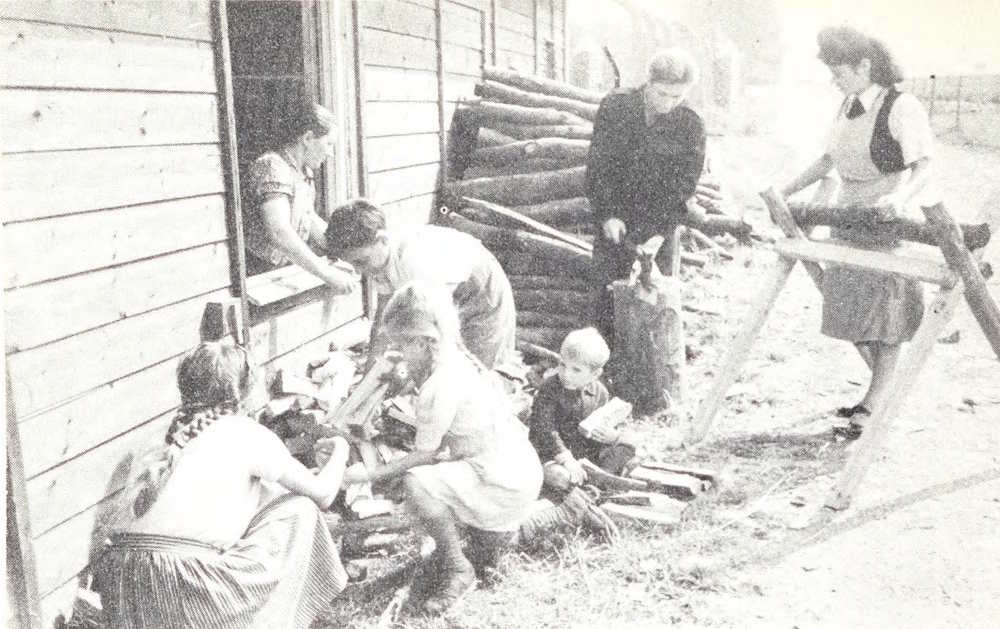
[Pg 42]were neatly dressed and everything in their one
room home was in order. The two oldest boys have
work with a local carpenter; the younger boys cut
wood and fix up the family dwelling place. Mrs.
Walt introduced me to her children one by one:
Candita, Josef, Mathilde, Agnes, Bruno, Matthias,
Emilia, and Anton. They were handsome, normal
children. The terrible experience of fleeing and of
being homeless had been softened for them by the
tremendous protective power of a mother’s love.
These children were secure and well balanced. I
asked them if they wanted to emigrate to some other
country and they all agreed that until they knew
the fate of their father they would make the best
of life in Germany and not plan any emigration. I
have pictures of this family busy about their sewing,
their mending, their wood-chopping and all their
other activities. I have a picture, too, of a real heroine
and a Catholic mother who might qualify as a
valiant woman of today.
Mourning for children lost
Perhaps the most inconsolable women are those
who lost children during the expulsion, either by
death or disappearance, or whose children were deported
into unknown regions for forced labor. This
is not uncommon at all, and is particularly true of
the women who have come from such areas as East
Prussia. In a casual conversation with a woman in
an expellee camp near Neumuenster, one of our
delegates was told that two of her daughters had
been deported into Russia at the time that she and
her husband and four other children were expelled.
[Pg 43]Her daughters at the time were 19 and 21. She has
never heard from them and does not know if they
are still alive.
The mortality of children during the expulsions
is something that no one can ever write about statistically,
but there is no doubt that it must have
been very high. A woman named Mrs. Drescher,
who is now in a camp in the bleak isle of Fehman
of Schleswig-Holstein in the Baltic Sea, spoke for
many more when she said to a War Relief Services
delegate, “I started from Danzig with four children
and I arrived here with two. A little boy and a little
girl died on the way, and yet we could not stop because
they were always driving us on. We had to
save the other two.”
Mourning for children about to be born
Caritas directors and social workers told me that
one of the greatest tragedies in an Expellee family
is the knowledge that a new life is expected—that a
child will be born into the world. The mother often
has not even a scrap of material for covering the
newly born, and she is considered lucky if she is
given a packing case to serve as a cradle. With daily
living confined to one small room, or a part of a
room, and sanitation difficult to maintain for lack
of soap, it is easy to understand the anxiety of a
mother who must care for a new born child in the
midst of the shortages and the confusion. It is particularly
difficult for Catholic mothers in the Diaspora
areas, where Catholic teaching on birth control
seems to the ordinary citizen as utter folly. Yet
Catholic mothers accept the children that God sends
[Pg 44]to them, even in their desolation. They tell the Caritas
directors that they know that Providence will be
with them if they bring the new souls into the world.
Often, Providence acts through the gifts of infants
garments, sent in such number by the Catholic
Women of the United States. So many layettes, sent
directly or through the hands of the Holy Father,
have reached these mothers just in time for them to
cover the body of a child born into homelessness.
When an American visitor entered a barracks-room
housing four complete families (two with
teen-age children) and asked, “Do you have any
small children here?”, he was struck by the vehemence
of the answer, “No babies or little children
here, thank God.” These were Catholic expelled
families, from Yugoslavia and Rumania, who in
normal circumstances would want to raise happy
families in their flourishing villages. In the horror
of exile, each child is a tragedy.
A Catholic leader, working among younger Expellee
families, said quite frankly that if we urge
Catholics to live up to their faith in matters of birth
prevention we must stand ready to help the mothers
to accept their burdens. “It is layettes or Birth Control,”
she told us quite frankly.
Much has been done by Catholic women in this
regard, but much must still be done if each new life
is not to be looked on as a tragedy. There are so many
separated families, so many widows, among the Expellees,
that it is almost a form of genocide when the
parents who might be producing children are dissuaded
therefrom by the terrifying material conditions
of their lives.
[Pg 45]
Mourning for husbands
The number of young women of the expellees
whose husbands are still in slave labor in Russia is
enormous. Again in Schleswig-Holstein, one of our
delegates went into the country to see how the expellees
were living when they worked on the large
estates of the area. A simple little woman from East
Prussia, named Mrs. Kupsch, lived as did five other
families in rooms back of the barn, one family to
a room. It took her fourteen days to get to Schleswig-Holstein
with her four children after she was expelled
from her farm. Her husband wrote to her
every few months from his slave labor camp in
Russia. She did not even know where he was located.
Her sole income is 93 Marks monthly from the local
welfare agency, and whatever gifts come to her
through charitable agencies. The well of misery
among the women whose husbands are laboring in
the night of slavery in unknown Asiatic areas is
something that no one can attempt to describe.
Old women waiting for death
The plight of the aged women among the expellees
could be the subject of a book. It is enough
to say that these old women and old men were
herded into cattle cars and dumped out as callously
as were all the other expellees. Caritas operates 168
homes for the aged among the expellees, but even
with the greatest efforts on the part of local Catholics,
the lot of the dispossessed aged is still a cruel
one. Here and there, by almost a miracle, Caritas has
managed to set up Old People’s Homes that are
[Pg 46]cheerful and happy places—such is the Old People’s
Home at Wewelsburg in the Diocese of Paderborn.
But hundreds and hundreds of damp cellars,
bunkers, or air-raid shelters also house the old
people dislodged by mass expulsions in the twilight
of their lives. Sometimes, one barrack in a camp is
set aside for the aged and there one sees the old
women busy with their beads, if they are Catholic,
or possibly doing some sewing or knitting. Often,
they have no knowledge of the whereabouts of the
rest of their families; often they know that they are
already dead. So many of them are gentle and without
bitterness. So many of them await death as a
blessed and happy deliverance.
Thus, the plight of the women among the expellees
is a particularly bitter thing; from the young
women who have lost parents, to the wives who
have lost husbands, the mothers who have lost or are
separated from their children, even to the aged
women who sit quietly awaiting death in a world
which has shown to them its most cruel face. The
examples of tireless work and a boundless heroism
among these women give one faith in the better
qualities of humankind.
[Pg 47]
CHAPTER V The Children
“These Little Children are looking for Their Parents,”
was a printed announcement that met me all
over Germany. Underneath this announcement were
the haunting faces of fifty little children—little ones
separated from their parents and relatives during
the mass expulsions. The little faces on the poster
stared at me in railroad stations, in welfare offices,
on church doors, and in public buildings.
The children who do not know their own names
and whose parents are being sought; the children
who know their names and who still search for their
parents; the thousands upon thousands of children
who have vanished without trace and may all be
dead—these are the problems which present themselves
in any discussion of the Expellee children of
present-day Germany. There are special Search Services
designed to reunite these tragic little victims
with their parents and many thousands of happy reunions
have been brought about.
No one was able to count the number of children,
especially infants, who died in the course of the expulsions,
although many have stories to tell of children
who died on the roads. Often the cold, lifeless
bodies of infants and small children were the first
[Pg 48]to be handed out of the windows of the deportation
trains.
There are no adequate reports on the health and
welfare of the millions of children who survived,
and who as innocent, unknowing Pilgrims of the
Night were led to the dismal barracks and shelters
that were to serve as their homes from then on.
The little lost children
But to return to the faces on the poster, the children
were too young at the time of flight to remember
their last names or the address of their
parents. The descriptions underneath each picture
highlight the unimaginable suffering that is meted
out to the innocent in any mass expulsion.
One little child was found on the road by a soldier;
another two children knew that their mother
was taken to Russia from East Prussia. Another child
knew that his first name was Gerhard and that he
had a telephone in his house in Pomerania. Under
every photo is written in a few words an individual
tragedy which was implicit in the Allied decision
to uproot millions of human beings in the days of
chaos that followed a world war.
This poster of little lost children searching for
parents more than four years after the end of the
war, symbolized for me all the guiltless who have
suffered in the mass expulsions of close to 12 million
people from areas of Eastern Europe.
I asked also about other children who were expelled
and found that between 160,000 and 180,000
children were lost in the course of the uprooting of
Germanic minorities and German citizens from such
[Pg 49]areas as the Sudetenland, Silesia, East Prussia, Yugoslavia,
and Hungary.
In most cases these children, still unaccounted for,
were the casualties of the peacetime war action.
Many died on the road; hundreds upon hundreds of
nursing babies died for lack of nourishment and
warmth in the chaotic days after arrival during the
terrible winters of 1945/46 and 1946/47. Parents are
still searching for the children from whom they were
separated and whom they believe to be alive.
Public searches conducted by posters, by advertisements
and by thousands upon thousands of radio-broadcasts,
have given a tone of tragedy to everyday
life in Germany. There are special radio programs
for those children who know their names and
the former addresses of their parents. There are also
special radio programs for parents who still believe
that their children who were separated from them
during the deportation can be located somewhere
in Germany or in the neighboring lands.
Day after day, heart-breaking announcements
Day after day, one can hear these heart-breaking
announcements of parents who still hope to find
their children three or four years after the separation.
One might reasonably ask why parents allowed
themselves to be separated from their little ones. It
is easier to understand, when one hears such announcements
as that regarding a young boy who
had walked to a nearby town to go to the store, and
before he returned his whole family was forcibly
loaded on to a truck and taken to a detention camp
[Pg 50]for expulsion. Other children were placed on different
deportation trains from the parents.
Search services for missing children
The lost children are a very special problem of all
welfare agencies which are cooperating to locate as
many of them as possible and to reunite them with
their families. The children who are searching for
their parents and whose little faces stare at you all
over Germany from the posters I described, are, in
general, well taken care of by public and religious
welfare agencies. It is interesting to note that many
calls have come to German welfare agencies for the
adoption of these children by families living in other
lands, but in general expellee children are not available
for adoption because they have been taken by
German families. The remainder of the unaccompanied
expellee children are being kept until extensive
investigations are made regarding their
parents and relations.
Uprooted orphanages
Two representatives from War Relief Services-N.C.W.C.
for Germany sought out the institutions
having expelled children and found some homes
filled with uprooted orphans.
In the Bavarian countryside is one such institution
for children conducted by the Sisters of St. Charles
Borromeo. The children and the Sisters were included
in the fiction of mass guilt and were expelled
from a bordertown in Silesia. Given little time to
gather their charges together, the Sisters managed
[Pg 51]to keep the little family intact on the deportation
train. A home was provided for them all by the
American Military.
The children sheltered in this home have been
spared nothing of bitterness, or terror, or death.
Three of the orphans were a brother and two
sisters, Klaus, Gertrude and Hilda. Klaus, as the
eldest, had brought his two sisters to the safe-keeping
of the Nuns before the evacuation from Silesia.
His father was already dead, and when his mother
died as a result of a bombing raid, he, at eleven
years of age, presented himself at the door of the
orphanage, holding a five-year-old sister by one hand
and a seven-year-old by the other. The Nuns were
keeping the pathetic remainder of the family intact
because of the security it gave each child to be near
the other.
Two little boys, Horst and Dieber Twerdon,
were turned out of the family home at the height of
the expulsions, and began walking toward the center
of Germany with their mother. So great was the cold
of the march, that the mother lay down by the side
of the road and died. The two little boys walked
on alone until they were picked up by authorities
and added to the uprooted brood congregated in the
Bavarian home.
So many tales of pitiful little children could be
told; tales of the fatherless, of the motherless, from
whom everything was taken except the love of those
dedicated women who, of the little helpless beings
entrusted to them, lost not any one.
[Pg 52]
Child life in barracks
The expellee children who are living in barracks
and almost uninhabitable buildings of all types are
subjected to constant sufferings and agonies. One
room to a family is a luxury. Sometimes, this room
may formerly have been a stall for a horse. One extremely
large expellee camp, the Rositen Kaserne
near Salzburg, was formerly a Veterinary Center for
horses. Each sick horse had his own stall in which
the animal was tied to a heavy post. Now, in this
former horse hospital, each expellee family lives in
one of these stalls and the heavy post is a reminder
to each member of the family that their home is
really a stable. There is little privacy for family living
in such conditions. There is less privacy when
20 families must occupy sections of large halls in
the former castles that have been pressed into service
for expellees. What can we expect of children
who live in such constant overcrowding, surrounded
by daily reminders of their degraded lot as expellees?
Youth without hope
A Red Cross leader explaining that one of the
most explosive situations in Western Germany was
that of unemployed, homeless, footloose youth,
stated that there are more than 300,000 young men,
between the ages of fourteen and twenty-five,
among the Expellee groups who are without jobs,
or job-training. These young people, old enough to
understand the indignity of their lot in the barracks
and hovels of strange towns and villages, but too
[Pg 53]young to appreciate the cataclysm that has come to
all Europe, can only look forward to nothingness.
There are no places in the schools for them to learn
a trade; no jobs are opening up for them in an
economy that has not even jobs enough for adult
breadwinners. There are at present no real chances
of emigration.
These young people look backward to the day by
day destruction and systematic cruelty of the war
years, and to the inhumanity and chaos of the years
of peace. It would not be surprising if out of this
immense mass of youth without hope, there should
emerge a cold dangerous nihilism. Since they have
seen the depths, they might come to fear nothing,
to reverence nothing, not even life itself.
The appeal of hungry and homeless children is
one that goes right to the heart. No one needs to
ponder, or study whether such an appeal should be
answered by help even at a sacrifice. The appeal of
these young people is one that must go to the mind
as well as to the heart. The future of the West will
have to count with these young people, whether for
good or for ill. Up to now, the world has shown
them by all methods possible that it does not want
them, nor does it want their intelligence, or their
skills. They have been driven from their homes, and
driven out of participation in the business of living.
Those who have parents are still under some restraints
and are linked to religion, to family, to some
small, eventual hope of making a contribution to
society by work. But even then, the parents themselves
are full of discouragement, because most of
[Pg 54]them had hoped to provide training or higher education
for their teenagers, and now find themselves
utterly unable to do so.
There are others who have lost all ties with family—either
through death or through deportation to the
East. Some young men were urged by families living
in the Eastern Zone to flee to the West because of
imminent danger of forced labor. Still others have
come to the West after escaping from forced labor
in the uranium mines. Many of these youngsters are
sixteen and seventeen years of age. Were it not for
the activities of Lutheran Aid and Catholic Charities
in setting up homes for these boys, it is hard to
say what would have become of them.
I visited such a home for homeless boys at
Wewelsburg, in the diocese of Paderborn, Westphalia,
and saw what stable and disciplined young
citizens they become when gathered into the warm
and intimate atmosphere of a home. A selfless young
leader of Catholic Action directed the home, and
gave each boy a sense of responsibility, a sense of
belonging. A course of training, as near as possible
to the capacities and desires of the boy, was provided
in the neighbourhood. Forty boys lived in this
Youth Home, recently rebuilt after being completely
burnt out. The boys themselves worked on the building
and renovation. All of the boys were Expellees,
though some of them had been expelled first into the
Russian Zone of occupation before deciding to cross
into the so-called Golden Zone of the West. Many
of them had escaped from forced labor.
“These little children are looking for their
parents.”
“Parents seek these lost children.”
Home for this child is behind the barbed wire
of former slave labor barracks.
An Expellee child in a camp in Schleswig-Holstein.
[Pg 55]
The one diocese of Paderborn has had to set up
eight such Youth Homes, for homeless, driven youth—seven
for boys and one for girls. Forty Youth
Homes have already been set up by Caritas in
Western Germany. Many more such homes are
needed in the Western Federal Republic if these
young people are to be rescued for a normal, useful
and stable existence.
Children of the dispersion
From a religious point of view, the Catholic children
who have been expelled into the Northern
areas of Germany, where there are neither sufficient
churches nor schools, are at present a very pressing
and special problem. These children are served by
priests who come to them on foot, on bikes or on
motorcycles. They are prepared for First Communion
and Confirmation in crowded barracks rooms
and Lutheran churches kindly lent for the occasion.
The richness of Catholic life which their parents
knew before the expulsion is entirely absent. The
faith is kept alive only by the heroic efforts of weary
and overburdened priests and dedicated lay people
from among the expellees.
Much self-help has been organized among the
German Catholics to save this generation of children
who are living in the Diaspora, or Dispersion areas
of Germany. Every year, the dioceses of South-Germany,
particularly Bavaria, bring down thousands
of the expellee children from the areas of Schleswig-Holstein
and North-Germany to spend the summer
months with Catholic families.
[Pg 56]
Tale told at night by homeless children
Bavaria in the summer is rich in color and richer
still in its expressions of Catholic life. Some of the
children from Schleswig-Holstein used to sit in the
evenings and tell the Bavarian youngsters what they
thought of the lovely domed churches of the Bavarian
countryside. The little expellee children marvelled
at the colorful interiors of the churches, at
the vestments of the priests, at the beautiful marriage
ceremonies, at the fact that one could go to
Confession and Communion at almost any time because
the priest was near the church and near the
people.
For the expellee children from Schleswig-Holstein,
there were very few priests and their life was dark
and sad. They told how they waited on the road,
often without shoes and in the rain, for the priest
who came to them on his cycle. They explained how
their Mass was said in bare schoolrooms without any
color or loveliness.
A picture of desolation
A Bavarian girl listened to these stories told in
the evenings by homeless and yearning little ones.
These tales impressed her so much that she painted
them into a picture—a picture which in its accuracy
and power is a real masterpiece. The young Bavarian
girl was Veronika Reich of the diocese of Augsburg
in Bavaria. Veronika painted in the lower part
of the picture several crowded scenes of color and
joy, a church wedding, a child being baptised, a
Bishop dispensing Confirmation, children being
[Pg 57]taught Catechism by the priests, children going to
Confession, children receiving Communion. Behind
these scenes rise the spires and the cupolas, or
“onion” towers, of the typical Bavarian churches.
Towards the top of the picture, the colors grow
dark, and we see two little groups of shoeless children,
standing by the side of the road waving in welcome
to a priest on a bicycle. The buildings are plain
as schoolbuildings are. The top of the picture is absolutely
black in color. In this way Veronika, hardly
more than a child herself, interpreted the longings
and sufferings of other little children from whom
so much has been taken, even the joys of their religion.
I wish that every Catholic in America had
seen this most unbelievable picture that came from
the hearts of some children and the hand and heart
of another child. Among the Pilgrims of the Night,
the expellees of Western Europe, the children are
the most desolate of all.
[Pg 58]
CHAPTER VI The Priests
One of the most significant books that was given to
me during my recent tour of Europe was a bound
volume containing the names and addresses of 2,700
expelled priests who were uprooted from their
parishes in 1945, 1946 and 1947. None of these Catholic
priests had been accused of crimes of any sort.
Most of them were simple pastors of country and
city parishes whose aim was the spiritual welfare
and eventual salvation of their flocks. Many of them
had suffered at the hands of the Gestapo.
And yet, when the theory of mass expulsion on a
racial basis was applied to such areas as Pomerania,
East Prussia, Danzig, and Silesia and the Sudetenland,
these men of God were thrust from their parish
churches, from their rectories, and joined the nearly
12 million expellees who trekked through the heart
of Europe as uprooted pilgrims of the night. And
they still are joined to the lot of the disinherited,
for they live among them in daily service, in daily
sacrifice.
The book to which I refer has been printed by the
Seminary for expelled seminarians located in Koenigstein,
near Frankfurt. It lists the former dioceses of
the priests, their date of ordination, and their present
[Pg 59]whereabouts in Western Europe. We see in this
book listings of priests ranging from young men who
were just ordained to priests ninety years of age.
Some of the priests as members of such religious
orders as the Franciscans and Augustinians were
generally accepted by the houses of their orders in
Western Germany. The vast majority of these expelled
priests were simple pastors and they have
gone out among their people who were expelled
with them. Their life differs little from that of any
other homeless expellee.
I have known a priest to live in a single room
of an old house, so as to be near the former slave labor
barracks where the expellees from Silesia
manage to exist. I have seen pictures taken by
Caritas of the dwellings of other expelled priests;
one priest from the Ermland diocese was able to
get a little room in the attic of a resort hotel, a room
which serves not only as his study, his sleeping
quarters, and garage for his only means of transport,
a bicycle, but also as his parish office where
he receives his parishioners.
Homeless priests—their flocks dispersed
One of the burdens that lie most heavily on these
expelled priests is the knowledge that their former
parishioners are scattered throughout all the zones
of Germany. These driven people had no choice as
to their destination; or to be exact, they had no
destination. To cite an example, Father Johannes
Preuss, now located in Neumuenster, Schleswig-Holstein,
reported that he had a parish of 700 souls
in Nossberg, East Prussia. When the expulsion came,
[Pg 60]trains took his parishioners in different directions
and he has received word from them from all four
zones of Germany. The largest number of his parishioners
landed in the Russian zone. He does not know
how many of his parishioners were deported eastward
to slave labor in Siberia, nor how many died
on the roads and in the cattle cars during the expulsion.
He does know that exhaustive efforts to find
out how many of his parishioners are still alive resulted
in a total of 450 out of 700. Father Preuss
also gave us another significant figure: out of the
ten priests fulfilling their ministry in the area of
Gutstadt, (where his parish was located), seven
were killed or deported and only three live to labor
among their expelled flocks in Western Germany.
The particular diocese of Ermland from which
Father Preuss comes suffered possibly more than any
other diocese in the loss of its priests and the loss of
its faithful. About 40 per cent of its priests are dead
or missing.
For all the inhabitants of East Prussia, Catholic
and Protestant, the total of dead or missing comes to
1 out of every 5 people. This is the cost that is paid
by human beings in general, the guilty and the innocent,
the aged and the children, for mass expulsion.
A priest in siberia
One of the priests of this Ermland diocese is now
in the United States on a mission on behalf of the
St. Boniface Society, the Church Extension organization
of Germany. This young Ermland priest has told
us in a calm, gentle way of his experience—experiences
[Pg 61]which are true, unfortunately, for other
priests, and men and women.
Because of his opposition to Nazism, Father Gerhard
Fittkau was forbidden to teach by the Gestapo,
though he had earned his doctorate in theology and
was needed as a professor in a Catholic High School.
He was appointed as the young pastor of the parish
of the Nativity of Our Lady, in Suessenberg, East
Prussia. He had in his pastoral care a little flock of
91 families, numbering 460 people. They were in the
main, the owners of well-kept farms, hard-working
and orderly, but not rich—part of a Catholic enclave
in a prosperous Protestant area.
He was there in January, 1945, when the Russian
advancing army almost completely encircled the
area of Central Ermland in East Prussia. Though
tempted to flee, in the wake of many who had managed
to get out before the arrival of the Soviet
troops, Father Fittkau found in the sacrifice of the
Mass, the strength to remain, though it might mean
death or deportation. Every day he celebrated High
Mass, and all the parishioners who remained, together
with evacuees from other villages, prayed
with great faith and devotion. The confessional was
busy as never before. The instruction for Holy Communion
was speeded up so that the little ones could
also receive the Holy Eucharist; the Sacrament was
carried to the old and the sick. For so many it was a
viaticum, explains Father Fittkau, not only for the
aged and ill, but for the young and the strong.
“When I consider,” says Father Fittkau, “all that
God’s grace must have accomplished in those days
[Pg 62]of extreme distress, the price we had to pay was
surely not too high. Could our parish ever have been
led by any other means to such trust in God, to such
resignation, and to such love?”
When the Soviet army entered Suessenberg, girls
and women were immediately rounded up and taken
away for “peeling potatoes for the soldiers.” They
returned after being abused by the army men,
broken-spirited and infected by disease. Father
Fittkau was able to protect a group of several
women and girls and a Grey Sister from such violation,
though he came close to being executed for his
deed.
Twenty-five villagers were murdered, including a
seventy-three-year-old sacristan, the sixty-five-year-old
church bell-ringer, the twenty-three-year-old girl
organist, and four other girls under twenty-five. Six
priests of the surrounding area were executed.
After burying the bodies of his dead parishioners
in the hard-frozen earth, Father Fittkau had to
register at the newly set-up Red Army headquarters.
There, he met three elderly priests who had been
herded in from the neighborhood. The four of them
were sent as a special detail to go out into the fields
and gather for a common grave the bodies of about
fifty murdered civilians—bodies already partly
mauled by animals. Before their task was fully done,
the priests were arrested and marched by the Soviet
Secret Police to a cellar in a neighboring town.
Many civilians were locked up in other cellars of
the same town and were not allowed out of the
improvised cells even for any of nature’s needs.
(This was a common Soviet prison procedure.)
[Pg 63]
Finally in March of 1945, two months after the
arrival of the Red Army, the prisoners knew their
sentence—the deportation to Siberia for slave labor.
About 2,500 men and women from the area were
sent off at the same time. Forty-eight other men and
boys, ranging in age from 14 to 73, were in the dark,
ice-cold car with Father Fittkau for a 21 day journey,
which included stops at Moscow and Kotlas for
delousing. The journey continued until they reached
a forced labor camp near Pechora in the Tundra
near the Arctic Ocean. When the freight car was
opened at the destination, seven of the forty-nine
men had already died. Father Fittkau staggered
with the men into a large compound, filled only with
bare, snow-covered barracks. Around the compound
was a ten-foot wooden fence. Four large watch
towers stood at each corner of the camp. It seemed
as though most of the inmates of this compound had
died, but the few who were left were led off shortly
after Father Fittkau arrived. They were Poles and
Ukrainians who had been deported to Siberia in
1940 and 1941, when between one and one-half and
two million innocent men, women and children of
Polish nationality were brutally uprooted from their
homes for forced labor.
“They were ragged, prematurely old, pitiful human
creatures,” says Father Fittkau, “the remnants
of those poor people who had been removed to this
forced labor district when Stalin shared Poland with
Hitler.”
Father Fittkau worked with other men, and many
deported women with shaved heads and men’s garments,
on the earth works and timber-works for a
[Pg 64]canal. One of his only sources of comfort was the
companionship of a Protestant minister. Together,
they tried to force their worn out minds to hold on
to spiritual realities while men, reduced to a vegetative
existence, fell and died in the snow around
them.
At the end of the first month, a quarter of all the
inhabitants of the compound had already died. The
unfortunates who could not work, but also could not
die, were sent farther north to a so-called barracks
hospital, where little could be done for them in
the way of medical aid. They were observed by a
specialist, however, for the signs of degeneration
due to lack of vitamins and general malnutrition.
With his legs and feet swollen from weakness and
hunger, and his entire body marked with abscesses
and eczema, Father Fittkau waited for death, but
unexpectedly, on the Feast of Our Lady of Ransom,
he was freed, and added to the first batch of freed
laborers that would be returned to Germany.
Recovering in a half-destroyed hospital in Berlin,
he learned of the expulsions from the East. The flock
of his little parish of Our Lady’s Nativity were now
homeless wanderers, mostly in the Soviet Zone of
Germany. The poor little village had been scattered,
says Father Fittkau, “from the Urals and uttermost
reaches of Siberia, to the Rhine.” From letters and
reports, he estimates that scarcely half of his former
parishioners are still alive.
Father Fittkau stresses that this story of the dispersal
of a parish is nothing exceptional—but rather
the typical story of the atomization of thousands of
parishes since the end of the war.
[Pg 65]
As soon as he had recovered, Father Fittkau was
placed in charge of the Chancery of the late Bishop
Maximilian Kaller. In this work, he was thrust into
the heart of all Expellee problems since Bishop
Kaller was named by the Holy Father as Bishop of
all Expelled Catholics in Germany.
Father Fittkau wants to make known the sufferings
of the priests of the disinherited, so that special
help can be sent to them to aid them in their holy
and heroic tasks. He wants to make known, too, his
strong feeling for the reconciliation of all Christians,
especially former enemies, who have suffered so
much that they should have no hatred left—only
love and compassion.
Uprooted Catholics without churches
One of the least understood problems concerning
the expellees is that of the Catholics who were
expelled into the Protestant areas of Germany, where
there are neither churches, parish centers, nor
schools. Here the task of the homeless priest is made
a thousand times more difficult, because he must find
places to say Mass and he must find ways of getting
to his poverty-stricken flock. They cannot come to
him over great distances because they lack means
of transportation and money. They lack strength
often to walk the miles necessary to reach the town
center where Mass is being said. There are three
Catholic dioceses in Germany which have received
in the last few years, hundreds of thousands of destitute
Catholics whose spiritual and material needs
are overwhelmingly great. The two dioceses of
Osnabrueck and Hildesheim in the north of Germany
[Pg 66]found their Catholic populations increased
almost overnight by more than a million Catholics.
These dioceses, which are located in the predominantly
Protestant areas of Germany and which have
received so tremendous an influx of Catholics, are
known as the Diaspora dioceses. The diocese of
Paderborn was also affected in this way as well, as
we will make clear later.
The diocese of Osnabrueck extends all the way up
to the Danish border and includes within its area
the entire province of Schleswig-Holstein which juts
out into the Baltic and North Sea. Schleswig-Holstein
has been since the 16th century an almost
wholly Protestant area. As a result of the mass expulsion,
the population of this province rose from
1,500,000 to 2,700,000. The Lutheran expellees from
East Prussia, Pomerania and Silesia came into an
area where their spiritual needs could be met in
some measure by the local Lutheran churches and
Lutheran Pastors. The thousands upon thousands of
Catholic expellees found themselves living not only
in material misery in wooden barracks and in rooms
in back of barns, but in the deepest spiritual misery
because of the lack of the consolations of religion.
Bishop Kaller immediately stationed more than
sixty-five expelled priests in the area of Schleswig-Holstein.
These devoted men were helped by the
Lutheran Pastors who gave them the use of their
Lutheran Churches to say Mass, and by local public
authorities who allowed them to say Mass and to
give instructions in public schools on Sundays and in
the evenings. The Bishop of Osnabrueck has also
[Pg 67]transferred some of his best equipped priests to this
area to help in the organization of new parishes.
Several wooden churches and parish centers have
already been erected.
The efforts of the priests to cover great tracts of
territory are supported by the work of selfless
women, who trudge on foot, or go by bicycle, to
teach Catechism in the most remote settlements. A
group of young women have even grouped themselves
into a new society to meet the needs of the
times. In a barracks on a lonely section of Schleswig-Holstein,
they pray and study to prepare themselves
for their apostolate as pastors’ helpers.
I sent one of the delegates of War Relief Services
up to Schleswig-Holstein to make a special survey of
the struggles and needs of these priests, and among
other reports, I received one on the typical Sunday
of an expellee priest in Schleswig-Holstein.
It might be well to mention in this connection that
the Diaspora area of the Lutheran expellees is in
Bavaria and Southern, predominantly Catholic, Germany.
Here the Lutheran homeless find themselves
without churches. Their pastors often use Catholic
halls and establishments to give the ministrations of
their belief to Lutheran expellees. One sees them on
their bicycles moving over the roads of Munich and
the southern German countryside on their visitations.
I am sure that studies have also been made of the
struggles of these Pastors, but I would like to present
to you this living picture of a priest and a pastor, who
in the dark night of exile, tries to keep alive the light
of faith.
[Pg 68]
Almost never off his motorcycle
Father Francis Motzki, the report states, was an
expellee from the diocese of Ermland in East Prussia,
who was sent in 1946 by Bishop Kaller to care for the
souls of the expellees in northwestern Schleswig-Holstein.
He found a room in the town of Bredstedt. It is
a little room which contains besides his bed, his
desk, his clothing, his work table, his book case, and
his parish supplies, a locked tabernacle on the wall
which contains the body and blood of the Lord of
all the world. Father Motzki works and eats and
receives his local parishioners in this one room. As
there is no Catholic Church in the town of Bredstedt,
he must keep the Most Blessed Sacrament in
this tabernacle so that he will be ready to go to the
sick and dying when called.
Catholic expellees are located in camps and villages
all around Bredstedt, and Father Motzki says
Mass in eight different places and gives religious
instructions to children and young people in thirteen
places. Though he is well under forty, he looks like
an older man. He is almost never off the motorbike
on which he commutes between the various places
where he gives instructions and visits his parishioners.
He has recently developed a serious kidney
ailment but cannot curtail his work for souls.
He has known great personal tragedy, since one
of his sisters was deported for slave labor in Siberia,
in 1945, and was never heard from again. A second
sister was also deported, but was returned to Germany
[Pg 69]in 1948. She rented a room in the same house,
and prepares Father’s meals and acts as housekeeper
for his furnished room.
I came early one Sunday morning to the town of
Bredstedt where Father Motzki said his first Mass
in the Lutheran Church at 7:45 in the morning. He
had a full congregation consisting solely of expellees.
Because there was a three-hour interval before his
next Mass, Father Motzki was allowed to take liquid
refreshment—some hot coffee. After his cup of coffee,
Father Motzki set out for his second Mass station at
Lutjenholm. This was in a public school. When he
arrived the women from the nearby expellee barracks
were already there and the teacher’s desk was
covered with clean linen and with fresh flowers for
the celebration of the sacrifice of love. Most of the
congregation at this Mass were grown-ups. Confessions,
heard in the open hallway of the school,
preceded the Mass, which began at 11:30 o’clock.
Immediately after the second Mass, Father Motzki
proceeded to Bargum and arrived there in time to
say his third Mass in a school at 1 P.M. There were
many camps in the vicinity, and the school room was
crowded with a congregation that consisted of more
than half young people. The clean linen and the
flowers just picked from the fields were already
there, and one could see the joy with which these
forsaken people welcomed the priest of God. At
this Mass Father Motzki delivered a special sermon
for the children and young people, because a large
number of them were to be confirmed on the following
Thursday by the Bishop of Osnabrueck. The
[Pg 70]confirmation of these and all the other children of
the entire area would take place in the Lutheran
Church of Bredstedt.
Father Motzki reminded the children what confirmation
meant as the strengthening of the faith of
the Christian to meet the trials of the world and to
resist sin. He explained to them the entire ceremony,
including the making of the sign of the Cross with
the chrism, and the slap on the cheek by the Bishop
as a reminder to each child that it is his duty to
accept trials for Christ.
Children who knew Christ’s Cross
“It may be,” said Father Motzki, “that I have not
been able because of the difficulties of our life here
to instruct you adequately in all the aspects of the
faith for your Confirmation. It may be that there
are many points about Catholic doctrine that I
could have taught you more thoroughly, my beloved
children. When the Bishop makes the sign of the
Cross first with the holy oil on your forehead and
then over you, I know that you will understand
what he means by it. You know so well, though you
are only children, what the Cross means in our life
of every day. You are homeless, you are exiled from
your farms and your home towns. You must go out
without shoes, and you have known terrible hunger.
You understand all these things. You know the way
of the Cross!
“And so, when the Bishop, who represents to you
Christ himself, makes the Cross over you, you will
know from your own sufferings, not from my teaching,
what Christ meant by the Cross.
Confession in the school hall.
“Oh Mary, help us all, out of the depth of our
need.”
Though he may be hungry and tired, the
Expellee priest is a tower of strength to the
people whom he visits in their barracks homes.
Father’s fourth Sunday Mass in a Lutheran
Church.
[Pg 71]
“When the Bishop slaps each one of you on the
face to remind you to be willing to suffer for Christ’s
sake, you must remember to offer up willingly all
the suffering of your own bodies and of your family
for Christ. He took His Cross and offered His life
for each one of us.”
After the Mass the children and young people
joined in singing the beautiful and touching hymn
of Maria Hilf. As they sang, “Oh Mary, help us all,
out of the depth of our need,” it was clear from their
faces and from their sad voices that they knew what
the Cross really meant, and also what it meant to
accept the trials of the world.
There were tears in the eyes not only of the
Expellees but also of the War Relief Service delegate
as this hymn was sung.
No food before evening
Father Motzki then visited some of the sick and
aged in the nearby barracks. I could not help but
notice as we drove along throughout the day, following
Father’s route, how rich and lovely was the
countryside, with its flat, well-cared-for fields, fine
barns, and neat little cottages. Everywhere we saw
the magnificent cattle for which the area is famous.
Every now and then, we would pass an impressive
establishment, owned by a larger landowner, and
we would admire the tremendous, solid brick barns.
By contrast with all this comfort and solidity, the
clusters of unpainted, greyish-brown wooden barracks
in which so many of the expellees lived
seemed even more desolate and forlorn.
After his visits, Father took to the road again and
[Pg 72]headed for the town of Langenhorn, where at 3
o’clock in the afternoon he said his fourth and last
Mass of the day in a Lutheran Church, kindly lent
to him by the minister. The main aisles of the
church were filled and many people went to communion,
particularly younger people and children.
Again Father Motzki gave his sermon on confirmation
and again the voices of children who knew the
misery of separation and homelessness filled the
building.
At 6 o’clock that evening Father Motzki was back
in Bredstedt and sitting down to his first solid food
of the day.
To save a whole generation
You who read may think that this case is very
unusual. It is not at all. Other priests go through
the same heart-breaking schedule, covering regularly
six thousand three hundred Mass stations in Lutheran
churches, movie houses and schools, only because
they want to save a whole generation for the
Church. Priests know that men and women and
children who have been deprived of everything
may become bitter and cynical if they are not given
the consolations of religion. It is only to prevent
the loss of a whole generation in the Diaspora areas,
that the expellee priests, like true apostles and true
pilgrims, wear out their strength in saying Masses
and giving instructions over wide areas. In the
province of Schleswig-Holstein alone there are 341
Mass stations for the expellees where 83 priests say
Mass as often as is humanly possible. Already young
priests have died under the strain of this schedule.
[Pg 73]This is an area where Catholic relief from America
can play a vital role in saving for the Church a
whole generation, a generation of the uprooted, of
the disinherited.
Our Lord has put so often into our hands here in
the United States the bounty that we can share so
that these children, so deeply wounded by separation
and suffering, may not also be disinherited from
the Kingdom of the Lord.
[Pg 74]
CHAPTER VII Two Bishops and Their Burdens
While I was in Germany, a striking photograph on
the cover of a German pictorial magazine caught
my eye. It was the picture of a tall Bishop in his
robes. There was hung about his neck, just above
his pectoral cross, a miniature wooden house into
which the faithful were putting their offerings of
money. The picture was that of His Excellency, the
Most Reverend Lawrence Jaeger, Archbishop of
Paderborn, who dramatized the need for new houses
in today’s Germany by striding with this odd collection
box among the 500,000 faithful assembled
at a great Catholic festival in Bochum, a Ruhr
mining town. The Archbishop was begging in person
for the homeless, the bombed-out, the expellees, and
just as he actually carried around his neck the miniature
wooden house, so he carries, and is weighted
down by, incredibly heavy burdens. His immense
diocese, stretching across the heart of a battered
continent, illustrates every conceivable post-war
problem.
I had the privilege before I left Germany of spending
several hours with Archbishop Jaeger in his
modest home in the midst of a ruined city. Paderborn
was eighty per cent destroyed in the bombings
[Pg 75]that accompanied the end of the fighting on German
soil. While not a military objective, the city stood
squarely in the path of the army. A Nazi mayor fled
for safety with his own family without transmitting
to the residents an offer for the cessation of hostilities
in exchange for the surrender of the city. The
cathedral and the episcopal residence were only
part of the losses of the Church. Also destroyed were
the headquarters of the St. Boniface Society, the
century-old organization for helping mission area
parishes; the great seminary of the diocese; various
hospitals; the motherhouse of the Sisters who serve
the blind; and the diocesan Caritas headquarters.
Around the Archbishop are the other destroyed cities
of his diocese, including the famous industrial targets
of Dortmund, Bochum and Gelsenkirchen, as
well as many smaller towns. It was the thousands
upon thousands of family dwellings which had met
complete destruction that brought anguish to the
heart of this “Father of the Poor.”
Before the war the flock of Archbishop Jaeger
numbered 1,900,000. Since the war 1,200,000 expellees
have flooded the area of his diocese, of whom
800,000 are Catholics. Archbishop Jaeger invited me
to drive to one of the new villages made up of these
expellees. It was founded on the site of an old
prisoner of war camp and consisted largely of barracks
and quonset huts. Most of the barracks had
seven rooms and in each room is an expelled family,
or what is left of the family group. One of the quonset
huts had been made into a chapel and a priest
comes to say Mass each day and to instruct the
children. Another serves as a hospital in which five
[Pg 76]nurses supplied by the Caritas of the diocese do all
they can to minister to the spirits and bodies of
these exiles. It is to camps such as these that the
millions of pounds of food, clothing and medicines
of War Relief Services-N.C.W.C. are channelled.
This camp at Eselheide is just one of the many
villages of exiles whose care and welfare lie so
heavily on the public and private welfare agencies.
Father Dietrich, the Director of Charities for the
archdiocese of Paderborn, accompanied us on this
visit and outlined some of the other burdens of his
Archbishop.
Of the 800,000 Catholic refugees, a large number
have been settled in those parts of the diocese that
are not equipped with Catholic churches or schools.
Hundreds of new service and welfare centers have
had to be opened so that priests may have a meeting-place
to instruct children and celebrate Mass.
The greater number of the Catholic expellees were
dumped from the transports into the large section
of the Paderborn diocese that extends into the
Russian Zone. Archbishop Jaeger makes regular
visits to the Russian Zone, and I was shown a map
of the towns and villages at which he stopped on
his last visitation. More than 300 Catholic centers of
various types have been set up in the Russian section
of the diocese for these unfortunate expellees.
In the main, they are administered by priests, themselves
expelled. They are helped in their day-to-day
needs by a commissariat established at Magdeburg,
the largest town of the diocese in the Russian Zone.
This tremendous diocese extends into three occupation
[Pg 77]zones, British, American and Russian, its furthest
point being less than twenty miles from Berlin.
The proportion of expellees among the Catholics
of this diocese is higher than one in every three.
What struck me with tremendous force was the outlay
of the diocesan Caritas on behalf of these destitute
newcomers to a scene of destruction. Seventeen
homes have been opened for aged expellees, including
one for the aged blind. Two large orphanages
have been set up for the hundreds of homeless
expellee children, and eight youth homes for teenagers
who are studying crafts and professions.
A recuperation center for returned Prisoners of
War, who are still being returned daily, allows these
men to search for their expelled families while they
are regaining their strength. All these are extra burdens,
accepted courageously by a Bishop who is an
example to all of Christian hope.
In talking with me of the past, Archbishop Jaeger
told me of the losses among his younger priests
during the war. The Nazis took countless priests and
impressed them into the army as medical corps men
and stretcher-bearers. Others went as chaplains to
the soldiers. In this way, one hundred of the active
younger priests of the Paderborn diocese died during
the war years. Another twelve are still prisoners of
the Russians. There is no word about their return.
Father Dietrich, the dedicated diocesan Caritas
Director, was himself a prisoner of the Gestapo for
not supporting the war; while the rector of the Salvatorian
Fathers, Father Reinold Unterheld, perished
in Dachau for the same reason.
[Pg 78]
Archbishop Jaeger and his entire flock are now
working with the release of energy that comes to
men who have regained freedom.
This diocese, which embraces the very heart of
Germany, was coveted by anti-Christian leaders.
Himmler set up his SS headquarters and his own
dwelling in a picturesque and ancient village,
Wewelsburg, that commands a long view of the
Westphalian landscape. For himself and his SS,
Himmler bought the entire village, including the
ancient triangular castle. The lovely Catholic Church
was expropriated and the sacrifice of the Mass was
discontinued. The inhabitants were told to find
homes outside the village. Himmler considered this
village, Wewelsburg, the center of Germany and of
the future. He boasted that from a high conference
room in Wewelsburg Castle, marked symbolically
with a radiating star as the “Middle-Point of the
World,” the ideas of the future would radiate, and
that Rome as a center of spiritual leadership would
be replaced.
Wewelsburg is again a Catholic village, host to
expellees from the East, to young men in its Catholic
Youth Home, to homeless old people in a home for
the aged, to orphan children, to productive artisans
and to families.
Such Christian hospitality to so many victims of
the peace came from the generous impulses of Archbishop
Jaeger, Father Dietrich, the Catholic Charities
Director, and the sorely-tried flock of the
Archdiocese of Paderborn. Both the Archbishop and
his Charities Director stressed again and again the
[Pg 79]importance of the relief goods from Catholic Americans
in saving the lives of the helpless, the sick, the
aged and the fatherless, both among the local population
and among the expellees. Large amounts of
War Relief Services-N.C.W.C. supplies were channelled
into the Paderborn area at regular intervals
by the central office of Caritas.
This story of this Archbishop presiding over the
needs of an immense diocese in the heart of Europe,
is only one of many. I have given it in some detail
because it represents the problems and struggles of
many other Bishops of Christ’s Church, who, groaning
under the burdens of their suffering flocks, the
homelessness of them, the terror and the hopelessness
of them, must nevertheless serve as towers of
strength, and sources of help in a cruel and destroyed
world. Similar stories could be gathered about the
brave Bishops of Poland, of Hungary, of Yugoslavia,
of the war-shattered dioceses of Italy.
An expelled bishop
On the grounds of the Seminary of Koenigstein,
in the peaceful valley not far from Frankfurt, is the
grave of an expelled Bishop—a Bishop who carried
one of the most stupendous burdens ever given to
any shepherd since the beginning of Christ’s Church.
His flock were the more than 7,500,000 Catholics
who were included among the Expellees from such
dioceses as those of Ermland and Breslan, which
were denuded of their Germanic flocks.
Bishop Maximilian Kaller, an exile also in death,
is buried at Koenigstein because it is here that the
[Pg 80]newer generation of priests for the Expellees, drawn
as they are from among the young men of the
Expellee group, are being trained.
Bishop Kaller was appointed by the Holy Father
as Bishop of all the Expellees. He was to coordinate
all spiritual resources to ensure the unbroken continuance
of the Church’s ministry to this destitute,
nomadic flock, spread all over Germany. He was to
plead the cause of his disinherited millions at all
doors.
When the Expellees were denuded of their possessions,
Bishops were turned out of their dioceses,
not by any church authority, of course, but by men
who usurped all authority, both of God and of man.
Bishop Kaller was thrown out of his Ermland
diocese, and came to central Germany, as poverty-stricken,
as homeless, as buffeted by men, as were
the first bishops of the Church in apostolic times.
Joined by Father Gerhard Fittkau, whose experiences
were described in a preceding chapter, he
opened an office in Frankfurt. It was an office that
consisted of one room, where he and Father Fittkau
stored all the records they had, where they answered
the tremendous volume of mail, and where they
slept when they called a halt to the work that was
never done.
In 1945, Germany was a place of chaos and
misery, though we who saw it feel we can never
communicate anything of the reality of that chaos
or that misery. Bishop Kaller, without funds, without
a car, travelled the roads of Germany to visit
those who had been given into his care. He would
stand up in the obscenely overcrowded trains, he
[Pg 81]would walk great distances to meet with priests and
lay people; he would fast and go sleepless on his
way so that the organization of spiritual care for
the homeless would not be hindered. And then he
would return to the crowded room in Frankfurt
where hundreds of letters awaited him—letters filled
with anguish and terror and the blackest misery.
Night after night he would work answering these
letters, not only offering words of comfort, but planning
works of relief.
So many of the letters told of urgent material
needs—even for blankets to cover the homeless at
night, for food for sick and dying children. So many
letters begged the Bishop to help find a mother,
lost in a railroad station in the terror of a mass
exodus; to find a child lost on the road when the
mother became ill; to find a father who had disappeared
into the void of captivity in the East.
But what tore at his Bishop’s heart especially
were the repetitions of anguished appeals like this:
“If you can’t help us, won’t you send us priests;
won’t you send Christ to us, here in our wilderness.”
The priests he sent, those priests who labor as
we tried to describe in an earlier chapter. The
Sacraments were brought to the homeless in the
camps and settlements all over Germany. The daily
anguish of his task, and the daily privation of his
life, showed in the emaciated face and frame of
Bishop Kaller. He pressed his poor body on beyond
its powers.
And finally, one day in 1947, before he could see
any lightening of the burden, before any real improvement
in conditions had been noted in the lives
[Pg 82]of his people, he died. His death came on the eve
of his trip to Rulle in the diocese of Osnabreuck,
where homeless faithful and priests of his former
diocese were gathered together to hear the message
of their shepherd. The priests, the men and women
and children, who had come to Rulle to be strengthened
by their spiritual father, were stunned to hear
that they were, in a sense, fatherless. Bishop Kaller’s
Vicar-Capitular announced the death of the saintly
Bishop, saying “How rich we were to have such a
Bishop—to have a Bishop who was so poor.” The
Vicar-Capitular pointed out that Bishop Kaller imitated
St. Francis in his poverty.
To the tired exiles, so many of whom had come
on foot great distances, the Vicar-Capitular said:
“The road will not be easy for us. The road to every great
pilgrimage leads through Stations of the Cross. And we are
all pilgrims, on every day, not only today. We must daily
walk many miles to quiet our hunger, but there is one road
we must seek and see every day, the road to which the
shepherd’s crook of our Bishop pointed over and over again,
the road which brings us near to God, the road on which we
must place ourselves every day with the Sign of the Cross.
“On that road our Bishop Maximilian preceded us.”
In his last pastoral letter entitled, “The Contribution
of the Homeless to Peace,” written in Lent
of 1947 to all expelled Catholics, Bishop Maximilian
Kaller drew the real lessons from the mass homelessness
of the millions, and asked them to offer up
their sufferings as a contribution toward peace.
After stating that “the criminal policy of the German
leaders had been judged by history,” he asks the
[Pg 83]Expellees to join with the Saviour in carrying “the
terrible accumulation of guilt in this world.”
We have a translation of his words to his people:
“In humble, repentant prayer we will accept whatever God
wills. Through prayerful participation in the divine sacrifice
of Our Lord, we will always find again the strength to crucify
our heart with its wicked passions, with its greed and envy,
its vengefulness and its hatred.
“Our sacrifice must be joined to our prayer. For us, this
consists especially in the patient, voluntary endurance of the
injustices which have been done to us. In that manner, we
follow the Saviour, and we carry with Him the terrible
accumulation of guilt in this world. Only in this way do we
break the power of evil in the world....”
It is a marvelous testimony to the memory of
Bishop Kaller that these lessons have not been lost
on the Expellees. So many of them, particularly
their priests, repeat those sentiments, using almost
the same words. They stress their role in the eventual
achievement of peace as one of willing acceptance
of their daily want and long exile, and some have
openly expressed their belief that this sharing with
Christ of the terrible accumulation of the world’s
guilt may be the Christian alternative to war.
By the time that Bishop Kaller fell dead, broken
in body by his heavy burdens, he had laid the foundations
for the spiritual care of the Expellees. The
supply of priests for the future was assured through
the foundation of Koenigstein Seminary where the
students from the seminaries in the East were accepted
as well as the new vocations, many from the
ranks of the demobilized army.
One might ask how Bishop Kaller, on the call of
[Pg 84]the Holy Father, was able with so clear an understanding,
so sure and quick an analysis of the problem,
to assume so appalling a task of the Church
on the move. It has been brought to my attention
that, in almost a prophetic manner, Bishop Kaller
had published at the beginning of World War II,
a brilliant study called “The Wandering Church.”
In it, he told priests of the special problems that
were coming upon the church as a result of the
movement of populations.
Service among migratory Catholic workers had
been, providentially, a very important part of Bishop
Kaller s experience. For eleven years, as a country
priest, he had served among the Polish sugar-beet
workers who came to Pomerania. His command of
the Polish language was excellent, and he loved
his Polish flock as a father. That they loved him in
return was proved by the fact that out of their
seasonal earnings, they gave him enough money to
build three churches so that their sacramental life
would not be interrupted during their work in
Pomerania.
Considering the unforeseen displacements of population
that came during and after the years of the
war, it would seem that Bishop Kaller’s words had
the ring of prophecy in them when he stated that
“... it is by no means impossible that the title
‘Wandering Church’ will come to be regarded as
the characteristic name of the Church in our time.”
I shall quote an entire paragraph from the early
part of the late Bishop’s magnificent analysis:
For, strictly speaking, this “Wandering Church” is only a
part, though a very important one, of a very significant general
[Pg 85]movement which is going on in the whole Church. From
an original migration of a considerable number of young
people, there has developed in Germany a huge migration
and resettlement of the entire people and, with it, of the
Church. Only by tackling the entire problem of this migration
from a pastoral point of view, can the thorny work of
the “Wandering Church” proper hope to reach its goal. The
work done thus far in the “Wandering Church” is therefore
only the beginning of the solution of much wider problems,
and has become a rousing call of the greatest concern for
the entire pastorate. The center of gravity of the problem of
the “Wandering Church” has tended ever more to move
from the care of the “extraordinary,” transitory migration of
groups of young people, to that of the great interior migration,
wandering and resettlement of the German people,
which has grown from year to year. This phenomenon is of
such far-reaching importance that it is by no means impossible
that the designation “Wandering Church” will come to
be regarded as the characteristic name of the Church in our
time.
These words were meant for the whole church,
and the whole church has come to know their
meaning. Bishop Kaller himself, came to have in
his pastoral care, the greatest and heaviest burdens
of the “Wandering Church.”
As if he foresaw this, he wrote; “It is taking too
much for granted to suppose that, in a few years,
our entire Church in Germany will, on account of
this migration, have completely altered its appearance.”
He analysed the types of ordinary and extraordinary
migration that economic conditions and
war might bring on the Church everywhere and
pointed out the grave dangers to the faith. He remarked
the strange fact that priests often withdraw
into their sacristies and fail to see the coming catastrophe.
[Pg 86]Even parishes that have already suffered
from the emigration of the faithful for this or that
cause fail to take the appropriate measures to reach
out after the souls who have left. The priests tend to
“... meet the situation with speechless dignity or
with a sudden fervor of desperate activity.”
The Bishop suggested, instead, a calm analysis of
the situation, and appropriate measures on the part
of the parish priests to explain the changed status
of the church by instructions, sermons, retreats, and
the revivifying of parochial societies. The priests
and the entire community must be educated to the
care of migrating members, to welcome them, to
make them feel they have found a home, to lead
them to church. Specific organizational measures
relating to a faultless system of registration of new
and old parishioners, of reports to other parishes of
parishioners who are expected to settle there, are
outlined. These measures have served well the Expellee
priests who know the location of their former
flocks, and are thus able to give a sense of continuity
in Catholic life even to those who might
seem to be swallowed up in the anonymity of mass
living. This long-distance pastoral care, even though
the Expellees are now settled in other parishes and
new areas, is a great source of moral strength to
scattered Catholics.
But the sublime message of this overwhelming
article is not its organizational message, which is of
the practical order, but rather its prophetic vision,
that out of the chaos of modern war a new era of
the Church should come forth.
A tall Bishop in his robes—about his neck hangs
a miniature wooden house into which the faithful
were putting their offerings of money.
An expelled Bishop blesses his homeless flock.
The miter with the message of peace was made
of cardboard.
His Eminence Cardinal Frings, Papal Protector
of Expellees, examines with Monsignor
Swanstrom, Executive Director of War Relief
Services-N.C.W.C., and Mr. James J. Norris,
European Coordinator for the Organization, a
booklet on the Expellee problem prepared by
the Catholic Refugee Council of Germany.
The village of St. Stephen grows every day.
[Pg 87]
“Is it not the will of God,” asks Bishop Kaller,
“that the final result of the terrible turmoil which
has come over mankind should be to point out with
urgency to the Church her true vocation as pilgrim
and stranger on the journey towards the perpetual
Sabbath rest of her only home in Heaven?”
We who have seen the destruction visited upon
the great edifices that were left to us by the Church
of the Middle Ages, and who hear now of the future
necessity for decentralization (and therefore immense
migrations from great centers of population)
due to the threat of Hydrogen and Atom bombs,
can understand what Bishop Kaller must have seen
through grace when he wrote the foregoing words,
and when he said:
“‘The Wandering Church’ is the Church of the
future.”
There was faith in his heart when he stated “we
must look on the ‘Wandering Church’ and its miseries
with the eyes of faith. By it, God visits and arouses
us. Does not the innermost being of the church
reveal itself, though not perhaps at first sight, in
the ‘Wandering Church,’ namely as the ever-living
Christ? ‘The foxes have their lairs; and the birds of
the air have their nests, but the Son of Man has not
whereon to lay his head.’”
And Christian hope speaks through him when he
says near the end of his unforgettable article:
We should lose no more time in the realization that the age
of the “Wandering Church” is an age of Salvation.
Sympathy with those who suffer was so deep in
the heart of the saintly Bishop that he fought the
ministry of evil, the Gestapo, until during the war
[Pg 88]years, he was taken out of his diocese by Gestapo
officials as a prisoner. He was not interned, as he
had expected to be, but it was thought that he
would scarcely dare to return to his See, the town of
Frauenberg. Exiled to central Germany, he was free
to move after the arrival of the Allies, and he returned
to Frauenberg as a pilgrim, on foot.
But perhaps the most Christ-like aspect of Bishop
Kaller’s life came to light after his death when two
letters were discovered in his correspondence. One
is a letter from the Bishop to the Apostolic Nuncio
and the other the answer from the Nuncio.
There had been a discussion regarding the possibility
of having a priest enter the Concentration
Camp of Theresienstadt, where thousands of Jewish
men, women and children were interned. Some of
these innocent victims of racial hatred were Catholic
Jews, or the half-Jewish offspring of mixed marriages.
The only way that they could be ministered
to was to have a priest enter Theresienstadt and
live with the inmates, partaking of their hunger,
their daily terror, their bonds.
In a letter so beautiful, so selfless, that it reads
like a letter of one of the Saints, Bishop Kaller, on
the 27th of February, 1942, offered to be the priest
to enter Theresienstadt, to give testimony of his
complete identification with the innocent victims
of persecution, and to bring Christ’s ministry to the
Jewish Christians.
“I would want to be the priest who will minister
to the Non-Aryan Christians,” writes Bishop Kaller.
The Bishop explains how he has meditated upon
this offer, and has come to the decision that he
[Pg 89]himself, and not some delegated priest, must accept
the task. He even analyses a section from a book of
meditations entitled, “Concerning the Disposition to
Martyrdom,” and expresses the hope that no human
considerations at all enter into his decision.
Not even his closest friends, no member of his
Chancery or of his diocese, was to know of this
letter until after Bishop Kaller had died. The letter
goes on to say:
“I believe and hope that this will of mine corresponds to
the Will of God. But I will always comply with the opinion
of superiors.
“The highest fidelity must embrace everything. I will keep
nothing for myself, will have no reservations. I want to fulfill
my office according to the order which I receive. St. Francis
of Assisi shall be my model; he who took the words of God
completely literally and fulfilled them. I will not actually be
able to fulfill all to the fullest extent.
“It will require a long practice, but I may say that the will
is there.
“Whether I judge rightly about myself, and about my wish,
I do not know, because selfishness and temptations are so
tightly interwoven with human nature that one often does
not know and does not guess how deeply these two enemies
are hidden.”
These are the words of a man selling himself
unto slavery for his poor enslaved brothers. His
offer was refused.
This letter is only now revealed to show the
character of the first real Bishop of a truly “Wandering
Church,” a Bishop whose example still inspires
the millions whose wanderings are not yet over.
[Pg 90]
CHAPTER VIII The Long Procession
“The blight of the detention-camps in time of peace, which
is the blight of innocent brothers’ and sisters’ frustrated lives,
and the plight of millions who now must answer to the
hideous appellation of ‘expellees,’ are no longer simply a
subject for humiliation and regret. There is more here even
than a stark challenge to Christian compassion. You have
been able to see and judge for yourselves: more insistently
than ever at this hour that the agony of the so-called ‘displaced’
is a summons to prompt and responsible community
action.”—His Holiness Pope Pius XII to group of American
Congressmen studying problems of the displaced and expelled
of Europe.
Opposite the railway station in the town of Salzburg,
Austria, is a tremendous hotel, now partly ruined
by bombing. The large sign on the front of this
hotel reads: HOTEL EUROPE—REFUGEE CENTER.
This sign is symbolic of all Europe and more
particularly of Western Europe. The entire Western
continent is crowded with people who have fled
from their homes, or who have been forced out of
their homes and homelands. There are the regular
Displaced Persons who are cared for in camps; the
new displaced persons who are fleeing from tyranny
and persecution in Eastern Europe; there are the
thousands of displaced Jews, the pitiful remnants of
a race which has undergone the most terrible holocaust
[Pg 91]of blood of the ages; and finally, there are the
Expellees, close to 12 millions of them. I have tried
in these chapters to give a realistic picture of life
among these Expellees because, from the point of
view of large-scale help, they are the most abandoned,
the most helpless, the most inconsolable of
the refugees of our day.
Expelled without relation to individual guilt
The HOTEL EUROPE—REFUGEE CENTER contains
close to 500 of these refugees within its partly destroyed
walls. These men, women and children were
evicted from their homes and farms in Yugoslavia
without relation to any individual guilt or crime.
They were dumped into a partly destroyed Austrian
hotel in 1945, and they are still there. The men have
all found some kind of work because they are energetic
people and are willing to do anything to keep
their families alive. The women try to make homes
out of the corners of draughty rooms. They look
to the world for a word of recognition of their plight.
Up to now, they have found little recognition or
understanding. This symbolic HOTEL EUROPE is the
end of the road for these expellees whom we call
the Pilgrims of the Night.
It happens that the Expellee group in and around
Salzburg represent one aspect of the whole problem,
that of the Volksdeutsche, or ethnic Germans. These
had been, for centuries, the citizens of such countries
as Yugoslavia, Rumania and Hungary. Their ancestors
had been invited to settle in uncultivated regions
in an earlier age in European history, when boundary
lines were not so sacred as they are now, and when
[Pg 92]racial and national distinctions had not attained the
tremendous importance now granted to them. Three
hundred years ago the ancestors of the Germanic
minorities drained swamp-lands of the Voyvodina
area of present-day Yugoslavia, and laid the foundation
for making this area one of the most productive
of the entire region. Though the descendants of the
settlers continued in most cases to speak a dialect of
German (owing to the compactness of their village
colonies and the lack of communication facilities)
they were considered Yugoslav citizens on an equal
basis with the other heterogeneous nationalities
that were joined together after World War I to form
the new country of the South Slavs. Similarly, the
German ethnic groups in the Banat region of
Rumania and Hungary were citizens of those countries,
with the same duties and rights as other citizens,
including the duty of conscription into the
armed forces of the country in which they lived.
Expulsion was particularly bitter for the Volksdeutsche
groups of South-Eastern Europe because
to them Austria and Germany were alien lands.
There was little or no feeling of kinship with the
local populations which were forced to receive them.
Besides their different mode of speech, it was found
that even their manner of dress was distinctly alien.
It was as though the United States descendants of
the first settlers from England and Holland were
driven back into English and Dutch communities
precisely because their ancestors in some rather
remote past had originated there. The kinship would
certainly have been lost over the centuries even
though similarity of language remained.
[Pg 93]
These Volksdeutsche colonies are sometimes understood
to have been planted by Hitler for imperialistic
purposes. Nothing could be further from the
truth, although some members of these German
ethnic groups did prove themselves amenable to
Nazi arguments. Because of these individual traitors,
whole masses of people have now been deprived of
their rights and dispossessed of their farms, their
homes, their businesses and factories. Of the three
hundred and ten thousand Expellees in Austria, the
greater number are Volksdeutsche.
Such tracts of rich farmland, such businesses and
factories carefully built up over years of patient
effort, fell as rich plunder to the new regimes of these
Eastern countries. They were used as booty for distribution
to other settlers—innocent pawns who by
reason of the acceptance of these homes and lands
are now bound in vassalage to the regime that can
take and give away without reference to any of man’s
needs or his rights.
All savings, pensions, accumulated possessions for
old age, were lost to the expelled people and they
found themselves starting life as a new kind of
pioneer—unwilling pioneers in already overcrowded
and partly destroyed regions—pioneers not of hope,
but of despair.
It is open to question how long the communities
sheltering these unwilling settlers can bear the cost
of this heartless dumping of human cargo into their
midst.
Public welfare agencies find that their heaviest
burdens in welfare and in unemployment payments,
come from the presence of the expellees. Local taxes
[Pg 94]go in large measure to the upkeep of the expellees
who are invalid, aged or infirm. Payments to expellee
dependents of dead servicemen, to the disabled,
and to the necessitous Expellee families on
an emergency basis, etc., totalled one billion three
hundred and fifty million D marks in the last three
years. The religious charitable agencies have performed
a work of rescue that is almost unparalleled
in history. For example, Caritas, or German Catholic
Charities, had collected up to the end of 1948, 210
million D marks for direct help to expellees. In addition
to this, scores of new institutions have been
opened since the war to take care of the aged, the
sick, the orphaned and returned POWs of the expellee
group. The Hilfswerk and the Innere Mission
of the Lutheran Church have performed a rescue
work of similar magnitude and Christian generosity.
However, the solution of the expellee problem is
far from being found. The crisis of expellee help is
now. Unless energetic action is undertaken within
the next year to find basic solutions for the problem
of the twelve million expellees, of whom seven
and a half millions are in the Western Zones of Germany,
it is unlikely that Western European recovery
will become a fact.
The pyramid of chaos
As this is being written, unemployment in Western
Germany is rising in such a way as to suggest
the terrifying army of the unemployed in an earlier
era—the era that ushered in Hitler. More than 2,000,000
men are already out of work, with prospects of
[Pg 95]a rise to 3,000,000 in the winter to come. Any economist
who analyzed the pyramid of chaos in Western
Germany could have foreseen the shattering of a
false prosperity by so enormous a drop in employment.
The pyramid of chaos of post-war Germany
is a five-tiered structure, at the base of which is the
indescribable destruction of modern warfare with its
saturation bombing of urban centers. It would have
been the task of a generation to restore life and
health into a battered and almost lifeless economy,
without the hindrance which came from the next
tier, or block, of the pyramid—the division of this
highly centralized nation into Eastern and Western
zones. In addition to the sealing off of the zones
from each other by artificial economic and governmental
barriers, there is the graver problem of the
complete detachment from Germany of large agricultural
and industrial areas to the East. The products
of these areas might conceivably have made
the difference between solvency and economic bankruptcy
to a Germany which must eventually attempt
by some measure to feed its own population, and
balance expenditures for necessary imports with
credits earned by exports. A third tier was the dismantling
of factories that had been turned to wartime
uses—a program that provided much employment
during the three years immediately after the
end of the war. Such dismantling activity was deceptive
because it gave a wrong impression of the
problem of unemployment in post-war Germany.
But all the time, the workers knew they were destroying
their own livelihood with every day’s work;
[Pg 96]and they knew, too, that many of the plants could
have been reconverted to their earlier peacetime
operations.
Higher in the pyramid of chaos is the problem of
the forced labor of German prisoners in Russia. By
virtue of this, a labor force of enormous proportions
is kept from the reconstruction of a destroyed
economy.
As the highest block in the pyramid, and conceivably
the block that will topple the whole structure
of Germany’s economic life, is the presence of
the Expellees, if we wait until the structure topples,
as well it may when and if 3,000,000 Germans find
themselves unemployed, there will be frantic measures,
hastily rushed into execution, to meet such
problems as that of the Expellees. But waiting only
endangers the stability of Western Europe as a
whole, because nothing can happen in Western Germany
without deep repercussions in Free Europe
as a whole.
It would be well then to take a realistic view of
the Expellee problem and see it as the “inflammatory
material” for the West that it really is. It was the
High Commissioner for Germany, John J. McCloy,
who stated in his broadcast to the nation entitled
“Progress Report on Germany” that, “Inflammatory
material exists in the vast numbers of refugees and
in homeless youth.”
Whether we look on the expellee problem as a
human, social, religious, or as a predominantly economic
problem, we cannot escape the fact that this
group of expelled and unsettled people is a danger
to the recovery of Western Europe as a whole.
[Pg 97]
That little piece of earth which a man owns and
from which he draws the sustenance to nourish his
children, belongs to him under the laws of God and
man, and cannot be alienated from him without
breaking asunder those laws. The only real solution
to the problem of expelled human beings is to restore
the operation of the natural law, and of the
moral law which used to guide nations as well as
individuals, by giving back their homes, farms, and
businesses which were expropriated. Regardless of
any political considerations, regardless of frontiers, regardless
of historical bitternesses, or desire for retribution,
this fact is irrefutable. Naturally, anyone with a
broad vision of Europe’s past, present and future,
must see in these mass expulsions of millions of
human beings from the land which gave them sustenance,
the unmistakable symptoms of a deep and
malignant sickness of society.
The vision of Europe with these millions of homeless
driven creatures is one that must give rise to
the deepest concern, since peace cannot be established
without real justice, and real justice demands
that all those from whom homes have been taken
should have these homes restored to them—whether
it be in Eastern Poland or in Eastern Germany.
Failing a solution based on real justice, there are
other solutions which take the problem as it presents
itself, and proceed from there.
Herewith are four ways in which we as Americans,
with concern for our neighbor’s welfare, can
at this moment approach the problem of expellees:
[Pg 98]
(1) Recognition of expellees as international
problem
Since the expulsion of these people was begun and
given impetus by international agreement, it is unthinkable
that the whole burden of resolution should
lie upon the people of an impoverished and destroyed
nation. This problem internationally created
(after the Potsdam agreement) should be studied
and resolved by international action of the countries
who can help or receive the expellees.
(2) Relocation within germany
The expellees were distributed in Germany and
Austria on a haphazard basis. Intellectuals were
unloaded in out-of-the-way villages, farmers were
dumped into industrial towns, and skilled workers
and artisans found themselves in agricultural sections.
The land reform in Germany, with its breakup
of the remaining larger estates, will allow for the
resettlement in Germany of only a certain number
of farming families.
A. Agricultural Resettlement
A brilliant overall study of the Expellee problem
has been prepared by the Catholic Refugee
Council of Germany under the sponsorship of Cardinal
Frings of Cologne, the Papal Protector of Refugees.
This study, published as a pamphlet in English
and German, and entitled Economic Rehabilitation
of Expellees in Western Germany, analyses the
make-up of the refugees as regards former livelihoods,
and finds that more than 250,000 families
[Pg 99]now in Western Germany (embracing a total of
750,000 persons) were self-employed as independent
farmers before expulsion from their homesteads. It
is estimated that in the next decade about 80,000
farm holdings in Western Germany will become
available for resettlement, owing to lack of heirs and
other causes. Forty thousand of these farms will be
allotted to Expellee farming families. In addition
to this, the breakup of larger estates, the utilization
of former army and Nazi property, and the reclamation
of waste land and unused farmland, will release
farmsteads to accommodate another 60,000
Expellee family groups. Even the resettlement in
this manner of 100,000 Expellee families would require
the use of more credits than now seem available
in the German economy. But granted that these
100,000 family groups are placed back in their professions
on the land, there is still the problem of
150,000 family units whose accustomed mode of life
was independent farming. We will mention this
group again in discussing emigration possibilities.
Another 1,400,000 persons in the Western Zones
were engaged in forestry and in other forms of agriculture;
many of them were laborers and agricultural
artisans. The resettlement of this group has
been somewhat easier, since many have already
adapted themselves to a life which involves working
on the farm holdings belonging to the native German
population. As the Expellees belong to more
favorable age and sex groups than the native population,
their placement in such labor was a natural
solution in innumerable cases to a shortage of manpower.
[Pg 100]
B. Redistribution and Rehabilitation in Work
Very little further work can be done in the advantageous
placement of workers according to their
skills until the haphazard dumping process of the
Expellees on the German landscape has been corrected
by a planned redistribution of the newcomers
in areas that can in some measures absorb their
particular work-experiences. While I was in Germany,
a general relocation of this type was getting
under way—the process of transplanting the Expellees
from their temporary haven in Schleswig-Holstein
to the Southern area of Germany, or what
was the French Zone. While Schleswig-Holstein, a
poor province industrially, had to accept an enormous
number of expelled people, the large area
under French occupation did not take any of the
homeless group. The argument was that as France
had not signed the Potsdam Agreement, allowing
for the mass expulsions, the French authorities were
not obligated to accept any of the people uprooted
by the expulsions. Now that the three Western occupation
Zones are unified in the Bonn Federal Republic,
the area of the French Zone is being used
to accept settlers from the most overcrowded provinces.
The redistribution process begins with the finding
of job opportunities for the working member of the
family. The worker comes first, and after living
quarters are found for his dependents, the family
unit is reestablished. This process of relocation, while
it relieves the population pressure in Schleswig-Holstein,
does not solve other economic problems. Uneconomic
[Pg 101]family units, for example, widows with small
children, grandmothers or grandfathers with younger
non-employable family members, are not accepted in
such a scheme, and must remain in the relatively
poor province as heavy burdens on public and private
welfare agencies. However, the relocation of
the workers is in itself a great good, since many
people who could not find work in an agricultural
area will become producers in a more diversified
economic setting.
This redistribution process must go on all over
Western Germany, until the maximum number of
Expellees are again made producing citizens in fields
that are allied to their experience and skills. Already
the native diligence of the various groups among the
Expellees has manifested itself in the setting up of
enterprises under the most difficult and unpromising
conditions. In this connection, I would mention the
St. Stephen Village, near the destroyed city of Darmstadt.
Here in a sandy waste, marked by bomb
craters, a group of Hungarian Expellees of Germanic
origin saw the opportunity to grow vines similar to
those they had cultivated on a sandy tract of Hungarian
soil. With help from Catholic agencies, this
group cleared the sandy expanse, and not only
planted it with vines, but with the other crops, including
potatoes, that are complements to the vine-growing
economy. Working at first with borrowed tools, the
men later found it possible to make their own cultivators
and other farm tools from the scrap they
found in the neighborhood of flattened Darmstadt.
Three barrack structures were erected for the
first settlers, and later, 14 families were placed in
[Pg 102]barracks quarters in a nearby village. The little village,
named after the patron saint of Hungary, was
created out of zeal and faith during the darkest
days of hunger and chaos in Germany.
A similar tale of zeal and hard work comes from
the village of Mottgers in Hesse, where a group of
weavers from the Sudetenland found themselves
placed after the expulsion. In a few abandoned army
huts, they immediately set to work to fashion handlooms.
When twenty had been made, and by some
means the men and women were already busy weaving,
these ingenious exiles were granted seven mechanical
looms as long as they could manage to
obtain the raw material. In a short while, the new
enterprise was turning out 22,000 yards of textiles
every month. This particular group was a unit under
the guidance of its parish priest who, fortunately,
was able to stay with his parishioners in their exile.
Under the guidance of the parish priest, the workers
are now able to mobilize their resources to turn
rubble into bricks for the erection of new homes.
Wherever some kind of work is provided, the hunger
for a little home asserts itself, and every privation
is endured until the four sheltering walls are raised.
Other enterprises of the Sudetenland exiles already
under way are glove-making, glass-making
and lace-making establishments. These growing businesses
are further testimony to the traditional energy
of the people of the Sudetenland area, the products
of whose hands and brains were for a long time
made for world markets. The taxes on the Sudetenland
enterprises were a large source of the monetary
support of the Czechoslovak republic.
Rubble is turned into homes. All the family
helps.
The St. Johann housing development for Expellees
proceeds as the builders place their homemade
bricks one upon the other.
[Pg 103]
Twenty-five thousand among the Expellees in
Western Germany are said to be former owners and
operators of independent industrial enterprises.
About a fifth of their number have already established
small factories or industries in their new environment.
One of these industries I saw in operation
near an Expellee village in Westphalia. An old
barn had been converted into a wood-working establishment,
where skilled woodworkers turned out
door frames and other necessary items to convert
mass barracks quarters into individual dwelling
units.
Statistics reveal that there are among the Expellees,
about 150,000 formerly self-employed artisans,
or skilled handicraft workers. These in the
main lack tools, raw materials, and places to work,
and are therefore prevented from making any real
contribution to the economy of their present surroundings.
The self-help projects initiated by the Expellees
with such indescribable ingenuity, have been carried
just about as far as is humanly and materially possible.
After the currency reform, when holdings in
marks were all but wiped out, the Expellee enterprises
suffered cruel set-backs. It must be remembered
that the small capital of the Expellees was in
marks because they did not own equipment or real
property. Some of the small industries, begun with
such sacrifice and back-breaking work, went under
after the currency reform. The capital levy (lastenausgleich)
for the equalization of burdens, was designed
in some measure to equate the sacrifices of
the money reform over the whole community by
[Pg 104]taxing real property. But the exiles often lost their
precariously organized livelihood just the same.
From all accounts, the greatest need in the setting
up of productive enterprises today, is for credit. The
larger, well-established industries, if they are operating
at all, get help under the E.C.A. in the form
of raw materials. The health of German economy,
and of German social life as a whole, depends and
will depend in a particular way, on the nurturing and
keeping alive of the small industrial enterprises.
These are the economic units that can absorb the
skills of the uprooted and the disinherited, and turn
them back to the ways of peace and of contribution
to others—rather than to the nihilism that surely
faces them if their hands are idle, their skills unused.
The nurturing of these smaller enterprises would be
the only way to absorb into useful work the half
million youths whose lack of future imperils a whole
generation. Too great a rationalization of work processes
with labor-saving devices is no solution in an
economy where there are so many idle hands. The
small workshop would seem to be one answer. The
various land governments of Western Germany already
understand this and have managed to guarantee
credits of 300 million D Marks for workshops
and small industrial enterprises. Even this sum is
only a small beginning but it shows an awareness
of social and economic realities.
Now that the D Mark is more stable, and gives a
real economic incentive to work because of its buying
power, the availability of credit is crucial to any
revival of employment in Germany, and for the increased
employment of Expellees in particular. To
[Pg 105]avoid the further social disintegration of greater unemployment,
I would propose that the new Ministry
for Expellee Affairs in the Western German Republic
be given a real role to play. This Ministry might
receive through E.C.A. the means to extend credit
for the continuance and initiation of Expellee enterprises
and for the necessary redistribution of the
Expellees according to their skills. Some counterpart
funds have already been allocated for this, but it
would hardly be fair to tie up a great amount of
counterpart funds in this way. What I am suggesting
is an entirely new grant under E.C.A. for the uprooted
people of the West as a token of understanding
of the urgency of the problem.
A special study of the costs of the economic reestablishment
of all the Expellees within Western
Germany, reveals that about twenty-seven billion
D Marks, or about seven billion dollars would be
needed for the task. A fraction of this sum, if allocated
now, would obviate great tensions and dangers
later.
Already the Expellees are forming into political
units to plead their cause. If little recognition of
their plight comes to this disinherited group from
the West, there are fears that a nihilistic trend will
seize them—a trend of thinking that nothing could
be worse than their present sub-proletariat existence.
“Here is the rock on which all our plans can
smash,”[2] an Allied official was quoted as saying in
reference to the success of political agitation among
the Expellees. Political strategists are described in
this dispatch from East Germany as trying to take
[Pg 106]advantage of the fact that “the refugees largely unemployed
and many of them living in desperate
poverty present an area for political agitation unparalleled
in any Western European country since
the advent of the Marshall Plan.”
It is precisely because the Marshall Plan has not
touched the lives of these forgotten people that it is
proposed here that a substantial grant be made
through the Western German Federal Republic to
the Ministry for Expellee Affairs. The lifeblood of
credit would then begin coursing through the economically
moribund community of exiles.
C. Reestablishment of Families through Housing
Projects
I have tried to describe the housing conditions
in which the Expellees have been living these years
of peace. A few figures will clarify the overall situation.
Approximately five million housing units are
needed in Western Germany as a whole to give a
decent minimum of living space to the inhabitants
crowded into the already densely populated area.
Even if a quarter of a million housing units were
built each year, it would be twenty years before the
situation would be regularized.
The Red Cross of Switzerland surveyed the housing
situation in Bavaria with reference to the Expellees,
and came to a more pessimistic conclusion.
Whereas in May, 1939, there were just about seven
million rooms for the seven million inhabitants in Bavaria,
there were in May, 1949, only six million
two hundred thousand rooms (as a result of war
destruction) for an increased population of nine
[Pg 107]million four hundred thousand inhabitants. To return
to the conditions of ten years ago, three million
two hundred thousand units would be needed. Were
these to be constructed at the rate of 100,000 yearly,
it would take thirty-two years to return to the housing
situation of 1939.
The Catholic Church in Germany has been in the
forefront of the struggle for improvement in housing
conditions for Expellees, as well as for bombed-out
native Germans. There existed in Germany, until it
was liquidated by the Nazi regime, a Catholic Settlement
Service, for the promotion of adequate family
dwellings and housing developments. This Catholic
Settlement Service was reconstituted on the initiative
of Bishop Maximilian Kaller by the Fulda Conference
of German Bishops. In every German Diocese
there is an autonomous branch of the Catholic
Settlement Service, whose headquarters are located
in Cathedral Place, Frankfurt-on-Main. Already,
housing developments for Expellees are springing
up all over Germany, developments that show remarkable
degrees of initiative and community cooperation.
The diocesan Settlement Committee consists of
representatives of Caritas, or Catholic Charities, and
lay representatives including engineers and architects.
This Committee serves as advisers to the self-help
group which initiate the projects. There is a
three-month course given at the Frankfurt-on-Main
headquarters of the Catholic Settlement Service on
the planning aspects of housing developments, while
another three-month course in the actual building
and financing processes is given at a new housing
[Pg 108]development in Hettingen near Buchen. The housing
project in Hettingen was one of the first to be
realized, and is under the inspired direction of a
forward-looking priest, Father H. Magnani. In Hettingen,
the Church gave to the homeless some land
it possessed, and a building cooperative was formed.
Planning was done in the winter, and in the spring
housing for 150 homeless people was begun and
carried to completion.
In the diocese of Aachen, the Church deeded over
enough property for 4,000 people to plan homes for
themselves on a self-help basis. In the diocese of
Augsburg, the “Christian Housing Aid” has rebuilt
more than 1,000 homes, while in the Bamberg diocese
a large housing project for Expellees is under
way. This is the “St. Joseph Expellee Housing Project”
in Bamberg itself, while in Erlangen, in the same diocese,
the diocese has set aside a large parcel of
property for a similar development.
Many more examples could be given of the
Church’s tremendous struggle to put the uprooted
families back into homes of their own. The Catholic
Church works side by side with the Lutheran
Church on this social problem, since there exists
also the Settlement Service of the Evangelical
Church to carry out a similar task. The mutual concern
of the Christian Churches is the protection and
rehabilitation of the family, and of family life.
The energy and zeal of Church leaders in this
regard has been magnificent, and is matched by the
hard work of the homeless, once they see there is
hope of reestablishing their families outside the
barracks or mass quarters. In almost every destroyed
[Pg 109]town in Germany, the visitor can see men and
women making bricks, often with the aid of rubble-crushing
machines. Children join in the work after
school, and the houses are raised in record time.
Voluntary effort, however, can only point the way.
Large-scale resettlement within Germany calls for
extensive credits and overall planning. A housing development
plan for Expellees, wisely planned in connection
with relocation according to skills and
available work, would go far toward solving the unemployment
problems for several years to come. Without
these extensive credits, which can only come
through the E.C.A., there is no real hope for so large
a scheme.
(3) Planned emigration
Much has been said regarding emigration from
Germany as a solution for the Expellee problem.
Within limits, there is certainly much to be said for
the emigration of some groups to areas of the world
that could absorb them. However, one must bear
in mind that the demographic picture of the German
population is catastrophically out of balance now,
and that any emigration which would unbalance
it further, would be a disaster. Thus, any large-scale
emigration of able-bodied men, already so few in
relation to the dependent population (orphans,
aged, war-wounded, etc.) would cause great concern
to those interested in the future well-being of
the people as a whole. As was mentioned before,
there are about 150,000 formerly independent farming
families for whom there is little hope of reestablishment
within a Germany from which 28 per cent
[Pg 110]of all arable land has been taken since the end of
the war.
There are among Expellees, as I have pointed out,
many groups who come from far away, and who by
the fact of their history and experience are natural
pioneers. These are the Germanic groups from Yugoslavia,
Rumania and Hungary, whose fame as hardy
farmers and colonizers is well known. These people
are not attached to German soil because their forebears
have not lived on it for generations. In this,
they differ from the native Germans who were expelled
from such areas as Silesia and East Prussia.
The Germanic groups from East Europe would make
excellent emigrants.
At the same time, a siphoning off of about one
hundred fifty thousand to a quarter of a million families
by emigration would allow the remaining Expellees
to be integrated into the industrial and agricultural
life of Germany. The St. Raphael’s Union, a
Catholic emigration organization which was disbanded
by the Nazis because of its rescue work for
persecuted Jews, has now been restarted and is ready
to help in any and every emigration scheme. However,
the St. Raphael’s Union, though helped by
funds from American Catholics, has not yet been
able to effectuate much in the line of emigration
from Germany because of the restrictions placed by
the Allies on any such plans. Since its reactivation,
the St. Raphael’s Union has been able to resettle
only 9,000 people in various receiving areas of the
world. The inclusion of 54,744 Expellees in the latest
United States D. P. bill, and the assurance of paid
[Pg 111]transportation for them as for other displaced people,
give increased proof of the growing realization
that active measures must be taken towards a resolution
of the Expellees problem. Renewed hope for the
reactivation of the program of emigration has arisen
as a result of the inclusion of 54,000 Expellees in the
latest United States legislation to admit DP’s.
Selected groups from among the expert farmers
and technicians might be valuable adjuncts in any
and every scheme to raise the living standards of
peoples in backward areas—and might well be used
as colonizers in connection with certain aspects of
the so-called Point Four Plan for the development,
industrially and agriculturally, of far-flung areas of
the world.
(4) Continuation of voluntary aid
It is understandable that Americans are beginning
to wonder why it is necessary to continue giving to
Europe so many years after the war was ended.
They know that their taxes are being used in the
economic rebuilding of Western Europe. So great
was the catastrophe of destruction and mass expulsions,
that Western Europe needs every help that
can come from governmental sources, as well as the
continued support of religious relief organizations.
It is hard for us to realize the staggering difference
between World War I and World War II in the indescribable
immensity of destruction and dislocation
of life.
Caritasverband, Catholic Charities of Germany, is
heavily overburdened with the large dependent
[Pg 112]groups among the Expellees. It is Caritas which
reaches out to the helpless aged and the helpless
young, to the orphaned, to the sick prisoner of war
who comes back from slave labor to find that his
family has disappeared. Three hundred and three
Caritas institutions have been founded or replanned
to serve the Expellees in the past five years of privation.
Of these, one hundred and sixty-eight are
Homes for the Aged, sixty-five are Children’s Homes,
while the remainder are hospitals, Prisoner of War
Hostels and other institutions to meet special Expellee
needs. If the protective and loving hand of
the Church of Christ were removed from these people
in their hour of helplessness and need, their
night of despair would be unrelieved by any light.
The religious problem presented by millions of
Catholics in predominantly Protestant sections, destitute
Catholics who lack churches, parish centers,
schools and even cemeteries for their dead, is a problem
that we Catholics can ignore only at great peril
to the future of the Church. These little chapters
have been attempts to bring closer to ordinary Christians
the enormity of the burdens placed on other
ordinary people—and to remind all who are able to
help that they must give that help in this time of
crisis.
The long procession
Up to now, the expellees living in their slave labor barracks,
in their half-destroyed hotels, even
in their stables, have not been recognized as a great
international and human problem. It is because of
[Pg 113]this that they have been excluded from international
help and international planning. We have called
them “The Pilgrims of the Night,” because they have
walked a road that was so dark and impenetrable in
its misery and hopelessness. We Catholics of America,
whose hearts are so open to the anguish of
others, must see them as part of the long procession
of those who have suffered since the beginning of
the persecution in Europe in the last fifteen years.
The dispossessed have been driven forth, wave upon
wave, from their homes: Poles and Balts to the unknown
wastes of Siberia, Jews and Poles and the rest
to the ovens of the crematoriums. There are the
Displaced Persons of many lands who can never
walk back to their beloved homes and homelands,
the men and women and even little children who
flee in terror from the East to the West, and the
Expellees, whose procession is so long because there
are so many millions of these poor driven human
beings still unsettled, still homeless.
In an article entitled “The Homelessness of God,”
Ida Gorres relates the homelessness of the millions
to the homelessness of God who has been driven
out of our hearts. She says:
“Millions of men have been taken from their native soil
and driven like loose sand over the face of the earth, refugees
from every class and of every kind, defenseless strangers
meeting with strangers, having a good reception from good
men and a harsh one from hard men. How many new words
our language has produced which would have been incomprehensible
to anyone some years ago, and all intended to
describe the one thing, that men are without homes any
more. In every street in the world, down to the last out-of-the-way
[Pg 114]village, one can hear strange tongues and see strange
faces belonging to foreign peoples and to different stocks but
all betokening an encounter with the same cruel fate, both
men and women, young and old. No, never since the dawn
of history has the like been known. Is this not in truth a sign,
a pattern and a likeness of what we have ourselves done to
God?”
If we did not contemplate this long procession
of anguished humanity with the eyes of the spirit,
it would be difficult not to give in to despair. Only
the Christian answer to the great mystery of suffering
gives any clue to the understanding of the limitless
anguish that has beaten its way over the face
of the earth in our time. The long procession only
has meaning when we remember that each poor
driven man, woman or child who walked in it trod
in the very footsteps of One who long ago made a
lonely pilgrimage—burdened by the cut tree that is
the symbol and explanation of all our suffering, and
of all our hope.