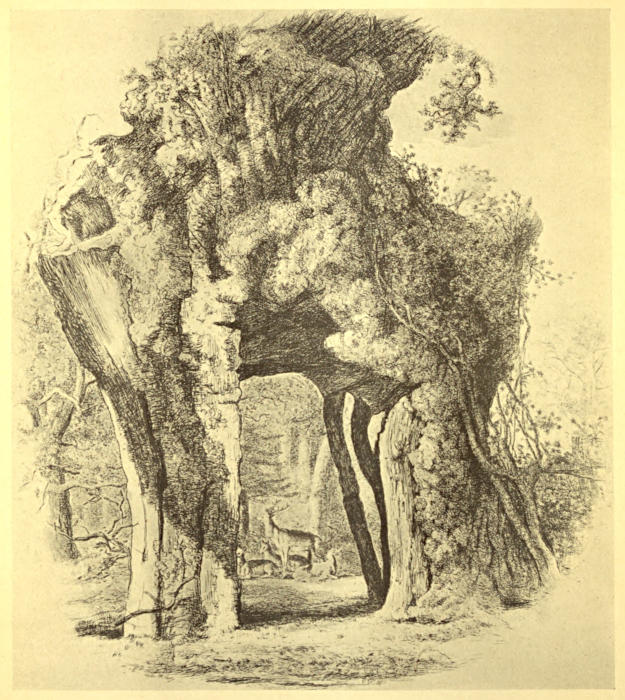
THE GREENDALE OAK
(1720)
[i]
THE ANTIQUARY’S BOOKS
GENERAL EDITOR: J. CHARLES COX, LL.D., F.S.A.
THE ROYAL FORESTS OF ENGLAND
[ii]
[iii]
THE GREENDALE OAK
(1720)
[iv]
[v]
THE ROYAL FORESTS
OF ENGLAND
BY
J. CHARLES COX, LL.D., F.S.A.
WITH FIFTY-THREE ILLUSTRATIONS
METHUEN & CO.
36 ESSEX STREET W.C.
LONDON
[vi]
First Published in 1905
[vii]
THIS ATTEMPT TO DELINEATE SOME OF
THE MAIN FEATURES OF
THE ROYAL FORESTS OF ENGLAND
IS DEDICATED
WITH MUCH ADMIRATION AND RESPECT TO
RICHARD HISCO WHITWORTH
CHAPLAIN OF NEWSTEAD PRIORY
AND FOR
FORTY YEARS VICAR OF BLIDWORTH
IN RECOGNITION OF
THE REMARKABLE GRIP THAT HE HAS OBTAINED
OVER THE FOREST-LORE OF SHERWOOD
AND OF HIS SKILL
AS A MODERN BALLAD-WRITER
ON THE
OLD ROMANTIC LINES
[viii]
[ix]
| CHAPTER | PAGE | |
| I. | Early Forests | 1 |
| II. | The Forest Courts | 10 |
| III. | The Forest Officers | 17 |
| IV. | The Beasts of the Forest | 25 |
| V. | The Forest Agistments | 41 |
| VI. | Hounds and Hunting | 47 |
| VII. | The Trees of the Forest | 68 |
| VIII. | Later Forest History | 76 |
| IX. | The Forests of Northumberland, Cumberland, Westmoreland, and Durham | 87 |
| X. | The Forests of Lancashire | 98 |
| XI. | The Forests of Yorkshire—Pickering and Galtres | 107 |
| XII. | The Forests of Cheshire | 131 |
| XIII. | The Forests of Staffordshire | 137 |
| XIV. | The Forest of the High Peak | 150 |
| XV. | Duffield Frith | 181 |
| XVI. | Sherwood Forest | 204 |
| XVII. | The Forests of Shropshire, Worcester, Warwick, and Hereford | 223 |
| XVIII. | The Forests of Leicestershire and Rutland | 231 |
| XIX. | The Forest of Rockingham | 237 |
| XX. | The Forest of Oxfordshire | 257 |
| XXI. | The Forests of Berkshire, Buckinghamshire, and Huntingdonshire | 266 |
| XXII. | The Forest of Dean | 274 |
| XXIII. | The Forest of Essex | 283[x] |
| XXIV. | The Forest of Windsor | 287 |
| XXV. | The Forests of Sussex | 301 |
| XXVI. | The Forests of Hampshire | 304 |
| XXVII. | The Forests of Wilts | 313 |
| XXVIII. | The Forests of Dorsetshire | 330 |
| XXIX. | The Forests of Somersetshire | 333 |
| XXX. | The Forest of Dartmoor | 340 |
[xi]
| PAGE | |
| Verderer’s Slab, Bakewell | 17 |
| J. Charles Wall. | |
| Verderer’s Slab, Chelmorton | 18 |
| J. Charles Wall. | |
| Forester’s Slab, Wirksworth | 18 |
| J. Charles Wall. | |
| Forester’s Slab, Bakewell | 19 |
| J. Charles Wall. | |
| Forester’s Slab, Hope | 19 |
| J. Charles Wall. | |
| Forester’s Slab, Hope | 21 |
| J. Charles Wall. | |
| Forester’s Slab, Papplewick | 21 |
| J. Charles Wall. | |
| Woodward’s Slab, Newcastle-on-Tyne | 23 |
| J. Charles Wall. | |
| Woodward’s Slab, Papplewick | 23 |
| J. Charles Wall. | |
| Hunting Dogs | 51 |
| Berners or Harbourers | 55 |
| Wyrall Effigy | 66 |
| Wyrall Effigy | 67 |
| Deer Hunters of Cranborne Chase | 83 |
| V. M. M. Cox. | |
| Hunting Costume, Seventeenth Century | 89 |
| Chief Forester’s Slab, Durham | 97 |
| J. Charles Wall. | |
| Hunting Costume, Thirteenth Century | 182 |
| Letters in Centre of Oak | 221 |
| Hunting Costume, Fourteenth Century | 238 |
| Cattle Brands, Essex Forest | 285 |
| The Hart (Turbervile) | 298 |
| King and Queen Oaks, New Forest | 308 |
| M. E. Purser. | |
| The Hare (Turbervile) | 334 |
[xii]
| The Greendale Oak | Frontispiece | ||
| From Strutt’s Sylva Britannica, 1826. | |||
| I. | The King Hunting (1) | To face page | 4 |
| Brit. Mus. MSS., Royal 10 E. iv., ff. 253-4. | |||
| II. | The King Hunting (2) | ” | 8 |
| Brit. Mus. MSS., Royal 10 E. iv., ff. 255-6. | |||
| III. | Head of Attachment Court Roll | ” | 14 |
| Accounts Exch. Q. R., 134/16, temp. Edw. II. | |||
| IV. | Red Deer | ” | 26 |
| From Gilpin’s Forest Scenery, 1791. | |||
| V. | Wild Boars | ” | 30 |
| Brit. Mus. MSS., Add. 27, 699. | |||
| VI. | Wolf and Sheepfold and Wild Goats | ” | 32 |
| Brit. Mus. MSS., Royal 12 C. xix., ff. 14, 19. | |||
| VII. | Pigs of the New Forest | ” | 42 |
| From Gilpin’s Forest Scenery, 1791. | |||
| VIII. | Netting in Woods and Streams | ” | 58 |
| Brit. Mus. MSS., Cott., Tib. A. vii., f. 51. | |||
| IX. | The Four Beasts of Venery | ” | 60 |
| X. | The Four Beasts of Chase | ” | 62 |
| XI. | The Four Beasts of Sport | ” | 64 |
| Plates IX., X., and XI., are from Cott. MSS., Vesp. B. xii., ff. 1, 2. | |||
| XII. | Maple Tree, Boldre Churchyard | ” | 72 |
| From Strutt’s Sylva Britannica, 1826. | |||
| XIII. | Straw Helmets and Swindgel of the Deer-hunters of Cranborne Chase | ” | 84 |
| V. M. M. Cox. | |||
| XIV. | Deer Stalking | ” | 102 |
| Brit. Mus. Add. MSS., 27, 699, ff. 108-9. | |||
| XV. | Forest Hermit | ” | 108 |
| Brit. Mus. MSS., Royal 19 E. iii., f. 133.[xiii] | |||
| XVI. | Berner and Limehound, and Crossbow Shooting | ” | 122 |
| XVII. | Dog Leeching and Rewarding the Hounds | ” | 140 |
| XVIII. | Foxes, Deer in Forest, and Wolves | ” | 164 |
| Plates XVI., XVII., and XVIII. are from Add. MSS., 27, 699, ff. 6, 20, 23, 28, 50, 58, 109. | |||
| XIX. | Sherwood Forester of Fee, Skegby Church | ” | 204 |
| Photograph from the Rev. H. J. Stamper. | |||
| XX. | Monument of Thomas Leake, Blidworth Church | ” | 216 |
| Photograph from the Rev. R. H. Whitworth. | |||
| XXI. | Haywood Oaks, Blidworth | ” | 222 |
| Photographs from Rev. R. H. Whitworth. | |||
| XXII. | Ladies Rabbiting | ” | 304 |
| Brit. Mus. MSS., Royal 10 E. iv. | |||
| XXIII. | The Hill Woods, Lyndhurst | ” | 316 |
| From “The New Forest,” Horace G. Hutchinson. | |||
| XXIV. | A Deer Leap, Wolseley Park | ” | 330 |
| W. Salt, Arch. Soc., vol. v. | |||
[xiv]
County historians have, as a rule, with but rare exceptions, either entirely ignored the story of the royal forests within their confines, or have treated the subject after the most meagre fashion. Nevertheless, there is abundant and most interesting material for their history at the Public Record Office in a mass of documents which are but very rarely consulted. Occasionally, too, much can be gleaned from manuscripts at the British Museum, Cambridge University Library, Guildhall, or Lincoln’s Inn, and in a few cases from rolls or books of forest proceedings in private hands.
If references had been given to every document cited, almost every page would have bristled with footnotes, involving a considerable curtailment of the rest of the letterpress. Not a single statement, however, is made—where no author is cited—save on the authority of original and contemporary records.
It may be helpful to some to state the chief classes of documents whence forest lore is to be obtained in the vast national depository in Chancery Lane.
(1) Placitæ Foresta, or Forest Proceedings, Chancery—John to Charles I.—consisting of presentments, claims, perambulations, etc., before the Justices in Eyre of the Forests. They are contained in 156 bundles, and an inventory of their contents will be found in the Dep.-Master of Rolls Reports, v., App. ii., 46-56.
(2) Swainmote Court Rolls of Windsor, 2 Edw. VI. to 14 Charles I. Inventory in Report, v., App. ii., 57-9.
[xv]
(3) Forest Proceedings, Exchequer, Treasury of Receipt, Henry III. to Charles II. To these documents there are three volumes of MS. Calendars.
(4) Miscellaneous Books of Exchequer, Treasury of Receipt, vol. 75, Edw. I.; assarts and wastes in diverse forests, vol. 76; pleas and presentments of Sherwood, Hen. III. to Edw. III.; vol. 77, game in all forests north of the Trent, 30 Hen. VIII.
(5) A Book of Orders concerning Royal Forests, 1637-1648. State Papers, Domestic, Charles I., vol. 384.
(6) Records of Duchy of Lancaster. A great variety of forest presentments, attachments, perambulations, pleas, etc., Hen. III. to James I., pertain to Lancashire, Yorkshire, Staffordshire, Derbyshire, etc. A printed list of all the Duchy Records was issued in 1901; those relating to forests are on pp. 39-47. Among the maps and plans (pp. 76-80) are many relating to the Forest of the High Peak.
(7) Lists of Minister Accounts, with thorough indexes, were issued in 1899; much royal forest information occurs in many of these accounts.
(8) Occasionally Court Rolls of Manors, etc., yield information; these also have printed lists and indexes, issued in 1896.
(9) Both Close and Patent Rolls for the thirteenth and fourteenth centuries abound in royal forest incidents; they have been well calendered (printed) for the greater part of this period.
As to these records, I have a large number of references and brief extracts—far more than are used in the following pages—for the different counties, and I would gladly on application save trouble, if I could, to any genuine worker as to a particular forest or forests.
With regard to printed books that bear on the subject, references to the more important will be found in each of the chapters; but there are three of such real value on this little studied subject that they demand special mention.
In 1887, Mr. W. R. Fisher published a 4to volume on The Forest of Essex: its History, Laws, Administration, and Ancient Customs, and the Wild Deer which lived in it. The [xvi]book owed its origin to the spirited action of the Corporation of the City of London, in rescuing much of the illegally enclosed land of Epping Forest; it is based throughout on documentary evidence, and illustrates, in many ways, forest law and procedure in other counties besides Essex.
The documents relative to the Yorkshire Forest of Pickering are exceptionally voluminous and interesting. They sufficed to fill four volumes of the new series of the North Riding Record Society, and were put forth by Mr. R. B. Turton between 1894-7. I had obtained transcripts of many of these documents in 1890, and made considerable extracts from others in 1902-3 before I was acquainted with these books. They are not well arranged, but both transcripts and introductions are of the greatest value to the forest student, particularly of the fourteenth century.
In 1901 the Selden Society issued Mr. G. J. Turner’s Select Pleas of the Forest, the one masterly work on English forest law and procedure, more especially of the thirteenth century. To this admirable volume these pages are much indebted, and from it not infrequent quotations have by leave been taken. I desire also here to gratefully acknowledge the help I have received from Mr. Turner, outside his published work, and particularly for his reading the proof of the earlier chapters, though it is not to be understood that he is responsible for any statements. It is much to be hoped that Mr. Turner will ere long produce another book on the later Forest Pleas in the time of their decadence.
Passing long periods of my earlier life within the bounds of two old royal forests, Exmoor, Somerset, and Duffield Frith, Derbyshire, and living subsequently close to the confines of the Staffordshire forests of Kinver, Cannock, and Needwood, the subject treated of in these pages has always had for me a particular fascination. Accidentally meeting in early life with a copy of that very rare little work, Dryden’s edition of L’Art de Venerie (1843), by William Twici, huntsman to Edward II., which is described in chapter vi., made me desire to know [xvii]more about the subject. Thirty years later I had the good fortune to make the acquaintance of that rare old antiquary and sportsman, the late Sir Henry Dryden, Bart. Various discussions and correspondence on England’s forest law and early hunting led to his desiring me to bring out a new and extended edition of his valuable little treatise. The project got deferred, but this book, in which his drawings of hunting costumes and hounds are reproduced, to some extent fulfils his wishes.
No one is better aware of the deficiencies of these pages than the writer. It would have been easy enough to have found original material sufficient to fill a volume of this size for almost each of the forests named therein; in some cases, such as the Peak Forest, Rockingham, and more especially Sherwood, it seemed almost sinful to be content with such brief summaries of a few of the more important facts. Nevertheless, it seemed best on the whole to condense the entire matter within the limits (kindly made more elastic in this case) assigned to the series of “Antiquary’s Books.” In doing this, certain sections that had been prepared on such subjects as the Clergy and Forest Pleas, Historic Trees, Place and Personal Names in Forest Districts, and a Glossary of Terms had to be abandoned. In the heartless work of cutting down, by more than one half, the material prepared for the press, as well as in other ways, I had the timely assistance of my son, Mr. Cuthbert Machell Cox.
It might be well for the reader interested in any particular forest or shire to recollect that illustrations of any special topic treated of in the opening chapters are not, as a rule, repeated subsequently; reference to the index will often supplement information given under the chapter on a definite shire. It is hoped, too, that the index will serve as a glossary, as each forest term used is explained once or oftener in the text.
The absence of any reference to the counties of Bedford, Cambridge, Cornwall, Hertford, Lincoln, Middlesex, Monmouth, Norfolk, and Suffolk, arises from the fact that there is [xviii]practically no information with regard to any royal forests within their confines.
If these pages arouse greater interest in the much neglected story of England’s royal forests, it will be an abundant reward for no small amount of time and trouble expended on record searching and on general reading in the pursuit of a subject that was at one time so widely developed, and had so great an influence on our social and economic life.
J. CHARLES COX
St. Albans, Sydenham
July, 1905
[1]
“A forest,” according to the last edition of the Encyclopædia Britannica, “is a tract of country covered with trees, of one or several species, or with trees and underwood.” This has become the popularly accepted meaning of the term for several generations, but it is historically false; and so far as this volume is concerned, we have to go back to Manwood’s definition as expressed in his Lawes of the Forest (1598), wherein he describes a forest as “a certen territorie of wooddy grounds and fruitfull pastures, priviledged for wild beasts and foules of forrest, chase, and warren, to rest and abide in, in the safe protection of the king, for his princely delight and pleasure.”
But even Manwood, and others who have followed him, are not correct in assuming that the term originally, or of necessity, implied woody grounds or natural woodland. Dr. Wedgwood seems to be right in considering “forest” as a modified form of the Welsh gores, gorest, waste, waste ground; whence the English word gorse, furze, the growth of waste land. Others consider its derivation to be from the Latin foris, out of doors, the unenclosed open land. From the fact that so many wastes were covered with wood or undergrowth, it gradually came about that the term “forest” was applied to a great wood.
Perhaps the following definition is as accurate a one as can [2]be given in a few words, of what used to be understood by the English term “forest” in Norman, Plantagenet, and early Tudor days. A forest was a portion of territory consisting of extensive waste lands, and including a certain amount of both woodland and pasture, circumscribed by defined metes and bounds, within which the right of hunting was reserved exclusively to the king, and which was subject to a special code of laws administered by local as well as central ministers.
Had the true meaning of the old term “forest” been grasped, much waste of learning, and of vain strivings to prove that such barren tracts as by far the greater part of the forests of Dartmoor, of Exmoor, and of the High Peak, or even of the larger portion of the New Forest were wood-covered in historic times, might have been spared.
A chase was, like a forest, unenclosed and only defined by metes and bounds, but could be held by a subject. Offences committed therein were, as a rule, punishable by the Common Law and not by forest jurisdiction, though swainmotes were sometimes held therein, proving that they had originally been royal forests. The terms “chase” and “forest” were occasionally used interchangeably, owing to a chase having been secured by the Crown, or the Crown having granted a royal forest to a subject.
A park was an enclosure, fenced off by pales or a wall. In certain forests there were various parks, as in Duffield Frith, and Needwood, and Sherwood; and in most, at least one or two; but many parks were held throughout the country by subjects under Crown licence, altogether apart from forests. Forest law prevailed in parks within a forest, but not in those outside such limits. An Elizabethan estimate, of doubtful value, states that the old royal forests were sixty-nine in number, and that there were in addition thirteen chases and more than seven hundred parks.
The term “warren” also requires brief discussion. The public had a right to hunt wild animals in any unenclosed land outside forest limits, unless such right had been restricted by some special royal grant. The word “warren”—the subject is ably treated by Mr. Turner (Forest Pleas, cxxiii.-cxxxiv.)—was used to denote either the exclusive right of hunting and taking certain beasts (feræ naturæ) in a particular place, or the land [3]over which such right existed. Grants of free-warren over demesne lands outside forests, so frequently made by our earlier kings both to religious foundations and to private individuals, prevented anyone entering on such lands to hunt or to take anything belonging to the warren without the owner’s licence, under the great penalty of £10. No one might, therefore, follow the hunt of a hare or of a fox or other vermin into warrenable land; but following the hunt of deer into such land was held to be no trespass, as deer were not beasts of the warren. Lords of warrens had the power of impounding the greyhounds or other dogs, and the nets and snares of trespassers.
In the consideration of England’s old forests, it is well to remember that subjects from time to time, in different shires, were seized of lands within forest bounds; but, when that was the case, they were not allowed on such lands the right of hunting, or of cutting trees, or of high fence making, or of doing anything which could be interpreted as detrimental to the deer, save by special grant from the Crown.
It has been pointed out by Mr. Turner that the history of English forests divides itself into three periods, namely, from the earliest times up to 1217, when the Charter of the Forest of Henry III. was granted; from that date up to 1301, when large tracts were disafforested by Edward I.; and thirdly, from 1301 up to the present day.
As to the story of the forests in the first of these periods, it must largely partake of the nature of conjecture based upon subsequent knowledge.
As the Romans gradually made themselves masters of England, they must have destroyed much of the vast extent of woods that gave shelter to the British tribes. This work of destruction—begun in the later prehistoric stage—was accelerated by two other causes, apart from military reasons; wooded districts were cleared in order to use the richer tracts for tillage and pasturage; whilst the greater attention paid to iron and lead smelting led to a steady diminution in timber through the demands for fuel.
The Saxons made further development of iron smelting works. This gradual clearance of the natural woods, coupled with enclosures of land round homesteads and settlements, [4]drove back the deer and other game into the depths of the woods and the more desolate districts.
These wilder tracts were used as common hunting grounds; but in course of time the chieftains and more powerful local men usurped the rights hitherto exercised by all. Eventually, as the Saxon overlords or kings gained greater power, they claimed, as part of their royal prerogative, the right to reserve the chase, or at all events the higher chase of the deer, in selected areas chosen for their nearness to favourite residences, or for the exceptional predominance of game. The royal hunting grounds (silva regis) as well as the king’s lands or royal demesnes (terra regis) were gradually formed out of the original folkland held by the common people under their thegn; so that when Egbert, in the ninth century, became the first king of all England, he found himself possessed of many royal hunting grounds in most parts of his kingdom.
During the later Saxon and Danish period the chase became more and more restricted. The freeholder still had the right to kill the big game on his own land, but might not follow it into or upon the king’s woods. The lesser game could, however, be then followed even in the king’s woods by the holder of the land, up to the time of the Conquest.
In this, as in so many other respects, the mention of forests or woods in Domesday Survey is merely incidental. The name of swainmote, as applied to a minor forest court of local administration, which so long survived and was of such general use, is in itself sufficient to establish the fact that there was a pre-Norman customary forest law. The question as to the first introduction of a body of written forest law in this country depends largely upon the genuineness of the code usually attributed to Canute, and termed Constitutiones de Foresta. This Latin code, in thirty-four brief chapters, purports to have been drawn up by Canute both for the English and the Danes. Although its authenticity was long ago doubted by Coke, it has been quoted by many able writers, such as Palgrave and Kemble, without the expression of any doubt as to it being a genuine historic document; but Professor Freeman and Bishop Stubbs subsequently adduced such weighty reasons for considering this code a forgery, or at all events containing so many interpolations as to be valueless, that present-day scholars are almost unanimous in rejecting it. The best defence of it is to be found in Mr. Fisher’s Forest of Essex. On the whole, it seems probable that this Latin code has a certain value in showing the general drift and tendency of Anglo-Danish forest law; but that its worth has been vitiated by being dressed up at the hands of some Norman scribe, with the object of lessening the hostility to the severity of the forest laws introduced by the Conqueror.
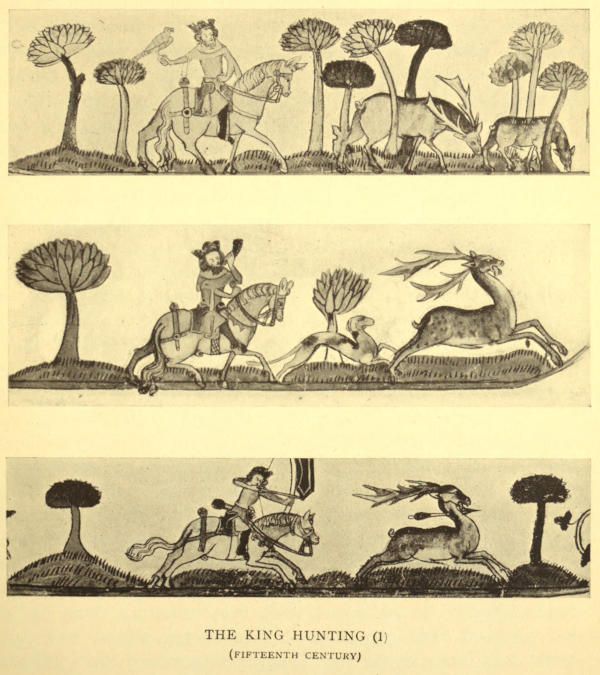
PLATE I
THE KING HUNTING (1)
(FIFTEENTH CENTURY)
[5]
The Conqueror acquired, by right of conquest, not only the demesne lands of the Confessor and of the nobles who had opposed him, but also all the rights of the chase over great woodland or open stretches of both cultivated and uncultivated ground, where royal hunting rights had previously been exercised by Saxon or Danish kings. With William and his immediate successors the chase was a passion, and hence a code of singularly harsh and burdensome “forest” laws soon came into operation. The Conqueror took advantage of the autocratic position secured to him and his followers by their military success, to carry out “afforestation” not only over the restricted areas that had been the hunting grounds of his predecessors on the throne, but over almost all the old folkland that remained unenclosed. The term “forest,” that had been long in like use on parts of the Continent, was then introduced into England, and made to embrace vast districts, which included woodlands and wild wastes of moor, as well as patches of cultivated land. Within these afforested tracts, he decreed that the right of hunting was vested solely in the Crown, and could only be exercised by the king, or by those who were specially privileged under royal licence to share in it. The feudal idea about all wild animals, however monstrous and harsh in operation, possessed a rough logical basis. It was argued that all such animals were bona vacantia, or ownerless property, and hence pertained to the king; that hunting was essentially the pastime or “game” of kings; and that therefore the right of exercising the chase, or taking all kinds of beasts of venery, belonged solely to the king.
The subsequent Norman kings added more or less largely to the “forest” districts of England, making even whole counties subject to this exceptional jurisdiction—as, for instance, [6]Essex and Surrey. The complaints of the hardships caused by this autocratic proceeding gradually gained strength. Certain disafforestations were made even by Henry II.; but in 1215 John was compelled to agree, by one of the articles of Magna Charta, to the disafforesting of all the great tracts of country which had been made forest during his own reign.
Soon after this, in 1217, the child-king Henry was made to issue the Charter of the Forest, in consideration of a grant of one-fifteenth of all movables of the whole kingdom. By this instrument it was provided that all forests, which Henry II. had afforested, should be viewed by good and lawful men; and that all that had been made forest, other than his own royal demesne, was forthwith to be disafforested.
In accordance with this charter special perambulations were ordered to be made before March, 1224-5, by twelve knights elected for the purpose.
There is much confusion among both national and local historians as to the number and extent of England’s forests at this period; and certain of our State documents appear to be somewhat contradictory. Fortunately, however, a great gale, that affected almost the whole of England towards the close of the year 1222, was the incidental cause of furnishing the longest extant list, of an early date, of England’s royal forests. The windfall was so considerable, that Henry III. issued orders to the forest officials not to interfere with any of the prostrate trees or broken branches until further orders, and at once to proceed to draw up a careful valuation of their worth. Letters to this effect were despatched to—
Viridariis et forestariis de feodo de foresta de Dene, Nova Foresta, Brikestok, Braden, Rokingham, Lye, Brehull (Bucks), Galteriz, Windlesore, inter Usam et Derewentem, Huntindonie, Shirewud, Rotelande, Clive (Northants), Brunningemor (Berks), Cumberland, Penber (Hants), comitatus Leicestrie, Clay (Salop), Lya (Salop), Melkesham and Chipeham, Cet, Savernac (Wilts), Northumberland, Lancastria, Salopa, Kenefer, Canoc, Alrewas, Hopwas, Kenillewurth (haia et parco), Selewud, Nerechirch (Somerset), Graveling, Gillingeham, Pikering, Porcestre, Essexie, Wichewud, Axisholt, Notingham, and Periton (parco).
At the same time, like injunctions were forwarded to the [7]keepers of each of these forests. On 30th January, 1223, the king instructed the sheriffs of all the counties containing forests to place the money accruing from the sale of the windfall in some religious house within their jurisdiction, there to await further orders, and to place with it a roll giving full particulars of the sales, drawn up by a specially appointed clerk named in the letters patent.
The heading to these instructions on the Patent and Close Rolls of Henry III. is De Cableicio. The term cableicium, or cablicium signifies windfallen trees, and corresponds to the old French word chablis, which had a like meaning. It is quite clear that the term “cablish” (to use the English form), strictly speaking, implies uprooted trees, as distinct from mere branches. The forest officials, after the great gale, were ordered to remove nothing, nec de cableicio illo neque de branchura per impulsionem venti prostrata. Nevertheless, the word was occasionally given a wider meaning—as, for instance, in 1223, when cableicium was applied to twelve great branches that had fallen in Windsor forest. But in this case the wood was sufficiently substantial to be reserved for the repair of the king’s houses. Cablish seems never to have been applied to such windstrewn wood as would be used for fuel. We have met with the word in several forest rolls or records in Northamptonshire, Rutland, Hampshire, and Derbyshire as late as the time of Henry VII.; though at that period the English word rotefallen, or rootefaler, was more usual as descriptive of the tree uprooted by the wind, and was used in distinction to the mere wyndfallen wood of smaller dimensions.
Other forests that occur in the Patent and Close Rolls of the earlier years of Henry III., which are not specifically named in the great storm order of 1222, are: Alnwick, Northumberland; Easingwold and Wakefield, Yorks; Clipston and Silverston, Northants; Acornbury and Kilpeck, Hereford; Peak Forest and Horston, Derbyshire; Alveston, Furches, Keynsham, and Horewood, Gloucester; Feckenham, Worcester; Cheddar and Selwood, Somerset; Freemantle, Hants; Buckholt, Clarendon, Ifwood, Sugrave, and Weybridge, Wilts; Poorstock, Dorset; Finmere and Woodstock, Oxon; and Havering, Essex.
[8]
Edward I. in some cases broke the Forest Charter under legal quibbles; but he did not, in general, desire that the boundaries of the forest as settled by his father, should be disturbed. Towards the end of his reign, however, strong political pressure induced him to consent to further disafforesting. The Forest Charter was confirmed in 1297, but further perambulations were undertaken between that date and 1301, by which large reductions were made in the forest area.
It would have caused general disturbance to the industries of the country, if the pursuit of special occupations pertaining to the soil had been prohibited within the very wide areas of the forests. Such industries were allowed to be followed under particular restrictions, and were worked, as a rule, for the profit of the crown. The most important of these was the question of iron smelting, particularly as the forges consumed so large an amount of wood or charcoal. Grants were made from the crown for permission to have itinerant forges. Such forges abounded in the Forest of Dean, and were also met with in the forests of Sussex, Duffield, Sherwood, Pickering, etc.
Henry III., in 1231, granted this liberty (forgia itinerans) to Mabel de Cantilupe for life in Dean Forest. The grant states this was in accordance with a custom sanctioned by John and other of the king’s royal ancestors. Another grant of the following year provided that the lady might have an oak on each of any fifteen days she chose, every year as long as she lived, for the support of this forge.
The symbol of a man who was entitled to use an itinerant forge seems to have been a pair of bellows. This symbol is to be found on two early incised slabs in the church of Papplewick, Sherwood Forest.
In some cases there were permanent forges of some size, belonging to the crown, within the forest bounds; of this there were two instances in Duffield Frith.
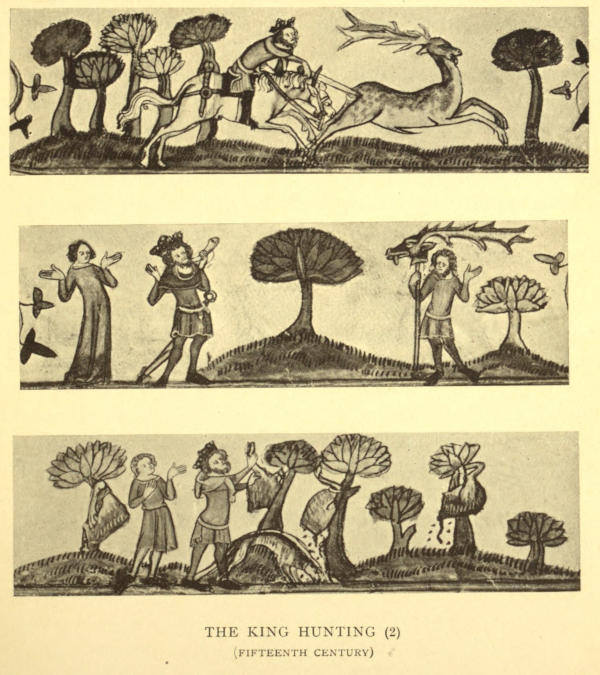
PLATE II
THE KING HUNTING (2)
(FIFTEENTH CENTURY)
In the Belper ward of Duffield Frith there was considerable surface coal mining; on Dartmoor and Exmoor there were particular regulations affecting the procuring of peat; whilst in other forests the quarrying of stone for building purposes, for millstones and for tombstones, as well as the burning of lime and digging of marl were pursued, but in all cases with due regard for the non-disturbance of the deer. Such callings [9]were confined to particular sites, as far as possible on the fringes of the forest.
The following of trades that were obviously detrimental to the deer, through odour or otherwise, such as the tanning of hides, were rigorously prohibited within forest bounds.
“Purlieu,” strictly speaking, was all that ground near any forest which had originally been forest by perambulation of Henry II., Richard I., or John, but had been severed by the Forest Charter of Henry III. Round some forests the purlieus were of considerable extent. As a rule, the purlieu man had certain forest agistment and other rights, but of considerable less value than the actual forest tenant; in return for this he was subject to a modified form of forest law, the chief of which was the non-disturbance of deer that he might find among his crops. The tenants on the outskirts of Galtres forest, Yorks, and of Duffield Frith, Derbyshire, were termed “bounderers”; they had certain privileges as well as obligations.
The purlieu custom varied much in different districts and passed under various local terms. Such were the Wynlands, or Wydelands, of the Peak, and the Venville of Dartmoor. Cranborne Chase, which was nearly identical with a forest, had its well-defined Inbounds and Outbounds. The old name of Outwoods is not infrequently to be found in the vicinity of an old forest, as at Duffield, Clarendon, and Kinver; its use denotes that the place so called was formerly within the forest purlieus. The forest of Clarendon had its Inlodges and Outlodges.
[10]
The forest eyre was a court called into being by the king’s letters patent, by which justices were appointed to hear and determine pleas of the forest throughout a particular county or groups of counties, or occasionally in the special area of a county or counties. A short time before the eyre was held, letters close were directed to the sheriff relative to its business. By these they were ordered to summon (1) all dignitaries and other free tenants who had lands or tenements within the metes of the forest; (2) the reeve and four men from every township within the metes; (3) all foresters and verderers, both those then in office and those (or their heirs) who had held such office since the last pleas of the forest; (4) all those persons who had been “attached” since the last pleas; (5) all the regarders; (6) and all the agisters. The sheriffs were at the same time directed to see that the foresters and verderers brought with them all their attachments or attachment rolls since the last pleas, and that the regarders brought with them their regards duly sealed, and the agisters their agistments.
The proper interval between those forest eyres is supposed, from analogy of eyres for pleas of the Crown and common pleas, to have been seven years; but in practice, to the great inconvenience of all concerned, considering the multiplicity of business, the intervals were usually much longer, and almost wholly capricious. For example, Derbyshire affords more than one instance of intervals exceeding thirty years; whilst Pickering yields an instance of an interval of over fifty years, namely, from 1280-1334.
Every three years a thorough inspection not only of the woods, but also of every part of the forest, was expected to be [11]made; this was termed the Regard. The duty of the twelve or more knights, who were called the Regarders, was to draw up answers to a long set of interrogatories termed the Chapter, which covered almost every possible particular as to the condition of the forest demesnes. But the most important function the regarders discharged was as to the assarts, or enclosures of waste with or without warrant, and to purprestures, or encroachments made by the building of houses or the like. In practice the full formal regard, with its complete roll of answers, was usually only made shortly before the holding of each eyre, when the sheriff was ordered by the Crown to see to the regard being duly performed.
The amount of business that had to be transacted at these eyres was very considerable, and usually involved repeated adjournments. The work would have been still greater if it had not been that a large number of the delinquents were naturally dead before ever the court was held; and that not a few of the former offenders, who had been released on bail, had passed out of the jurisdiction of the sheriff, and could not be traced. The proceedings of the court were, roughly speaking, divided into two parts—the pleas of vert and the pleas of venison. In both cases the chief object of the proceedings was the collection of fines and amercements for breaches of the forest laws, which—contrary to the usual opinion—had little, if any, trace of the old Norman severity. In fact, so far was this from being the case, that if a man was determined to poach venison, he met with far lighter punishment if the offence was committed in a royal forest, than if he was dealt with by the common or manorial law for a like offence in a private park. The first forest code (usually cited as the Assize of Woodstock) was extant in the time of Henry II.; it records the severities of his grandfather, when cruel mutilation and capital punishment, irredeemable by any forfeiture, were among the ordinary penalties; but all this disappeared in the thirteenth century.
The presence of the reeve and four men from each township was strictly enforced; and the fines for total absence, or absence at the opening of the court, of these and others who were summoned, were rigorously exacted. The consideration of the essoins, or excuses for non-attendance, was always the first [12]business of the court. It was also usual for juries from the different hundreds to be summoned; but their duty, as well as that of the men from the townships, seems to have been confined to attesting the truth of any statements affecting their districts which might appear on the rolls, and to being amerced for any particular neglect that might be brought to light. As to any jury proper, at these pleas, for the purpose of pronouncing a verdict on the delinquents, there is no trace; such decisions were left entirely in the hands of the justices.
By article nine of the Forest Charter, a man might be imprisoned for a year and a day; but in practice, so far as the eyre was concerned, a fine seems to have been the invariable judgment of the justices. These fines were so apportioned to the position and means of the delinquents, that they could, as a rule, be readily paid; and there are various instances in which, after being pronounced “in mercy,” they were excused payment on the ground of poverty. The sheriff was ordered to arrest those who failed to appear, and sentence of outlawry was at last pronounced, after the due number of summons before the county court. The fines imposed on offending foresters, verderers, or other forest ministers were rightly of a much heavier character than those imposed on ordinary offenders.
With regard to the venison pleas, the chief forester was expected to answer for all manner of venison delivered by warrant or otherwise since the last eyre. Under these pleas also came all the presentments for illegal or supposed illegal venison trespass of every kind, including the receiving of venison illicitly killed, or the harbouring of known offenders.
The vert pleas dealt with all the charges connected with damage to timber or underwood, its felling, carrying off, unlawful sale, or misappropriation, as well as the grant of “fee” or gift trees. The question of vert is dealt with more in detail in the section on forest trees.
In addition to the question of assarts and purprestures, another important matter always brought before the forest eyre was the list of claims or privileges by royal grant or charter, the majority of which were usually held by the religious houses. Each case had to be duly discussed and sanctioned, or refused, or curtailed, at each successive eyre.
[13]
There was not a single forest wherein several monasteries had not particular privileges conferred in early days, and in some they were very numerous. Over the great stretch of Peak Forest, Derbyshire, the abbeys of Basingwerk, Beauchief, Darley, Dernhall, Dieulacres, Leicester, Lilleshall, Merivale, Roche, and Welbeck, together with the priories of Kingsmead, Launde, and Lenton, all had rights. Such rights referred for the most part to the felling of timber necessary for their churches and buildings, or their farmsteads and fences, as well as to the collecting of undergrowth or dead wood for fuel. The agistment of cattle at certain seasons and the pannage of swine were granted from time to time; whilst venison rights, more particularly in the shape of a tythe of the deer killed, pertained to some few religious houses. The tythe of the wild boars killed in Dean Forest went to the abbey of St. Peter’s, Gloucester, and the tythe of the deer hunted in Pickering Lythe was the perquisite of the abbey of St. Mary’s, York.
In addition to the forest pleas proper, certain special inquisitions as to the condition of the forest and the charges against trespassers were held by the local officials, but under the particular justice of the forest or his deputy. Such inquisitions were probably caused, in the first instance, by the infrequency of the eyres. By a tiresome confusion, these courts of general inquisition in latter days are sometimes termed swainmotes, though they differed as much from the real swainmote as from the forest pleas.
The swainmote of later times, about which Manwood is somewhat mistaken, as shown by Mr. Turner, was practically the same as the attachment court. The two terms, “swainmote” and “attachment” (and occasionally “woodmote”), are used interchangeably in later days in various local proceedings of the same forest, of which full records remain—as, for instance, in Sherwood, Windsor, Clarendon, and Duffield Frith. At one and the same time in the fifteenth century, local courts of a like character were being held in the forests of Windsor and Northants under the style of swainmotes, in Lancashire and Sherwood as attachment courts, and in Staffordshire and Derbyshire as woodmotes. These courts of attachment, if regularly kept, as ordered by the Forest Charter, met every [14]forty-two days in each of the several bailiwicks or wards into which a forest was divided, but on different days of the week. Thus, at Sherwood Forest these courts were held at Linby, Calverton, Mansfield, and Edwinstowe on Monday, Wednesday, Thursday, and Friday respectively in every sixth week; though not infrequently they had to adjourn for lack of any business to transact.
The true swainmote, according to Henry III.’s Charter, was only to be held three times a year, namely, fifteen days before Midsummer, when the agisters met to see to the observance of the fence month; fifteen days before Michaelmas, when the agistment of the woods began; and at Martinmas, when the agisters met to receive the pannage. But, as has been remarked, the name swainmote (the court of the free-forest tenant of Saxon origin) became in later times a usual alias for the attachment court.
The Attachment, or Forty-day Court, as it was sometimes termed, was so called because its object was to receive the attachment of the foresters or woodwards, and to enter them on the verderers’ rolls. The legal term “attachment” (differing from “arrest,” which only applied to the body) had a threefold operation in the forest as at common law; a man might be attached by (1) his goods and chattels, or (2) by pledges and mainprize, or (3) by his body. The usual proceeding was that if the foresters found a man trespassing on the vert they might attach him by his body, and cause him to find two pledges (or bail) to appear at the next attachment court. On his appearance at that court he was mainprized (that is, set at liberty under bail) until the next eyre of the justices. If offending for a second time, four pledges were held necessary; if a third time, eight pledges; and for a fourth time, imprisonment until the eyre.
If, however, a man was taken killing the deer or carrying them away—which was called being taken with the manner, or mainour, an overt sign such as blood on the hands or clothes—he could be attached at once by his body, and imprisoned until delivered on bail by the king, or the justice of the particular forest, to appear at the next eyre.
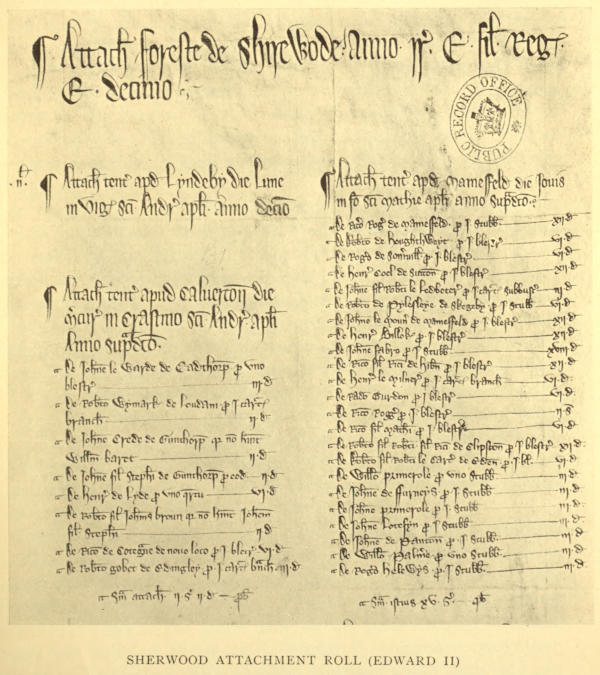
PLATE III
SHERWOOD ATTACHMENT ROLL (EDWARD II)
Those who lived in the forest, and were taken in the king’s demesnes cutting green wood or saplings, or even gathering [15]dry wood from oaks, hazels, or other trees, could be amerced in the attachment court, unless the damage they had done was appraised at more than 4d., in which case the delinquent was to be attached to answer for his offence at the next eyre. Questions of the escape of cattle or sheep, and any breach of the particular agistment pannage regulations for the swine, were also dealt with by this court. When the trespasser was not a dweller in the forest, the forester or woodward, even in a vert case, was expected to attach his body and take him to prison (each forest had its own prison for forest offences), from which he could be released only by the order of the king, or the justice of the forest. In the matter of venison, these lesser courts had not originally any jurisdiction; but in later times pledges were often taken for the appearance of such trespassers at the eyre.
In addition to the general forest inquisition, there were also special inquisitions dealing with venison trespasses held under the bailiff of the forest in conjunction with the foresters and verderers. Several of these are extant of the thirteenth century. One of the most interesting rules of these special cases provided that if any beast of the forest was found dead or wounded, an inquest was to be held by the four neighbouring townships of the forest. The finder of the deer was to obtain pledges for his subsequent appearance; the flesh was to be sent to the nearest lazar-house, or given to the local sick and poor if there was not one within reasonable distance; the head and skin were to be given to the freeman of the township where it was found; and the arrow or other weapon to the verderer, who had to keep it for production at the next eyre.
Inquests were also held by the four neighbouring townships in cases of definite forest trespass; and the bows, arrows, or snares found upon a trespasser had to be delivered to the verderer for future production. Owing to such inquests being sometimes held at the same time as the gathering of a swainmote, the rolls of these local courts, if carelessly consulted, appear to be dealing with venison trespass when such was not the case.
It must be remembered that these forest inquisitions were only necessary when a beast of the forest was dead or wounded, or when an actual trespass had been committed in the forest.
[16]
The forest pleas or eyres were usually held in the county town, but occasionally those summoned had to appear in another county. This was the case with the delinquents and officials of Duffield Frith; that forest was in the honor of Tutbury, and the pleas were held at that Staffordshire town. Now and again a special booth or tent was erected to accommodate the justices, as was the case in part of Rockingham forest in the sixteenth century.
The swainmotes sometimes assembled in the open air, but far oftener in the respective lodges of the different wards, as in Needwood and Sherwood forests. Charges for the repairs of the lodges are of frequent occurrence in forest accounts. There was generally a central court-house or justice seat where special inquisitions were held, with accommodation if required for the keeper or chief forester, and with a chapel annexed, as in the New Forest and the Forest of the Peak. There is a Lancashire instance of a swainmote being held in a chapel.
[17]
The chief local authority over a forest was the keeper or warden, who was also variously known as a steward, bailiff, and chief or master forester. In no two forests were the terms for the various ministers exactly similar, and the nomenclature often varied for the same forest at different periods. Certain forests, such as those of Cheshire, were ruled by hereditary wardens or keepers; but they were more usually appointed by the Crown, during pleasure, under letters patent. This office was often held in conjunction with that of keeper of the forest castle, as was the case with the Peak Forest. Writs relative to the administration of the forest business were addressed to this chief keeper, as well as orders for the delivery of venison or wood.
For the most part he was expected to preside personally, or through his deputy or lieutenant, at the local courts. He had considerable perquisites and privileges, and was generally allowed to distribute a certain amount of venison to the county gentlemen of the district without direct warrant.
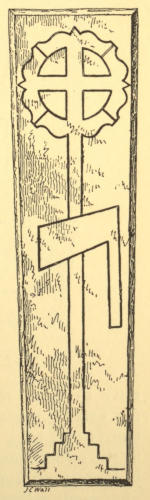
VERDERER’S SLAB
TWELFTH CENTURY
Bakewell, Derbyshire
The verderers were forest officers directly responsible to the Crown, although, like coroners, they were elected by the freeholders in the county court on writ addressed to the sheriff. The appointment was considered to be one for life; but any verderer could be removed by the Crown for incapacity, or for [18]lack of due property qualification within the forest. The verderers were always men of some position, and frequently knights; they had no salary, and perquisites of any kind were the exception. They varied in number; in the smaller forests there were only two; four seems to have been the average, but in Sherwood there were six. It was the verderer’s duty to view, receive, and enroll all manner of attachments for vert or venison trespass; and he had to attend all forest courts and take the leading part under the steward or keeper at the swainmotes. In the swainmotes, the verderers were the judges in all vert cases of the value of 2d. or under; this was afterwards raised to 4d.
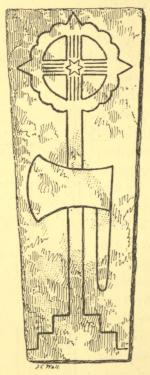
VERDERER’S SLAB
TWELFTH CENTURY
Chelmorton, Derbyshire
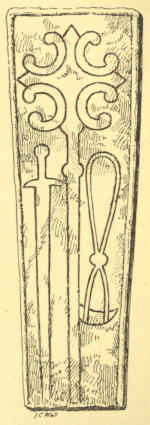
FORESTER’S SLAB
TWELFTH CENTURY
Wirksworth, Derbyshire
The verderer’s symbol of office was an axe. In several forests, as in Duffield, there was a chief verderer, styled the [19]axe-bearer, appointed directly by the Crown, and the recipient of certain perquisites.
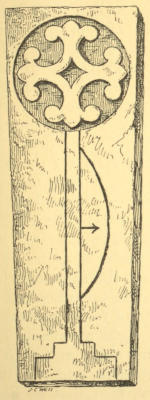
FORESTER’S SLAB
THIRTEENTH CENTURY
Bakewell, Derbyshire
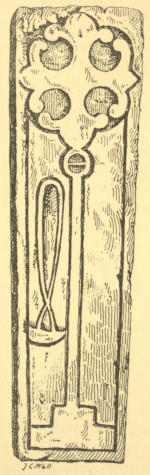
FORESTER’S SLAB
THIRTEENTH CENTURY
Hope, Derbyshire
Foresters were officers sworn to preserve the vert and venison in their own divisions, or walks, or wards, which were sometimes termed bailiwicks. They had to “attach” offenders, and present them at the forest courts. If they found any man in the forest with bows and arrows, snares or dogs, they might arrest and imprison him as if they had actually seen him hunt or kill the deer. They had to take special care of the deer during the fence or close month, i.e. the fortnight before and after Midsummer Day, when the fawns were usually dropped, and to provide them with deer-browse or tree-clippings in the [20]winter. They might not hunt themselves, or even carry a bow, save under warrant or direct order of the keeper, or when training the young dogs according to custom. Foresters had always certain rights of pasturage and pannage, and usually one or two deer and one or two trees during the year. The working forester was generally also paid so much the day, always reckoning seven days to the week, as he was supposed to be ever on duty.
The foresters of Clarendon, Wilts, eight in number, received 2d. a day each, at the rate of 365 days to the year, including all Sundays and holy days. This rate of payment is mentioned in 1360, and it remained the same in 1483. Twopence a day was also the usual wage of the Pickering foresters. Occasionally foresters were appointed by letters patent of the Crown; this was the case with some of the Sherwood foresters, temp. Edward IV., who received 4d. a day, and were allowed to act by deputy.
There was often a general or itinerant forester for the whole area, who had a higher rate of pay, and, as he was mounted, was frequently called the riding forester. Sometimes the Crown appointed several such foresters, as did Edward I. for Peak Forest at the beginning of his reign, calling them forestarii equitii. In the next century there is record of the Crown appointment of a chief forester for the same district at the very high wage of 12d. a day. Such an officer as this was, at a later period, known in various forests under the name of bow-bearer, from having the right always to carry a bow, personally or at the hands of his attendant. To this office special perquisites were usually attached, and eventually the duties were almost entirely honorary, save that he had to wait upon the king, and regulate the royal hunting, when he came to a particular forest.
Strictly speaking, the symbol of a royal or chief forester was a bow, whereas that of the ordinary forester was a horn.
In several of the larger forests, such as those of Lancashire, Cheshire, Dean, Sherwood, and Pickering, there were hereditary foresters-of-fee. In the Peak Forest, when the question of their origin came up at forest pleas, they always claimed to date back to the days of William Peverel. There were originally four (though afterwards subdivided) for each of the [21]three great bailiwicks of the Peak Forest, who held certain bovates of land in serjeanty, discharging their obligations in one case by hunting wolves, and in the others by some amount of forest supervision. In two of the three bailiwicks they had sworn servants or grooms under them. This kind of forestership could be held by women and by clerks, but the duties had then to be discharged by deputy. The foresters-of-fee were bound to attend all courts, even the frequent swainmotes of their bailiwick, in person or by authorised sworn deputy.
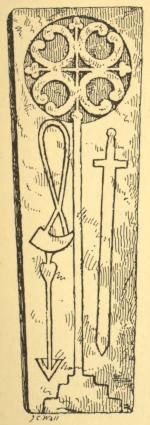
FORESTER’S SLAB
THIRTEENTH CENTURY
Hope, Derbyshire
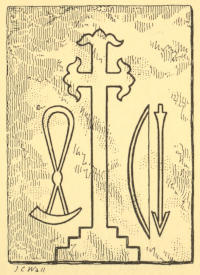
FORESTER’S SLAB
FIFTEENTH CENTURY
Papplewick, Notts
There were usually special perquisites at the time of holding an eyre. Thus the justices in eyre in 1488 assigned to the forester of Windsor a beech and a small oak, and to the forester of the baily of Basilles an oak and a buck.
In the earlier forest days, foresters appear to have been frequently quartered, in whole or in part, on the tenants within [22]the bounds. Hence, long after definite wages had become customary, attempts were made to maintain these boarding arrangements. These wages in kind for themselves, their horses, and their dogs, were termed puture, or putre. A case occurs in the Year Book of Edward III. of a claim of this kind made by a forester of Inglewood against the abbot of St. Mary’s, York. He claimed food and drink at the table of the abbot’s servants on every Friday, together with the right to carry away, whenever he pleased, a flagon of the best ale, two tallow candles, a bushel of oats for his horse, and a loaf of black bread for his dog.
Special provision was made against this levying of payment in kind by the foresters or their servants, in the Forest Charter of 1217. A statute of 25 Edward III. also strictly forbade “the gatheringe of vitailes nor other thing by colour of their office against anye man’s wil within their bayliwick” by all forest ministers, but at the same time left a loophole for its continuance by exempting that which was “due of olde right.” Puture disputes were a special grievance in the Lancashire forests, where this charge on the tenants became commuted for a money payment.
The drink money of the Dartmoor foresters went by the name of poutura in the thirteenth century.
The position of the woodward of a forest, as distinguished from a forester, is often misunderstood. The woodward, though primarily responsible for the actual timber or underwood, as the name implies, was also, as a rule, a forester—that is, he was at the same time responsible for the venison. To understand their position, it must be remembered that all the lands within a king’s forest were never entirely demesne. In every forest there were various woods which were private property; but they were subject to general forest jurisdiction, such as the free ingress and egress of the king’s game. Nor could the owners, without the king’s licence, do anything therein, such as clearing away growing timber for cultivation, building houses or sheds, establishing forges, or burning charcoal, that might be held to do damage or cause annoyance to the deer. To look after their rights, such wood owners were allowed, nay, were required, to have officials termed woodwards to guard the king’s venison, and therefore they were [23]not allowed to act save as sworn servants, taking oath to serve the king in the matter of venison, and having power to attach and present.
The symbol of the woodward was a small hatchet or bill-hook.
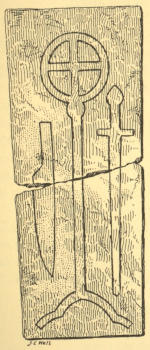
WOODWARD’S SLAB
TWELFTH CENTURY
Newcastle-on-Tyne
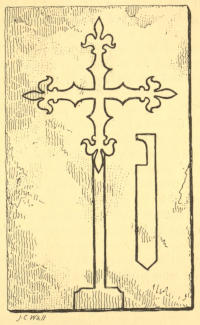
WOODWARD’S SLAB
FIFTEENTH CENTURY
Papplewick, Notts
In later forest days a kind of chief woodward was sometimes termed the axe-bearer; and we find a “sealing axe” mentioned in later forest accounts of Wiltshire, Worcestershire, and Yorkshire, which was used for blazoning timber intended to be felled.
Agisters were the officers who were chiefly concerned with the collection of money for the agistment or feeding of cattle and pigs in the demesne woods or lands of the forest. Beasts of the plough (for the most part oxen, but occasionally an inferior breed of horse) were generally allowed such agistment [24]under certain restrictions; and pigs, from 11th September to 11th November. But each forest had its own peculiarities. Horse-breeding establishments, or stud farms, were an early institution in Peak Forest; whilst cattle were the predominating feature of Dartmoor. Sheep were usually specially restricted. Goats were at all times peculiarly disliked by deer, and very rarely permitted. As a rule, agisters were expected to report to the verderers, or direct to the swainmote, cases of illegal agistment, or of escapes of animals into the forest.
Rangers were officials that are not heard of till towards the end of the fourteenth century; their duties were originally confined to seeing that forest law was duly observed in the outlands or purlieus of the forest. Their office corresponded in some respects with that of the mounted forester.
The regarders were responsible for the regard or survey of the forest, which has been already explained. Less than twelve could not make a certificate of their “view,” so more than that number were generally appointed. When making their regard, they were to require the presence with them of the foresters and woodwards. The regarders, or some of them, were expected to be present at every removing swainmote.
Another class of officers, of which there are many in such forests as Duffield, were the parkers or keepers of the different parks. They not infrequently had under them palers, palesters, or palifers, who were permanently employed to maintain the pale fences of the parks.
[25]
Manwood’s Treatise on the Forest Laws, the first edition of which appeared in 1598, has usually been accepted, without demur, as giving indisputable details about the forests of England. Mr. Turner has, however, rightly pointed out in his recent volume, Select Pleas of the Forest, that Manwood, writing at the end of the Elizabethan period, when forest law had for the most part decayed, is by no means altogether reliable, particularly in those parts that treat of what constituted beasts of the forest and beasts of the chase. In such particulars Manwood seems to have relied on foreign rather than English treatises on hunting, a fault in which he has been imitated by more than one modern writer, and also to have confused methods of hunting with forest legislation.
Manwood declared that there were five beasts of the forest—the hart, the hind, the hare, the wild boar, and the wolf; but this in reality only makes four, for the hart and the hind are the male and female of the red deer. He then made a second division, termed the beasts of the chase, which included the buck and the doe (the male and female of the fallow deer), the fox, the martin, and the roe. The law, however, made no distinction of this kind between the red and fallow deer; both of them were distinctly beasts of the forest, in any legal or customary significance of that term.
The truth as to the English beasts of the forest, or king’s game, all of which originally came under the head of venison, can only be ascertained by a study of the eyre rolls and other original forest proceedings. It then becomes clear that the forest beasts numbered four—the red deer, the fallow deer, the roe, and the wild boar.
[26]
The hare has no business to be found in such a list, save in the single warren of Somerton, within the bounds of the Somersetshire forest of that name. In no other place is the hare known to have been preserved by forest laws.
Again, the inclusion by Manwood of the wolf among the beasts of the forest is absolutely without warrant.
As to beasts of the chase, a term without any legal significance, it may be held to include, in addition to the deer, the wolf, the boar, the hare, the fox, and other vermin, such as the wild cat, martin, badger, otter, and even in some cases the squirrel. All that can be meant by this term is, that these animals were chased and hunted, though after very different fashions.
In charters of warren, a term already briefly discussed, the hare was the principal beast. A decision of 1338 placed the roe among the beasts of the warren; but it was not a decision of universal application. The fox, and more especially the coney or rabbit, were also regarded as beasts of the warren—that is noxious beasts which were hunted or killed, but not preserved.
As to fowls of warren, they certainly could not be held to be noxious. They included the pheasant, the partridge, and the woodcock, as well as, in certain cases, such birds as the plover, and even the lark, the capture of which was held to be a warren trespass. Mr. Turner considers that it is probable that all birds, taken by snares or hawks within a warren, were held to be fowls of the warren, and that their capture constituted a legal trespass.
The one bird that has some claim to be considered a “fowl of the forest” is the swan.
The Red Deer (cervus elaphas), the largest of the British deer, was the chief beast of the forest, and remained so for a long period in all the wilder districts, such as Dartmoor, Exmoor, the Peak Forest, Sherwood, and the uplands of Pickering.
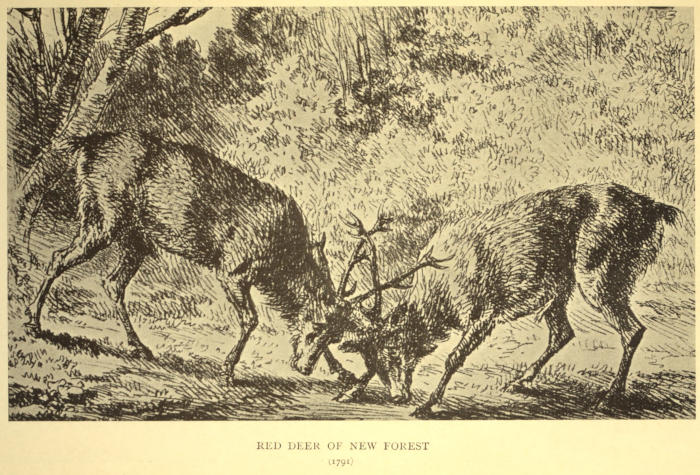
PLATE IV
RED DEER OF NEW FOREST
(1791)
The Fallow Deer (dama vulgaris), introduced at an early date into Britain, was more commonly sheltered in parks within forest bounds. In a few cases both red and fallow deer were found in the same forest outside parks; whilst other forests only sheltered one species. Thus in Derbyshire, down to the [27]time of their disafforestation in the seventeenth century, only red deer were found in the Peak Forest, and only fallow deer in Duffield Frith. In the fifteenth century, the fallow deer were far the most numerous in the forests of Essex, Northampton, Wiltshire, Hampshire, and Dorset; the proportions at later dates are given in a subsequent section.
The different names applied to both these species at different ages of their growth are not a little confusing, and vary somewhat from forest to forest. The following table of terms, denoting the age and sex of the red and fallow deer respectively, somewhat altered from a table given by Mr. Turton in his account of Pickering forest, will be found useful:—
| RED DEER | FALLOW DEER | |||
|---|---|---|---|---|
| YEAR | HART | HIND | BUCK | DOE |
| 1st | calf | hind calf | fawn | fawn |
| vitulus cervi | vitulus bisse | juvenculus | juvencula | |
| 2nd | brocket or knobber | hyrsel or hearse | pricket | tegg |
| brokettus | hyrsula or ursula | prikettus | tegga | |
| 3rd | spayard | hind | sorrel | doe |
| spardus or sorellus cervi | bissa or cerva | sourellus | dama | |
| 4th | staggard | soar, sore | ||
| staggartus or sourus cervi | sorus | |||
| 5th | stag | buck | ||
| staggus | damus or dama m. | |||
| 6th | hart | great buck | ||
| cervus | ||||
| 7th | great hart | |||
[28]
“Feton” (feta) is the term frequently used to signify a fawn, usually of the red deer, in the earlier forest pleas and accounts. It occurs several times in forest proceedings of the High Peak. The author of the Feudal History of Derbyshire makes the amusing mistake of reading it seton, and expends much learning on the derivation of such a term!
The term raskall or raskell occurs in various later forest accounts. It usually means deer out of condition, fit neither to hunt nor kill; but is occasionally used (as in Rutland accounts) to denote female deer.
“Murrain” was the generic term in mediæval England, for almost every form of disease that affected cattle as well as deer. From the records that are extant in various forest proceedings of the deaths of deer from murrain, it is clear that sometimes this term was used to denote a severe form of infectious illness that caused great ravages among the herds; whilst at other times, when only two or three die in the year from murrain, it would seem to be of the nature of some ordinary ailment. As a rule, the foresters were expected to hang up on the trees of the forest the carcases of those deer that had died of the murrain, and always to keep a strict record of those that thus perished. On several occasions there are instances of foresters being presented and fined, for skinning and taking the hides of those that had died of disease.
At a later period, as in Duffield Frith, the foresters were ordered to take the more sanitary course of burning the carcases. From a manuscript book, dealing with the perambulations and pleas of Sherwood, in the reigns of Henry III.-Edward III., it appears that the vast number of 350 head of deer (both red and fallow) had fallen victims to the murrain in the year 1286.
The full records of the Pickering eyre of 1334 give details as to the deer and murrain during each successive keepership since the last eyre in 1280. During the keepership of Richard Skelton upwards of 500 died of murrain. The murrain was severe in the forest of Rockingham during the reigns of Henry VI., Edward IV., and Richard III., particularly in certain years; 1,400 head of game died of disease during the whole period. In the first five years of Henry VII. the deaths from murrain amounted to 282. In the first year of Henry VII., [29]80 fallow deer died of murrain in the Wiltshire forests of Melksham and Pewsham, namely, 27 bucks, 33 does, and 20 fawns; but in the second year of his reign the far greater number of 340 perished, and in the third year 140. In 1489, and again in 1493, an unusual number of both red and fallow deer were found “dede of murrayn in Epping forest.” The most appalling case is that of Clarendon forest, in 1470, when 2,209 died of murrain in the one year.
The Roe Deer were the most graceful and the smallest of British cervidæ, a fully grown buck only standing twenty-six inches high at the shoulder. It must have been quite common—at all events in the south of England—in early days, as is proved by the scientific series of explorations carried out by the late General Pitt-Rivers in the Romano-British villages round Rushmore, Wilts. The roe or roebuck is mentioned in forest proceedings under the interchangeable terms of capriolus or cheverellus, the latter being Latinised from the French chevreuil. A roe killed in 1251 in Rockingham forest is entered, as Mr. Turner points out, as cheverellus in the forest inquisition, and as capriolus in the corresponding eyre roll. The writer of the Feudal History of Derbyshire has made nonsense of the various forest presentments for the killing of roebucks in the Peak, by translating capriolus “wild-goat.” The killing of a wild-goat in this forest would have been a work of merit, and certainly not deserving presentment.
In the full records of the Derbyshire eyre for the Peak of 1251, the killing of a roebuck is presented, and at the next eyre, 1286, five such cases are recorded. These Derbyshire instances help to clear up a matter of some importance in the history of England’s forests. In the thirteenth century there is no doubt that there were in general four, and only four, beasts of the forest; these were the red deer, the fallow deer, the roe deer, and the wild boar. In a charter of 1212, King John granted to the monks of Lenton the tithe of all his venison taken in Derbyshire and Nottinghamshire. The word “venison” (venacio) was applied in mediæval days to the beasts of the forest, and is in this case defined as the red deer, fallow deer, and wild boar. From this it has been supposed that the roe was not considered as a beast of the forest in all counties. Mr. Turner, in his valuable work on Forest Pleas, commenting [30]on this, says: “It is unfortunate that no documents still exist which relate to the forests in Nottingham and Derby in the reign of Henry III. or his predecessors,” and adds that a roe occurs in the Nottingham forest eyre of 15 Edw. I., but that as this is a single case, the great rarity of the roe in these counties may be inferred. The instances here adduced show that this is a mistake.
At the eyre for Pickering forest, Yorks, in 1338, the question as to whether the roe was a true beast of the forest arose, and the justices in eyre referred the question to the court of King’s Bench, when it was decided (contrary to previous decisions) that it was a beast of the warren, for the curious reason that it put to flight other deer. It has been supposed that from that date the roe ceased to be a beast of the forest throughout England. But that decision was either not generally known, or applied only to the peculiar case relative to the manor of Seamer. In 1398 a case was presented at a swainmote held at Tideswell, Derbyshire, of a venison trespasser killing a roebuck and a fallow doe. As late as 7 Henry VII. a charge of taking a roe deer in a snare in Clarendon forest was preferred against an offender, at the eyre held at Salisbury.
There are many interesting particulars relative to the roe deer in the records of Pickering forest. Edward II., in 1322, paid the large sum of £5 for cord to make nets to catch roebuck. This expenditure on cord would not be for the purpose of making small snares, but to aid in the construction of a buckstall into which the deer would be driven. Henry, Lord Percy, claimed, in 1338, to hunt and take fox, roe deer, cat, and badger on his manor of Seamer, although within the forest. The jury found that Lord Percy and all his ancestors had hunted and taken roe deer, but that that animal was a beast of the forest, for which offence poachers had been convicted and fined at the last eyre. The justices referred this point to the judgment of King’s Bench, with the result already stated.
The few cases of venison trespass that are extant with regard to the forest of Exmoor, prove that it possessed both red deer and roebuck. Presentments for killing roe deer are also extant in the case of the Forest of Dean and several others.
The Wild Boar.—The wild boar is one of the oldest and [31]most renowned of the animals of the British forests. It appears on ancient British coinage, on various works of art of the later Celtic period, on Romano-British altars, and with frequency on Norman ecclesiastical sculpture. The chroniclers tell us that boar-hunting was a favourite sport of Henry I. Pickering forest had great repute for its wild boars at the beginning of the thirteenth century. King John, in 1214, ordered the constable of the castle on two occasions to render assistance to the royal huntsman, who was coming with his hounds to kill wild boar in that forest. The boars were to be sought in that part of the forest where the king was wont to hunt them. The constable was to see that the meat was well salted, and the heads soaked in wine and dispatched to the king. In 1227, Henry dispatched his huntsman to Pickering to take twelve wild swine for the royal use.
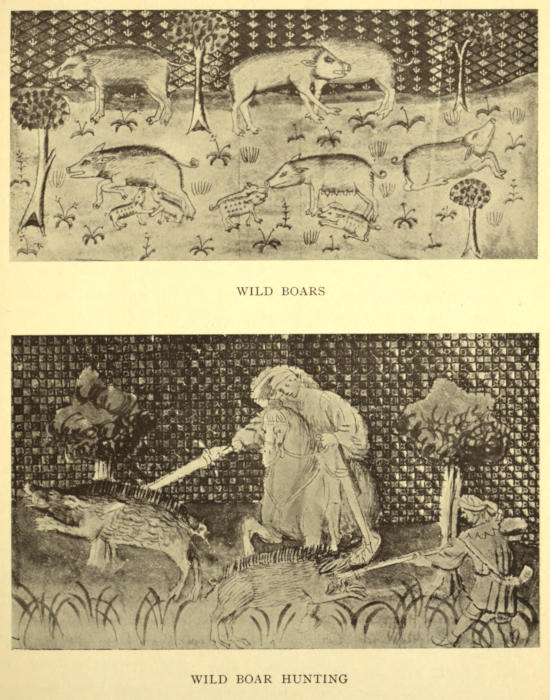
PLATE V
WILD BOARS
WILD BOAR HUNTING
King John’s anxiety about the preservation of this beast of the forest lasted to the end of his life. In September, 1216, he wrote to the constable of St. Briavel ordering that the cattle were only to be agisted on the fringes of Dean forest, and not in the forest itself, and particularly not in those places frequented by the wild boars. In a list of game taken for Edmund, Edward I.’s brother, in 1279, in Dean forest, under letters patent, mention is made of one wild boar.
Thomas de Langley, master forester of Wychwood, Oxon., in 1217, received the royal command to allow William de Brewere to take wild boars (porcos silvestres) in that forest; and in 1223, the same forester was instructed to take two wild boars and transfer them to the royal park of Havering, which was part of Waltham forest.
There are several records of wild boar hunting in Clarendon and other Wiltshire forests in the fourteenth century.
The boar or wild pig roamed through Cranborne Chase as late as the days of Elizabeth. Hutchins cites two fifteenth-century cases noted in the presentments of this chase. Robert Clare, in 33 Henry VI., was ordered to be distrained for killing four wild pigs on Iwerne Hill. Thomas Robe, vicar of Iwerne, was attached in the following year for killing four wild pigs in Iwerne Wood with his bow and arrow.
As forests lessened in extent, the wild boar diminished in numbers; but their survival in Lancashire, Durham, and [32]Staffordshire, in the sixteenth century, can be readily established. James I. hunted the boar in Windsor forest in 1617. Charles II.’s reign is the latest time at which this animal is known to have survived in England in a really wild state.
The Wolf.—The abundance of wolves throughout England in pre-Norman days is borne witness to by the Saxon name for January, namely, the wolf-month. There was probably no part of England where the wolves had surer or more prolonged retreats than amid the wilds of the Peak Forest and its borders. The last places in this country where they tarried were the Peak, the Lancashire forests of Blackburnshire and Bowland, and the wolds of Yorkshire. It has been confidently asserted (Blaine’s Encyclopædia of Rural Sports [1858] p. 105) that entries of payment for the destruction of wolves appear in the account books of certain parishes of the East Riding, presumably of sixteenth or seventeenth century date; but this on examination proves to be an error. They were abundant in Dean forest in the time of Edward I., and tenures of land in the forests of Rockingham and Sherwood, on the service of wolf-hunting, were renewed in the fifteenth century. The best authorities (such as Harting and Lydekker) consider that wolves did not die out in England until the time of Henry VII., 1485-1509. The last wolf was killed in Scotland in 1743. Packs of Irish wolves were not exterminated until 1710, and the last solitary survivor was killed in 1770. Place and field names afford remarkably abundant evidence of the considerable presence of wolves in North Derbyshire. Woolow (formerly spelt Wolflow), Wolfhope, and Wolfscote are well-known examples. Wolfscote Dale, though the term is not often used, is still the map-name for the upper stretch of Dovedale, and Wolfscote Grange and Wolfscote Hill are close to the forest border. On the opposite side of the Dove, in Staffordshire, is the ridge termed Wolfedge. The village boys of Hartington and Beresford Dale used to play at wolves and wolf-hunting in the “forties” of last century, apparently a traditionary game, as stated by the late Mr. Beresford Hope. Five cases of wolf in the field-names of enclosures within the bounds of the old forest have been found, whilst Wolfpit occurs as a boundary of Priestcliffe Common, and Wolfstone of Chinley Common in enclosure commissions, temp. Charles I.
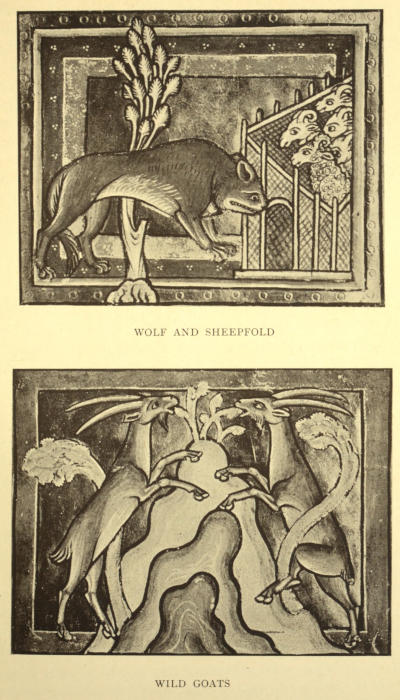
PLATE VI
WOLF AND SHEEPFOLD
WILD GOATS
[33]
A careful examination of forest and other records relative to Derbyshire has brought to light various wolf references, most of which are now cited for the first time. Among the evidences at St. Mary’s College, Spink Hill, is a charter of Robert Ferrers, Earl of Derby (who died in 1139), granting lands at Heage, which he held from the king on the service of driving the wolves out of his lordship of Belper, within Duffield Chase, which afterwards became a royal forest.
Two payments entered in the Pipe Rolls of Henry II. are highly significant of the devastation then caused by Derbyshire wolves. In 1160-1, 25s. was paid to the forest wolf-hunters (in lupariis) as an extra fee. In 1167-8, so great a value was set on the skill and experience of the Peak wolf-trappers (pedicatores), that Henry II. paid 10s. for the travelling expenses of two of them to cross the seas to take wolves in Normandy.
The accounts of Gervase de Bernake, bailiff of the Peak for 1255-6 are of special value, as they contain some of the very few specific entries that have yet been found among the stores of the Public Record Office of damage done to stock by wolves. Mention is made therein of a colt (pullum masculum) strangled by a wolf in Edale (jugulat’ cum lupo in Eydale); and in another place, in a list of waifs that accrued to the lord, there is reference to two sheep which were also strangled by wolves. There is another thirteenth-century reference to Derbyshire forest wolves which seems to have escaped the notice of county and other writers. The Hundred Rolls of the beginning of Edward I.’s reign record that Roger Savage was asked by what right he maintained dogs to take foxes, hares, wild cats, and wolves, and replied that he was the successor of William Walkelin, who had a royal grant to that effect.
At the pleas of the forest held at Derby in 1285, it was shown that a bovate of land held by John le Wolfhunte and Thomas Foljambe, two of the foresters-of-fee, was a serjeanty assigned for taking of wolves in Peak Forest. On the jurors being asked what were the duties pertaining to that service, the following was the highly interesting reply:—
“Each year, in March and September, they ought to go through the midst of the forest to set traps to take the wolves in the places where they had been found by the hounds; and if the scent was not [34]good because of the upturned earth, then they should go at other times in the summer (as on St. Barnabas Day, June 11th), when the wolves had whelps (catulos) to take and destroy them, but at no other times; and they might take with them a sworn servant to carry the traps (ingenia); they were to carry a bill-hook and spear, and hunting-knife at their belt, but neither bows nor arrows; and they were to have with them an unlawed mastiff trained to the work. All this they were to do at their own charges, but they had no other duties to discharge in the forest.”
In the records of Cannock forest, Staffordshire, for 1281, there is an entry of a wolf having killed a fat buck; the flesh was given to the lepers of Freford.
The Fox was always held to be noxious in England, and no penalty was attached to its destruction. Nevertheless, it was a breach of law to hunt them within a royal forest, save by special licence; the obvious reasons being that such hunting, if unrestricted, would disturb the king’s game, and prove an irresistible temptation to poaching with not a few.
William Rufus licensed the abbot of Chertsey to hunt the fox in the Surrey side of Windsor forest.
Richard I. and Henry III. granted licence to the abbot of Waltham to hunt the fox in the Essex forest.
King John, in 1204, gave the abbot of St. Mary’s, York, liberty to hunt the fox freely throughout all the royal forests of Yorkshire. The abbess of Barking had like rights in the forest adjoining her house. It need not be supposed that these religious superiors were expected by these licences to hunt personally—though occasionally an irregular abbot might thus indulge—the licence applied to their duly commissioned servants.
Licence was granted in 1279 to Adam Attewell, and those whom he took with him, to take foxes throughout the forest of Salop, by traps and other means, and to carry them away.
Everyone of England’s forests had one or more of the neighbouring landowners holding charters authorising the pursuit of the fox with hounds, save in the fence month; most of these charters dated from the thirteenth and some from the twelfth century. In the large majority of cases, the hunting of the hare was associated with that of the fox. The burgesses of Nottingham had a chartered right to pursue the fox and hare [35]in Sherwood forest, and this right was held to warrant certain burgesses keeping greyhounds at an eyre of 1538.
Thomas Bret, the vicar of Scalby, in Pickering forest, and four others, were each fined 6d., in 1336, for making folds of small thorns—a vert offence—in Scalby Hay to guard their sheep from the fox.
In Turbervile’s Noble Art of Venerie or Hunting (1575), the hunting of the fox and badger are described together. Both were hunted, or rather drawn, by terriers. He remarks:—
“As touching foxes, I account small pastime of hunting of them, especially within the ground; for as soone as they perceyve the terryers, if they yearne hard and goe neare unto them, they will bolte and come out streyghtwaies, unlesse it be when the bitch hathe yong cubbes: then they will not forsake their yong ones though they die for it.”
When the fox was hunted “above grounde,” after the earth had been stopped, the hounds of the chase thus employed are described as greyhounds, showing that the fox was usually coursed by sight, and not followed by scent.
The Hare was the principal beast of the warren. The large majority of chartered rights for the hunting of the fox within forests included the hare. The forest pleas of Somerset, in 1287, show a most remarkable exception as to the beasts of the forest in the case of the warren of Somerton, within whose bound the king preserved the hare, and inquests were actually held on those found dead.
At the eyre held at Rockingham in 1285, certain men were presented for setting nets for hares in Brigstock park.
A curious entry in the Close Rolls of 1276 mentions that the keeper of Bernwood forest was ordered to supply Sir Francis de Bononia (a famous secretary of Edward I.), with several young bucks and does, and also four live hares and six live rabbits, to be placed in the king’s garden at Oxford.
At an eyre held at Sherborne in 1288, the jury protested against the freemen of Cranborne Chase being deprived of their dogs, wherewith they had a right to hunt the hare and the fox.
The Coucher Book of the Duchy of Lancaster contains a great variety of presentments for hare hunting and hare taking, [36]particularly in the forest of Pickering, temp. Edward III. Robert Hampton, rector of Middleton, presented at the eyre for keeping four greyhounds and hunting hares at will, made no appearance and was outlawed. Matilda de Bruys was presented as accustomed to hunt and catch hares; she appeared, was fined 5s., and found sureties for good behaviour. Peter de Manlay, jun., a man of considerable position, was fined £1 for hare hunting, and Sir Nicholas de Menill £1 6s. 8d. Others were fined for hare hunting, or hare killing with bow and arrows, from 13s. 4d. to 1s. according to their position. How such charges came before the eyre as contrary to the forest assize, becomes clear from the nature of the charge in several of the cases; the delinquents are described as catching hares in various ways “to the terror of the deer.”
The Wild Cat was usually associated with the fox and hare in chartered rights for forest hunting; we have found it thus included in forest claims of Pickering, Windsor, Sussex, Cheshire, and Sherwood.
The wild cat is named by Turbervile, in 1575, as vermin which used to be commonly hunted in England. At that time they were not hunted designedly, but if a hound chanced to cross a wild cat he would hunt it as soon as any chase—“and they make a noble trye for the time that they stand up. At last, when they may no more, they will take a tre, and therein seek to beguile the hounds. But if the hounds hold into them, and will not so give it over, then they leap from one tree to another, and make great shift for their lives, with no less pastime to the huntsmen.” The wild cat is now extinct in England; it is supposed that the last one was shot by Lord Ravensworth in 1833, at Eslington, Northumberland.
The Martin is mentioned in two or three of the forest hunting grants. Thus, Richard Dove, chief forester of Mara and Moudrem, established, at an eyre held at Chester in 1271, his claim to the hunting of foxes, hares, cats, martins, and other vermin with hounds or greyhounds.
The Badger is also included in certain grants for forest hunting. This animal is expressly named in Henry III.’s grant in 1252 to Walter Baskerville in the forests of Hereford, Gloucester, Oxford, and Essex; in the 1253 grant to Roger Hardy, burgess of Scarborough, throughout the whole forest [37]of Pickering; in the 1253 grant to John of Lexington, in Essex; in two other grants in parts of Pickering forest; and in the 1297 grant to Thomas Paynel, in the Sussex forest of Ashdown.
The Otter obtains mention in a few forest proceedings and accounts. In the Peak Forest there are three or four instances of presentments for killing it with hounds; probably on the ground of disturbing the deer by such an action. Edward IV. had a pack of otterhounds, which, like the packs of harriers and buckhounds, was composed partly of running and partly of scent hounds.
The Squirrel even was named in some of these licences. It was included in the first-named grant of 1253 to John of Lexington; whilst the hunting hare, fox, squirrel, and cat throughout Sherwood forest formed part of the extensive privileges pertaining to Robert de Everingham, who was removed from his office of hereditary keeper or chief forester in 1289.
The Rabbit or Coney has already been mentioned in connection with warrens. The free chase and warren of Ashdown, Sussex, were held by Edward I.’s mother; in 1283 proceedings were taken against various persons for hunting and carrying of rabbits from her park at Mansfield. A raid made on St. Leonards forest, in 1295, included rabbits amongst the booty.
The office of parker of Blagden, in Cranborne Chase, carried with it “the ferme of the cunnyes.”
The rabbit warrens within the forest of Clarendon were of exceptional value, and are frequently mentioned in the accounts. In the time of Edward III. they were the perquisite of the chief keeper. In 1495, £100 received from the “Fermour of the Conyes in Clarendon,” formed an item of the revenue assigned for the king’s household. In the time of Charles I. these warrens were worth upwards of £200 a year.
Swans.—It was the duty of the chief minister of each ward of Duffield Frith to secure the king’s swans, and all waif and stray swans on the various rivers and streams within the forest limits. That there used to be many swans on the Derwent, in Duffield forest, is proved by the name Hopping Mill, or Hopping Weir, at Milford. Hopping, or upping, was [38]the term for the annual marking of the swans. Swainsley, on the margin of the river near Hopping Mill, is a corruption of Swansley. In some forests, such as Windsor and Clarendon, swan warding was an important part of the forester’s duty. In the latter forest a large number of swans were kept on the river. In Edward III. reign these royal birds were stolen on several occasions. In June, 1327, the prior of Ivy Church and another were commissioned to inquire and search for certain swans which were said to have been conveyed to divers places on the Avon, between Salisbury and Christchurch. Further commissions were issued to recover stolen swans in 1331 and in 1345; on the latter occasion the stolen birds were said to be worth the great sum of £100.
Eyries of hawks and falcons formed the subject of the second inquiry named in the chapter of the Regard, drawn up in 1229. In the long list of perquisites pertaining to the office of chief forester of Mara and Moudrem, claimed at the 1271 eyre held at Chester, is the right to all sparrow hawks, merlins, and hobbies.
Sir John de Meaux paid to the Earl of Lancaster for his woods of Levisham, in Pickering forest, 2s. annual rent, and eyries of falcons, merlins, and sparrow hawks. Thomas Wake, in his barony of Middleton, in the same forest, claimed to have eyries of sparrow hawks and merlins in his woods.
When the regarders assembled in Sherwood forest in 1309, the foresters swore to lead the twelve knights to view, inter alia, the eyries of hawks and falcons.
Falcons and falconers are named several times in the fourteenth century in connection with Rockingham forest.
Partridges and Pheasants have been already named under warrens. In 1336 two offenders were fined for catching partridges in Pickering forest; the one delinquent had to pay 3s. 4d., and the other 6d. The amounts were in all probability settled in accordance with their social position.
Part of the privileges granted in the forest to the abbey of Chertsey, by Henry II., was the liberty of taking pheasants. Among the offences dealt with at the eyre held at Guildford in 1488, for the Surrey portion of Windsor forest, was the fining of Ralph Bygley in the heavy sum of 100s. for being a common destroyer of pheasants and partridges, and a taker of birds. [39]Another offender at the same eyre was presented for killing six pheasants with a hawk.
Pheasants are mentioned in a raid on St. Leonards forest, Sussex, in 1295.
Herons.—There are several incidental notices of herons and heronries among the forest proceedings. In the raid that was made in 1295 on the forest, or rather the chase of St. Leonards, Sussex, herons formed part of the booty that was unlawfully removed. In 1334 Sir Walter de London, the king’s almoner, received the tithe of 157 herons that had been killed in Pickering forest. Mention is also made of herons sent up to London, out of Clarendon forest, for the king’s table, on several occasions in the fourteenth century.
Woodcocks.—The accounts of Duffield forest for 1313-14 make mention, under the ward of Hulland, of 4s. 6d. for “ix cokschutes.” A cockshut was a large net suspended between two poles, employed to catch or shut in woodcocks; it was used chiefly in the twilight. At the southern extremity of this ward is a farm still known as Cockshut. The same place-name survives on the sites of several of our old forests; and licences to use cockshuts were granted at swainmotes in Derbyshire, Hampshire, and Wiltshire. Reference to woodcocks will also be found under Galtres forest.
General licences for fowling in specific parts of a forest were sometimes granted in the local courts. On several occasions bird fowlers were attached at fourteenth and fifteenth century swainmotes in Duffield Frith, Clarendon forest, etc.; and a few examples of presentments at eyres for a like general offence are also extant. Thus, at Pickering, in 1334, Henry the Fowler of Barugh, Adam the Fowler of Ayton, and two others, were summoned and fined for catching birds in the forest by means of nets, birdlime, and other devices. The general disturbance of the deer would doubtless cause such action to be considered a breach of the assize of the forest.
Bees and Honey.—The fifth chapter of the Regard, issued in 1229, related to the king’s right to the honey in the royal demesne woods of the forests. At the Chester eyre of 1271, the hereditary chief forester of Mara and Moudrem claimed all swarms of bees as part of his extensive perquisites.
At an attachment court of the Lancashire forests of Quernmore [40]and Wyersdale, in 1299, several men were presented for taking a byke or nest of wild bees, and carrying the honey to the house of Ralph de Caton, where it was found, and also for burning the oak tree containing the comb; the tree was valued at 4d. and the honey at 6d.
A long roll of amercements, imposed at an eyre for Sherwood forest, held at Nottingham in 1334, includes a fine of 12d., in addition to 6d. the value of the honey, on two men, for carrying honey from out of the forest.
Particular indictments of the Pickering eyre of 1335 included the taking, by one Gilbert Ayton, of a gallon of honey and two pounds of wax out of old tree trunks. Gilbert appeared by attorney, and said that, by the great Charter of the Forest, it was provided that every freeman might have the honey found in his own woods. The indictment itself stated that he found the honey in his own woods of Hutton Bushell and Troutsdale, and therefore he asked for judgment in his favour, and obtained it.
The fifteenth-century directions to the “collectors” of the different wards of Duffield Frith instructed them to take for the king all bykes of bees.
The ancient right of the Crown to forest honey may be traced in the claim of the lords of the manor of Wanstead, Essex, in 1489, to the profits of bees, honey, and wax in Wanstead wood. One of the items in the charge at the Epping swainmote of later days was: “If any man do take out of the hollow trees any honie, wax, or swarmes of bees within the forest, yee shall do us to weet.” The lord of the manor of Minestead, in the New Forest, claimed the honey in his woods as late as 1852.
[41]
Apart from the beasts of the forest and chase, or the wild animals, every forest district had its quota of domestic animals, feeding regularly or occasionally within its bounds. These were subject to the strict oversight and direction of the agisters, whose office has already been explained. In almost every case, these animals were the property of the tenants of the forest or its purlieus. Dartmoor was a remarkable exception to this rule, inasmuch as almost every parish in Devonshire had certain rights of pasturage if it chose to exercise them.
All forests were liable to have agistment and pannage suspended altogether or in parts, for a certain year or more, if the circumstances of the case seemed to need it. Particular mention of this is made in a charter of Henry III. to the priory of Ivy Church in Clarendon forest.
In several forests, notably Essex, there was also a regular winter interval, though variable in duration, when all agistment was prohibited, for the purpose of reserving the food for the deer; this was called Winter Heyning. Mention is made subsequently of the fence month.
Swine and Pannage.—Swine were usually only allowed in forests during the season called the time of pannage, when they fed upon the acorns and beech mast which had then fallen. The mast season lasted from 14th September to 18th November. Under the English forest laws of Henry II., four knights were appointed to see to the agistment, and to receive the king’s pannage, which in well-wooded forests amounted to a considerable sum. No man might agist his own woods in a forest before those of the king were agisted; the agistment of the [42]royal woods ended fifteen days after Michaelmas. The usual agistment fee was a penny for each pig above a year old, and a halfpenny for every pig above half a year old. The swainmotes were constantly engaged in the late autumn, throughout England, in fining those who had unagisted pigs in the forest. The pannage fees were usually paid at a special swainmote held about Martinmas, which was sometimes, as in Duffield Frith, called the pannage, or “tack” court. Each tenant who had common rights “tacked,” or declared the number of his pigs turned into the forest. Any untacked were forfeited, and the tenant was also fined according to the steward’s pleasure. When the tenant had as many as seven swine, the king had one, but returned 3d. for it to the tenant; if eight, the king had one, returning 2d.; if nine, 1d. was returned; but if ten, one was taken with no return. This remained the Duffield rule to the end of its days as a forest. There is also a good deal of evidence of this being carried out in other forests; particularly the proviso of the king having the best one of every ten pannaged swine.
Guildford park, in the Surrey portion of Windsor forest, was agisted in 1257 with 156 pigs, and in that case the king’s claim was the heavy one of every third pig, amounting to 52 pigs worth 2s. each. In 1260 the same park was agisted with 240 pigs; but for that year 4d. was paid for each pig.
At a pannage court held at Birkley lodge on 29th October, 1523, for all the wards of Needwood forest, the pannage fees for 185 pigs amounted to 27s. 0½d., being at the usual rate of 1d. a pig, and ½d. for a young pig.
Fines for collecting and carrying off both acorns and beech mast were not uncommon at the autumn swainmotes.
It should be remembered that any freeman, in the case of swine and other animals, had a right, by the Charter of the Forest, to agist any free wood of his own, though situated in a forest, in accordance with his desire, and take his own pannage. The charter also granted leave to any freeman to drive his swine through royal demesne woods, in order to gain his own wood or some place outside the forest.
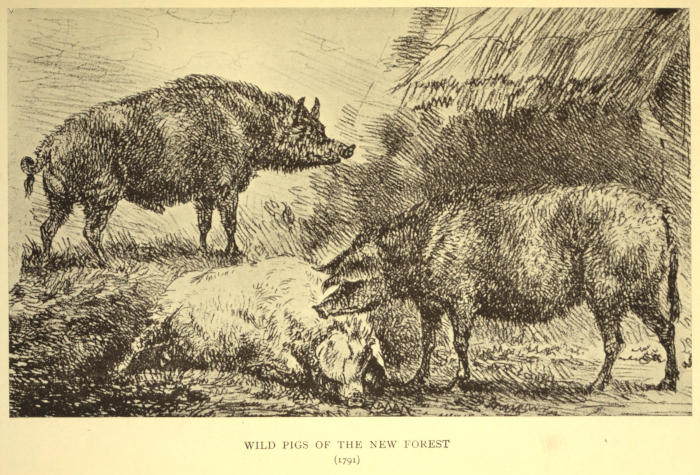
PLATE VII
WILD PIGS OF THE NEW FOREST
(1791)
Cattle.—The agistment of cattle in certain stretches of the forest, as well as their pasturing on particular lands, was usual throughout England. From an early date it was customary to [43]insist upon all such cattle being branded for identification. Thus, in the accounts of 1321-2 of Needwood forest occurs an item of 3d. paid for an iron for branding the cattle. It was, for the most part, the duty of the reeves of the forest parishes to mark with some distinctive sign the cattle entitled to feed upon the wastes. In the case of the Essex forest, the mark consisted of a letter surmounted in each case by a crown. The marking irons were usually eight inches in height; Mr. Fisher has given examples of a considerable number. Representation of the cattle marks of the different parishes of Pickering forest are given in Home’s Town of Pickering (1905).
Dartmoor was the most conspicuous example of a vast forest district given up chiefly to the pasturage of cattle. The accounts and court rolls, from the time of Edward III. to James I., give full details of the large amount of cattle turned out in each of its four divisions. They numbered at times upwards of five thousand head, and the charge right through this long period was 1½d. each. They came from all over Devonshire, and the annual great drives, to see their correct marking and numbering, are described in the section on that forest. “Drifts” of cattle for a like purpose also occur in the Needwood proceedings.
Several of the forest rolls from the time of Edward I. to Elizabeth, yield particulars of the vaccaries or great cowhouses with pasturage attached, which were on the royal demesnes, and were included in the forest accounts, whether under direct management or let out to farm. Instances occur in the cases of Duffield, Pickering, Clarendon, and Cheshire, and notably in the later history of Peak Forest.
It may here be noticed that the place-name Booth, by itself or in combination, is usually indicative of the site of the residence of those who acted as cowherds. This is particularly noticeable in the neighbourhood of Edale, Derbyshire, where there were five separate vaccaries in the time of Elizabeth.
Horses.—The agistment of a limited number of horses, and more particularly of mares with colts, was common throughout England’s forests. Records of their agistment in the parks of Duffield forest occur in the accounts of several centuries. It was generally recognised that they did more damage than cattle or sheep, and therefore their escape fines were heavier. Thus at a Belper (Duffield forest) woodmote court of 1304, [44]various offenders, presented by the foresters, paid 12d. as fines for suffering foals and mares to wander in the ward, whilst the fines for plough-cattle and sheep were from 3d. to 1d.
In subsequent particulars as to the Peak, reference will be found as to the establishment of stud farms within a forest area.
The ministers’ accounts of the issues of Pickering castle and forest in 1325-6 show that there was a stud (equicium) of two black stallions, called “Morel of Merton” and “Morel of Tutbury”; seventeen mares; six three-year-olds (pullani), four two-year-old colts (staggi); three two-year-old fillies (pultre); four yearling fillies (pultrelle); eight other young horses (pulli de remarencia); and ten foals from the mares (pulli de exitu).
Sheep.—A charter of Canute contains the grant of a right to feed a flock of sheep in a forest. At the Domesday survey there were a large number of sheep in parishes pertaining to the forest of Essex. But the Norman forest laws distinctly forbade sheep pasturing in forests without licence. The reason usually alleged for this restriction, as stated in a seventeenth-century action at law, was in respect of the dislike “which the Redd and fallow Deare doe naturallie take of the sent and smelle of the sheepe; as also for that the sheepe do undereate the Deare, and hurt and spoyle the coverte, and thereby prejudice and wrong the Deare both in their feeding and layer.” This, however, was flatly denied by the other side, who said that “dayly experience proveth the contrary; and that yt is an usuall thing to see a deere and a sheepe feed together in one quillet of ground, even upon one mole-hill together.”
When the tenants of Broughton, in Amounderness forest, Lancashire, claimed at an eyre of 1334 common pasture in the forest of Fulwood, sheep were excepted because they failed to produce any special grant for the pasturing of such animals.
In the later forest days, when the breeding of sheep in this country had greatly increased, grants for their admission into forests became much more common. The agistment rolls of Dartmoor forest for 1571-2, which had previously been confined to cattle and horses, include a considerable number of sheep, in flocks varying from three hundred to ten. The illegal introduction of sheep into Peak Forest in Elizabethan days, and their consequent wholesale impounding, is described [45]in a subsequent chapter. The freeholders of Needwood forest, in 1680, decided that sheep found pasturing in the forest were to be forfeited, and twelve shillings a day fine for each sheep!
Sheep-farming on the royal demesnes in districts associated with forests, and therefore found in forest accounts, occur occasionally, notably in the forests of Pickering and Peak Forest. The sheep are usually divided into wethers (multones), ewes (oves, or oves matrices), two-year-olds (bidentes), hogs, or male one-year-olds (hogastri), gimmers, female sheep from first to second shearing (jercie) and lambs. Milking ewes and the making of sheep-cheese was usual throughout mediæval England. Certain particulars relative to this custom will be found under the Peak Forest.
Goats.—The turning out of goats to pasture, even in the wildest parts of a forest, was unlawful; save in occasional very restricted areas, under express licence. By tainting the pasture, they effectually banished the deer. The Scotch law of the forest provided that if goats were found for a third time in a forest, the forester was to hang one of them by the horns on a tree; whilst for a fourth time he was forthwith to slay one, and leave its bowels in the place, in token that they were found there.
In the lodgment or adjudication of claims before the eyre, goats are often expressly excluded. Thus the prioress of Wykeham, at the fourteenth-century Pickering eyre, claimed common of pasture in certain woods and adjoining wastes for all animals except goats; and when not mentioned, they were certainly tacitly excluded. On the other hand, at the same eyre, the claims of Gilbert de Ayton to pasture goats in the moors and woods of Hutton Bushel, within the covert and without, at all times of the year, and of Ralph de Hasting in his woods and moors at Allerston, Cross Cliff and Staindale were allowed. Certain stray goats found in the forest of Mara, Cheshire, in 1271, were forfeited to the master forester. The tenants of Broughton, in the Lancashire forest of Amounderness, had common pasture granted them at Fulwood, in 1334, for all animals save goats. At a swainmote in Wyersdale forest, in the same county, held at Whitsuntide, 1479, eight transgressors were presented for keeping goats; the goats numbered forty-one, eight of which belonged to the prioress of [46]Seton. No fewer than fifty-six persons were presented at the Epping Forest justice seat of 1323-4 for keeping goats on the forest contrary to the assize.
When Henry III. was tarrying at Stamford in 1229, he was approached by the men on the royal demesne of Kingscliff and the neighbouring townships, complaining piteously that Hugh de Neville, the keeper of Rockingham forest, and his bailiffs prohibited them from turning out their goats in the forest of Cliff according to ancient custom. The goats must have been in considerable numbers, for the men asserted that they could not support their lives if this prohibition was sustained. The king thereupon ordered that they should be permitted to pasture their goats in the more open part of the wood (in clariori bosco), and wherever they would do the least injury to the forest.
[47]
The sixth article of the Charter of the Forest (1217) dealt with the old custom of the lawing of dogs. The inquisition or view of the lawing of dogs in the forest was for the future to be made every third year, and he whose dog was then found to be unlawed was to be fined three shillings. This mutilation of dogs, termed lawing or expeditation, to prevent them chasing the game, is said to be as old as the time of Edward the Confessor. By the forest law of Henry II. it was done to mastiffs. The charter of 1217 laid down that the lawing was to consist in cutting off the three claws of the forefeet, without the ball. “The mastive,” says Manwood, “being brought to set one of his forefeet upon a piece of wood eight inches thick and a foot square, then one with a mallet, setting a chissell two inches broad upon the three clawes of his forefoot, at one blow doth smite them cleane off.”
This lawing, though originally intended only for mastiffs, was usually applied to all dogs in forest bounds. This was certainly the case in the forests of Rockingham, Pickering, and Essex. The right to have unlawed dogs was not unfrequently granted by the Crown to persons of position and influence. Thus the Canons of Waltham, the Bishop of London, and the Dean and Chapter of St. Paul’s had grants exempting their house dogs in Essex forest; whilst the Earl of Arundel and other laymen obtained complete exemption. It was the custom in some forests, as at Pickering, for outlying townships to pay a composition, termed in that forest “hungill” or “houndgeld,” for the purpose of securing immunity from lawing.
The dog of most common occurrence in forest proceedings is the greyhound (leporarius), which hunted by sight. By the [48]Assize of Woodstock (1184), the keeping of greyhounds in the forest was forbidden. In the cases of venison trespass throughout the forests of England, the illicit hunting of deer with greyhounds, with or without bows and arrows, is the commonest charge. The last chapter of the Regard of 13 Henry III. directed inquiry to be made as to who had braches or greyhounds or anything else for doing harm to the king’s deer. Lists of those keeping greyhounds are sometimes found amongst the extant eyre rolls. Greyhounds found in a forest, or straying in pursuit of deer, were sent forthwith to the particular justice of that forest. Thus a number of greyhounds in the charge of poachers, found in Rockingham forest in 1246, were sent by the foresters and verderers to Sir Robert Passclew, then justice of that forest. It is thought that the old greyhound was a larger and more powerful dog than that which we know by that name, and more nearly resembled our deerhound. Dr. Caius (English Dogges, 1576) applies the word to various breeds. He describes the greyhound as—
“A spare and bare kinde of dogge (of fleshe but not of bone); some are of a greater sorte, and some of a lesser; some are smooth skynned, and some are curled; the bigger thereof are appoynted to hunt the bigger beasts, and the smaller serve to hunt the smaller accordingly.”
Brache (brachettus) was the general term for hounds that hunted by scent (odore sequentes), and the bercelet (bercelettus) was a smaller hound of the same kind. The limehound (limarius) also hunted by scent, and the name may have been but an alias for a bercelet. The limehound, or lymer, as it is termed by Twici and Caius, took its name from the line or thong by which it was held. Caius says this dog is in smelling irregular and in swiftness incomparable, and that it taketh the prey “with a jolly quickness.”
The mastiff (mastivus) is of fairly frequent occurrence in forest proceedings of the thirteenth and subsequent centuries; it seems to have corresponded to our dog of the same name. It was large and strong, and evidently employed chiefly for the protection of property and person. It was used for the destruction of wolves, and was capable of hunting and pulling down both red and fallow deer.
[49]
Strakur was the name of a kind of dog in favourite use among Cumberland deer-poachers, according to an eyre roll of 15 Edward I. But it was not merely a North-country word, for we have met with it twice in Wiltshire forest proceedings.
Velters (valtri, veltri, or vautrarii) were running hounds akin to but separate from the old greyhound. Blount says that it was a mongrel hound used for the chase of the wild boar.
In addition to the rough division of dogs of the forest into those that hunted by sight and those that hunted by scent, terms are commonly found, in the forest proceedings, for dogs that hunted different kinds of game. Thus those that were used for hunting the red deer were termed cervericii canes, or hart hounds. They were a breed of running hounds, and were not used exclusively for hart hunting. In the fifteenth century the king had a master of hart hounds.
Damericii canes were the buckhounds for hunting the fallow deer. Small packs of these buckhounds are frequently mentioned as accompanying the royal huntsman of Henry III. and Edward I.
The roe deer were occasionally hunted, and canes cheverolerez are mentioned several times as being sent to forests by King John. On one occasion Adam, his huntsman, was accompanied by a pack of seventeen roehounds, and on another by one of twenty-four.
Porcerecii canes is obviously the name of hounds used for hunting wild boars. We have met with the term in several rolls of John, Henry III., and Edward I., among dogs dispatched to the royal forests.
Lutericii canes is the equivalent for otterhounds. Mr. Turner cites their occurrence in a wardrobe account of 18 Edward I. They are also mentioned in the same reign in the Peak Forest, and occur in connection with Clarendon forest in the fifteenth century.
Haericii canes denoted a particular kind of running hound, and is usually rendered “harriers.” There is said, however, to be no real philological connection between the term and hares, and they were certainly used in hunting deer, as is abundantly proved by Mr. Turner.
Dogs are frequently distinguished by their colour in cases [50]of venison trespass. In the case of a Rockingham trespass of 1246 with five greyhounds, one was white, another black, a third fallow, a fourth black-spotted, and the fifth tawny (teyngre). Other terms for greyhound colour in forest proceedings are ticked (tetchelatus), tiger-marked or brindled (tigrus), and red (ruffus and rubens). In a presentment of the Lancashire forest of Quernmore a greyhound is described as being red with a black muzzle (cum nigro mussell). Occasionally a dog’s name is entered on the proceedings, as was the case with a certain black greyhound in Peak Forest, called “Collyng.” The name occurs in poaching charges at two different courts.
The early treatises on hunting pay great attention to the diseases of sporting dogs and their general treatment.
Frequent mention will be found in subsequent chapters of the general custom of allowing local foresters to kill one or two deer a year, when training their young dogs.
In Sir Henry Dryden’s edition of Twici (vide infra), there is a brief appendix on the various kinds of dogs used in hunting. He gives a plate, here reproduced, of outline sketches of dogs from illuminations of Gaston de Foix’s French treatise. Fig. 1 is the alant, or kind of mastiff, described as running swiftly but also following by scent. It was used in France chiefly for bears and boars. On account of its ferocity, it was generally kept muzzled. Fig. 2 is a gazehound, or greyhound. Fig. 3 is a lymer, or limehound, with hanging ears something like a bloodhound. Figs. 4 and 5 picture the brache or rache. This is usually represented in Gaston’s pictures as black and tan. It corresponded to our beagle.
The old seasons for forest hunting are almost invariably given wrongly in works or articles dealing with the subject; the errors were usually made through imagining that the English seasons coincided with those prevailing on the Continent. The true hunting times can, however, be gathered from original forest proceedings.
Pinguedo was the term for the season of hunting the hart and the buck when they were fat, or, to use forest jargon, “in grease”; it extended from 24th June to 14th September.
Fermisona, or fermisone, was the period for hunting the hind and the doe, which lasted from 11th November to 2nd February. The summer hart or buck venison was considered much more of a delicacy than the winter hind or doe venison.
[51]
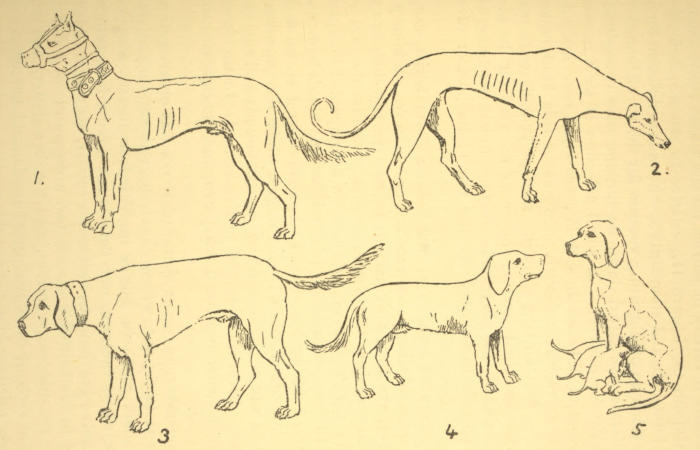
HUNTING DOGS. DRYDEN’S TWICI
[52]
There are a variety of entries on the Close Rolls from the time of John to Edward II., relative to the dispatch of the king’s huntsmen and attendants and hounds to different forests, for the purpose of obtaining venison for the royal household; most of this was salted down on the spot and committed to the sheriff for delivery. A small selection of such cases, of the reigns of Edward I. and II., are cited here instead of under the respective forests. Entries of this kind make it quite clear that no large hunting staff or kennels were maintained in the actual forests; they were reserved for the king, and occasionally for his friends, the local foresters having only a few hounds in training for the use of the master of the forest.
On December 13th, 1275, Matthew de Columbariis, keeper of the forest of Clarendon, received orders to permit Henry de Candover, the king’s huntsman, to take twenty does for the king’s use against Christmas, and to give him due aid and counsel; certain of the king’s yeomen accompanied the huntsman. In 1280, when Philip de Candover was king’s huntsman, he received during his visit to Clarendon forest 2s. 6d. a day from the sheriff of Wilts for his wages, whilst the expenses of his horses and of the pack of twenty-six hounds and their two keepers (or berners) amounted to £18 13s. 4d. In the following year the pack numbered thirty-two, and the expenses were £24 15s. 1d.
In November, 1313, the sheriff of Berks was ordered to pay to Robert le Squier, whom the king was sending to take eight hinds and six bucks in Windsor forest, with two berners, three ventrers, one berceletter, twenty-four running dogs, twelve greyhounds, and two bercelets, his wages, during his stay in his bailiwick, to wit 12d. a day, and 2d. a day for each of the berners, ventrers, and the berceletter, and 1½d. a day for each of the dogs, greyhounds, and bercelets. He was also to deliver him salt for the venison, and carriage for the same, to the king. There was another order to the sheriff of the like kind in June, 1314, and in July, 1316.
Edward II., in July, 1315, issued his mandate to the sheriff of Devonshire to pay to Robert Squier and David de Franketon, [53]two of the royal yeomen, wages of 12d. a day, two berners and two ventrers 2d. a day, together with ½d. a day for each of twenty-four running dogs, and 1½d. a day for each of nine greyhounds, whilst they hunted for the king in Dartmoor Forest. He was also to provide salt and barrels, and carriage for the venison. At the same time, the keeper of Dartmoor Forest was ordered to permit Robert and David to take twenty harts.
In July, 1315, Edward II. (after giving like instruction to the sheriff of Somerset with regard to the forests of Neroche, Petherton, Mendip, and Selwood) ordered the sheriff of Devon to pay to the king’s yeomen, Robert Squier and David de Franketon, whom the king was sending with two berners, twenty-four running dogs, two ventrers, and nine greyhounds, to take venison in the forest of Exmoor, 12d. a day each whilst thus engaged, together with 2d. a day for each of the berners, and ½d. a day for each of the running dogs, and 2d. a day for each of the ventrers, with 1½d. a day for each greyhound. He has also to provide the yeoman with salt and barrels for the venison, and to provide for the carriage of the same. At the same time the keeper of Exmoor received orders to permit the king’s huntsmen to take twenty harts out of the forest. Exmoor was evidently at that time the exclusive haunt of the red deer; the keepers of Neroche, Selwood, and Petherton were ordered to supply so many bucks (i.e. fallow deer), whilst the keeper of Mendip was to supply twelve bucks and twelve harts.
The berner (bernarius) was the title of the man in charge of running hounds; the ventrer or fewterer (veltrarius) had charge of the greyhounds; and the berceletter was responsible for the bercelets or hounds that hunted by scent. The reason for salting down the venison was because of the difficulty of obtaining fresh meat in the winter season, when root crops were unknown, and the expenses of fodder for all kinds of cattle were so serious. In a few of the forests large larders were maintained, for the express purpose of salting the venison when the summer season of hunting was over. In such cases there was, of course, no necessity to order the sheriff to see to the salting or pay for the carriage of the meat to the royal household. There were such larders in Duffield Frith and in Needwood forest. An example of a year’s accounts, containing [54]references to the local salting, and to the general distribution of the venison, are here given.
The master forester of Needwood, for the year 1313-14, was John de Myneers. His venison accounts for the year show that 95 fat bucks and 12 does were killed in the twelvemonth. Ten of the bucks served for the king’s hospitality at Tutbury, ten more were sent to the king at Melburne, and twenty-three bucks and six does to the king at Castle Donnington. Six does were sent to Bagworth for the hospitality of Robert de Holand. Twenty-one bucks were distributed, on the king’s warrant, to John de Ashborne, Walter de Montgomery, and ten other gentlemen. The remainder were salted down for winter use in the larder. The master forester’s accounts include 19s. 5d. for 4 qrs. 6 lbs. of salt for the larder, whilst 4s. 4½d. were paid as wages of the larderer for five weeks’ work.
Nicholas de Hungerford was at the same time (1313-14) master forester of Duffield Frith. His general accounts for the forest showed receipts of £15 16s. 0½d. Of this amount £9 2s. 6d. was paid in wages, 16s. 8d. for salt for salting the venison, and 1 stag and 31 bucks and does in the forest larder at Belper. The deer taken this year, by order of the master forester, under the warrants of the Earl of Lancaster, were 1 stag, 41 bucks, and 25 does. In addition to this, Lord Robert de Holand—the foundations of whose great moated house still remain within the Hulland ward—was allowed to take 20 bucks for the earl’s larder. The master forester paid 9s. 8d. for the carriage of 33 bucks from Belper to Kenilworth, and 14s. for the carriage of 12 bucks from Belper to Castle Donnington, and 4 bucks to Melburne, in accordance with letters from the earl.
It was the custom in every forest to cut what was usually termed browsewood or clear browse for the sustenance of the deer in the winter season. The references to this practice are innumerable and interesting throughout almost every class of forest proceedings. Manwood says:—
“When there is not sufficient foode for the deere, neyther of grasse nor of such fruites, then the forresters that have the charge of the wild beasts, must provide browsewood to be cut downe for them to feed upon.”
[55]
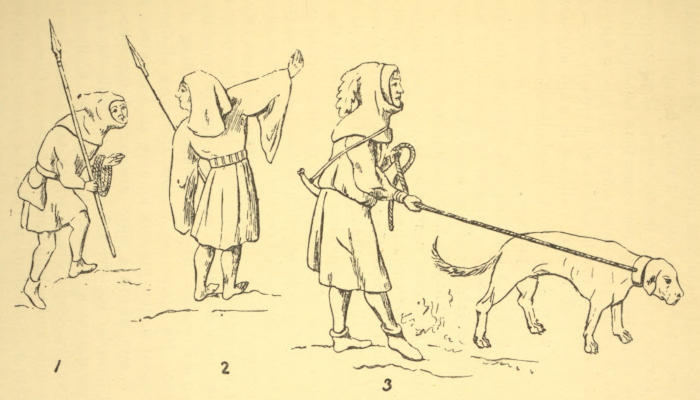
BERNERS OR HARBOURERS. FOURTEENTH CENTURY
[56]
He also states that the lord of a forest might enter, by his officers, into any man’s wood within the forest limits, to cut such browsewood for the deer in winter. It was usual to cut it in the late autumn, and store it ready for sprinkling about when the severe weather or frosts came. It was supposed to be cut from twigs that were not more than an inch in circumference, nor heavier than a deer may readily turn up with his horns. In all forests the browsewood seems to have chiefly consisted of oak twigs; but evidence is cited showing that holly and ivy, as well as maple, hazel, thorn, and ash were occasionally used for this purpose.
In the more favourite royal forests, such as Rockingham, Clarendon, and Windsor, a certain amount of hay was also used for the winter feeding of the deer at an early period, but in later forest history hay-feeding became commoner.
Everything in the forest was made to give way to the deer, and where hedges or enclosures of any kind were permitted for the cultivation of crops, they had always to be constructed sufficiently low to allow of the ingress and egress of the deer.
The owners of lands adjoining the forest were in the habit, if they had a grant of imparking, of making certain contrivances called deer-leaps or salteries (saltatoria). These were so contrived that the deer could readily leap into the park over a fence of moderate height, but were prevented from returning by a steep upward slope in the ditch inside the park fence. Occasionally such deer-leaps were deliberately constructed in parks within a forest for the convenience of catching or herding the deer. But there are various instances of deer-leaps being presented to the justices in eyre as a nuisance to the forest. If it was within a short distance of the forest, they had power to order its removal. At the Cumberland eyre of 1285, a presentment was made that Isabel of Clifford had a park with two deer-leaps, one of which was a mile (leuca), and the other a mile and a half from the forest of Quinfield. At an inquisition at Somerton, in 1364, the jurors complained of two deer-leaps three miles distant from the forest, as detrimental to the king’s game and contrary to the assize of the forest.
Buckstalls, etc.—There are various references in forest proceedings to buckstalls. A buckstall was an extended trap or [57]toil for deer, of which nets usually formed a component part; but the definition generally given—“a net for taking deer”—is not sufficient. Earth ramparts and wattled work were also generally used in its construction; it was, in fact, a kind of cunning enclosure wherein the deer could be taken alive, as is implied in the term deer-hay. A “buckstalle vel dere-hay” is named in presentments of Clarendon forest.
Matthew de Hathersage, a baron, was presented at the eyre of 1251 for having a buckstall in his great wood at Hathersage, which was distant barely two bow-shots from the king’s forest of the Peak. The baron pleaded that his ancestors had always had a buckstall in their wood, and that formerly it was still nearer to the bounds of Peak Forest. The upshot of the matter was that the decision went against Matthew, who had to pay a fine of twenty marks.
The master forester of Duffield Frith was instructed to see that there were no buckstalls set upon the borders of that forest, and the ministers of each ward were enjoined to present at the woodmote the setting of “any haye or buckstakes, trappes, or springes for deere.”
Among the claims at the Pickering eyre of 1334, the prior of Malton claimed that he and his men were quit of all buckstall service, which he explained to mean a duty laid on all other forest residents of assembling for the purpose of collecting the deer into an enclosure which they have to make for that purpose, and failing, are heavily fined. The prior failed, however, to make this part of his claim good. The prior of Ellerton at the same time claimed a like exemption from buckstall attendance, and on the production of a charter of Henry III. his claim in this respect was allowed.
An instance occurred at the forest pleas of Pickering in 1488, in which the term buckstall was used simply for snaring-nets. It was then presented that one Thomas Thomson, a yeoman, with a number of unknown persons, entered Blandsby park at midnight with a horse laden cum retibus vocatis buckstalles et ropes, killing about twenty does. An Act of Parliament, a few years later, prohibited anyone who was not the owner of a park, chase, or forest, using a buckstall under a penalty of £10.
There were various devices, apart from the buckstall or [58]enclosure, used for the snaring of deer. In 1246, the forester of Brigstock park, Rockingham forest, found two men setting five snares of horsehair for taking fawns or hares. The men were taken before the verderers, and gave pledges to appear at the next eyre. In 1251, a trap was found set in the same park. Robert, chaplain of Sudborough, was suspected, and on his house being searched the woodwork of a trap with the cord broke was found; on the cord was deer’s hair. In 1255, a snare, consisting of four cords stretched round a dish of water, was found in the wood of Bassethawe (Rockingham). The foresters watched all night to see if anyone would come, but in vain. On the following day an inquisition was held by the four neighbouring townships, before the stewards of the forest and one of the verderers. Sir Robert Basset, the owner of the wood, found twelve pledges to produce Peter, the forester of the wood, whenever required; the cords were handed to the verderer to produce at the next eyre, and the wood of Bassethawe was taken into the king’s hands.
The commonest kind of deer snares seem to have taken two forms, occasionally both combined; the one was the intertwining of cords between stout stakes in the midst of a usual deer track, and the other the suspending of halters or looped ropes in the trees overhead to catch the deer by their heads or horns. In 1260, five workmen employed in Guildford park in mending the pales and cutting down oaks for that purpose, set cords to entangle the deer that came to feed on the fresh oak leaves. The cords were found by the park-keepers, and the men bound over to appear at the next eyre. There was an interval of ten years before an eyre was held, and meanwhile two of the delinquents had died. The justices, in 1270, fined the other three half a mark each.
Two labourers in Duffield Frith were committed, in 1321, by the verderers to appear before the justices to answer a charge of having set cart-ropes in an opening in the pale fence of Shottle park, with halters suspended in the trees overhead. There is another instance of a like snaring of deer, with a cartrope and smaller cart gear, at Weybridge, Hunts, in 1455.
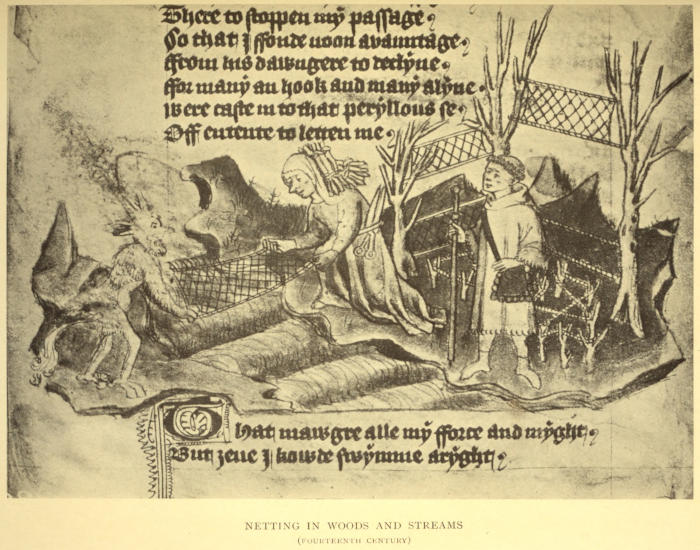
PLATE VIII
NETTING IN WOODS AND STREAMS
(FOURTEENTH CENTURY)
The venison indictments at the New Windsor eyre of 1488, included a charge against Thomas à Clowe, of Clewer, and [59]four others, of having fixed halters (capistra) and other snares in a place called Brodeles, and there with a halter caught, suspended, and killed a doe, whilst others after a like fashion had killed a red deer’s fawn. They were convicted, and ordered to appear before the justices at Westminster within fifteen days.
The forest proceedings at the Waltham swainmotes of the seventeenth century mention various devices then in use in Essex for the killing of deer, such as “engines called wyers, engines made of ropes, withes, dear-hays, buckstalls, and tramels, and other nets.” Mr. Fisher tells us that one of these nets, described as a “thief net,” was baited with bottles, flowers, and looking-glasses; an apparatus designed to practise upon the curiosity of the deer. One man was presented for pitching halters about a grove; another for “hanging a lyne in a creepe-hole to ketch a deer.”
Among the Cotton collection of the British Museum (Tib. A. vii.), is a fourteenth-century illuminated manuscript called The Pilgrim. The pilgrim meets with every variety of temptation at the hands of the devil. Entering a forest district, he is tempted by the Evil One to catch both fish and game, and is taught how to net and snare both river and woods. The picture of this incident (Plate VIII.) gives a realistic idea of the commoner forms of deer snaring.
Cheminage and Fence Month.—It has been disputed whether the term “cheminage”—that is to say, way-leave or passage through a forest in return for payment—was ever used apart from the fence month. In particulars to be inquired into by the jury of the Duchy of Lancaster, in the honour of Pickering, one of the articles runs:—
“Whoe receiveth the Chiminage yearlie within the foreste, namelie, a tax upon cartes and cariages, traveylinge over the foreste in fence moneth, formerlie sometimes xiiis. iiiid. per annum, sometimes more?”
Nevertheless, at various dates, the term “cheminage” is frequently used without any limitation to a particular month, and is perhaps best defined as a toll for wayfarage through a forest.
The chymynagium of Duffield Frith pertained to Robert [60]Ferrers, Earl of Derby, in the reign of Stephen. Henry II. granted cheminage throughout the whole forest of Pickering to the burgesses of Scarborough, a right confirmed on several subsequent occasions.
The fourteenth section of the Charter of the Forest, 1217, provided that it was only a forester-of-fee who had a right of cheminage, namely, for carriage by cart for the half-year, 2d., and the same for the other half-year; for a horse that bare loads, ½d. the half-year. But this fee was only to be taken of those who came as merchants from outside foresters’ bailiwick; cheminage was not to be taken for any other carriage by cart. Those who bore on their back brushwood, bark, or charcoal, though it was their living, were to pay no cheminage to the king’s foresters unless they took it in the royal demesne woods.
The confirmation granted by Henry III. in 1256, to the burgesses of Scarborough, stated that they were to be quit of cheminage throughout the whole forest of Pickering, so that they might carry timber, brushwood, turf, heather, fern, and all else freely, wherever and whenever they pleased, except during the fence month. The priors of Malton and of Ellerton established their claims to be free of any payment, great or small, for the passage of their loaded carts, wagons, or pack-saddles throughout Pickering forest. The hospital of Cricklade had a like exemption in the Wiltshire forest of Braydon.
The fence month, or in Latin mensis vetitus, which lasted from fifteen days before Midsummer to fifteen days after, was the special time when the deer required quiet and protection, for it was just about the usual time for fawning. The whole principle of cheminage was to prevent forest roads being freely used, so as to check disturbance of the king’s game. These precautions were naturally redoubled during this particular season. In several forests agistment of pigs, and sometimes of cattle and horses, was permitted during the fence month, but in all such cases the agistment fee was very largely increased. So too with cheminage.
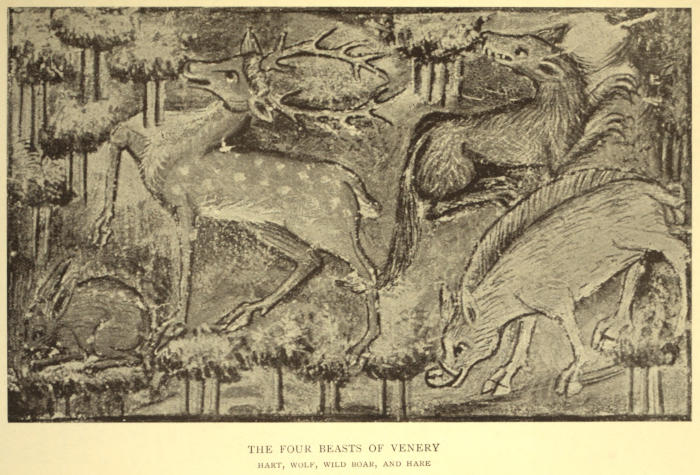
PLATE IX
THE FOUR BEASTS OF VENERY
HART, WOLF, WILD BOAR, AND HARE
In certain forests the money for way-leave was materially increased during that month; whilst in some cases, as at Cranborne Chase and in Pickering forest during its later period, such fees were only collected during that time. It was also customary in some forest districts, as at Rockingham, to allow [61]the different townships within the forest to be rated at a certain sum, in proportion to the number of their carts, for way-leave during the prohibited period. In the stricter forests all passage for carts, etc., was absolutely forbidden to all outsiders in this month.
A toll of 4d. for every cart or wagon, and a 1d. for every packhorse crossing over Harnham Bridge, near Salisbury, into Cranborne Chase, was paid as a check upon travelling during the fence month, as late as the early part of last century. This toll was collected by virtue of a warrant from Lord Rivers, and during the month a pair of deer’s antlers were fixed on the bridge as a warning to travellers.
Hunting Treatises.—Twici’s Le Art de Venerie, written in Norman-French, is the oldest book on hunting in England. William Twici was huntsman to Edward II., and wrote this short treatise, circa 1325, at the end of the reign. There is a record on the Close Rolls of July, 1322, of Twici being sent by the king to the forests of Lancaster to take fat venison, with a larderer, two berners, four ventrers, a page, twenty greyhounds, and forty harthounds; the sheriff was to pay Twici 7½d. a day for his own wages, 2d. a day to each of the berners and ventrers, 1d. a day to the page, and ½d. a day for each of the hounds. From a later Close Roll entry we find that William Twici died, as a royal pensioner, in the abbey of Reading in the spring of 1328. It may therefore fairly be assumed that he wrote his short treatise when in retirement at Reading towards the close of his life.
An early English version of this tract, wherein the name of John Gyfford is associated with Twici, is among the British Museum MSS. (Cott. MSS. Vesp. B. xii.). This was privately printed by the late Sir Henry Dryden, Bart., in 1843, with introduction, notes, and illustrations, making a book of eighty pages.
The Master of Game, written between 1406 and 1413 by one of Edward III.’s grandsons, Edward, the second Duke of York, is a translation from the French of the celebrated hunting-book Livre de Chasse. The author of this French treatise was Count Gaston de Foix, who began to write it on 1st May, 1387. Of the thirty-six chapters of The Master of Game, only the last three, and a paragraph at the opening of the first chapter or [62]prologue are original. The titles of the last three chapters are: (1) “How the hert shuld be snaryd with the lymer, and ronne to and slayn with strength”; (2) “How an hunter shuld seke and fynde the hare with rennyng houndes, and slee here with strength”; and (3) “Of the Ordinaunce of the maner of hundyng whan the king wil hunt in foreste or parke for the hert with bowes, greyhoundes and stable.” It will therefore be seen that, interesting as this translation of a French book is, it throws but little, if any, light on ordinary English hunting and forest customs, for that which it does state in the words of the Duke of York, only applies to the formal hunting of the Court on a grand scale. It is the lack of knowledge of original and contemporary forest proceedings in England that has led so many writers astray. When purporting to write about England, they have really been writing about France, and the Continental customs relative to forests and forest hunting differed as widely in mediæval days from those in use in our own country, as does “sport” in the two countries at the present time.
The best manuscript of The Master of Game is the one in the British Museum (Cott. MSS. Vesp. B. xii.), written about 1440. It is from this copy that several of the illustrations of this volume are taken.
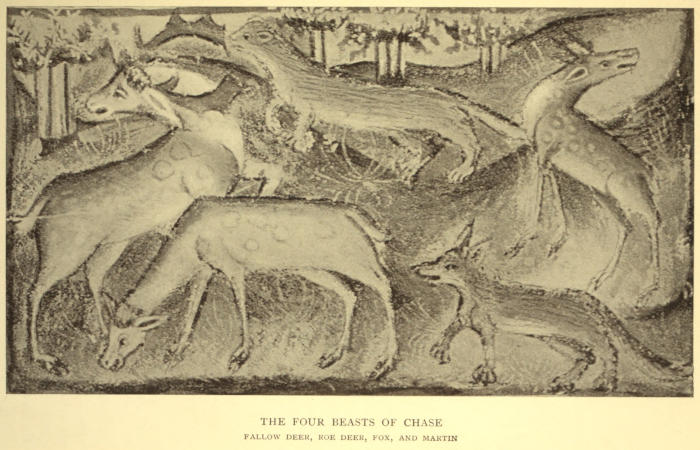
PLATE X
THE FOUR BEASTS OF CHASE
FALLOW DEER, ROE DEER, FOX, AND MARTIN
Prefixed to this manuscript is the English rendering of the Twici tract (first printed in Wright and Halliwell’s Reliquiæ Antiquæ in 1541), whilst the two opening folios contain the following rhymes, the work of the fifteenth-century transcriber, which are rendered more valuable by the three small groups of wild animals of English forests, here reproduced:—
In the light of these rhymes and their classification of the wild animals, it at once becomes apparent whence Manwood derived his misleading lists, so continuously cited, of (legal) beasts of the forest and of the chase.
The four beasts of venery—the hart, wolf, wild boar, and hare—were sylvestres; that is, they spent their days in the woods and coppices, and were taken by what was considered true hunting, being tracked and roused by the lymers or lymer hounds, and afterwards pursued by the pack (Plate IX.).
But the fallow and roe deer, with the fox and martin, were beasts of chase; that is, they were campestres, or found in the open country by day, and therefore required none of the niceties of tracking and harbouring in the thickets, but were roused straight away by the packs of hounds (Plate X.).
The third group, neither of venery nor chase, were the badger, wild cat, and otter (Plate XI.).
The Boke of Saint Albans is the earliest English printed treatise on hunting. It was first issued at St. Albans in 1486. The author, according to the second edition, was Dame Julyana Bernes. Two other tracts, the one on hawking and the other on heraldry, were published with it, whilst to the second edition (1496) was added a fourth tract on fishing. This rhymed account of hunting is based partly on Twici and partly [64]on the Duke of York’s version of Livre de Chasse; it possesses no originality.
The Noble Art of Venerie or Hunting, by George Turbervile, of which the first edition was issued in 1575 and the second in 1611, is almost a literal translation of Jacques du Fouilloux’s La Venerie, first printed in 1560. The illustrations are also identical with those of the French work, save for one or two exceptions, and several of them are made to do service more than once with different headings. The book is only of small service as an exponent of English hunting customs.
Sir Thomas Cockayne’s Short Treatise of Hunting is a very rare and delightful tract of thirty-two pages, published in 1591. It is most genuinely English throughout, and gives the writer’s own experiences of the different kinds of hunting then prevalent. He recommends that roe deer should be hunted from the beginning of March till Whitsuntide.
The seventeenth century supplied two works of some celebrity on the sport of hunting. That prolific writer, Gervase Markam, brought out the first edition of Country Contentments in 1615, wherein hunting holds the foremost place. Before the end of the century this work had passed through fifteen editions. The second was The Gentleman’s Recreation, compiled by Richard Blane, a literary hack, and first issued in folio in 1686. Its chief value is in the plates, which aptly illustrate the sporting costume of that period.
In the eighteenth century books and essays on hunting multiplied; but the one memorable production, first printed in 1781, was Beckford’s charming and scholarly work, Thoughts upon Hunting.
Hunting Costumes.—One of the most valuable features of Sir Henry Dryden’s annotated Twici is the discussion on the costume of foresters, huntsmen, and their attendants. The plates illustrative of their dress are borrowed from that rare little treatise. Royalty and the nobility hunted on horseback, wearing their usual riding dress, as is evidenced by a great variety of illuminated manuscripts. The king’s huntsman was also usually mounted, and there was generally one riding forester to each forest; but the ordinary class of huntsmen, berners, varlets, etc., were on foot. In the thirteenth century they are generally represented (p. 182) as wearing close-fitting caps, [65]and tied under the chin; they were probably of leather, not of cloth, as suggested by Sir Henry Dryden. Their long loose robes seem unsuitable for active work, but they were perhaps more closely girt for action than artists cared, with an eye for flowing lines, to represent them. The foremost, with horse, represents the huntsman, and his attendants carry respectively a boar-spear and a longbow.
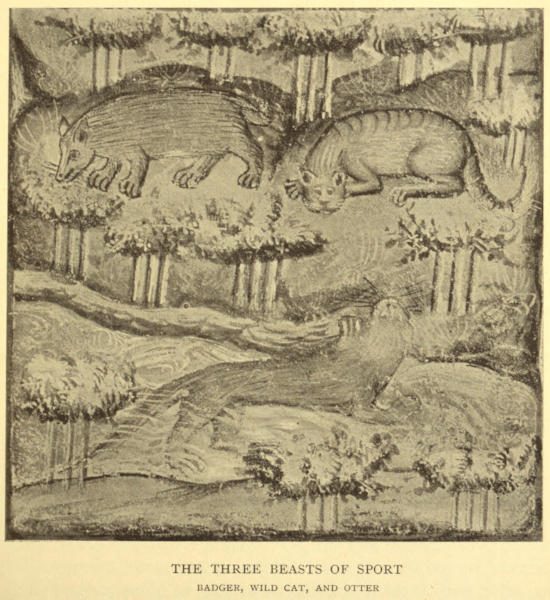
PLATE XI
THE THREE BEASTS OF SPORT
BADGER, WILD CAT, AND OTTER
The two figures of the fourteenth century (p. 238) are taken from the representation in Stothard’s Monumental Effigies of the highly interesting wall-painting, now almost obliterated, at the back of the canopied recess over Sir Oliver Ingham’s tomb at Ingham church, Norfolk. He died in 1344. Both figures wear cowls, or caps and short capes in one. In shape they resemble the camail in armour of that period; and they were probably of cloth, as they were coloured green in the painting. The short jupon of the figures on the left, also coloured green, is open at the sides to the hips, where a few buttons close the upper part of the slit. The legs were grey in the painting, and were probably worsted trunk-hose. The brass-studded bawdrick was of red leather. Four arrows show from a quiver worn at the back, and the longbow is held in the left hand. The attachments of the horn to the bawdrick and of the quiver to the body is not shown, and had probably disappeared when the drawing was made. The figure on the right, in the act of stringing his bow, is attired after much the same fashion, but he wears a longer coat buttoned down the breast, also painted green, and round the waist is a brown leather quiver belt.
The fourteenth-century figures on page 55 are taken from an illustration in the Phillipps MSS. copy of Gaston de Foix, and show a considerable similarity between the hunting costume of England and France. Figure 1 in this picture, having unharboured a buck, has coiled the lymer’s cord round his arm; a white leather scrip or bag is attached to a black belt; the coat is green, and the camail and stockings red. Figure 2 is a berner, dressed much the same as the harbourer, but having wide sleeves to his coat. Figure 3 represents a berner or harbourer on his walks in the wood with lymer and cord; his coat is green, and his red cowl has a dagged ornamental appendage.
[66]
At Newland, Gloucestershire, is the defaced fifteenth-century coarse stone effigy of Jenkin Wyrall, forester-of-fee in Dean forest, who died in 1457.
The two illustrations given of this tomb show the forester wearing a peculiar loose cap, folded in plaits and knotted at the top. He wears a loose frock or jupon, with full sleeves and a short skirt, trunk-hose, and low boots. The horn on the right side is small, whilst on the left side is slung, by double straps, a short hanger or hunting sword. His feet appropriately rest on a brache or hound.
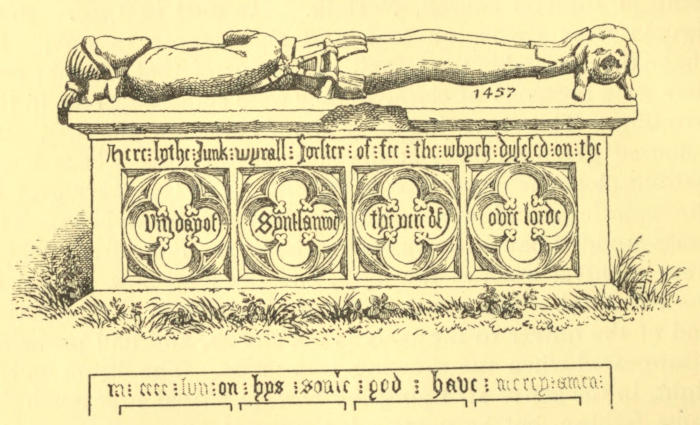
WYRALL EFFIGY
Sir Henry Dryden was mistaken in considering this “the only effigy of a forester in hunting costume in England.” In the church of Skegby, near Mansfield, is the fourteenth-century stone effigy of one who must have been a forester-of-fee or some forest minister of Sherwood forest. The photographic plate (No. XIX.) gives a vivid picture of his dress. He wears a close-fitting cap, probably of leather; the tight-fitting sleeves of his inner jerkin show at the wrists through the short hanging sleeves of the outer garment, and over it he wears a tippet that had doubtless a cowl at the back. A hunter’s horn hangs at the right side, suspended from a strap over the left shoulder. The feet rest on a hound.
The quaint figures on page 89 are drawn from scenes in pargeting work on the George Inn, Forster’s (or Forester’s) [67]Booth, Northumberland, dated 1637, on the edge of the old forest of Whittlewood. The man in front with a spear is leading a fox by a chain which his greyhound has caught, whilst the dog is coursing a hare. The other man is blowing the mort at the capture of a hart by a brache. The dress may be left to speak for itself. Unlike the other figures illustrated, both men wear leather gauntlets.
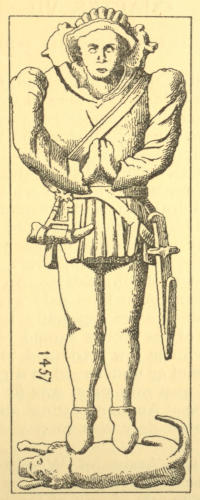
WYRALL EFFIGY
[68]
After the end of the glacial period, the first of the trees to obtain firm lodgment in the soil would be the hardiest kinds, such as the birch, elder, aspen, and willow, together with the more sturdy shrubs, such as the holly, juniper, blackthorn, whitethorn, and gorse. As time advanced, the more gregarious kinds, such as the oak and hazel, so abundant among the fossil flora, would follow; whilst other trees, such as the beech, ash, hornbeam, and sycamore would gain foothold in their respective localities. Most of the other trees that have been for many centuries of common occurrence in this country, such as the English elm, sweet chestnut, lime, and poplar, were introduced during the Roman occupation.
Our earliest known forest laws paid great attention to the preservation of timber, more especially lest their destruction or the disturbance of the woods should be prejudicial to the king’s game. The forest law attributed to Canute states that anyone touching wood or underwood in a royal forest, without the licence of the forest ministers, was to be held guilty of a breach of the chase. Anyone cutting an oak or other tree that bore fruit for the deer was to pay 20s. to the king in addition.
Henry II., by the Assize of Woodstock, ordained that foresters were to be held responsible for the destruction of demesne woods. The sale of any of the king’s wood without warrant was prohibited.
In most forests, tenants, as well as privileged persons in the vicinity, had limited rights to housebote, haybote, and firebote, or to one or more of these privileges; that is to say, wood [69]necessary for maintaining their houses, mending their hedges, and supplying their hearths and ovens with fuel. Thus, in addition to the claims of ordinary tenants, the abbot of Darley, the parson of Duffield, the parson of Mugginton, the heirs of Peter Nevill, the heirs of Cardell, the heirs of Bradburn, the heirs of Kniveton of Mercaston, the heirs of Bradshaw, and the heirs of four other families all claimed and used the liberty of having housebote, haybote, and firebote in Duffield Frith.
With regard to the question of the vert of the forest, sometimes called by the picturesque English term of “green hue,” it included all trees, whether bearing deer fruit (such as acorns and beech mast) or not, as well as underwood. That which grew in the demesne woods of the king was, according to Manwood, “special vert,” and the damaging of it was a greater offence than the interference with other vert in private woods within the forest; but of such distinctions the records of the local courts or eyres contain but little trace. In all cases, however, the penalties were more severe on those who dwelt outside the forest. Anyone using wagons to take timber out of demesne woods not only incurred a fine in proportion to the value of the timber, but, if the offence was repeated, also forfeited both wagon and team. Instances of this are cited in the account of Pickering forest.
In 1287, as stated subsequently in chapter xvi., the justices drew up special vert by-laws for Sherwood forest, which are of much interest and precision.
If the regarders reported that a wood in private hands had been wasted, the Crown had a right to take it into its own hands, provided the justices in eyre confirmed such presentment. There are various instances of the Crown seizing such woods in the forest of Essex during the reign of Edward I.; and in 1323 the prior of Bermondsey had his wood seized by the Crown on account of waste. Such woods were usually redeemed on payment of substantial penalties.
The connivance of forest officers in vert offences was frequently brought before eyres by the reports of the regarders, notably in the case of Pickering.
The oak, as might naturally be supposed, was the chief forest tree in every part of England, and its timber was the most valuable. The special grants of timber from royal [70]forests that were so frequently made by our kings, from John to Edward III., almost invariably specify that the wood was oak. Such grants were largely made to religious houses, both for their conventual buildings and their churches; they were also made from time to time for the repairs or the erection of mills, bridges, castles, and manor houses. The trunks of these oaks were, for the most part, sent whole to the recipients, but occasionally the master forester had orders to supply so many rafters, joists, tie-beams, or other roof timber ready for use, and not infrequently shingles ready-trimmed for roofing, or trees suitable for such a purpose. The selection of the trees for timber purposes was usually left to the master forester or keeper; but in some cases, particularly where a river ran through a forest, it was suggested in the warrant that trees should be felled which were most convenient for carriage.
Gifts of dead trees for firewood were fairly common, particularly to the religious houses, whilst a great number of monasteries obtained chartered rights of sending carts into the forest on particular days or at special seasons to obtain fuel for their fires or ovens.
Oaks were also the usual trees assigned as a perquisite to the various officials at the time of holding an eyre; and they were also the “fee-trees” assigned yearly to certain forest ministers.
When the master forester of Duffield drew up his list of trees felled through divers orders of the Earl of Lancaster for the year 1313-14, they amounted to sixteen oaks (quercus) and six robura. The precise meaning of robur, and in what it differed from quercus, is by no means easy to ascertain. The two terms appear side by side in almost every old forest account throughout England. Mr. Turner gives an interesting dissertation on this (Pleas of the Forest, 147-8), wherein he cites many uses of the word robur; it is there considered that it is equivalent to a pollarded tree of oak or any other kind. A wider range of references, and particularly those of a later date than the thirteenth century, would, we think, qualify much that is there stated. Probably it may usually mean an oak which has been pollarded; but is it not possible that quercus and robur, at all events in some forest rolls, were the two indigenous varieties of oak, sessiliflora and pedunculata? [71]The old foresters could scarcely have failed to notice the difference of their appearance, and particularly the decided difference of texture in their timber. The word “roer,” as an English form of robur, occurs in the later forest accounts of Clarendon and other south of England forests, and it will therefore be adopted for subsequent use in these pages.
The sweet chestnut (Castanea vesca) has given rise to considerable and warm discussion as to its claim to be an indigenous tree. On the whole, the soundest opinion seems to be that it is of foreign importation at an early date. The oft cited supposed quotation from Fitzstephen, originated by Evelyn, alleging that there was in his days a great forest of chestnuts near to London, turns out to be an invention, for the chestnut is not even mentioned in the particular passage. The idea also, at one time so current and still confidently held by a few, that chestnut wood forms the roofs of many of our oldest churches and at Westminster Hall, proves on examination to be a fable. In all these cases the wood is in reality the close-grained oak of the sessiliflora variety.
There was, however, at least one place in England where chestnuts grew in abundance, and had attained considerable size as early as the twelfth century. This was in the forest of Dean. The tithe of chestnuts in that forest was granted by Henry II. to the abbey of Flaxley. This chestnut wood was evidently much prized and esteemed a great rarity. The old name for Flaxley, as mentioned in the foundation charter, was the valley of Castiard, a place-name probably derived from the presence of the chestnut trees. In the regard of the forest of Dean, taken in preparation for the eyre of 1280, it was presented that the wood of chestnuts had much deteriorated since the last eyre through the bad custody of Ralph Abbenhale, the forester-of-fee of the baily of Abbenhale. The regarders found there thirty-four stumps of chestnuts that had recently been felled, of which Robert de Clifford, the justice, had had two for making tables.
There is mention made in a New Forest account roll, temp. Ed. III., of a chestnut wood (bosco de castaneariis).
The lime, or linden tree (Tilia Europæa), is considered by some to be indigenous to England, whilst others regard it as an introduction of the Romans. It obtains occasional and [72]interesting mention in forest proceedings and accounts. It was chiefly valued, as it is in some parts at the present day, for its inner bark, which was largely used for the making of mats and cordage.
This bark was termed bast or bass; hassocks covered with these bark strips, and fish mats are still often called basses. In Duffield Frith, where the limes were numerous and specially guarded, the regulations provided that “every keeper of wardes shall have a baste rope of them that bee layd to basting when the basting falls in their office, and all the wood that the basters cut the first day is the keepers, and the residue that is cut after in common to the king’s tenantes.” By another ordinance, the tenants were entitled to the small boughs of linte or lime trees blown down by the wind to the value of half a load, and also to “the linte in baisting time,” which was common to them after the first day.
Among the claims made by the tenants of Needwood forest was that of “hoar lynte.” This was the term used in other parts, as well as in Derbyshire and Staffordshire, for the white wood of the lime tree after the basters had stripped it of the inner bark.
In the time of Philip and Mary, the parker and sub-parker of Redlington park, in the Rutland-Leicester forest, were presented for felling three lime trees (“Le lyneray trees”) worth 6s. 8d. each.
The maple (Acer campestre) was known under the name of arabilis in the earlier forest proceedings, where it is of fairly frequent occurrence; but towards the opening of the fourteenth century the English word maple, in such forms as “mappill,” “mapull,” and “mapeles,” begun to take its place, and occurs many times among the smaller trees or undergrowth in the sixteenth century.
The most interesting entry in the receipts for Colebrook ward, Duffield Frith, for the year 1313-14, is the large sum of £12 18s. 6d. from the sale of wood for making bowls (bolas). Common bowls were made of various woods, but the beautifully polished non-porous bowls of well-marked maple wood fetched a high price, and were often strengthened and adorned with bands and plates of silver. Suitable wood for the making of these “masers” was doubtless found in Colebrook ward. [73]In the hedgerows of this part of old Duffield forest, and in the present parks and woods of Alderwasley, maple trees still grow to an unusual size.
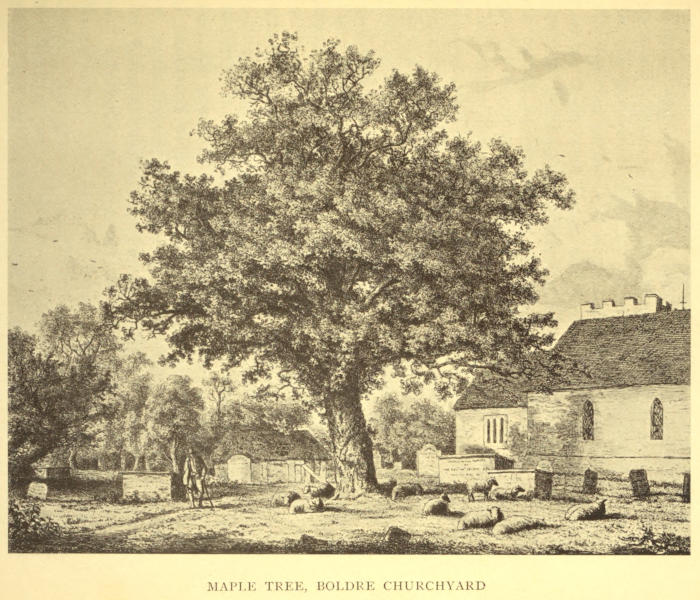
PLATE XII
MAPLE TREE, BOLDRE CHURCHYARD
It is but rarely that the maple is found in England of any size. William Gilpin, the author of Forest Scenery, says of it: “The maple is an uncommon tree, though a common bush.” The finest maple tree in the kingdom is the one in Boldre churchyard (Plate XII.); it stands appropriately over Gilpin’s grave; he was rector of Boldre for twenty years, dying in 1804.
The beech is named with a fair amount of frequency in forest accounts; there were beech woods of some size in Windsor, Pickering, Northamptonshire, and Clarendon forests, and it is often named in Hampshire records. The Windsor records show that beech was used for shipbuilding purposes.
The birch, alder, crab-apple, hornbeam, ash, blackthorn, whitethorn, and holly occur from time to time. The hazel was common everywhere; in Pickering it was sufficiently abundant to make the nut geld, or payments for licence to gather nuts, an item of some importance in the forest accounts. The elm is of very rare and late occurrence.
The dissolution of the monasteries by Henry VIII. proved a severe blow to the woods in the forests. A large number of these woods, some in almost every forest, had belonged to the religious houses. No sooner had they passed to the Crown or into private hands than the greater part of them were cleared of timber. In 1543 an Act for the preservation of timber was passed, the preamble of which laid emphasis on its great decay and likelihood of scarcity, as well for building houses and ships as for firewood. It was enacted that in copse of underwood, felled at twenty-four years’ growth, there were to be left twelve standrells or store oaks on each acre, or in default of oaks, so many elm, ash, or beech, etc. When cut under fourteen years’ growth, the ground was to be enclosed or projected for four years. Wood cut from fourteen to twenty-four years of age was to be enclosed for six years. Cutting trees on waste or common lands was to be punished by forfeiting 6s. 8d. for each felled tree. This and other Acts of Henry VIII. and Edward VI. were extended and confirmed by the 13th of Elizabeth cap. 25. A later Elizabethan Act provided for the whipping of idle persons cutting or spoiling any wood, [74]underwood, or standing trees, provided they could not pay the fine.
Certain Elizabethan forest surveys, such as those for Duffield Frith, give the fullest possible particulars as to forest timber and undergrowth, enumerating every tree.
A survey of the timber of the Lancaster forests taken in 1587 supplies much detailed information. Quernmore forest is described as having a circuit of six miles. In it was Easton wood of six acres, set with alder, hazel, and whitethorn of forty years’ growth, worth 10s. the acre, and also containing five score small sapling for timber trees, worth 5s. each. In another wood, called New Kent, were forty dotard oaks for firewood, worth 2s. each; and forty small saplings, worth 5s. each. Dickson Carr, “sundray besett with aller (alder) of an evil growth,” was to be got up and new planted. Details are also given of four other small woods within the park, and there were in addition 140 dotard oaks, worth 2s. each, standing about in different places.
Full particulars are also given of Quernmore forest, outside the park; the largest wood, Hollinhead, was four miles about, and contained 100 saplings, worth 6s. 8d. each; on Rowend Hill were 128 oaks, worth 7s. each; at Ashpotts were alder and hazel of twenty years’ growth, worth 4s. an acre; and on another hill 212 small saplings, at 5s. each, etc. This timber was reserved for the repair of Lancaster Castle, and of the tenants’ houses, when they had need, on the testimony of six sworn men, and of the fish garths and weirs on the waters of the Lune. From 1577 to 1587 eighty timber trees had been supplied for the repair of that castle at an average value of 6s. 8d. a tree. Three hundred and fifty trees had been used in that period for firebote and housebote of the tenants, eighty for fish garths and weirs, twenty for park gates and dogstakes, and forty dotard trees for fuel. A single fee-tree, in addition to 2s. worth of fuel wood, was also granted yearly to the auditor, receiver, surveyor, head steward, clerk of the court, woodward, and axe-bearer.
In Wyersdale, this survey shows that there were a good many ash and birch trees, as well as holly, alder, blackthorn, and whitethorn. The tenants were entitled to the wood they required for repairs on the testimony of six sworn men.
[75]
Spyre, or spire, is a word found in some of the later wood accounts; it denoted a young upstanding tree, and is still occasionally used by woodmen.
The term blestro, or blettro, occurs frequently in earlier attachment court rolls (e.g. Plate III.); it means a sapling, usually of oak. Stubb, or stub, in like records, appears to signify a dead or decaying pollarded tree, and not a mere stump.
[76]
The later history of the forests, in the time of their decay, is briefly treated of at the close of most of the following chapters that deal with the different counties. But there are a few general and particular statements relative to the forests from the time of Henry VIII. to George III. that it is found best to cite in a separate section.
In 1538-9, an interesting return was made of all the “kinge his game,” both red and fallow, north of the Trent, arranged under counties and parks (Misc. Bks. 77). The parks of the duchy are not included.
| Nottingham. | ||||
| Bestwood Park | 700 | fallow, | 140 | red. |
| Clypston Park | 60 | ” | 20 | ” |
| Grynley Park | 150 | ” | ||
| Sherwood Forest | about | 1,000 | red. | |
| Yorkshire. | ||||
| Galtres Forest | 800 | fallow. | ||
| Haitfeld Chase | 700 | red. | ||
| Gredling Park | 60 | fallow. | ||
| Pontefract Park | 434 | ” | ||
| Wakefield New Park | 200 | ” | ||
| Ackworth Park | 21 | ” | ||
| Rypax Park | 45 | ” | ||
| Eltoftes Park | 15 | ” | ||
| Wakefield Old Park | 40 | ” | ||
| Conisborough Park | 440 | ” | ||
| Raskell Park | 120 | ” | ||
| Bristwick Park | 160 | ” | ||
| Likenfeld Park | 429 | ” | [77] | |
| Calton Park | 30 | ” | ||
| Wressel Park | 50 | ” | ||
| Newsome Park | 72 | ” | 17 | red. |
| Topcliff Great Park | 435 | ” | ||
| Topcliff Little Park | 247 | ” | ||
| Spofforth Park | 175 | ” | ||
| Wensdale Forest | 610 | ” | 60 | red. |
| Pickering Forest | 140 | ” | 50 | ” |
| Durham. | ||||
| Teesdale Forest | 210 | ” | 140 | ” |
| Northumberland. | ||||
| Alnwick Park and members | 500 | ” | ||
| Warkworth Park | 110 | ” | ||
| Yorkshire. | ||||
| Hurst Park | 120 | ” | ||
| Sherif Hutton | 400 | ” | ||
| Temple Newsom | 90 | ” | ||
| Phipping Park | 30 | ” | ||
| Total | 6,352 | fallow. |
| 2,067 | red. | |
| 8,419 |
The ill-judged attempt of Charles I. and his advisers to reimpose forest law is treated of under the respective forests where the boldest efforts in this direction were made. This was particularly the case in Oxfordshire, where an endeavour was made to levy most extravagant penalties. The Peak Forest is an instance of amicable arrangement between the Crown and the forests tenants; while Duffield Frith, in the same county, is a striking instance of resistance.
In 1639, Charles I. issued the following order for distribution of fat venison to the foreign ambassadors then in England:—
“Right trusty and welbeloved Cozen and Counsellor, we greet you well. Whereas we have sent you a schedule under our signe manuell in which were mentioned such number of deere of this season as we are pleased to bestow upon the Ambassadors and Agents of divers Princes residing with us, together with the severall Parks and Walks wherein we purpose the said Deere shall be killed, We will and comand you forthwith to cause your severall warrants to be directed to [78]every of the keepers of the said Parks and Walks, Authorising them to kill and deliver the said Deer according to our pleasure expressed in the said Schedule. And hereof ye are not to fayle, any restraint for killing of our Deere comandment or privy token given to the contrary notwithstanding. And this our letter shall be your sufficient warrant and discharge in that behalf. Given under our signet at our Court at Oatlands the last day of July in the Fourteenth yeare of our reigne.
“Charles R.”
The schedule particularises:—Three bucks for the French Ambassador, from Hyde Park, Woodford Walk, and Windsor Great Park; three for the Venetian Ambassador, from Windsor Little Park, Bushie Park, and Epping Walk; three for the States Ambassador, from Theobald Park (2) and Chingford Walk; two for the King of Spain’s Agent, from West Henalt Walk and Chappell Henalt Walk; two for the Queen of Bohemia’s Agent, from Lowton Walk and Theobald Park; two for the Queen and Crown of Sweden’s Agent, from Lowton Walk and New Lodge Walk in Essex Forest; two for the Duke of Saxony’s Agent, from Enfield Great Park and Enfield Chase; and two for the Duke of Florence’s Agent, from Walthamstow Walk and Enfield Chase.
At the same date the king ordered twenty-two bucks and one stag to be sent to the Lord Mayor, Aldermen, and Recorder of the City of London. The bucks were mostly from the royal parks round London, but four came from Salcey Forest and one from Grafton Park in Northamptonshire; the stag was from the Great Park at Ampthill.
The following list of Christmas venison supplied to Charles I. in London is the last trace that we can find of the purveying of venison from the forests at large for the royal household.
“Venizon brought to Whitehall against Christmas in anno 1640 for ye expence of his Majestie’s house, and issued out by my Lords warrants out of the severall forests, chaces and parks as followeth, viz.:
Does. To Whittlewood Forest 12 To Cheut Forest 04 To Claringdon Parke 08 To New Forest 12 To South Beare 02 To Salcey Forest 03 [79] To Rockingham Forest 24 To Holmeby Parke 02 To Grafton Parke 04 To Whichwood Forest 06 To Ampthill Parke 04 To Alice Holt Forest 03 To Waybridge Parke 04 To Enfield Chace 04 To Somersham Parke and Chace 04 To Windsor Great Parke 02 To Higham Ferrers Parke 02 To the Old Lodge Walk in Cranborn Chace 02 To New Lodge Walk in Windsor Forest 02 Totall 104 does To Ampthill iij hindes To Loughton Walke j hinde To Egham Walke j hinde Totall 5 hindes”
On January 18th, 1641-2, the king issued his licence to the “Noble French Lord, the Baron of Vieville,” second son of the Marquis of Vieville, “to hunt and kill with his hounds or beagles the game of hares” within all forests, chases, parks, and warrens this side the Trent, for his recreation.
On the re-establishment of the monarchy, Charles II. took various measures, not only to preserve forest timber, but also to restock several of the royal forests with deer. He also accepted various presents of foreign deer from abroad. In 1661 £54 was paid to Harman Splipting, “Mʳ of the ship Angel Gabriell,” for freight of stags from the Duke of Oldenburgh. A further sum of £176 8s. 8d. was disbursed for a parcel of deer sent to His Majesty by the Duke of Brandenburgh. During the same year £75 was paid in keepers’ fees, at 5s. per head, for 300 deer presented to the king by several noblemen and others, and delivered at Windsor and Waltham forests and Enfield Chase.
In 1662, £15 was paid for “keeping German deer at Wanstead” during the winter; and £42 5s. 6d. for three new wagons for moving deer and the rent of a place in which to keep them. [80]In the same year £18 was disbursed for twelve “brasshorns” for the king’s huntsmen.
A brief undated account of all the forests within the Duchy of Lancaster during the reign of George I. names the following:—
Lancashire.—Quarnmore, Blasedale, and Wyersdale; “the inhabitants inclose divers partes thereof, and doe therein what seemes good to them.”
Amounderness; the like.
“The parke of Myerscough and the Keepership; lately granted to Benjamin Houghton, Esq., during pleasure; by the same grant he is steward of the forest of Quarnmore, and accountable to the king for the profits. The herbage of the park of Myerscough leased to—Tildersley, Esquire.”
Yorkshire.—The park of Ackworth, granted with the manor to the city of London, in which there is a covenant for keeping the park stored with deer, “near the Castle of Pontefract, which hath been and was (4 Charles I.) a most princely structure,” razed to the ground in the civil wars.
The park of Pontefract, leased to Robert Monkton, Esquire, saving all great trees, etc.
The forest of Pickering Castle and manor leased for 99 years to Mr. Dallowe, but not the forest.
The forest of Knaresborough; large encroachments.
Staffordshire.—The forest of Needwood; granted to William, Duke of Devonshire, William, Marquis of Hartington, and Henry Lord Cavendish, with the offices of Steward of the House, and Constable of the Castle of Tutbury, Lieutenant of the Forest, Master of the Game, and Bailiff of the New Liberties.
Castlehey park; granted for 99 years, in 1677, to Henry Seymor, Esquire.
The parks of Hanbury and Tutbury; granted for 99 years, in 1698, to Edward Vernon, Esq.
Hylings and Russey parks; granted for 99 years, in 1698, to Sir John Turton.
Buckinghamshire.—Olney park and Silwood coppice; granted to James Earl of Northampton, for 99 years, in 1673.
Hampshire.—Samborne or How park; granted in 1663 to Mrs. Mary Blagge, widow.
[81]
Wilts.—Braydon forest; part belongs to the Exchequer and part to the Duchy.
Middlesex.—The Chase of Enfield; granted in 1687 to Lord Lisburn for 50 years, with all the offices, from Master of the Game to Woodwards.
In the early part of the eighteenth century Waltham Chase, Hants, was made notorious by the operations of a gang of deer-stealers, who were known throughout the district by the name of “Waltham Blacks,” from their custom of blacking their faces for their nightly forays to escape identification. Like the deer stealers of Cranborne Chase, on the other side of the county, of the same period, they preferred to be known by the name of Hunters, and considered their actions fit to be ranked among deeds of bravery. So strange was their infatuation that, as Gilbert White tells us in his Natural History of Selborne, no young person was allowed to be possessed of either manhood or gallantry unless he was a “hunter.” Their recklessness caused them eventually to be joined by men drawn from the coarser criminal classes, with the result that their hunting was not infrequently accompanied by acts of wanton violence. These crimes were met in 1722 by an Act of extreme severity.
Although this lawless spirit originated and came to a head at Bishops Waltham, in Hampshire, more than one gang of reckless poachers and smugglers, with blackened faces, styled themselves “Waltham Blacks,” and traversed the country, especially the forest districts, robbing deer parks and fish ponds, and demanding money. They would brook no opposition, and shot dead a young keeper of Windsor who merely put his head out of a lodge window to remonstrate. Sir John Cope, of Bramshill, in the north of Hampshire, threatened two men whom he thought he recognised in daylight as belonging to the gang with legal proceedings, and the next night over five hundred of his young plantations were cut down. Windsor suffered severely from these marauders. In the year of the passing of the “Black Act” over forty of the gang were secured in that district. A special assize was held at Reading, when four of the worst offenders were executed and hung in chains in different parts of the forest, and the others were transported.
During the disturbed period of the Civil War, and afterwards [82]during the Commonwealth, deer-hunting by unauthorised persons became customary on Cranborne Chase, and was subsequently indulged in by many of the gentlemen of the neighbourhood as a kind of “brave diversion.” In the earlier part of the eighteenth century, not a few persons of good breeding and birth thought it no disgrace to hunt or poach at night, to drive the deer into nets, and to enter into fierce combats with the keepers. Hutchins thus describes this “kind of knight-errantry amusement of the most substantial gentlemen of the neighbourhood”:—
“The manner of this amusement, as it was then called, was nearly as follows: A company of hunters, from four to twenty in number, assembled in the evening, dressed in cap, jack, and quarterstaff, and with dogs and nets. Having set the watchword for the night, and agreed whether to stand or run, in case they should meet the keepers, they proceed to Cranborne Chase, set their nets at such places where the deer are most likely to run, then let slip their dogs, well-used to the sport, to drive the deer into the nets, a man standing at each end to strangle the deer as soon as entangled. Thus they passed such a portion of the night as their success induced them, sometimes bringing off six or eight deer, good or bad, such as fell into the net, but generally of the latter sort, which was a matter of little importance to those gentlemen hunters who regarded the sport, not the venison. Frequent desperate bloody battles took place; and instances have unfortunately happened where sometimes keepers, at other times hunters, have been killed.”
A reproduction is given on the opposite page of an original painting, executed in 1720, of a group of these hunters with their bee-hive caps, wadded coats, quarterstaffs, and nets. The person in the centre is Mr. Henry Good, of Bower Chalk, described as a man “of rare endowments both of body and mind.” It appears as a frontispiece to that rare book Mr. Chafin’s Anecdotes of Cranborne Chase (1818), where the special details of the deer-hunter’s equipment are thus described:—
“The cap was formed with wreaths of straw tightly bound together with split bramble-stalks, the workmanship much the same as that of the common bee-hives. The jacks were made of the strongest canvas, well quilted with wool to guard against the heavy blows of the quarterstaff, weapons which were much used in those days, and the management of them requiring great dexterity.”
[83]
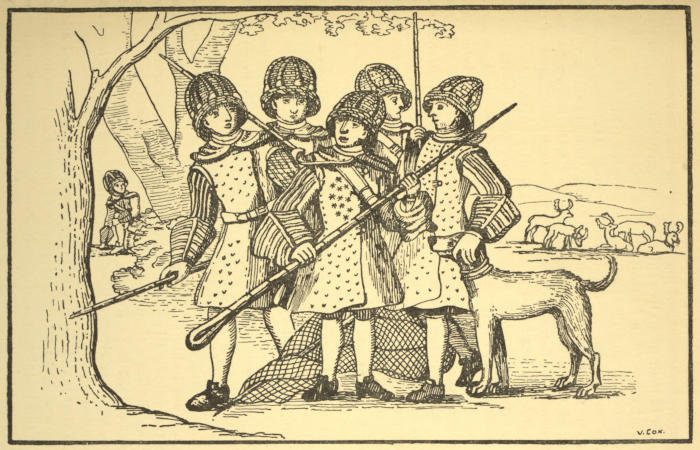
DEER-HUNTERS OF CRANBORNE CHASE
[84]
Soon after the “gentlemen” who indulged in “this rude Gothic amusement” of night poaching had had their portraits taken in their protective suits, which somewhat resemble those worn by American football players, this kind of sport fell into abeyance among those of position, for the poor reason that it was patronised by the lower orders. Hutchins shrewdly remarks that when this change came, about 1730, its votaries ceased to be called deer-hunters, and were known as deer-stealers. So fierce became the affrays that the forester of the West Walk was killed in 1738, and shortly afterwards the like fate befell the forester or keeper of the Fernditch Walk.
There was a serious pitched battle on Chettle Common, Cranborne Chase, on the night of December 16th, 1780, between the keepers and deer-stealers, the latter headed by a sergeant of dragoons, who were then quartered at Blandford. One of the dragoon’s hands was severed from the arm by a hanger of a keeper, whilst one of the keepers was rendered permanently lame by the blow of a swindgel. In another affray in 1791 one of the deer-stealers was killed and ten were taken prisoners, and eventually transported for life.
The only known relics of these terrible chase strifes are two of the straw caps and an example of that deadly weapon, the swindgel, secured by the keepers from the deer-stealers in 1791. They belong to Mr. Castleman, of Chettle Lodge, and were specially photographed for the Reliquary (N. S. i., 241), in 1887.
The two straw caps or helmets, shown on Plate XIII., are painted dark green to hinder their being noticeable at night-fall. The lining is thickly stuffed with wool. The longer arm of the swindgel is 14 in. long, whilst the shorter arm is only 6 in., but has a circumference in the widest part of 4½ in. The total weight is 1 lb. 2 oz.; it is made of a hard, close-grained wood. The swivelled hinges are of iron, and there is a leathern handle-loop to go round the wrist.
Towards the close of the eighteenth century increased attention was given to the importance of forests as yielding timber for the maintenance of the Navy. Commissioners were appointed to inquire into the state and condition of the woods and forests belonging to the Crown. Between 1787 and 1793 they issued seventeen reports. The first two reports, as well [85]as the fourth, the eleventh, the twelfth, the sixteenth, and the seventeenth, are of a general character. The third deals with the Forest of Dean, the fifth with the New Forest, the sixth with forests of Alice Holt and Woolmer, the seventh with Salcey, the eighth with Whittlewood, the ninth with Rockingham, the tenth with Wichwood, the thirteenth with Bere, the fourteenth with Sherwood, and the fifteenth with Waltham in Essex.
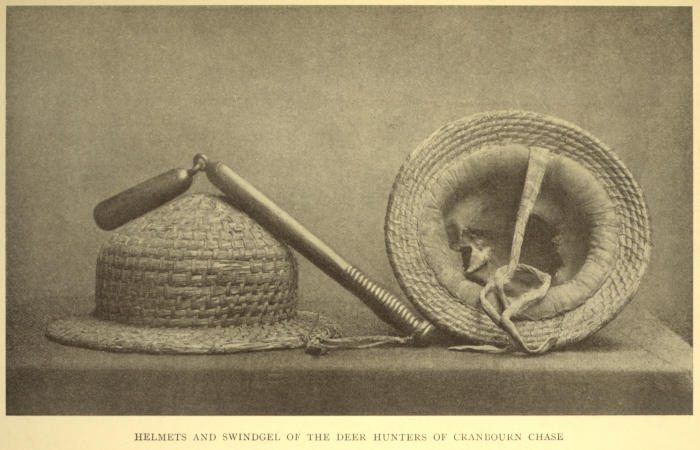
PLATE XIII
HELMETS AND SWINDGEL OF THE DEER HUNTERS OF CRANBORNE CHASE
A Descriptive List of the Deer Parks and Paddocks of England, by Mr. Joseph Whitaker, was published in 1892. The number of red or fallow deer, or both, in each enclosure, with the acreage, is set forth in each case, with other particulars of the more interesting examples. They vary in size from 4,000 acres at Savernake to a single acre at Bagnall House. The beautiful park of Savernake, with the open country adjoining, presents the best picture of an old English forest. Bowood, which used to be an important part of Clarendon forest, is another good example of forest scenery. If the woods of fir and pine were removed, a great part of the New Forest offers much the same features that it did in days of old. For fine oaks the parks of Windsor, Cornbury, and Kedleston are pre-eminent, whilst Thoresby park, Notts, is not to be equalled anywhere for the variety and beauty of its timber. Spetchley park, Worcestershire, is fenced with old oak pales, fastened with oaken pegs after the original fashion. An ancient stout style of oak deer fence is also still maintained round Hardwick park, Derbyshire.
No fewer than fifty parks mentioned in Mr. Evelyn Shirley’s delightful Account of English Deer Parks have ceased to contain deer since 1867, when that work was issued.
The red deer are still found in a wild state in Devon and Somerset, on Exmoor forest and its confines. The growth of popularity attached to the hunting during the last half-century has materially added to their preservation and increase. There are also a few red deer on Martendale Fell, Westmoreland.
Fallow deer still run wild in the New Forest and Epping forest, and a few stray deer are sometimes noticed in the woodlands of old Rockingham forest. It is a disputed point whether these last are a remnant of the old herds, or escapes from neighbouring parks.
The roe deer, though few in number and decreasing, may [86]yet be found in parts of Cumberland, Durham, and Northumberland; whilst in certain of the wooded combes on the Milton side of the vale of Blackmore, Dorset, they roam freely about under the protection of the landowners. They were introduced at Milton about the beginning of the nineteenth century.
In 1884, six of the Milton roe deer were caught and transported to Epping forest, in an endeavour to stock that district. A little later, Mr. E. N. Buxton obtained eight more roe deer from the same district; they have slightly increased, and are supposed now to number about twenty-five.
A few of these Milton deer have of recent years made their way into the New Forest; they were first observed there about 1870, but they do not number more than a dozen.
[87]
Nearly in the centre of the county of Northumberland stands the picturesque little town of Rothbury, “almost startling, from the beauty of its situation.” The parish, which is over thirty miles in circuit, was once all forest land; by far the greater part of it is much as it was in the days of mediæval England, consisting chiefly of wild, uncultivated moorland.
The maps still mark the tracts above and below the town as North Forest and South Forest. Many a writer on Northumberland, even some well-informed ones of recent times, have tried to realise how different this district must have looked when “clothed with trees and underwood.” But, for the most part, this never was and never could have been the case with Rothbury forest of historic days. Nevertheless, the actual valley of the Coquet was, beyond doubt, far more closely wooded in early days than it is at the present time; indeed, etymologists tell us that the very meaning of Rothbury is “the town in the clearing.”
Some twelve miles north-east of Rothbury lies the celebrated little town of Alnwick, on the Alne, which was also surrounded by a tract of country under forest law in the twelfth and thirteenth centuries. The rolls of an eyre held at Newcastle in 1286, show that there were three bailiwicks in the forest of Northumberland; one to the south of Rothbury and the Coquet, another to the north of Rothbury between the Coquet and the Alne, and a third immediately to the north of the Alne. There were four verderers to each bailiwick.
[88]
The forest of Northumberland is repeatedly mentioned in the Patent and Close Rolls of Henry III., at times when there were general directions as to the forests at large. Thus in 1222, when orders were given to the sheriffs, verderers, and foresters throughout England as to the woodfall after the great storm, Daniel de Newcastle received particular instructions as warden of the forest of Northumberland.
When forest perambulations were being undertaken in 1225, the duty of surveying the Northumberland forest was assigned to Roger de Morlay and Roger Bertram, with Nicholas de Hudham as clerk. In January, 1229, the sheriff, foresters, and regarders were instructed to make a regard before the end of the octave of the ensuing Easter, preparatory to the holding of an eyre by the justices.
In 1281 a scheme for the disafforesting of Northumberland was drawn up. The inhabitants of the forest district were to pay an annual rental of 40 marks to the Crown for this privilege, in proportion to the value of their lands; 23 marks were to be paid by those north of the Coquet, and the remaining 17 marks by those to the south of the same river.
In February, 1286, William de Vesey, Thomas de Normanville, and Richard de Crepping were nominated as justices to hold an eyre of the forest of Northumberland, to cover the period from the holding of the last eyre in the reign of Henry III. up to the date of the disafforesting.
The barony of Alnwick was held during most of Edward I.’s reign by that great palatinate bishop, Anthony Bek, of Durham. In 1299, a special commission was held to inquire into the breaking of the bishop’s parks and chase at Alnwick, where his deer had been hunted and carried away, and arrows drawn upon his parkers, some of whom were wounded. But as the parks and chases of this district ceased to be under forest law from 1281, their history must not be pursued any further.
Henry Algernon Percy, the sixth Earl of Northumberland, died without issue in 1537. The family of his brother, through the attainder of their father, who had been executed for his support of the Pilgrimage of Grace, were incapable of succession. The earldom, therefore, became extinct, and the chief part of the estates passed to the Crown, and thus continued for twenty years.
[89]
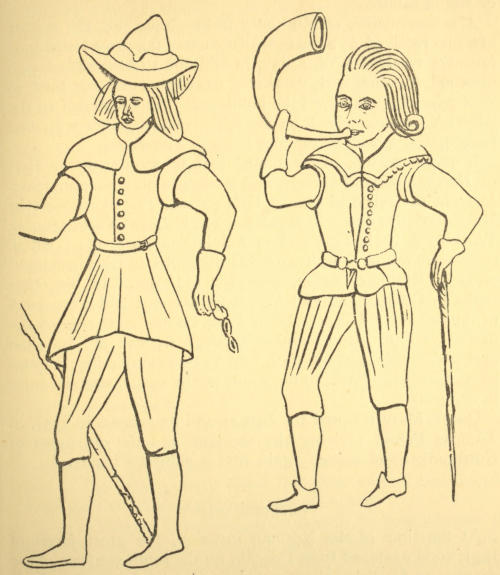
HUNTING COSTUME. SEVENTEENTH CENTURY.
Although the forest district, with its parks and warrens, did not come under forest law by this reversion to the Crown, nevertheless a word or two are admissible as to its governance under Henry VIII. A survey that was taken in August, 1539, of Rothbury and its members, gives Sir Cuthbert Ratcliffe as master of the game in the forests, chases, parks, and warrens of Alnwick, and John Heeson as bow-bearer, with many other masters and keepers of different parks. Cuthbert Carnabie, master of the game in Warkworth park, was also constable of [90]Alnwick Castle, as well as master of the game. Among his privileges, Carnabie was entitled to as many salmon taken in the Coquet as would serve him for keeping his house; but he had to pay 6d. for each salmon, and 2d. for each “gylse” or young salmon.
A perambulation of Rothbury forest shows that the master of game received £7 a year; whilst each of the three keepers or foresters received a 1d. a day, in addition to blownwood, and firewood, together with “one stag in summer and one hind in winter for the makyng of the houndes.” The keepers of all the Alnwick parks received £3 6s. 8d. a year, together with two horse-gates, a buck in summer and a doe in winter.
It may here, too, be mentioned that an account of the Earl of Northumberland’s parks and games in this county, taken early in the reign of Henry VIII., shows that there were in Holn Park 879 deer; in Cawledge (or College) Park, 586; in Warkworth Park, 150; and in Acklington Park, 144. All of these were fallow deer, but outside the parks, in the unenclosed parts of Rothbury forest, were 153 red deer. In his other parks in Cumberland and Yorkshire, the earl had 3,659 head of fallow and red deer. Holn Park, on the west side of the castle with the Alne running through it, was at this time enclosed within a stone wall, said to be twenty miles in compass; Cawledge Park, to the south of the castle, was six miles in compass.
Queen Mary restored the barony and its estates, in 1557, to Thomas Percy, reviving the earldom, and the old forest of Northumberland passed again into a subject’s hands.
At the time of the Norman invasion, the great forest of Inglewood stretched from Penrith, on the south confines of the county, to Carlisle, about twenty miles to the north. It is described in the Chronicle of Lanercost as having been “a goodly great forest, full of woods, red deer and fallow, wild swine, and all manner of wild beasts.”
Reginald Lacy obtained a grant from King John in 1203 for himself and Ada, his wife, daughter and co-heir of Hugh de Morvill, of the forestership of Cumberland. In the following [91]year he paid the considerable sum of 900 marks, as well as five palfreys, to have livery of the property of the said Ada, and to enjoy the keepership of the forests of the county in as ample a way as Hugh de Morvill had held it. Reginald died in 1214, and Ada, his widow, gave a fine of 500 marks for livery of her inheritance including the forestership. The widow married Thomas de Multon, who paid £100 fine and one palfrey to the Crown, soon after the accession of Henry III., to hold the office of forestkeeper in right of his wife. Thomas de Multon, who was frequently sheriff of Cumberland, died in 1240, and is named as forest keeper in various documents, such as that generally issued after the great storm of 1222. In 1229 Thomas de Multon received orders to supply Roger de Quincy with two stags out of the Cumberland Forest as a gift from the king. Two years later Multon was instructed to prohibit the foresters from entertaining or affording hospitality to those passing through the county forest.
Several manors within the forest were granted, in 1242, to the kings of Scotland in satisfaction of their claims on the northern counties of England, but they were resumed at a later period by Edward I.
At an eyre, held in the reign of Henry III., Robert, Bishop of Carlisle, was fined the heavy sum of £69 6s. for depredation of the herbage of Cumberland Forest; but this sum was forgiven to his executors in the next reign.
With the beginning of Edward I.’s reign, the term Forest of Cumberland gave way, for the most part, to the title of Inglewood Forest; but the latter title had a more restricted signification, as the older county forest included several manors between the river Eden and the parish of Alston.
In 1274 Edward I. ordered an inquest to be held whether or no Alexander, King of Scotland, and his men of Penrith and Salkeld ought to have, and have been accustomed to have, common of pasture in any part of the park of Plumpton, which was enclosed in the time of Henry III., and, if so, within what bounds; and also to make like inquiry as to the King of Scotland and his men having any claim to housebote and heybote in any part of Inglewood Forest. Plumpton Park was disafforested in the time of Henry VIII.
Richard le Escat, one of the Inglewood foresters, killed [92]William, son of Elias de Grenerigg, in the forest in 1280; but he obtained a royal pardon, as it was proved that William was caught in the act of venison trespass, and that he was slain on refusal to be arrested.
An eyre was held in 1285. The roll show that the forest was divided into three bailiwicks, with twelve regarders for each. There were twelve verderers for the whole forest. One of the more noteworthy presentments at this eyre, cited in full by Mr. Turner in Forest Pleas, was the charge that Isabel de Clifford, who held the park of Whinfell in Westmoreland, had two deer-leaps which were nuisances to the forest, one of them being only a league from Inglewood Forest, and the other only a league and a half. The justices for this eyre were William de Vesey, Thomas de Normanville and Richard de Crepping.
William de Vesey, whilst justice of the forest beyond Trent, took to the king’s use in 1289 a hundred bucks, which he delivered to Peter de Chaumpvent, steward of the household; fifty of these bucks came from Inglewood Forest. He received a formal quittance for taking them in September, 1290, when his son, John de Vesey, succeeded him as justice of the forest.
Attachment courts were held in this forest, as was customary, every forty-second day. There is an Inglewood attachment roll extant of the year 1293.
A commission was issued in 1298 to inquire, by the oath of foresters and verderers of Inglewood, in the presence of Robert de Clifford, justice of that forest, whether the abbot of Holmcoltram had sufficient pasture without the forest launds for his stud, draught oxen, and swine, or not. The abbot asserted that he had chartered rights of common for these purposes in all places in the forest between the rivers Caldew and Alne. Certain of these launds had recently been enclosed, for the king’s profit, by Geoffrey de Nevill and William de Vesey, heretofore justices of that forest.
Pardon was granted in January, 1300, to John, Bishop of Carlisle, and his men for taking a buck in this forest. In the same month, power was granted by the Crown to Robert de Clifford, forest justice, and two others, to divide up the king’s wastes in the wood of Allerdale, within the forest bounds, into [93]numbers of acres to be held by tenants at yearly rental to the Exchequer; also to sell wood, green or dry, by view of the foresters and other officials.
Among the various details pertinent to this forest on the Patent Rolls of Edward II., the following may be mentioned. John de Harbela, king’s yeoman, obtained a grant, in 1312, of the bailiwick in the forest of Inglewood, which Thomas de Multon held, and which on account of a forfeiture he had incurred, was in the king’s hands. Two years later Thomas de Verdon was appointed forester in the place of Harbela. In 1315 William de Dacra was appointed steward of this forest by the Crown during pleasure. In the same year a commission was issued to inquire into the carrying away of certain of the king’s falcons from the eyrie in the forest of Inglewood. Henry de Panetria, at the request of Queen Isabella, was granted for life, in 1316, the bailiwick of the forestership of “Gaytsheles,” in this forest. Grant was made, in 1317, of pasture for their beasts in Inglewood Forest to the nuns of Ermynthwait, in consequence of the severe loss that had been inflicted on them by the king’s enemies. John de Crumbwell was warden of Inglewood in 1318, when acquittance was granted to Robert de Tymparon, an agister within the forest, for £4 10s. 9¾d. for pannage from the date of his being an agister in the time of Edward I., which sum had been paid into the hands of Robert de Barton, late keeper of the king’s victuals in the park of Carlisle. In the same year, John de Rithre, king’s yeoman, was appointed steward of the forest during pleasure.
The Exchequer accounts of this reign give the expenses incurred by Robert, the squire, for a summer hunt for the king in Inglewood Forest, which lasted for four days. His servant was paid 12d. a day, whilst an allowance of ½d. a day each was made for ten greyhounds and for three bercelets, or hounds that hunted by scent.
When the reign of Edward III. is reached, the record entries relative to the forest of Inglewood, its records of Gaystall or Gatesgill, and Penrith, and its launds of Plumpton, Hesket, Braithwait, Ivetanfield, and Middlescough, etc., become so frequent that a considerable and interesting volume on its annals might readily be compiled. Here there is only space [94]for a few brief extracts from the less known and uncalendered rolls.
An Exchequer Roll of 1335-6, when Richard de Nevill was keeper, shows that the laund of Plumpton, of which Roger de Wastedale was the agister, charged 6d. a head for horses, 4d. for draught oxen, 3d. for cattle, and 2d. for stirks. Sheep were only allowed on two or three of the launds, and were charged at 4d. a score. The agistments of the year produced £26 15s. 4d. The letting of the lodges of the forest brought in 29s. 8d. The ward of Penrith commuted the fence month fines by a payment of 16s. 8d. from six townships, and the ward of Gaystall by a payment of 23s. 8d. from fourteen townships. The pannage money was but small, indicating a decided paucity of woods; only 9½d. from Penrith ward, and 6s. 5½d. from Gaystall ward. Among the attachments of Gaystall were 6d. for a horse, 2d. for two stirks, and 12d. for pigs.
There is another very full agistment and attachment roll of 1375-6, wherein there are various fines, from 1d. to 12d., for vert offences.
The accounts of Richard, Earl of Salisbury, for this forest, in the reign of Henry VI., are of a good deal of interest. The returns of the frequent attachment courts are confined to vert offences; the fine for a cartload of wood was usually 2d., and for a wagon 4d. The fence month fine money in Gaystall ward was 20s., contributed by twelve townships, far the heaviest share being 6s. 8d. from the city of Carlisle. The like fine for Penrith ward amounted to 13s. 8d., of which Penrith itself paid 6s. 8d. The dead wood of Gaystall ward produced 11s., and that of Penrith 20s. The small amount of actual wood within this wide sweep of forest is again shown by the lowness of the pannage fees, which only amounted to 6s. 0½d. in the two wards. References in forest accounts to churches or chapels (save in the matter of tithes) are quite exceptional; but in these rolls certain rents of lands at Grueythwaite (Greenthwaite) are assigned to a chapel there, which had recently been rebuilt.
A survey of Inglewood Forest, taken on 8th August, 1539, mentions Sir Henry Wharton as master of game, and William Hoton, Esquire, as bow-bearer. The officers in the sub-forests of Ashdale and Wastedalehead were Sir Thomas Wharton, [95]master of game, Richard Vikars and Thomas Nycholson, foresters of Ashdale, and William Fletcher and Nicholas Hunter, foresters of Wastedalehead. The sub-forest of Westwood had the same master of game, and Micah Avon bow-bearer, with Richard Dykes and Thomas Wilson keepers. The sub-forest of Nicholl had Sir William Musgrave as master of game. The keepers of Wastedale had a hart in summer and a hind in winter, equally divided between them.
An expense roll of this forest for the first year of Elizabeth is chiefly occupied with the details of repairs done to the “court houses” of Penrith, Sowerby, and Gaystall. Repairs were also done to the leads, and the glass and iron of the windows of Kidkirk chancel at a charge of £3 6s. 8d.
Charles II., on his marriage with Katharine of Braganza, settled on her, as part of the royal dower, the forest of Inglewood.
In 1696, the forest of Inglewood was granted by the Crown to William Bentinck, first Earl of Portsmouth, as an appurtenance of the honor of Penrith.
In Jefferson’s Cumberland, published in 1840, it is stated that the forest or swainmote courts for the seigniory of Hesket were still held annually on June 11th in the open air, on the great north road to Carlisle, the place being marked by a stone table placed before a thorn called Court Thorn; at this court a variety of annual dues were paid to the lord of the forest.
On Wragmire Moss, in the same parish, a well-known ancient oak, spoken of as the last tree of Inglewood Forest, fell “from sheer old age” on June 13th, 1823.
A considerable tract of wild land in this county was rendered subject to the fierce rule of the early forest laws in the time of Henry II. and John; but all this was disafforested by the Forest Charter, 1217, which only recognised as forests those tracts of country which had been in that condition when Henry II. came to the throne. In 1225, grave complaint was lodged by the knights and proved men of Westmoreland that certain magnates of the county were continuing to treat the disafforested demesne as though still subject to forest fines [96]and penalties, to the great injury of the inhabitants. Thereupon letters patent was issued by the Crown sternly reprobating such action, addressed in the first place to William de Lancaster, Baron of Kendal, with duplicates to Robert de Vezpont, sheriff of Westmoreland, to Earl Warren for the wood of Incelemor, and to Matilda de Lascy for the wood of Pippin.
It was doubtless in consequence of this royal reminder that John de Vezpont, when he succeeded his father three years later, granted to the lords of the manor of Warcop, Sandford, Burton, and Hilton, in this county, freedom from foresters’ puture, and from all things that might be demanded of that nature.
There is no mention of any forest of the county of Durham in the lists of royal forests temp. Henry III., and there was certainly no district under forest laws throughout by far the greater part of Durham. The forest of Teesdale is, however, occasionally named in the latter part of the fifteenth and in the first half of the sixteenth century. The number of fallow and red deer in this forest in 1538-9 has already been cited.
In the western angle of the county, where it is separated from Yorkshire on the south by the river Tees, and where it reaches out to both Cumberland and Westmoreland, Durham was in contiguity with forest districts of other counties, and forest laws probably there prevailed over a small area. An extensive township of the old widespread parish of Middleton-in-Teesdale still bears the reduplicated name of Forest-and-Frith; it begins 4½ miles north-west from Middleton, and ends on the borders of Westmoreland, near the sources of the Tees. At the furthest extremity of the wild district of Forest-and-Frith is Harwood, the very name denoting a tract of ancient woodland. Various of the smaller place-names and field names have reference to deer, and a few to the former presence of wolf and boar.
The large parish of Stanhope, immediately to the north of Middleton, has a western division termed Forest Quarter extending to the borders of Cumberland, just above Harwood, and including Weardale. Leland, writing in the time of [97]Henry VIII., said: “There resorte many rede dere, stragelers, to the mountaines of Weredale.” The forest of Weardale was held by the Bishops of Durham; the Boldon Book, of the twelfth century, affords many interesting particulars as to the hunting regulations of the district, but as it was not royal forest it would be foreign to our purpose to cite them.
Whatever small portion of Durham may at some time have been under forest law could only have attained that position through the overlap of some forest at its western extremity, whose administration pertained to another county.
In the crypt of Durham Cathedral is an unusually fine memorial slab of the latter half of the thirteenth century, which must have marked the interment of some chief forester or warden of a northern forest. On the sinister side of the cross is a sheathed sword with the sword belt twisted round it. On the dexter is a long bow-string, with the arrow fitted in the notch and the head showing on the further side of the sword. On the bow rests what appears to be the distinctive cap of the master of the forest, whilst in the angle above, between the bow and the string, is a small paddle-shaped implement, which may possibly indicate water or fishing rights.
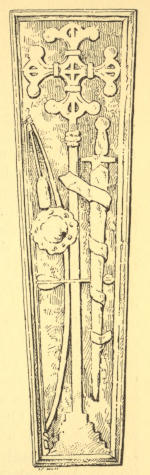
CHIEF FORESTER’S SLAB
DURHAM CRYPT
[98]
The forests of Lancashire, which were at one time very considerable, were chiefly situated in the high region on the east side of the county. In their earlier history they may be divided into two portions, namely, those in the ancient house of Lancaster, which were subject soon after the Conquest to Roger de Poictou; and those in the great fee of Clitheroe, subject at the same time to the family of Lacy. After the marriage of Thomas, Earl of Lancaster, with Alice de Lacy in 1310, all the forests of the county came under the one head of Foresta de Lancaster, and pertained to the earldom, and afterwards to the Duchy of Lancaster. But quite a century before this date all the various forests were frequently described under the common denominator of the county town. The more important forests were within the hundred of Lonsdale; those of Wyersdale, Quernmoor, Bleasdale, Myerscough, and Fulwood were all within the very extensive ancient parish of Lancaster, though the last three were in the hundred jurisdiction of Amounderness. In the hundred of Blackburn was the great forest of Blackburnshire, of which Rossendale, Bowland, Pendle, and Trawden were the subdivisions. In the hundred of West Derby was the forest of that name, often termed Derbyshire, with the parks of Croxteth and Toxteth.
In Harland’s edition of Baines’ Lancashire (1868-70) there is a certain amount of scattered, meagre information pertaining to these very considerable tracts of the county; but the history of the forests of Lancashire remains yet to be written. The material available would readily make an interesting work of one or two volumes. All that is here attempted is to give a few scattered facts which have not for the most part hitherto appeared in print.
[99]
In the first year of King John, Benedict Gernet held the serjeanty of the forest of the whole county, for which he rendered an annual payment of £26 13s. 4d. In the same year (1200) the king granted leave by charter to the knights and freeholders dwelling in his forest of the honor of Lancaster to use their own woods as they willed, declaring them exempt from the regard of the forest. For these privileges the knights and freeholders paid into the Exchequer, in the following year, the considerable sum of £283 17s. In 1206, John conferred the keepership of the Lancaster forests on Gilbert Fitz-Reinfred, one of his favourite barons.
John granted to the house of the lepers of St. Leonard’s, Lancaster, considerable privileges in the forest of Lonsdale, where they might graze their beasts, gather dead wood for fuel, and have timber sufficient for the repairs of their dwellings. Some time before 1220, Henry III. appointed Roger Gernet, forester-of-fee of Lonsdale, to the general keepership; in that year the lepers petitioned the king for relief from the exactions of Gernet, who claimed an ox from them in recompense for their winter agistment, and a cow for the summer pasturing; nor would he allow them to take wood for fuel or house repairs.
A writ was at once directed to the sheriff of Lancaster instructing him to stay the exactions of Roger Gernet, and a confirmation charter was sent to the lepers, allowing all their privileges without any payment in money or kind. From this and from a subsequent slightly amended confirmation we learn that the lepers were originally indebted to Henry II. for their forest favours, and that John merely ratified his father’s grant. Nine years later the pasturage rights of the lepers were restricted to a certain defined area of the forest. In 1227 Roger Gernet was confirmed in the custody of Lancaster Forest.
A perambulation of the Lancashire forests was undertaken in 1228, on the king’s precept, by William Blundel, Thomas de Bethune, and ten other knights, who said that the whole forests of Lancaster ought, according to the Forest Charter, to be disafforested, save Quernmore, Conet, Bleasdale, Fulwood, Toxteth, Derby, and Burtonwood. In the following year a confirmation of John’s charter to the knights and freeholders of Lancaster was granted by Henry III. for the enjoyment of the [100]neighbouring woods under certain restrictions. This was probably done to prevent the forests of Wyersdale and Myerscough, adjoining the county town, being disafforested, as was evidently the intention of the inquest of 1228, wherein they are not named as exceptions to the general disafforesting. Wyersdale forest, which took its name from the river, contained about 20,000 acres; Quernmore, to the north of it, about 7,000 acres; Myerscough, about 2,200 acres, skirted the great north road from Preston to Lancaster; whilst Bleasdale was coextensive with the township of that name.
By charter of 30th June, 1267, Henry III. granted to his son Edmund the honor and castle of Lancaster, together with the vaccaries and forests of Wyersdale and Lonsdale, etc. But they were to be considered forests, and not chases of private ownership; and hence were entitled to be ruled by forest pleas held by the king’s justices.
Long notice was given of the rarely held eyre of justices for forest pleas, proposed to be held for the county of Lancaster at Easter, 1287. The first summons was issued for it in October, 1286, when it was stated that the justices would be William de Vesey, Thomas de Normanville, and Richard de Crepping. But this arrangement was subsequently cancelled. On 8th February the sheriff was instructed to order a preliminary regard of the forest to be taken, and ten days later he was ordered to issue summonses for an eyre to be held a month after Easter before Robert Brabazon and William Wyther. At these pleas forty-eight cases of venison trespass were presented. In at least one case, that of Nicholas de Lee, the chartered privileges of King John were pleaded in defence of hunting in the king’s forest.
There are various records extant of attachment courts of the forests of Quernmore and Wyersdale, which were under joint jurisdiction, temp. Edward I. The offences were chiefly venison trespass. The courts were always held on a Thursday, and presided over by the two verderers, John le Gentil and John de Caton. There are records of eight courts held in 1299, nine in 1300, and four in 1301.
The venison trespasses for this and other years show that there were both fallow and red deer in the Lancaster forests of this date, though the latter were the more numerous, and the [101]former more especially found in parks. The foresters reported that Thomas, son of Adam de Berewyk, clerk, wounded at night a certain buck within the township of Lancaster, and followed it up with bow and arrows, but the deer escaped and recovered. Immediately after the deed, Thomas entered into the service of certain magnates outside the county of Lancaster. The foresters were ordered to try and find and attach him.
On Thursday, after the feast of St. Katherine, 1293, a certain buck was found strangled in the forest of Claughton. An inquest was held, and the jury found that a certain white dog—whose they knew not—followed the said buck from Quernmore to Langlandebroke; that one Thomas de Harrey, coming that way, struck the buck on the back and broke its back; that Thomas immediately after fled, and they were not able to find him. The flesh and horns of the buck were given, in accordance with the Forest Charter, to the lepers of Lancaster.
At a court held at Easter, 1299, before the verderer, Ingelram de Gynet, Roger de Croft, and many others of the Ingelram family, were presented for hunting with greyhounds in Wyersdale; and Ralph de Bray for killing a doe with arrows and carrying it off. The offenders were committed, to use modern parlance, to the next forest pleas, but admitted to bail. At Trinity, in the same year, the attachment court was attended by three foresters and twenty-four sub-foresters; four of the sub-foresters held their office by right of service, and are entered as de feodo.
At the court of attachment held on Thursday after the festival of St. Barnabas, Harry, the parker of Quernmore, swore that the Sunday after the feast of St. Cecilia he was standing in the park and saw through the park pales Richard de Thirnum and Richard Cokker kill a doe and carry it off. He followed them, and shot arrows at them, so that they fled, leaving the venison, which was carried to Lancaster Castle. At a later court in the same year it was presented that the foresters found two men armed with bows and arrows in the forest of Quernmore, and two shepherds with their staffs with them, and that all four were taken prisoners to Lancaster.
In the next few years there were various presentments for taking harts and hinds. In 1306 several offenders came by night with greyhounds into the park of Quernmore, but being perceived by the foresters they fled, leaving behind them five greyhounds. These hounds were caught by the foresters, who took them to Lancaster castle.
Pleas of the forest were held at Lancaster on Monday, after the feast of St. Peter, 1334, before William le Blount and Henry de Hamburg, justices of the forest, assigns of Henry, Earl of Lancaster.
The names of the verderers are first entered on the rolls; the two for “Derbyshire” (i.e. West Derby) were Henry de Atherton de Ayntre and John de Gredleye, but their term of office had apparently expired, for they were removed, and Richard de Alvandeley and Richard de Eltonheved were sworn to that office in their stead.
Two new verderers were also sworn for the forest or hundred of Amounderness, whilst in the hundred of Lonsdale one of the two old verderers was removed and replaced by a new appointment.
The names of fifteen foresters of Amounderness and Lonsdale are entered on the roll, but only three appeared, for the remainder had died since the last eyre of the justices, and there was no one to answer for them. The three who came said that they appeared for themselves and the other foresters, and that they had no rolls nor indictments to present, for the verderers and their heirs kept such rolls in their own possession, as they were prepared to prove on the oath of their officials.
The prior of St. Mary’s, Lancaster, claimed two cartloads of dead wood for fuel out of the Lancashire forests, save in Wyersdale, on any day he liked in the year, and free ingress and egress in the forest for a cart and two horses, or with two carts and four horses to seek for wood, according to charter of Edmund, Earl of Lancaster, 1260. The prior also claimed tithe of hunting and pannage.
The burgesses of Lancaster also made their claim for fuel and building wood under a charter by Edmund; and the burgesses of Preston made like claims with regard to Fulwood forest. The various claims of the abbot of Furness were enforced by the production of charters of John, Henry III., and Earl Edmund, which were duly enrolled.
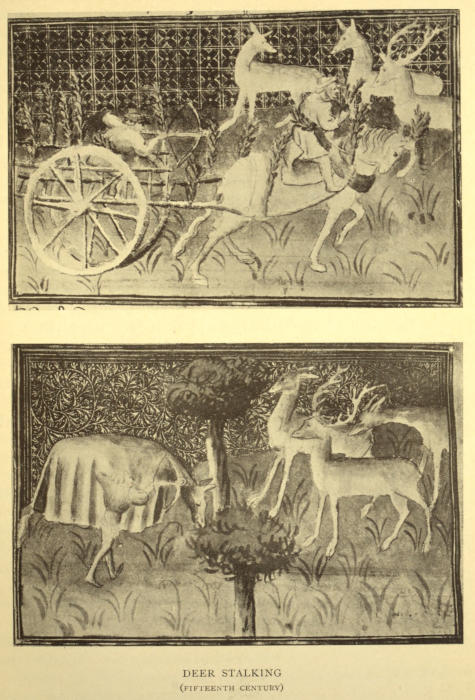
PLATE XIV
DEER STALKING
(FIFTEENTH CENTURY)
[102]
The tenants of the town of Broughton in Amounderness [103]claimed to have, from time immemorial, common pasture in the forest of Fulwood for all kinds of animals save goats throughout the year, except for six weeks during the acorn season (pessone), and for the four weeks of the fence or close month, by payment of 10s. at Michaelmas to the honor of Lancaster. Eventually it was agreed that the tenants of Broughton should have common pasture for their animals in Fulwood forest, save for sheep and goats, and for pigs, except in the fence month and in the six weeks of acorns. The considerable sum of £14 6s. 8d. was claimed as due to the lord for trespasses with animals in Fulwood forest by the men of Broughton up to the following Michaelmas; but this was remitted. Henceforth 10s. was to be paid by them at Michaelmas.
The foresters for the hundred of Derby enrolled at the last eyre numbered twelve, but the first nine were dead, and there was no one to represent them. The last three names were the survivors. They appeared, but said, like those of Amounderness and Lonsdale, that they had no rolls to produce, as they were always delivered to the verderers.
It was upwards of thirty years since the last forest pleas had been heard, and the justices were only able to obtain two of the verderers’ rolls for the intervening period, several having died and left neither heirs nor executors.
The successive keepers or master foresters of West Derby, since the last eyre, were also called upon to lay their rolls before the justices. But of these documents they obtained very few.
Ralph de Monneysilver had been keeper for five years, and died, leaving no heirs nor executors nor lands in the county.
Thomas Banastre was keeper for seven years. On his death, though he had lands in the county, no one came to restore the rolls; but eventually Adam Banastre, his relative and heir, appeared, and made fine for the rolls.
Richard de Hoghton was keeper for three years. On his death his son Richard eventually delivered the rolls.
Thomas Tanner was keeper for a year. On his death, though he had land in the county, no one restored the rolls, and distraint was ordered to be made.
Simon de Baldlyston was keeper for six years; he died in 1325, but no one came with the rolls.
[104]
William Gentil, who survived, was next keeper; he restored the rolls.
Ralph de Bikerstach was keeper for four years. On his death no one restored the rolls, and distraint was made on his lands.
Edmund de Neville, who survived, had been keeper for three years. His rolls were burnt by the Scots and enemies of the king; and he was ready to make fine for them.
At this iter there were three separate juries sworn for Lonsdale, Amounderness, and West Derby, numbering respectively 16, 15, and 12.
The venison presentments of the Lancashire forests were numerous. Thomas de Halghton was charged with hunting in the park of Quernmore at Ascensiontide with two greyhounds, one white and one red, and taking two bucks. Another charge specified the colour of the greyhounds, one white, and the other red, with a black muzzle (cum nigro mussell).
The accounts of Henry de Hoghton, master forester of Blackburnshire, for 1423, are extant. They show under Penhull (Pendle) that no business was transacted that year at the woodmote, held at Clitheroe; that the court perquisites from the woodmotes held at Ightenhill (otherwise Bromley) amounted to 12s. 2d.; that turf, stone and herbage were farmed at a rental of 26s. 8d.; and that 14s. 10d. was received for escape of beasts. Under Rossendale, 7s. 7d. was received in woodmote perquisites held at Accrington, and 5s. 1d. for perquisites of halmotes held at the same place. The woodmotes for Trowden were held at Colne, and other woodmotes were held at Totyngton. The total receipts of the master forester were £7 1s. 11d. The expenses, which were chiefly foresters’ wages, amounted to £6 2s. 2d., leaving a balance for the Crown of 19s. 9d.
In the same year, the collectors of Blackburnshire accounted for the receipt of £130 15s. 10½d. from farm rents, herbage, etc., in Pendle; £14 12s. 2d. from Rossendale; £23 13s. 5d. from Trowden; £18 5s. 4d. from Totyngton; and £7 12s. from Hodleston. The total receipts amounted to £263 16s. 7¾d.
Henry de Hoghton made separate returns as master forester of Bowland, entered under Harrop, Daxsholt, and Chipping [105]wards, in each of which woodmotes were held. The receipts were £65 19s. 4½d. The heaviest charge under wages was £6 13s. 4d. to the steward of the master forester. The parker of Laythegryme received 6s. 8d. for cutting deer-browse in the winter, which is said to have been necessary that season. The expenses of repairing the pales of the forest and fencing the bounds amounted to £5 19s. 10d.
Sir John Stanley, father of Thomas, first Lord Stanley, was appointed chief steward of Blackburnshire in 1424. He was also made master forester of Blackburnshire and Salfordshire. His accounts for the latter office for 1434-5 are extant, but are of a very simple description; they included 21d. perquisites of the woodmotes held at Colne.
The rolls of Quernmore and Wyersdale are the only ones that we have found which make mention of a court held in a chapel. In 1477 two swainmotes for the Wharmore division were held in the chapel of Wyersdale, and another in the following year on the feast of St. Wilfrid.
In 1501 the Crown issued a series of warrants to the Earl of Derby and others, directing that “putre money” or “forester fee” be paid by the tenants to the foresters and keepers of the forests of Penhull, Rossingdale, Accrington, and Trowden, in Lancashire, according to the old custom and use, as set forth in the account books of the duchy. It was stated that the old records also showed that the foresters had committed “divers displeasures and annoyances against the tenants, theire wyfes and servants in sundrywise by theire coming to theire houses for theire meate and drink,” and that on the tenants’ complaint the duchy had agreed that the tenants should pay yearly £12 13s. 4d. towards the foresters’ wage, in recompense for the meat and drink which was no longer to be claimed. This composition was paid yearly until 1461, when for certain special causes this payment was put in respite for a certain season. The sum of £119 6s. 8d. had been thus respited. Stringent orders were issued for the future payment of this fee by the tenants.
A like warrant was issued with regard to the foresters of Holland, in Yorkshire, in which case the fee had not been paid since 1484, and the sum respited amounted to £357 14s. 2d.
Rossendale, the largest of the four great divisions of the forest of Blackburnshire, with an area of upwards of thirty [106]square miles, was disafforested, on the petition of the inhabitants, about the beginning of the sixteenth century. A decree of the duchy for the year 1550, whereby the rights of a parish church were conferred upon the chapel of Rossendale, refers to the bill of supplication for the disafforesting as having been performed forty-four years previously, when the Crown came to the conclusion that the land would be used for good purpose if the deer were removed. The deer were accordingly killed, and the land let out to the inhabitants. The decree of 1550 states that whereas before the disafforesting there were only about twenty persons resident in the forest, the population then numbered about one thousand of all ages.
Although there was considerable disafforesting in the county as early as the end of Henry VII.’s reign in Blackburnshire, the Crown deer were preserved with some strictness in other parts of the county palatine long after the Restoration. William III., in 1697, issued his warrant, countersigned by the Earl of Stamford, as chancellor of the duchy, to the master foresters, bow-bearers, or keepers of the forests, chases, and parks of Lancashire, complaining of great destruction of deer, and ordering that precise accounts were to be returned yearly of the number of deer killed, and on what authority, as well as of the stock remaining, etc.
[107]
This forest district was known in early times as Pickering Lythe or Liberty, for which the term Pickering Vale seems to have been almost an equivalent at the beginning of the fourteenth century. But Pickering Vale possibly only included the cultivated or pasturage portions, and not the wastes of the actual deer forest. The antiquity of the woodland and stretches of the forest is clear, for the silva of Domesday was sixteen miles long and four broad, and was, perhaps, co-terminous with the whole soke.
The constable of the castle of Pickering was always also the keeper of the forest and the steward of the manor. The forest had a great repute for its wild boars about the beginning of the thirteenth century. In 1214 Peter Fitzherbert, who was constable of the castle, received orders from King John to render assistance to master Edward, the royal huntsman, who was coming with his hounds to kill wild boars in Pickering Forest, and to see that the meat was well salted and in safe custody. Later in the same year the king warned the constable of the coming of Wyott, another of his huntsmen, with his men and the royal hounds for a like purpose. The boars were to be sought in a certain part of the forest where the king was wont to hunt them, and Peter was again to see that the meat was well salted, and the heads soaked in wine. The boar’s head was one of the oldest standard dishes for an English Christmas, and as this order was given in November, the wine-soaked Pickering boars’ heads probably graced the Christmas board at Worcester, where John kept that feast in the year 1214.
[108]
Henry III., in July, 1225, sent letters to the sheriff of Yorkshire and the constable of Scarborough to inform them that he was sending two of his huntsmen, Master Guy and John the Fool (le Fol), with hounds to take red deer in Pickering forest. The sheriff was ordered to pay four marks, two for the expenses, and two for salt for preparing the venison. In September the sheriff received further instructions to forward to London, with all speed, in good carts, the venison taken by Guy and John in Pickering forest, there to be delivered to the safe custody of Odo, the goldsmith of Westminster, till the king had need of it.
Henry also shared his father’s love for the boar flesh of Pickering. In 1227 the king, when tarrying at Stamford, sent Guy and John “Stultus” to take twenty hinds and twelve wild pigs in his forest of Pickering, for the king’s own use. In 1231, when the king was at Wallingford, he dispatched his huntsmen to the same forest to bring back the large number of thirty wild pigs and fifty hinds; there can be no doubt that in each of these cases the meat was to be salted.
The first forest eyre for Pickering of which there is any record, and that only a brief entry in the great Coucher Book of the duchy, was held in 1280. Edward granted his brother Edmund the right of having justices of the forest whenever the king appointed such for his own forests, and also granted him the fines and ransoms that might accrue from the holding of the eyre.
Edward II. was at Pickering castle from 8th August to 22nd of the same month, in 1323. Whilst tarrying there, he ordered John de Kilvington, the keeper, to permit William, the hermit of Dalby, to have pasture in the forest for three cows, with their issue, for three years; William had previously obtained the royal permit for the pasturing of two cows for his lifetime, and the present grant provided that he should, in addition, have pasturage for a third cow so long as he remained a hermit. But the king had graver matters to attend to whilst at Pickering. An inquisition was held by the oath of the foresters, verderers, regarders, and other forest ministers, in addition to other lawful men, whereby it was proved that over two score persons, in addition to many unknown, had committed venison trespasses in the forest since the time that it [109]came into the king’s hands through the forfeiture of the Earl of Lancaster. Thomas of Lancaster had been executed at Pontefract after the battle of Boroughbridge, in April, 1322, so that all these offences had been committed in about a twelvemonth. The unsettled condition of the country, and particularly of the Scarborough and Whitby districts, where the earl had numerous friends and allies, had doubtless led many to think that the forest laws could be then infringed with impunity. Among the offenders were several of position, such as Sir John de Fauconburg and Sir Robert Caponn, who led a large company on 29th June, with eight greyhounds and bows and arrows, and there took a hart and hind, and carried the venison away to Skelton castle. At Martinmas, Sir Robert Caponn made another entry into the same part of the forest with nine men, and carried off three deer; and on a third occasion, a few days later, he came with seventeen unknown men, “for the purpose of doing evil, but they took nothing.” A minor offender was convicted of entering Blandsby park and giving the parker 12d. and a silk purse to say nothing about it. The king instructed the sheriff to arrest all these transgressors, and to deliver them to John de Kilvington to be kept in prison in Pickering castle until further orders.
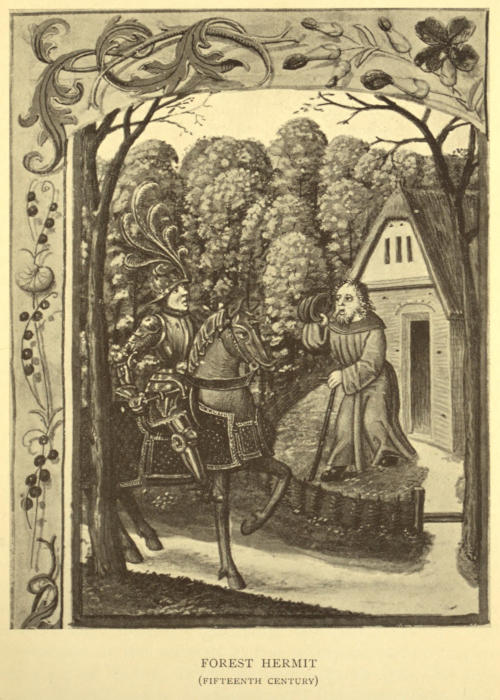
PLATE XV
FOREST HERMIT
(FIFTEENTH CENTURY)
The forest did not in any way suffer from the northern invasion of 1322, as it was saved by a war indemnity. For when the Scots that year made a bold foray into England, under Robert Bruce, and pillaged among other places the abbey of Rievaulx, which closely adjoined the liberty of Pickering, John Topcliffe, the rector of Seamer, and other leading men of the district, with the assent of the whole community, purchased the immunity of the vale and forest of Pickering from the river Seven on the west to the sea on the east. The covenant to effect this was made with Robert Bruce on 13th October, 1322, through the Earl of Moray, for 300 marks to be paid at Berwick. Nicholas Haldane, William Hastings, and John Manneser, at the request of the whole community, gave themselves up to Robert Bruce at Rievaulx on 17th October, to sojourn as hostages in Scotland until the money was paid. Afterwards the men of the community, although the Scots had kept to their bargain, refused payment, and the three Pickering hostages were still in prison in Scotland in July, 1325.
[110]
During Edward II.’s sojourn at Pickering in 1322 he gave 10s. to John, son of Ibote, of Pickering, for following him the whole day when he hunted the hart in Pickering chase, and also the roe deer.
The case of Sir John Fauconburg’s poaching came up again in the reign of Edward III. A close letter to the treasurer and barons of the Exchequer, of September, 1327, sets forth: That Sir John had shown the king, by petition before him and his council, that Hugh le Despenser, the younger, had lately caused Sir John to be indicted at Pickering, in Edward II.’s presence, for taking a hart and a hind, and caused him to be kept in prison until he had paid 100 marks fine, of which sum he paid 10 marks; that he prayed the king to be released from the remainder of the fine as he was indicted contrary to the law of the realm and of the forest; that the alleged trespass was made when Pickering forest was in the king’s hands by reason of the quarrel with Thomas of Lancaster, and it was ordained in the late Parliament that the king was not to have the issue of lands of those who were of the said quarrel; and further, that Sir John was indicted before another than the keeper of the forest, contrary to the law and assize of the forest. This last ingenious plea, namely, that Edward II. had presided at the Pickering court in person, instead of John de Kilvington, prevailed, and the barons were ordered, if they found that Sir John had been indicted before another than the keeper, to remit the arrears of the 100 marks.
Pleas of the forest were held at Pickering on 6th October, 1334, before Richard de Willoughby, Robert de Hungerford, and John de Hanbury, justices in eyre. The foresters-of-fee of the West ward were Sir William de Percy, who was present, and a lady forester, Petronilla de Kynthorp, who was represented by Edmund de Hastings as her deputy. The foresters-of-fee of the East ward, were Roger de Leicester, Hugh de Yeland, and William le Parker. All these had several sub-foresters under them. Sir Ralph de Hastings, the keeper of the whole forest, had seven foresters immediately under his control. Four verderers, thirteen regarders, and four agisters (two for each ward) were also present.
No pleas had been held since 1280, and the verderers, past and present, or their heirs, were bound to produce the rolls, [111]with vert and venison presentments, of their term of office. Alexander, the son and heir of Bernard de Bergh, deceased, appeared and handed in his father’s rolls, and the same happened with the sons of two other deceased verderers. In two other cases the sons put in no appearance, and the sheriff was ordered to seize the lands to compel attendances; the sons and heirs appeared before the court broke up, and were fined 40s. and five marks respectively. Two late verderers who were living appeared and produced their rolls. William Ward, late verderer, failed to appear, and writ was directed to sheriff; afterwards he appeared, and was fined half a mark for non-appearance the first day, and £5 for non-production of of his rolls, which he said had been stolen from him, and he knew not where they were. The successors of two other late verderers (deceased) were fined £3 for non-production of their predecessors’ rolls.
It was reported that Roger Mansergh, late forester-of-fee of the West ward, was dead, and that Petronilla, his daughter and heiress, came to perform the duties of her office and make her claim; another forester-of-fee of the East ward, Roger Bygod, late Earl of Norfolk, was dead, so that the same had remained in the king’s hands, and the constables of the castle, at their own risk, had appointed at pleasure Hugh de Yeland in his stead.
The rolls of those who had been agisters since the last eyre were also put in, in two cases by the sons and heirs of those who were deceased.
The constables of the castle, who were also wardens of the forest, were called upon to present their rolls and the muniments of the forest, since the last eyre held fifty-four years ago—they were Richard Skelton, William Levere, and Adam Skelton, all dead, the order of the court in each case being, “Let his successor appear and answer.” Then came John Dalton, a late constable, who produced his rolls. He was followed by John Kilvington, who said that during all the time he was constable, he was appointed, by commission from Edward II., warden of the honor, castle, and forest of Pickering, which was then for certain reasons in the king’s hands, and that as he had to render his account to the Exchequer all his rolls and other forest documents were in the king’s treasury, [112]so that he could not produce them, and he referred the justices to them. The late constable’s statement was then proved on oath by forest ministers, and in order to save time the justices decided not to send to Westminster to inspect the returns and accounts, and contented themselves with fining John the nominal sum of half a mark for non-production. Thomas Ugretred and Simon Simeon, both short-lived constables, did not appear or send any deputies or rolls, and writs were issued in each case. Sir Ralph Hastings, the then holder of the office for life, by appointment of Henry, Earl of Lancaster, made due appearance, and produced his documents.
With regard to the list of essoines before the justices, the majority of them were proved to be dead, and therefore no further proceedings could be taken in their case or in that of their bail.
The list of indictments by the foresters and verderers opens with a case of venison trespass on an exceptionally large scale. On 23rd March, 1334, there were gathered together at “Blackhodbrundes” (probably Blakey Moor) in the forest, a great concourse of people with greyhounds and bows and arrows; among them were several of considerable position, such as Nicholas Meynell (mentioned first) of Whorley Castle, Peter de Manley, the younger, heir to Mulgrave, John and William de Percy of Kildale, whilst other names of distinction, such as Wyvill and Colville, occur among the forty-two who were recognised.
The sport probably assumed the form of a great drive, for forty-three of the red deer (another account says sixty-three) were actually killed. By way, apparently, of showing their contempt for the foresters of the Earl of Lancaster, the sportsmen, before they left the forest, cut off nine of the heads and fixed them on stakes in the moor. Again, on 26th May of the same year, Nicholas Meynell, with Peter de Manley, and some others engaged in the former fray, but in a much smaller company, entered the forests with bows, arrows, and greyhounds; on this occasion, however, they had only taken one hind when the foresters came upon them, rescued the venison, and carried it off to Pickering castle. The special impertinence of this game trespass was that Edward III. had only arrived at Pickering castle on a visit to the Earl of Lancaster [113]on the previous day. The king tarried there till 30th May, and the eyre that was held a few months later was probably brought about as the result of this wholesale poaching by men of position.
None of the transgressors put in an appearance before the justices, and a writ was directed to the sheriff to compel their attendance. Eventually certain of them appeared, were convicted, imprisoned in the castle, and ransomed on finding pledges and paying fines—Nicholas Meynell £13 6s. 8d., Peter de Manley and William Wyvill £10 each, Robert Colville £6, Robert Staynton and two more £1 each, whilst twenty others were fined in sums varying from 13s. 4d. to 5s. Three more appeared later before the justices at Hackness, and were imprisoned and ransomed; the rest did not appear, and as the sheriff failed to find them, and they had no goods in his bailiwick, they were outlawed.
Sir Ralph Hastings, the then constable and keeper, was himself charged with venison trespass in 1327, but he produced a pardon from the Earl of Lancaster, dated 13th August, 1334.
Another trespasser who produced a pardon was Edmund Hastings, who, with certain of his household, hunted a hare by night on Midsummer Eve, 1316, and carried it home to Roxby. Edmund appeared and produced a pardon signed by Thomas, Earl of Lancaster, soon after the offence, as well as from his nephew Henry, the present earl.
A considerable proportion of the venison trespassers were men of good family, such as Moryns, Acclams, and Boyntons, in addition to those already named.
Here, as elsewhere, a certain number of the secular clergy were found to be culprits. Walter Wirksall, chaplain of Westerdale, was convicted of twice joining a poaching party in 1328, and was fined £1 6s. 8d. Robert Hampton, rector of Middleton, kept four greyhounds, and often hunted hares; as he did not put in an appearance and could not be found, the rector was outlawed. John, the chaplain of Hackness, in 1312, and again in 1314, knowingly received unlawfully hunted venison; on his conviction he was fined £1 6s. 8d. During the time of the sitting of the eyre, John Shepherd, parson of Levisham, was caught by Edmund Hastings, forester-in-fee, in the act of killing a hart with bow and arrow in Haughdale; [114]he was taken to the castle and there imprisoned. On being taken before the justices, he and his companion got off with the light fine of 13s. 4d. each. On 10th July, 1311, a servant lad of William Nafferton, vicar of Scalby, and two other men, carried a hind, which one of them had killed, to the vicarage, but without the vicar’s knowledge; there they skinned it, and Dionysia, the vicar’s maid, was an accessory, for she had part of the venison; part she sent as a gift to Emma Pinchon, laundress of Newby, and the rest she sent out to the fields to the vicar’s ploughmen for their dinner. One of those who carried the venison to the house was fined 6s. 8d., and the rest were outlawed. Outlawry was the usual penalty for these venison trespassers where the offender was poor and could not readily be found. It is highly probable that not a few of such outlaws eventually returned to their parishes or homes in the lighter cases.
Many of the delinquents of the earlier years since the last eyre were doubtless dead, and where that was known to be the case the information was struck off. But one case brought before the justices in 1334 went back as far as 1289. In that instance two men of Farndale, who killed two hinds in Parnelldale on 1st July, 1289, were fined, the one 26s. 8d. and the other 40s., thirty-five years after the offence was committed.
The enormous amount of business of every kind that accumulated for the justices to supervise at these long-deferred eyres generally caused the proceedings to be very protracted. This one at Pickering, with occasional sittings at Hackness for the liberty of the abbot of Whitby, actually lasted for two years, though, of course, they were not continuous sittings.
Among matters investigated by a jury at these pleas was the general amount of venison taken in the forest since the last iter. The returns made showed that when John Dalton was constable and keeper, he took 134 harts, and 158 hinds, bucks and does, as well as five hinds that Henry Percy took by his leave, and three hinds, three calves (red deer fawns), two fallow deer, and two roe deer, which he took and gave away as he pleased. When he appeared before the justices, Dalton stated that when keeper under Earl Thomas he took harts, hinds, bucks, and does, and delivered them in accordance with the earl’s orders and produced his warrants. Among others were seventy-two harts, [115]fifty-six hinds, and forty-two fallow deer for the earl’s larder; fourteen harts and eighteen hinds for tithe to the abbot of St. Mary’s, York; three hinds for the Bishop of Ely; and a large number of single deer to all the chief families of the district. The two roe deer and two calves were taken accidentally by his hounds when in the forest, and he was not able to rescue them alive. He denied taking and giving away three hinds and two fallow deer, but judgment was given against him in that, and he was fined £2, and had to find sureties for good behaviour. During the time of his office several hundred oaks were felled that were chiefly used for the fortifications and repairs of the buildings and stockades of the castle. Dalton was able to produce warrants for all save five oaks, and for these he had to answer at the rate of 6d. each, and 30s. for the offence.
Kilvington, when he was constable, had felled 107 oaks in the forest, and 305 in Haugh Rise and Birkhow. In his time 152 harts and 159 hinds and fallow deer were taken in the forest. He appeared, and said that all that he had done was by royal warrant, save that thirty harts and fifty hinds had died of murrain, and that their putrid carcases were hung on oaks in the forest. He was given till 13th March, 1335, to obtain certificates from the Exchequer. These certificates were accordingly produced at that date, but as they did not entirely free him he was allowed to make a fine to the earl of £20 to clear the remainder.
Richard Skelton, the late keeper, was dead; the foresters certified that during his time 390 harts and 524 hinds and calves, etc., were killed, but about 500 of them died of murrain, and that he gave a hunt after the earl’s game to Anthony Bek, Bishop of Durham, and another to Robert Bigot, who in each case carried off their game; but they were both dead.
They also made short returns for the brief periods that William le Eure, Adam Skelton, and Simon Simeon were successive keepers; in each case there were many deaths from murrain.
Ralph Hastings was able to produce warrants for all vert and venison since he had been keeper.
The Regard of the forest, presented on the opening day of the eyre, introduced another class of business and investigation [116]set forth under the various statutory articles. In this case the sworn statements were of exceptional length, as they actually had to present all assarts made in the forest since 28th October, 1217, namely, for 117 years! Those between 1217 and the last eyre were termed old assarts, and those since the last eyre new assarts. All these assarts and enclosures, and encroachments and spoiling of woods have been set forth at length by Mr. Turton from the Coucher Book.
Agistment records were put in, beginning in the year 1290. The pannage charge in both the East and West wards was 1d. for a pig, and ½d. for a little pig, that is under half a year old.
Particular indictments presented to the justices, when sitting, in 1335, included charges against foresters of skinning a hart that died of the murrain and keeping its skin, worth 1s. 4d., to their own use; foresters taking and retaining pasturage fees; foresters keeping pigs, horses, and beasts unlawfully; the prioress of Rosedale usurping the right of having a woodward in Rosedale wood; and the wrongful appropriation of honey.
The cases of vert trespasses committed within the demesne since the eyre of 1280, that were presented at the eyre of 1334, numbered only 93; but it must be remembered that the swainmote courts had power of dealing with the minor offences of this nature, and that in many instances the trespassers and bail must have been dead. The majority of the cases were for taking green oaks of comparatively small value. The fines imposed varied from 1s. to £5. In addition to oaks, alders, hazels, hollies, thorns, saplings, and poles are mentioned. The present verderers were held responsible for the value-fines of the swainmotes that their predecessors had received. Clergy, both secular and religious, appear among the transgressors. Of the former, the rectors of Brampton and Middleton, and the vicar of Ebbeston, had to answer for comparatively small offences. Of the latter, the offenders included the abbot of Whitby (for a trifling offence), the priors of Bridlington and Malton, and the preceptor of Foulbridge. The prior of Malton had the distinction of paying the heaviest vert fine of the whole eyre. He took green thorn and hazels in Allantofts, value £1, and carried it to Scarborough for kippering his herrings. The prior appeared and was convicted, and though it was stated that he had never since been found within the bounds of the [117]forest, he was held responsible for the value, and was further fined the sum of £5. Three servants of the prior of Bridlington felled, for the use of the prior, a green oak by night in Fulwood value 2d. They were caught whilst carrying it away in a wagon worth 40d., drawn by four oxen, worth in all £1 6s. 8d., and were handed over to the late prior to be produced at this eyre. The present prior was held responsible, and in addition to the loss of wagon and oxen was fined 2s. One of the servants was dead, and the two others, who had been released on bail, did not appear. Their bail was ordered to be forfeited, when it was found that they were all dead. This was evidently an old case that had probably occurred soon after the last eyre; but the vert roll, unlike that for venison, unfortunately gives no dates. There are several other instances of forfeiture of wagons and oxen; in these the value was much lower than in the prior’s case, for the other wagons are all valued at 6d., and the oxen in sums varying from 2s. 8d. to 3s. 4d. each.
The various cases of cattle taken within the forest that were unagisted since the last eyre, included upwards of 150 different charges. Such cattle were impounded by the forest ministers, and as a rule their value was paid to the lord ere released. These sums appeared in the annual accounts of the forest. It seems that the usual course was for all these cases to be brought before the eyre, but that no further proceedings were generally taken if it was shown that the value-fine had been paid at the time.
The fines for non-appearance on the first day of this protracted eyre were astonishingly numerous. They were evidently levied according to the position of the offender, and the extent of his rights within the forest. Thus the prior of the Hospitallers was fined £3; Henry de Percy and Thomas Wake, £2; William Latimer, £1 10s.; and the abbot of Rievaulx and Sir Richard de Ros, £1. There were several fines of 3s. 4d., and others of 1s. 8d. In thirty-two cases there were 1s. fines, whilst 6d. was the forfeit paid by nearly 300 persons. The townships of Pickering and Goathland were fined £1 for non-appearance of their four men and reeves on the first day, and four other townships smaller amounts. In about a dozen cases there was no fine on account of poverty. [118]Robert Stephen, though fined 6d., had nothing to pay because he was a villein; whilst John Foxlove was pardoned his fine for two good reasons, as he was both poor and dead!
The records of various swainmote or attachment courts of this forest for the year 1407-8 are extant. At one held at Pickering on 17th September, the woodwards of Crosscliffe and Stayndale were each fined 2d. for non-appearance. The attachments for agistment of pigs in the West ward during the close month were numerous.
The attendance of the officials at these minor courts seems to have been slack. At a swainmote held on St. Matthew’s Day, the forester of Alayntoft was fined 2d.; John Gower, one of the verderers, 6d.; William de Roston, deputy regarder, 4d.; John Westhorpe, regarder, 4d., for absence. The township of Brymyngeshoe was at the same time fined 6d. for the absence of their reeve and four men.
Fines were paid this year before John de Sultan, lieutenant for William de Roos, lord of Hamelake, the keeper of the forest, for the lawing of dogs. The West ward paid the large sum of £10 18s. 8d., duly portioned out among the different townships; Pickering, with Goathland, paid 60s.; Cropton, with Hartoft, 30s.; whilst others like Newton only paid 3s. 4d. The sum received for a like cause from the East ward was £3 0s. 8d.
The due number of courts, namely, one every forty days, were held in 1408 at Pickering, and other forest centres. At the Langdon court, Sir David de Rouclyffe was presented for having felled in Goathland, in a close called Malton close, nine oaks for a balk then being made in Pickering at a place called Barylgate, and also seven oaks and twenty-three logs of willow and linden for building there.
The forests pertaining to the Duchy of Lancaster naturally suffered severely during the Wars of the Roses, and perhaps none more so than Pickering. In October, 1489, Henry VII. enjoined upon Brian Sandford, steward of the honor of Pickering, constable of the castle, and “master forster of our game within the seid honnor,” that no manner of person be permitted in any way to take or disturb the game for the space of three years—“As it is common unto our knowledge that our game of dere and warenne within our seid honnor is gretly [119]diminnished by excessive huntyng, and likely to be destroied, without restreyn in the same be had in that depart.” “We desire,” continued the king, “the replenisshyng of our seid game not only for our singler pleasure but also for the disport of other oure servantes and subjettes of wirshipp in theis parties.”
The country had apparently not sufficiently settled down for justices to be spared at this period to go through the long processes involved in forest pleas at Pickering, and the king, in 1494, appointed Brian Sandford and Richard Cholmley to act as commissioners in procuring inquests as to the various transgressions in the forest, taking cognisances of all offences for the past five years. The jury, which included five esquires and three gentlemen, first presented that, on 1st July, 1489, Leo Percy, lately of Ryton, esquire, a forester-of-fee, killed a buck which Sir Thomas Metham had; on 12th July, a buck, which Master Babthorp, reeve of Hemingborough had; on 20th December, a doe, which John Clay and Robert Milner of Kirby Moorside had; on 22nd December, three does, one of which went to Sir John Pickering, another to Sir Thomas Metham, and the third to John Hotham, of Scarborough; and also at divers times six does and one hind in the park of Blandsby for his own use. In 1490 he killed nineteen, in 1491 nineteen, in 1492 fifteen, and in 1493 twelve, disposing of them to such persons as those already named, as well as to the prior of Watton, the rector of Levisham, Sir Marmaduke Constable, Guy Fairfax, and Robert Constable, of Holm.
They also charged Roger Hastings, one of the foresters-of-fee, with taking twenty deer.
On the other hand, Lionel Percy and Roger Hastings each claimed as foresters-of-fee two harts and two bucks in summer, and two harts and two does in winter; but the jury disallowed this, and returned that they were only permitted one course for their dogs twice a year. The two foresters claimed from every deer slain within the forest both the shoulders as well as the entrails, or numbles (barbillas, que barbille proprie nounbilles evocantur). But the jury disallowed this, stating that the foresters-of-fee had only a right to the left shoulder, the right shoulder and the entrails belonging to the master forester or his lieutenant.
[120]
In a schedule supplied to the Commission of fallow deer killed or taken out of the park of Blandsby, within the honor of Pickering, by the steward and his deputies or by others at his command, 12 are entered for 1488, including a buck each for the dean of York and for the abbot of St. Mary, York; and 12 died in the summer of that year of murrain. Of the 15 does killed at Michaelmas, in 1489, 6 were retained by the steward and 2 by his clerk; 6 died of murrain. But of 16 deer killed at Easter of that year, the steward kept 4 bucks, and his clerk 3 does; the murrain carried off 8 male deer. At Michaelmas, 1490, 13 deer were killed by the steward’s orders, all does, of which the dean of York received one; the murrain was responsible for the death of six. From this date up to the holding of the Commission the number of deer killed by the steward’s orders averaged 15 a year. Of those killed at Easter, 1491, a buck was assigned to “the weddyng of Crystofer Peghen,” and another “to making of a Preest.” The last entry probably refers to a feast given at Pickering by the parents of one who had been admitted to priest’s orders.
A separate schedule was presented of “the herts, hinds, and other reade dere which have been taken by Bryan Sampford Esquyre, steward of the honor of Pykeringe,” or his deputies, between 1488 and 1493. They included 9 harts, 3 hinds, 2 brocket, and 1 “Hyrsill.” A hind was also found hurt with a harrow in Newton Dale, which had to be slain. During this period 15 red deer died of the murrain.
A prolonged and fierce dispute arose between Hastings and Cholmley as to this forest, of which extraordinarily full records are still extant. Members of the Hastings family had been frequently stewards of the honor of Pickering, constables of its castle, and masters or keepers of the forest for some two centuries. Richard II. had appointed Sir Edmund Hastings to these offices, and Henry VII. had confirmed the appointment, and made him also keeper of Blandsby park in the second year of his reign. But Henry had soon cause to note the lax way in which the old officials of the duchy discharged their duties, and on the death of Sir Edmund Hastings severed the official connection of that family with the honor of Pickering. Sir Roger Hastings, as tenant of Kingthorpe, became one of the foresters-of-fee, but Brian Sandford became master forester and [121]steward. Within five years, however, of his being appointed, the new steward’s laxity in both vert and venison came before the very court of which he was joint commissioner with Richard Cholmley, whilst two of the other chief offenders were, as we have just seen, foresters-of-fee. The jury were themselves so tainted that they failed to convict, and eventually Brian Sandford was removed, and Sir Richard Cholmley appointed in his place. Though a man of eminence, Cholmley had then no connection with Pickering or the district, and his advent and that of his family was bitterly resented by the Hastings, who were not only jealous, but resentful towards the stricter forest rules.
In 1501 complaint was made to the chancellor of the duchy by Sir Roger Hastings, one of the king’s foresters of Pickering forest, against Sir Richard Cholmley, master of the forest and his deputies, for suffering great waste of both wood and deer in the forest and park. The charges are set forth with much particularity in a long schedule. The list of waste in those woods of the king’s demesne, where no free tenants were entitled to have any live trees, opens with thirty-six oaks assigned to the abbot of Whitby and twenty oaks to the dean of York. The allotment of forty-six other oaks is also specified. Various charges were made against the master’s servants, the gravest of which was:—
“Item, the said Richard Chomely hath a servaunt called John Colson, and he dayly ledes away the kinges wode be horse lade to Scarbrough, some day iiij horses, and oft tymes vj horses dayly this vij yeres and every yere to the value of v li, sum xxxv li.”
The waste in the wood called “the Yath” was said to be very considerable; about 150 loads of wood are enumerated, with the names of those who had them in a single year, as well as a great many stubs. In the same year, in the grounds of Deepdale, about 100 oaks had been felled by the officers and servants of the master, out of which only a very few had been used towards the repair of the castle walls.
As to the destruction of the king’s game, Sir Richard Cholmley was charged with hunting, chasing, and slaying with greyhounds, bows and arrows, or permitting to be slain by others, between 1499 and 1501, the following deer, the date, place, and name of the exact offender being in each case [122]chronicled. Fallow deer: 4 buck, 2 sowers, 3 does; red deer: 14 stags, 5 bucks, 17 harts, 19 hinds, 18 calves (both hind and hart, but not always specified which), and 3 hyrsills. In addition to this, 6 stags, 1 hart, 1 hind, and 1 calf had been found dead in Langdon and Newton Dale with arrows in them.
The answer of Sir Richard Cholmley to the bill of complaint of Sir Roger Hastings was brief, vigorous, and to the point. He said that the charges were false, and only intended to vex and trouble him, that neither the abbot of Whitby nor the dean of York had ever had any timber out of Pickering forest since he had been an official; that the whole of the charges as to the waste of wood were false, save that stubbs were delivered to certain tenants by his officers for “firebote,” according to ancient usage. As to the game, he had given “certain dear to the lords and gentylmen borderyng unto the said forrest to thentent that they shuld be lovyng and favorable to the kynges game there,” and that their number and condition were better than they had been when he entered on his office.
As a counterblast to this long and definite complaint, Roger Cholmley (brother to Richard) and others laid complaints of a much shorter character before the chancellor, in the following year, as to certain offences committed by Sir Roger Hastings in Pickering Lythe.
It became necessary to hold a local inquiry. The inquisition was opened at Pickering on 1st May, 1503. The jury found that in the year 1501 a stag was killed at Cross Cliff for Lord Clifford; a hart at Goathland for the Bishop of Carlisle; a stag for the Archbishop of York; a hart for the Abbot of Fountains; a stag for the Receiver-General of the Duchy; a stag for Mr. Empson; a stag killed by Sir Richard Cholmley and given to the Ambassador of Scotland; a stag killed by Sir John Hotham and Sir Richard Cholmley; and a brocket killed by Sir Ralph Bigot; also a buck and doe without licence by two yeomen. The jury further stated that the red deer in the forest of Pickering then numbered “200 over and above the number that were founden at thentre of the said Sir Richard Cholmeley, and whereas the said Sir Richard upon iiij yeres passed founde at his entre to said parke (Blandsby) xviij score falowe dere, there be nowe 500 or more.”
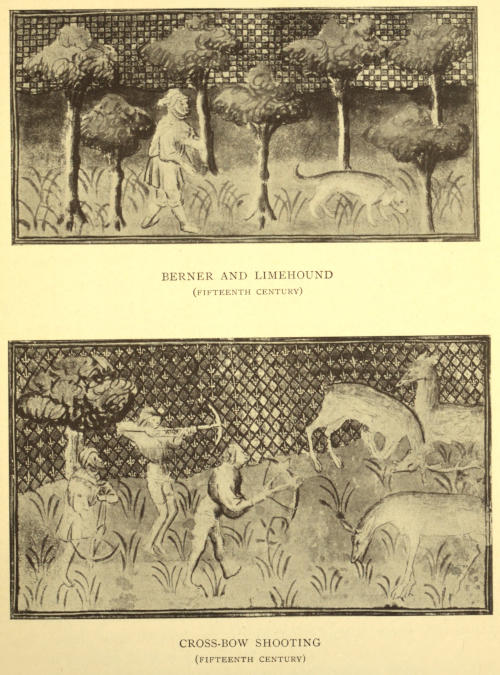
PLATE XVI
BERNER AND LIMEHOUND
(FIFTEENTH CENTURY)
CROSSBOW SHOOTING
(FIFTEENTH CENTURY)
[123]
As to the charge of wood wasting, the jury were equally emphatic, declaring that neither Sir Richard, nor his brother, nor any of the officials, “did sell, give, nor emploie to theire owne use any maner of wodde, excepte suche tymber and wodde as by theym hathe beene delivered to the King’s tenaunts and freehoolders as of right and due unto them.”
In addition to the findings of the juries, William Savage and Thomas Magnus, before whom the inquest was held, appended other valuable proof as to the condition of the forest and park. They stated that they had diligently examined on oath the foresters, keepers, and woodwards, as well as other persons, and that even those who were adversaries of Sir Richard had to admit that there were at least 200 red deer, a greater number than when he entered on his office; whilst Sir Richard and others deposed that they now numbered 300. The Commissioners resolved to test the matter for themselves:—
“Item, we being perfitely enformed that the circuit of the said foreste conteynneth upon lx myles aboute, did take with us viij persons, and went sodenly into the said foreste, and notwithstanding there be noe lawnde wherunto the said dere shulde resoorte, but all the moores in corne for the kingges tenants there, yet natheless the said viij persons brought unto us withyne two houres vij or viij score Rede dere, and soe we vewed thaym at the same sodeyn assemble.”
As to the park, Sir Richard’s adversaries did not deny that there were 400 fallow deer, whilst his friends deposed on oath that there were 500; the Commissioners on view believed the latter statement to be true.
The foresters were accustomed and allowed to occasionally take dead wood to Scarborough and elsewhere for sale; but in the case of John Colson, “he fortuned to toppe the toppes of certaine stubbe oakes, and sold the same with his wyndefallen wodde at Scarborough.” But directly this came to Sir Richard’s knowledge, John Colson was dismissed from office openly in court, and imprisoned in Pickering castle until he found sureties for his future good behaviour.
The deer of Pickering forest dwindled during Henry VIII.’s reign. In a return of all the king’s deer north of the Trent, drawn up in 1538, there were but 140 fallow deer and 50 red [124]deer in the forest. But perhaps the deer in Blandsby park escaped reckoning.
An inquisition was held as to the condition of the forest in 1562, the returns of the juries covering the period since the death of Henry VIII. It was stated that since that time Sir Richard Cholmley had felled eighty oak trees in Goathland, and much in other parts of the forest to his own use, and that he had used much timber in the making of his house at Roxby; that Sir Richard had taken down fourteen loads of the best dressed stones out of the chief tower and other parts of Pickering castle to build his gallery at Roxby, the castle being in ruin and decay; that the red deer were viewed to be 264, whereof 54 were male deer; and that the fallow deer in Blandsby park and woods adjoining were 600, whereof 77 were male.
In 1591, the killing of any deer, red or fallow, within Pickering forest, was prohibited for three years, as the stock was getting greatly diminished.
A survey of the woods taken early in 1608 mentions that the wall of stone round Blandsby park was greatly decayed in many places, and that there were then about 100 deer in it.
The elaborate survey taken in 1619-21 by John Norden, sworn to by forty-one jurors, gives full particulars as to bounds, woods, wastes, encroachments, and general manorial details. Norden complains that “the tenantes about Pickeringe are so unrulie, as they make their owne pervers wills a law.” In connection with the “spoylers of woode,” mention is made of oak, ash, alder, and maple. There were no keepers’ lodges in any part of the forest save in Blandsby park, where there were two.
“The foreste game shoulde be redd deere, but few lefte within the foreste, and they that are raunge into confininge woodes of Sʳ Thomas Posthumus Huby, having litle or noe covert els within the foreste, but Newton Dale onlie, where they are often disturbed with stealers of woode, so that it is manifest that for everye redd deare in the forest there are 5000 sheepe. The parke is replenishte with fallow deere, but being unstaunchte (unsatisfied) they raunge over all the adjacent feildes.”
A detailed survey of the honor and its members was also [125]drawn up in 1651. “Wee find,” say the Commissioners, “that within the Honor of Pickering there is a Forest, a Chace, and a Parke (as it did appeare unto us by an ancient Veredict, and by the Testimony of many ancient Inhabitants), and also certaine Lands that are no part of the Forest.” Neither red nor fallow deer are mentioned, but they could not have been extinct.
The honor of Pickering had been settled on Queen Henrietta Maria as part of her jointure. At the Restoration it reverted to her, and a survey was made in 1661. It is therein stated: “There is a forest called the forest of Pickeringe Leighe, and a park called Blandesbie parke belonging to the Honor. The Parke is stored with deare, but the game within the forest is almost quite decayed.”
In the centre of Yorkshire, extending right up to the walls of York, was the great hunting district known as the forest of Galtres. It stretched at one time about twenty miles northward from York to the ancient town of Aldburgh; being royal demesne, it was a favourite hunting-ground of the Saxon kings. From the days of Henry III. downwards, the incidents connected with this forest and its administration are of frequent occurrence, and it is strange that it has not found an historian. The exigencies of space only permit a few brief extracts. The two Yorkshire forests, whose officials received express directions as to the disposal of the cablish after the great storm of 1222, were those of Galtres and of the district between the Ouse and the Derwent. In 1227 Henry III. ordered the bailiffs of Hugh de Neville in the forest of Galtres to supply wood and charcoal for three days for the use of the archbishop in his house at York. In the same year the king gave four oaks out of this forest for the repair of the bridge at Topcliffe, and ten oaks to the prior of Marton for the building of his church.
A perambulation of the forests of Yorkshire was made in 1229, when it was certified that the whole forest of Galtres, the forest between the Ouse and the Derwent, and the forest of Farndale were true ancient forests of the king.
In 1231 oaks were furnished from this forest for the repair of mills at York, and on October of that year the king ordered [126]fifty hinds to be supplied for his use (salted venison) in the coming season from Galtres forest; in the same month he instructed the sheriff of York to obtain a sufficiency of wood and charcoal from this district against his coming visit to York on the Sunday before Martinmas.
Edward I., in 1280, gave the prioress and nuns of St. Clement’s, York, six oaks fit for timber out of Galtres, and made a like gift to the Franciscans of Scarborough. In the following year Geoffrey de Neville, the keeper, was ordered to supply twelve bucks to the Earl of Surrey; whilst six does were presented to the Archdeacon of Newark in the ensuing January. In the summer of 1283 there were numerous royal gifts of bucks from Galtres; on 18th September the keeper was directed to supply Anthony Bek, the elect of Durham, with twenty-five bucks.
Philip le Lardiner, son and heir of David le Lardiner, obtained seisin of the serjeanty of the forestry of the forest of Galtres, after doing homage for it, in January, 1284, which David at his death held of the king in chief. In the same year the Franciscans of York obtained six oaks for the work of their church; whilst the dean of York (Robert de Scarborough) obtained ten live does to help to stock his park of Brotherton, and the master of St. Leonard’s Hospital, York, four live bucks and eight live does to stock a park of his. In 1286 a regard was ordered to be taken in preparation for a forest eyre.
On 28th October, 1307, the sheriff of York received a mandate to assemble the foresters and regarders of Galtres to make a regard prior to the arrival of the forest justices. They were to elect new regarders in the place of those dead and infirm, so that there were twelve in each regard. The foresters were to swear to lead the twelve knights through their bailiwicks to view all trespasses which were to be expressed in the written capitula sent to the sheriff. The knights were to swear to make a true regard, and if the foresters did not lead them, or wished to conceal any forfeiture, the knights on that account were not to omit to view the forfeiture. The regard was to be made before the Feast of the Purification. Assarts made since 2 Henry III. were to be viewed, and their acreage, sowing, and ownership, and all other particulars, written down. All purprestures, [127]old and new, were to be likewise stated in full detail.
Orders were given in 1308 for the tithe of the whole venison taken in Galtres to be delivered to the abbot and convent of St. Mary’s, York, in accordance with the grants of the king’s predecessors. In 1311, and on various subsequent occasions, the king ordered the sheriff to cause new verderers to be elected for Galtres in the place of those removed by the Crown for insufficiency. Forest pleas were held at York in 1311, and again in 1313.
Various attachment court rolls of this forest, temp. Edward II., are extant. There were six such courts held in 1313-17, namely, three at Easingwold, two at Huby, near Sutton-on-the-Forest, and one at “Hillulidgate.” The fines imposed were chiefly for taking wood by the cartload. The Epiphany court at Huby imposed a fine of 6d. for twenty-four such cases, and one of 12d. The fines at the Easingwold court, at Ascensiontide, amounted to 18s., and included sixteen at 6d., two at 1s., and four at 2s., all vert cases. The fines at the St. John Baptist court at Huby included thirteen cases of turning out horses at 6d. each, and one of 3s. 4d. for the irregular agisting of pigs. At another court there was a small fine for collecting acorns.
The number of courts held annually seems to have been irregular; but possibly those only are entered where there was business to transact. Thus the rolls record eight courts in 1317-18 and eleven courts in 1318-19. In the latter year William Carlton, butcher, of York, was fined 2s. for twelve pigs taken in the forest in time of pannage. At the same court the straying of a black runt or steer (unum runctum nigrum) cost the owner 12d., and there was also a fine of 6d. for the straying of a colt (pro haymaldatione j pullani). The pannage of pigs at Huby brought in 3s. 10d.; at Easingwold, 26s. 1d.; pigs were charged 1d. each, and little pigs ½d. The fence month payments of the different townships amounted to 10s. 1d.; cheminage dues to 10s. A much larger sum was obtained when the dogs were lawed. In one year of this reign the lawing fees amounted to £9 8s.; the payment was 3s. in each case, save in one instance, when the owner pleaded poverty, and the fee was lowered to 12d.
[128]
A perambulation was made on oath as to the bounds of this forest in 1316, from which it becomes clear that the forest of Galtres comprised about sixty townships, containing within its demesne about 100,000 acres, or nearly the whole of the wapentake of Bulmer. The boundary line, beginning at “the foot of the wall of the city of York,” passed nearly due north to Crayke, and thence round by Stillington, Farlington, and Strensall, and so to Huntingdon, “even to the foot of the wall of Layrthorpe Bridge, where the perambulation began.”
The bounding jury also testified that there was but one forester-of-fee in this forest, namely, John Hayword, who held his bailiwick for the term of his life by the gift of Edward II.
In 1472, John Shupton, who held the office of riding forester in Galtres by letters patent of Henry IV., surrendered his letters in Chancery to be cancelled in favour of his son William. This was granted on payment of the usual fees, with £4 yearly for certain herbage.
There are also various Galtres attachment court rolls extant of the reign of Henry VI. (1422-60). Interesting reference is therein made to the custom of Thistiltak, or thistletake, though not at that period producing any appreciable income. “Thistletake” was a term at one time in use in Yorkshire, Lancashire, and Cheshire for a customary fee of ½d. a head from drovers, through certain forests or over certain commons, if they permitted their beasts to graze to any extent, even to the snatching of a single thistle.
In 1432 the agistment of cattle produced 15s., and the pannage of pigs 6s. 4d. Fines for taking a cartload of “ramell” (copse-wood) varied from 4d. to 6d., and for a cartload of “grissell” (which seems to have been a term for fresh cut grass for fodder) 6d. to 8d.
In 1483 Richard III. granted for life to his servant Geoffrey Frank, one of the esquires of the body, the office of the keeper of the king’s laund within the forest of Galtres, with fees of £10 yearly at the hands of the receiver of the lordship of Sheriff Huttun, and other profits. Grants were also made about the same time by the king to two out of the four foresterships; each of the four foresters had a wage of 4d. a day. Another office filled by [129]Richard III. in the following year was that of steward of Sutton within the forest of Galtres.
Some interesting particulars relative to this forest occur in connection with an eyre of the time of Henry VIII. At pleas held on 17th June, 1528, William Maunsell appeared as chief steward; Francis Coket was riding forester; Sir George Lawson and John Jenynges, Esquire, were the two foresters, each with a deputy; Ralph Hungayth, Esq., and Christopher Fenton, gent., were the two chief verderers. The constable and four men from each of the townships of Easingwold, Haxby, Alne, Tollerton, Newton, Skelton, Clifton, Mugginton, Huby, Strensall, and Stillington appeared.
Among the presentments were an assart of 80 acres by the treasurer of York Cathedral, a forester selling 100 loads of underwood in the last twenty years, the neglect of paling launds, the grazing of too many cattle, and trespass with crossbow and greyhounds.
Lord Cromwell, as chief justice of the forests, in addition to the privilege of common pasture for twelve score horned cattle, received £6 13s. 8½d. in fees from different townships.
“The office of the Ryding Forester with his fees accustomed” is thus set forth:—
“Furst the Rydyng Forester office is to ryde the perambulations with the kepers and the King his tenauntes at the tymes accustomede, to see and enqueare of all them that kepythe anye Closyng in Severallie that ought to be open in Winter, And also to hunte the purlewes and outer groundes with his houndes according to thoffice of a keper.
“Item the saide Rydyng Forester haythe in his Fee accustomede within the saide Foreste as folowethe Fyrste of Saynt Marie in Yorke iijs iiijd, of the Maister of the Comons their ijs, of Saynt leonardes in Yorke iijs vjd, at Huntington of holme landes iijs iiijd, of the Vicarage of Sutton ijs, of Shipton lands in Shipton ijs, at Newton upon Ouse iijs vjd, at Easingwold of the Kyng his tenauntes their ijs vjd, at Newbrough ijs, at Byland ijs, in tachment monye iijs.
“Suma, xxixs ijd”
“The office of the Bowebearer and Receyvor wythe his fees accustomed.
“Furste the saide Bow-bearer ought dailie to walke throughe all the saide Forest as one keper ayther by hym selve or his deputie or [130]deputies. Also he hayth in his Fee all forfayte Skynes bothe in Wynter and Somer by accustome. Also he haythe in Fee of Saynt Marye Abbaye in Yorke xijd, in Tachement monye iiijs one yere & iijs vjd one other yere, at Newborogh xijd, at Bylande xijd. Item he haythe oute of the Extreacte for his receyvourshippe 40s.
“Suma viij li viijs xd”
Cromwell also held the office of master of the game in this forest, and was declared entitled to rights of herbage, pannage, browsing, “cokkyes or the netting of woodcocks, windfallen wood, fishing and fowling, and the Laund House lodge with its herbage, of the estimated annual value of £10; also 12d for gayte lawe in the hole forest of every 20 horse 6d, of every 20 cattle, & 4d every score of sheep, & 2d of every pakkehorse, 2d for the hole year of every wayne, in fence moneth 4d other time 2d; also 34s 8d St Thomas day, and the last day of fence moneth in certain proportions from the townships. Suma £20. 1. 0”
The jury returned that “gate-lawe” had been leased for 26s. 8d. and had been highly misused by the farmer. They considered that gate money might be taken of all the “bounderers” that carried their own wood 2d., and 4d. if carrying other men’s wood, together with ½d. for every horse; also 4d. for every horse carrying merchandise or other stuff to or from the city of York.
During the civil war of the seventeenth century, which raged so fiercely round York, the forest of Galtres naturally suffered severely. It was disafforested in the time of Charles II.
Lack of space prohibits any reference to the Yorkshire forests of Hatfield Chase, Knaresborough, and Wensleydale.
[131]
The history of the royal forest of Wirral, as well as of other Cheshire forests, yet remains to be written. There are two large histories of the hundred of Wirral (Mortimer, 1847; and Sulley, 1889), but neither of them give more than a sentence or two to the story of its forest. There are citations from and references to various documents pertaining to this forest in Helsley’s fine edition of Ormerod’s Cheshire (1882); but there is much information to be gleaned that has not been touched.
On 11th September, 1275, the Crown instructed Gaucelin de Badelesmere, justice of Chester, to permit Roger Lestrange to take two stags in the forest of Wirral for the king’s use, and to cause them to be salted and brought with other venison to the king at Westminster by Michaelmas.
In August, 1279, the same justice was ordered to cause the abbot of St. Werburgh’s, Chester, to have a hart in Wirral forest for the feast of that saint.
Licence was granted, in 1283, to the lepers of the house of Bebington, within the forest, to enclose five acres of their waste and bring it into cultivation; but the dyke was to be a small one and the hedge low, so that the deer if they desired could leap it. In 1303 a hind that was found dead in the forest, with an arrow in its side, was given to these lepers according to the forest assize, but the arrow was the perquisite of the forester.
By an ordinance of 1284 it was provided that a hart was to be given annually to the abbey of Chester on the feast of St. Werburgh, and also the tithe of the venison yearly, in aid [132]of the great work of the building of the church, as was done in the forest of Delamere.
In 1328 the chamberlain of Chester was ordered to pay Richard de Weford the arrears of his wages as riding forester of Wirral, and to continue them annually, as the king had appointed Richard to this office at the request of Queen Isabel before his accession, in consideration of his services to her, and he was to hold this office for life provided he conducted himself well in the bailiwick. There seems to have been some neglect about this order, for it was repeated in 1329 to Oliver de Ingham, justice of Chester.
The citizens of Chester suffered so much from the shelter afforded to marauders by the forest so closely adjacent to its walls, that they petitioned Edward the Black Prince, then Earl of Chester, to cause it to be disforested. This was accomplished, but not until after the prince’s death, just at the close of the reign of Edward III. The Stanleys valued the perquisites of the master forestership at £40 per annum, but only received a pension of twenty marks on the abolition of the forest jurisdiction. Although at this date they lost all power and perquisites, the Stanleys of Hooton long continued titular foresters of Wirral, and were so styled in documents of the reign of Henry VII.
There was a good deal of woodland throughout the forest of Wirral in early days, as is proved, inter alia, by place and field names such as Woodchurch, Ashfield, Maplegreen, Okhill, etc. Place names also show where the lodges of several of the old wards or divisions of the forest stood. There is an old adage that says:—
That is, from Chester to the extreme north-western point of the peninsula of Wirral; but it is highly unlikely that this was the case in historic times. At all events, the wood had seriously diminished some years before Wirral was disforested, for in 1359 William Stanley, the hereditary forester, received a grant of four oaks out of the forest of Greves from the Black Prince, as he understood that Stanley had no wood for fuel in his own forest.
[133]
Within this forest was Shotwick Park, attached to the strong royal castle of that name. Various references to the game and timber in this forest are given by Ormerod.
These two considerable forests of Cheshire are generally mentioned in old documents in conjunction, although they had in some respects separate jurisdiction. The whole of this united forest district extended over all the hundred of Eddisbury save a few parishes, and over a greater part of the hundred of Nantwich. The forest of Mara was bounded by the Mersey on the north, and had the forest of Wirral on the west, whilst that of Moudrem stretched out to the south-east in the direction of Nantwich.
Ormerod tells us that “the jurisdiction was originally vested in four families”—Kingsley of Kingsley, Grosvenor of Budworth, Wever of Wever, and Merton of Merton, by which we suppose is meant that these four families held hereditary foresterships-of-fee. The master forestership of the whole was conferred early in the twelfth century on Ralph de Kingsley to hold on horn tenure, in the same way as that of Wirral. The Dones afterwards succeeded to the Kingsleys in the master forestership and in the forestership-of-fee. At the forest pleas, held at Chester in 1271, each of the four foresters-of-fee were fined heavily for destruction of woods; Done and Grosvenor £13 6s. 8d. each, Merton £10, and Wever £5. Richard Done, as chief forester of Mara and Moudrem, claimed at that eyre to have eight under-foresters and two grooms, who boarded with the tenants; two strikes of oat at Lent from every tenant for provender for his own horse; bracken at all times save the hunting season; pannage and agistment of pigs; windfalls, and lops of felled trees; crabstakes and stubbs; half the bark of felled trees; all cattle and goats taken at non-agistment times, ½d. each, and the same of straying beasts between Michaelmas and Martinmas; all sparrowhawks, merlins, and hobbies; all swarms of bees; the right shoulder of every deer taken in the forest; the horns and skin of every “stroken deer” found dead; waifs found in the forest; the hunting of foxes, hares, cats, weasels, and other vermin with [134]hounds or greyhounds; and the pelfe, or best beast of any that committed felony or trespass in the forest, and fled for the same, the lord having the residue.
The forest of Delamere, as it was afterwards called, was disafforested by Act of Parliament in 1812. Various interesting particulars are given by Ormerod, chiefly taken from the Harl. MSS.
A joint eyre was held at Chester for the forests of “Wirrall, Mara et Moudrem,” in August, 1347, which has hitherto escaped the attention of county historians. It was over twenty years since the last of these pleas had been held. Thomas de Ferrars was the justice in charge of the pleas. A considerable number of claims were brought forward, supported by charters which were enrolled. Among them were the claims of the abbots of Chester, Basingwerk, and Chester. One of the lay claims was that of William de Stanley, as chief forester of Wirral, to hunt hares and foxes with greyhounds at all times of the year; and that of John de Pennesley to dig turves, burn charcoal, and to obtain litter at any time of the year in Wirral forest, and to hunt with greyhounds and other dogs on foot, as well as large rights of pasturage. But some of the claimants overreached themselves, and were fined for making claims which they failed to establish. Among those who were thus mulcted were the abbot of Basingwerk, 40s.; the abbot of Vale Royal, 21s., and Robert de Bradeford and Robert de Swynnerton half a mark each.
There were a very great number of cases of purpresture or encroachment at these pleas, showing that the regard that preceded the pleas must have been a thorough one. As examples, the following may be briefly mentioned: John Hotherinde was indicted for building a certain house without warrant; he was declared in mercy, and the house was ordered to be levelled. Richard de Trafford had enclosed five acres without warrant; he was in mercy, and the fences were to be destroyed and the land thrown open. Robert le Hog was charged with taking eighty acres of moor and marsh in the parish of Wimbalds Trafford for agisting his own beasts without warrant, to [135]the annual value of 40s., and this for the last twenty years, so that there was neither agistment nor pannage for anyone else; he was declared in mercy, and the eighty acres were to be taken from him. In another case a man had erected a mill without licence, and the building was ordered to be pulled down; and in another case a man was in mercy for opening a marl pit.
The vert presentments of Wirral forest were exceedingly numerous. They were all cases of felling trees, not mere lopping. Their values varied from 2s. to 40s. Like presentments were also very numerous from Mara and Moudrem; the value charges, in addition to court fines, varied from 2s. to 20s. In some cases the transgressions were of a wholesale character, such as that of Thomas de Erdeswyk, who had felled sixty oaks. He was dead, but his wife appeared, and was fined a mark. Sir William de Legh, deputy keeper of Mara and Moudrem under Richard Doun, was charged by the jury with selling wood out of the lordship to the value of more than £100, and the same in conjunction with the sub-forester, doing the like in the forest of Moudrem to the extent of 100 marks. It is interesting to note the appreciation shown for a well-grown and beautiful tree; Peter de Thornton was charged with felling and carrying off una pulcherrima quercus, valued at 40s.
The venison cases show that there was an abundance of game, both red and fallow. Richard Spark was charged with killing many harts and hinds, as well as bucks and does, in Delamere forest, the exact number not being known. In Wirral forest two men who had killed a stag were released from imprisonment on paying the respective fines of 40s. and 20s. In another case in the same forest the transgressors had been hunting deer with a strangely mixed pack, consisting of a greyhound, a mastiff, and a cur.
The presentments at these pleas were made, for Wirral, by William de Stanley, keeper; Henry de Acton, riding forester, and by Richard de Haydock and five other foresters; those for Mara et Moudrem, or Delamere, by Richard Doun, keeper, Thomas de Clyve, riding forester, and by Robert Shefeld and six other foresters.
[136]
Cheshire possessed another considerable forest on the east side of the county. About a third of the large hundred of Macclesfield, including the town of Macclesfield and eighteen other townships, was forest even at the time of the Domesday Survey. It was usually known as the forest of Macclesfield; but in its earlier life, from its position on the borders of the palatinate, it was often called the forest of Lyme. The hereditary forestership or keepership of this forest, in conjunction with that of Leek, was granted to Richard Davenport, of Davenport, towards the end of the twelfth century, by Hugh Kevelioc, Earl of Chester. It continued attached to the earldom of Chester until its termination, when it passed to the Crown. But at an early date the forest area was materially lessened by a variety of Crown grants. A considerable portion, however, was not alienated from the Crown until after the Restoration. Up to the period of the Commonwealth the open forest was fairly well stocked with deer. Under the chief forester there were eight hereditary foresters-of-fee, bound to the performance of certain duties (often exercised by deputy), and possessed of considerable liberties. In the time of Edward I. the foresters’ liberties included the hunting of hare, fox, squirrel, and cat, with rights of fishing, fowling, and nutting. In addition to pannage and pasturage liberties, they also claimed the forearm (spanda) of deer taken in the forest, and all of any deer found dead in the forest, save the four limbs, which went to the manor of Macclesfield.
Swainmotes were regularly held at Macclesfield, and forest pleas, from time to time, in the same town, under the justice of Chester. Ormerod (iii. 539) gives a transcript of a swainmote of this forest temp. Elizabeth, and a few other particulars; but the history of this forest remains practically unwritten, and not for lack of material.
[137]
The ancient forest of Needwood was situated in the northern extremity of the hundred of Offlow, and in the four parishes of Tutbury, Hanbury, Tatenhill, and Yoxall. It was famed not only for the beauty, extent, and size of its timber, but more especially for the richness of its pasture land.
The earliest particulars with regard to Needwood forest, whilst it was yet under the control of the Ferrers, occur in the minister’s accounts for 1255-6. The foresters named for Tutbury ward were Robert Coan and Robert de Wynfleth; among the receipts were 13s. 10d. for the sale of dead wood, 3s. 4d. for the sale of forty customary rent hens, 7s. 3d. for agistment of cattle, 7s. 8d., and for a charcoal-burner’s licence for ten and a half weeks, 11s. 3d. The court fines of this ward included several penalties of 6d. for collecting nuts, and one for charcoal burning without a licence, but were chiefly for vert offences. The total ward receipts were £2 18s. 6d. Barton ward produced £4 9s. 8d.; Marchington ward, £3 16s. 11½d.; and Uttoxeter ward, £2 9s. 1d. The swine turned out in the forest for pannage amounted to 227, of which twelve went for tithe, six in alms, one to the steward, and one to the chief forester.
On the attainder of Robert Earl Ferrers in 1266, his confiscated estates were granted by Henry III. to his son Edmund, afterwards created Earl of Lancaster. One of the finest portions of these estates, afterwards known as the Duchy of Lancaster, was the honor of Tutbury, and within its limits was the splendidly wooded and exceptionally fertile stretch of Needwood forest. An extent of the lands of Edmund, the king’s brother, drawn [138]up 1298, gives definite particulars relative to Needwood forest. It was then divided into the five wards of Yoxall, Barton, Tutbury, Marchington, and Uttoxeter.
In Yoxall ward the agistment of cattle produced 30s., the sale of bark of lime trees 14s. 3d. the pannage of swine 30s., and court fees and escapes 6s. 8d. The sum of 7s. 7d. was also realised by the sale of eighty-eight hens, the customary payment of the tenants. In this ward was Rowley Park, the profits of which in herbage, mast, and wood was £1 6s. 8d. The whole profits of the ward came to £13 15s.
The profits of the ward of Barton from the like sources were £5 6s. 9d. Barton Park was in this ward, together with a hay called High Lindes.
Tutbury ward, including the parks of Rolleston, Hanbury, and Stockley, and Castlehay, produced £12 10s. 8d.
The hens, agistment, pannage, woodmote fees, etc., of Marchington ward, with the park of Agardsley, made receipts to the amount of £6 1s. 8d.
The like sources in Uttoxeter ward, together with the herbage and mast of a hay called the More, produced £3 18s. 4d.
The annual value of the whole forest, etc. (apart from all demesne lands and manorial rights, which were ten times the value of the forest), amounted at this date to £41 11s. 5d.
There is also a full record extant of the forest accounts for 1313-14. Robert de Cruce was the receiver of Tutbury ward. The receipts included 5s. 3d. for the sale of forty-two hens; 2s. 8d. for wood; 2s. for passage of carts and pack-horses; 26s. 1d. for agistment of cattle; 103s. for agistment in Castlehay; 25s. 4d. for the like in Stokeley Park, and 12s. in Hanbury Park; 71s. 2d. for windstrewn boughs for deer in winter; 9s. for shingles; £8 for all underwood in the ward and Castlehay sold for deer in winter; £8 for the like in Rolleston Park, and £2 in Hanbury Park; 9d. for honey and wax; 2s. 4d. for sale of a stray bullock; £5 15s. 6d. in woodmote fees; 3s. 5½d. for sale of 167 old pales of Stokeley Park, and 23¼d. for the old pales of Hanbury Park; yielding a total of £51 10s. 4d. The expenses came to £43 18s. 4½d.; the wages of the men getting the deer-browse in the ward and Castlehay amounted to 16s. 4d.; making 167 new pales for Stokeley Park, 10s. 4¾d.; and 3s. for lock and door for the forest lodge at [139]Birkley. The wages of the parkers of Hanbury and Rolleston were each 15s. 2d., whilst that of the parker of Castlehay was 30s. 4d.
The receipts of Barton ward, Ralph Laying receiver, were £13 12s. 7d., and the expenses £13 5s. 2d. John Don was the receiver of Marchington; receipts £27 2s. 7½d., expenses £28 2s. 7¼d. Robert de Tuppeleye was receiver of Uttoxeter; receipts £50 15s. 0½d., expenses £22 12s. 6½d. The receipts of Yoxall ward, Richard Coking receiver, were £34 17s. 8½d., whilst the expenses were £29 19s. 7d.
In the accounts of 1321-2, the expenses include 4d. a day to a carpenter engaged for three days in mending the gates of the Castlehay Park, 1½d. a day for three days for fourteen men engaged in ditching, and 3d. for an iron for branding the cattle.
Woodmote courts were held for each ward. A forest roll of 1336-7 (in bad condition) gives 2s. 6d. as the receipts of the woodmote of Tutbury ward, held on February 11th, in vert fines, chiefly for taking whitethorn. The taking of a cartload of greenwood out of Hanbury Park incurred a fine of 6d. The fines for vert trespasses in Castlehay amounted to 4s. 4d., including 15d. for taking a horseload of old wood. The fines about this date at the court of Marchington ward amounted to 2s. 10d., and included the straying of foals in the wood.
The woodmote courts of the five wards, held about Martinmas, 1370, brought in a larger amount of fines: Tutbury, 9s. 1d.; Marchington, 9s. 4d.; Yoxall, 3s. 10d.; Barton, 3s.; and Uttoxeter, 2s. 10d. The penalties were chiefly for removing horse, cart, or wagon loads of wood.
A full woodmote roll of 1-2 Richard II. gives £7 6s. 7d. as the total of the fines of all the courts of that year. A sledge-load of wood, called drag, or draw, is of frequent occurrence in this roll. The vert fines varied from 2d. to 8d. a case. At a Marchington ward woodmote, there were four cases of removing cartloads of old wood, four of green wood, and two of a mixture of old and green; the horseloads were thirteen in number, and the sledgeloads sixteen.
The pannage fees of the whole forest, termed “tak,” realised in 1400 £5 9s. 5½d. The total forest receipts of that year amounted to £43 1s. 1½d.
[140]
At an unusually heavy Marchington woodmote in 1403, when the fines amounted to 11s. 4d., the penalty in each case for a cartload of wood was 8d., and for a horseload 6d. An inquisition held that year in Tutbury ward convicted Robert Amond, John Roberg, John Fuklyn, and Giles Fuklyn, monks of the Cluniac priory of Tutbury, of breaking into the castle park, on Thursday, after the feast of St. Margaret, and there killing a doe and a fawn. This is one of the very few cases of conviction of monks for venison trespass. Woodmotes of this year were held at Birkley, or Byrkley, the site of the chief lodge.
A few years later the Benedictine monks of Burton were in trouble, but only for wood trespass.
Rolls relative to the minor forest courts of Needwood for the fifteenth and first half of the sixteenth centuries are exceptionally numerous.
At the forest woodmote held at Birkley on 15th May, 1450, various venison trespasses were presented, such as making snares (retia) and buckstalls, breaking into parks, hunting with greyhounds, and killing several fallow deer. There were seventeen separate charges, some of which involved several persons.
Various other records of woodmotes held in the last half of the fifteenth century are well worth consulting.
At the woodmote held on 3rd June, 1524, at Birkley Lodge, thirty-one trespassers in Tutbury ward were fined in small sums for ordinary lopping offences—one for breaking park pales, another 2s. for cutting eight oaks, and two men 3s. 4d. each for carrying off two cartloads of wood. The fines for this ward amounted to 18s. 6d. At the same court the fines in Barton ward were 3s. 7d., in Yoxall 9s. 8d., in Uttoxeter 2s. 10d., and in Marchington 13s. 9d.
In Sir Oswald Mosley’s History of Tamworth (1832) various interesting particulars of the forest customs of Needwood and Duffield are set forth at length.
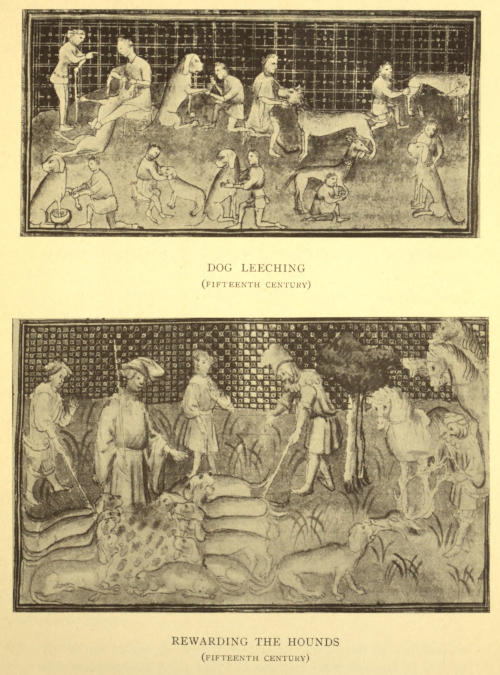
PLATE XVII
DOG LEECHING
(FIFTEENTH CENTURY)
REWARDING THE HOUNDS
(FIFTEENTH CENTURY)
The abbot of Burton-on-Trent and the prior of Tutbury held special privileges and peculiar rights in the forest of Needwood. One of the many unforeseen unhappy results of the wholesale suppression of the religious houses was the throwing into confusion of a variety of forest customs. Those on whom [141]the monastic estates were conferred not unnaturally endeavoured to sustain claims that had not been resisted when made by the public almoners of a district. Considerable conflict arose with regard to such matters at Needwood, and the absence of the checks exercised by the woodwards, appointed by various religious houses in most English forests, was one of the chief causes that led in this district to much wrong-doing on the part of the officials.
The detection of a particular keeper in a grave case of peculation in 1540 brought about a careful inquiry into the general conduct of the officials. It was then ascertained that in a single year the keeper of Tutbury Wood had cut down and sold 45 loads of timber, the keeper of Marchingdon, 111 loads; the keeper of Barton, 170 loads; the keeper of Yoxall, 124; and the keeper of Uttoxeter, 64. No forest could possibly stand the drain of an annual sale of 841 loads. The fraudulent keepers were discharged, and a certain amount of reformation achieved.
A survey of the parks of Needwood was taken in the reign of Philip and Mary, when the jury found that the deer of the castle park numbered 137, that those in Rolleston Park numbered 105; those of Stokeley Park, 160; those of Barton Park, 104; those of Shireholt Park, 144; those of High Lynns Park, 127; and that Castlehay Park had been disparked in favour of the king’s “race of great horses,” and Hanbury Park reserved for the king’s stud mares. A great waste of trees was in progress, and it was known that many had been cut down without any warrant, as the stools still standing showed no sign of the mark of the king’s axe. Among the claims then made by the tenants or commoners was that of “hoar lynt.” This term signified the white wood of the lime or linden tree after the basters had stripped such timber of the bast or inner bark for cordage or mats.
The survey of the first of Elizabeth, cited at length in Shaw’s Staffordshire, says:—
“The forest or chase of Needwood is in compasse by estimation twenty-three miles and a half, and the nearest part thereof is distant from the Castle of Tutbury but one mile. In it are 7,869 acres and an halfe, and very forest-like ground, thinly sett with old oakes and timber trees, well replenished with coverts of underwood and thornes, [142]which might be copiced in divers parts thereof for increase of wood and timber, lately sore decayed and spoyled.”
After giving the bounds and acreage of the four wards then extant, and naming the former fifth ward of Uttoxeter, the survey enumerates the ten parks within the forest, but Rowley Park had been granted by Henry VIII. to Justice Fitzherbert and his heirs.
The size of the nine parks of Castle, Castlehay, Rolleston, Stokeley, Hanbury, Barton, Shireholt, Highlands, and Agardsley, with the number of deer and condition of timber in each, are also duly set forth.
Elizabethan records of Needwood woodmotes are numerous. A woodmote was held at Birkley on 17th August, 1581, before George, Earl of Shrewsbury, high steward of the whole honor of Tutbury, in person. The jury were William Rolleston, Esquire; Humphrey Minors, William Agard, and Arthur Whittington, gentlemen, and eleven yeomen. The convictions for various forms of vert offences were unusually numerous at this court, as well as a few cases of pasturing sheep and cart-horses in the forest. The penalties exacted amounted to £9 15s. 4d.
The next woodmote was held at Tutbury on 16th July, 1582, when the fines reached the exceptionally high total of £22 1s. 5d. Two or three persons were fined on this occasion for not taking their pigs out of the forest wards during “le fence monethe.”
At the pannage court held at Newborough in November of this year, the fees for the pigs amounted to 48s. 1½d.
There are several rolls extant of woodmote courts of the reigns of James I. and Charles I., but they contain nothing of particular moment.
In 1654 the forest of Needwood was offered for sale “for the satisfaction of the soldiery.” The knights, gentlemen, and other inhabitants of twenty-one of the adjoining villages and townships thereupon petitioned Oliver Cromwell, pointing out the injustice of enclosing the forest area—then reduced to 5,600 acres, and only worth about 5s. an acre—whereby the old charter rights of many would be lost, and a great number of ancient cottagers deprived of the relief afforded by the [143]commons. It was also pointed out that the county of Stafford had already paid near £8,000 towards the soldiery on their disbanding. The last reason offered against the sale was, “That the forest of Needwood is mearly formed by nature for pleasure, no forest in England being comparable thereunto.”
This petition caused the project of the sale to be abandoned; but in 1656 a compromise was arrived at, whereby commissioners were appointed to consider all claims, and in 1658 it was agreed that half the open forest and one-tenth of the timber should be allotted to the freeholders, and the remainder be continued as the property of the State. The project went so far as to have the respective divisions for the different townships staked out and allotted. But the Restoration intervened ere the work was accomplished, and Charles II. decided to preserve the forest in its original state.
It was difficult to suppress the licence engendered during the time of civil strife. Eventually the duchy authorities overreached themselves by attempting to impose a new code of by-laws of great severity and doubtful legality.
About the year 1680, “the gentlemen, freeholders and others who have right of Common in the Forest or Chace of Needwood” drew up a petition (printed as a broadsheet) to the House of Commons, protesting against the arbitrary orders of Earl Stamford, as chancellor of the duchy, recently published, and asking relief, as their ancient rights and liberties were being invaded. The chief of these orders were—a fine of 10s. and forfeiture of cattle bearing a counterfeit mark; a fine of £10 apiece to the informer and forfeiture of cattle privately removed out of the forest after notice of a public drift; a fine of 5s., or 6s. 8d. in the case of a keeper, for conveying grist to any other mill than the Wood Mill; a month’s imprisonment for taking any crabtree, whitethorn, holly, or hazel out of the forest or parks; 6s. 8d. fine for each beast on any commoner or other person foddering cattle in the forest between the Feast of St. Andrew and the end of March; the forfeiture of all swine in the forest save in crab-time, and a like forfeiture and fine of 3s. 4d. on every swine insufficiently rung; sheep pasturing in forest to be forfeited, and 12s. a day fine for each sheep. These orders and others of a like nature had appeared under the great seal of the duchy, and had been read in all the [144]parish churches within or about the forest to the great disturbance of the people. The petitioners protested against the exorbitant character of the fines and forfeitures, the setting up of informers by great rewards, and the imprisonment of their persons, claiming that such penalties could not be imposed save by Act of Parliament.
Notwithstanding, however, the damage done to the forest in the Civil War, and the little check put upon depredations in the earlier part of the reign of Charles II., the timber of Needwood was at this period by far the finest in any English forest. A careful survey made in 1684 showed that the number of good trees in the four wards was 38,218, valued at £25,744 19s. 6d.; whilst those in the parks brought up the total to 47,150, with a complete value of £28,637 11s. 6d. The hollies and underwood were valued at an additional £2,000.
“Many of the treese are of soe large dimensions and length, that there may be picked out such great quantityes of excellent plank and other tymber, fitt for shipping, as is not to be found in any of your majestie’s other forests in England; most parts of this where the best tymber growes, lyeing within 12 or 14 miles of the navigable parte of the river Trent.”
The abundance of the deer proved an irresistible temptation to the poorer of the commoners, and though the gentlemen and yeomen did not exactly turn deer-stealers themselves, as in some of the southern forests, there was much sympathy with the poachers, who checked the depredations of the deer, and kept the country houses illicitly supplied with venison. The parks leased by the Crown to private individuals were rigorously protected; but the open stretches of the forest in the eighteenth century, though nominally well supplied with high-born officials and underkeepers or foresters, were, to a great extent, a prey to marauders.
An undated account of the duchy forests, temp. George I., at the Public Record Office, states that Needwood forest had been granted to William Duke of Devonshire, William Marquis of Hartington, and Henry Lord Cavendish, with the offices of steward of the honor, constable of the Castle of Tutbury, lieutenant of the forest, master of the game, and bailiff of the new liberties. Castlehay Park had been granted in 1677 for [145]ninety-nine years to Henry Seymour. The parks of Hanbury and Tutbury, for a like period, in 1698, to Edward Vernon; and two of the other parks at the same, and also for ninety-nine years, to Sir John Turton.
Mr. Mundy, the poet of Needwood, left it on record that he had known and conversed with a gentleman of the district, who had been high-sheriff of Staffordshire in the reign of George II., who used to boast how many deer poachers he had got off when arrested by the keepers, and how well they used to keep his table supplied with venison.
After considerable opposition, Needwood was at last disafforested by special Act of Parliament in 1804. The damage done to cultivation by the straying deer was no doubt excessive, and there were other distinct drawbacks to its continuance as a forest. Nevertheless, the general scheme of enclosure naturally aroused keen resentment among the lovers of its picturesque beauties and historic associations. Mr. F. N. C. Mundy, who had printed a stilted poem in 1776, called Needwood Forest, after the classical descriptive style then in vogue, produced, in 1808, a wild screed termed The Fall of Needwood, which, by its very extravagance, caused the utilitarian view to be the more appreciated. The following passage is a fair example of the character and style of its forty-five pages:—
There were two other Staffordshire forests besides Needwood—Cannock Chase and Kinver, both of which require investigating. [146]The exigencies of space prohibit more than very brief references to them in these pages.
Cannock Chase, notwithstanding its name, was an extensive royal forest. It seems to have taken its title from the Bishop of Lichfield’s Chase, fifteen miles in circuit, which was within the forest limits, and proved a constant source of grievance to the king’s foresters. General Wrottesley has printed the pleas of the forest of Cannock for 1262, 1271, and 1286, in Vol. V. of Historical Collections for a History of Staffordshire (1884); they abound in interest as to the venison and vert presentments, and the assarts and wastes of woods that came before the justices at these eyres. A venison offender in 1271 was pardoned, for the soul of the king, because he was poor and a minstrel, and two others were respited and forgiven non-attendance because they were in the Holy Land. One Thomas de Bromley, a very frequent malefactor of venison, and often indicted for trespasses in the king’s forests in Staffordshire and Salop, was caught with bow and arrows in the bailiwick of Teddesley, on Tuesday after the Feast of St. Gregory, 1267, by Walter de Elmedon, forester-of-fee of that bailiwick, and Roger de Pecham, riding forester for the whole forest. The foresters challenged him, whereupon Thomas climbed up an oak tree and shot arrows at them, until they took him by force and delivered him to the warden of the castle of Bridgnorth. There were many presentments at this eyre for the killing of roe deer.
Hugh de Evesham, a former riding forester, with other ex-foresters, were presented for stopping all carts passing through their bailiwicks with salt and other merchandise on the high roads, taking 4d. at least in the name of cheminage, and for other carts, 1s., and in some cases 2s. And this was done when the carts were not laden with timber or brushwood or anything from the forest, and when the carters were committing no forest trespass.
In 1276 when the king’s huntsmen were hunting in Cannock Chase, they put up a hart with their dogs and followed it to Brewood Park. There John de la Wytemore came up with bow and arrow and shot at it; the hart fled out of the forest to the fishpond of the nuns of Brewood. John followed it and dragged it out dead from the pond. Then John Gyffard, of Chyllynton, [147]came up, said he had pursued the hart, and claimed the whole of it. They skinned it; John Gyffard took half of it, and the nuns had the other half. This case was brought before the justices at the eyre of 1286. The nuns were pardoned for the good of the king’s soul, as they were poor. Although the hart was taken outside the forest, it was the king’s chase and put up by his dogs within the forest, and taken in front of them against the assize. The sheriff was therefore ordered to arrest the two Johns; they were taken and committed to prison, but released on paying the respective fines of a mark and 20s. The case of the wolf killing a buck in this forest in 1281 has been already cited.
The Close Rolls of Edward I. give evidence, from the various royal gifts, of a good supply of fallow deer, with a smaller number of red deer on the forest or chase of Cannock. In August, 1277, the king ordered the keeper of Cannock Forest to permit William de Middleton, Archdeacon of Canterbury, to take by his men all the fat harts and bucks that were fit to kill that season, and to aid and counsel the men in so doing. In the same month, 1279, the king granted Roger Mortimer ten bucks and two harts from Cannock. In 1280 Anthony Bek had four bucks, Richard de Tybetot the same number, and Philip Marmyon three. In 1282, Ralph de Hengham had six bucks, Henry de Shaventon, Reginald de Legh, and Otto de Grandi Sono four each, and the Prior of Stone one, all out of this forest as gifts from the king. Ralph Basset, of Drayton, had six bucks in 1283. Roger Lestrange, justice of the forest, was instructed, in July, 1284, to cause the Bishop of Worcester to have twelve bucks of the king’s gift out of the forest of Cannock; and in the same year Reginald de Legh received two bucks. On December 28th, 1284, the king sent word to Roger Lestrange that if the order given in the summer for the bucks for the Bishop of Worcester had not been executed, it was to be changed to six live bucks and six live does from Cannock, to stock that prelate’s park at Alvechurch.
The king was also generous with timber gifts, oaks from Cannock for building purposes being bestowed on the priory of St. Thomas, Stafford, the priory of Cokehill, and the Franciscan friars of Lichfield. When the king was at Brewood [148]in 1278, near Wolverhampton, a fire broke out; the justice of the forest was ordered to supply from Cannock four oaks to Henry le Mercer, of Brewood, Dean of Lichfield, four oaks to Philip le Clerk, and two oaks to Widow Amice, to aid in the rebuilding of their lately burnt houses.
The presentments at the Staffordshire eyres in Edward I.’s reign for the smaller forest of Kinver have also been printed by General Wrottesley.
The Close Rolls of the same reign contain many references to the forest of Kinver. In August, 1278, the king instructed Henry de Ribbeford to cause thirty bucks to be taken for him in the forests of Kinver and Cannock, as should be agreed upon between the respective keepers. Grimbald Pauncefote obtained three Kinver bucks in the same year. In 1281 four live hinds were granted to Ralph Basset from Kinver to help to stock his park of Drayton. A further proof that red as well as fallow roamed over Kinver is the grant of six harts to Edmund Mortimer in 1286. Two years later John, the son of Philip, the keeper of Kinver Forest, was ordered to deliver all eyries of falcons found that year in the forest to John Corbet, the king’s falconer, to be kept for the king’s use.
In 1282 the king ordered the release from prison of Richard Saladyn, who was in gaol at Bridgnorth for venison trespass. Bridgnorth was the prison for this forest, as well as for Cannock; the official calendar of these Close Rolls has made the amusing mistake of putting Saladyn in prison at Bruges, in Belgium! Bruges was the usual Latinised form for the town of Bridgnorth.
Among Edward I.’s timber grants from Kinver were six oaks to Margery de Wigornia, a nun of St. Wystan, Worcester; six oaks to the master of St. Wolfstan’s, Worcester; ten oaks for fuel to Contisse Loretti, wife of Roger de Clifford, a forest justice; and twenty oaks for shingles to Anthony Bek.
The perambulation roll of 1299-1300 shows the considerable extent of Kinver Forest at that date. Part of Arley, with Ashwood and Pensnet Chase, in addition to the parish of Kinver, [149]were included in the forest, as well as part of Morfe in Shropshire; but the greater part of Kinver Forest then lay in Worcestershire, for it embraced Pechmore, Hagley, Old Swinford, Chaddesley, Kidderminster, Wolverley, Churchill, and part of Feckenham, in addition to Tordebig, in Warwickshire.
Nevertheless, although most of its area was in Worcestershire, and its prison in Shropshire, Kinver Forest, taking its title from the small Staffordshire town of that name, was always reckoned as a forest of the last of these three shires.
[150]
The king’s forest of the High Peak was a wild district that formed part of the patrimony of the Anglo-Saxon kings, and was royal demesne at the time of the Great Survey. The parish of Hope and other adjacent lands were granted by the Conqueror in 1068 to William Peverel in conjunction with numerous lordships in Derbyshire, Nottinghamshire, and other counties which were known as the honor of Peverel. On the south side of the Vale of Hope, in a place of remarkable natural strength, Peverel built a castle, on the site of a former stronghold, which had given the name of Castleton to the cluster of houses below it. Twenty years later the district around is styled the land of Peverel’s Castle in Peak Forest (terram castelli in Pechefers Willelmi Peurel). The district of Longdendale was added to the Peverel property in the time of Henry I. On Peverel’s death in 1114, his vast possessions passed to his son, but in 1155 a younger Peverel was disinherited for poisoning the Earl of Chester, and all his estates were forfeited to the Crown. From that time until 1372, the castle and forest of the Peak were in the hands of the Crown, when they were transferred to the Duchy of Lancaster, and thence returned to the Crown by absorption in the following century.
At the beginning of the twelfth century, the forest of the Peak included the whole of the north-west corner of the county. The Hope district embraced the seven berewicks of Aston, Edale, “Muckedswell,” half of Offerton, Shatton, Stoke, and Tideswell; whilst Longdendale included the whole of the wide-spreading parish of Glossop, and much that was extra [151]parochial. According to somewhat later parochial divisions, the forest comprised the whole of the parishes of Glossop, Chapel-en-le-Frith, Castleton, and Hope, with most of Tideswell, considerable portions of Bakewell, and part of Hathersage.
It formed altogether an area of 40½ square miles.
From the time when Longdendale was added to the honor of Peverel, in the days of Henry I., the Peak Forest was divided into three districts, each having its own set of foresters, but all under one chief official. These three districts were known as Campana (i.e. the Champagne, or open country) on the south and south-west, Longdendale on the north and north-west, and Hopedale on the east.
The bounds of the forest, as set forth in the Forest Pleas held in 1286, were as follows, given in an English dress:—
“The metes and bounds of the forest of the Peak begin on the south at the New Place of Goyt, and thence by the river Goyt as far as the river Etherow; and so by the river Etherow to Langley Croft at Longdenhead; thence by a certain footpath to the head of Derwent; and from the head of Derwent to a place called Mythomstede (Mytham Bridge); and from Mytham Bridge to the river Bradwell; and from the river Bradwell as far as a certain place called Hucklow; and from Hucklow to the great dell (cavam, cave?) of Hazelbache; and from that dell as far as Little Hucklow; and from Hucklow to the brook of Tideswell, and so to the river Wye; and from the Wye ascending up to Buxton, and so on to the New Place of Goyt.”
In the case of a considerable number of forests there was much variation in their bounds subsequent to 1300; but the limits of Peak Forest remained to its close the same as they were in the thirteenth century.
The place where the forest justice held his inquisitions was usually termed the Justice Seat. This Justice Seat was occasionally held in different localities, or even in a temporary booth or tent, as in the great Northamptonshire forest of Rockingham; but the Justice Seat for the Peak Forest was about the centre of the district, in an extra parochial part, about equal distance from Castleton, Tideswell, and Bowden. Here stood a chief forestry residence and hall termed Camera in foresta regia Pecci, or Camera in Campana, with a chapel attached. This chapel was of earlier date than the large chapel [152]built by the foresters and keepers at Bowden about 1225, which place was henceforth usually known as Chapel-en-le-Frith. The Chamber of the Peak was not so important a place as the central lodge of many other forests, because the keeper of the Peak Forest being usually associated with the custody of the castle, the residence of the chief local official was at Castleton. The prison was at the castle of the Peak, and the baily of the castle was sometimes made to serve as a great pound for illegally pastured sheep; but there is no instance of the Justice Seat or even a swainmote being held at Castleton.
There are, unfortunately, too few records left of the smaller forest courts of the Peak to speak with confidence as to the regular holding of the frequent attachment courts or swainmotes in all the bailiwicks for any long period; but there are sufficient incidental references to show that such swainmotes were held in the thirteenth and early fourteenth centuries for Campana at the Chamber of the Forest, for Longdendale at Chapel-en-le-Frith, and for Hopedale at Hope. Subsequently the greater swainmote courts were held at Tideswell and at Chapel-en-le-Frith, though sometimes at Campana Lodge or Chamber of the Forest instead of at Tideswell.
In several of the larger forests, and notably in Peak Forest, there were hereditary foresters-of-fee. In this case, when the question of their origin came up at forest pleas, they always claimed to date back to the times of William Peverel. There were a certain number—originally four, though afterwards subdivided—for each of the three great bailiwicks of the Peak Forest who held certain bovates of land in serjeanty, discharging their obligations in one case by the hunting of wolves (see chapter iv.), and in the others by some amount of forest supervision. In two of the three bailiwicks they had sworn grooms or servants under them. This kind of forestership could be held by women and by clerks, but the duties had then to be discharged by deputy. The foresters-of-fee were bound to attend all courts, even the frequent swainmotes of their bailiwick, in person or by authorised sworn deputy.
The tenure by which such foresters held their land is made clear by divers inquisitions after death. Adam Gomfrey, 32 Edward I., died seized of a messuage and fifteen acres at [153]Wormhill held per servicium custodiendi pecci forestam. Walter de Nevil, 34 Edward I., died seized of thirty acres at Wormhill held per servicium custodiendi forestam. Nicholas Foljambe, at his death, 13 Edward II., held a messuage and thirty acres by the serjeanty of keeping the king’s forest of Campana, in the Peak, per corpus suum cum arcu et sagittis. Thomas Foljambe, 17 Edward II., held fifteen acres at Wormhill, by the service of finding a footman with bow and arrows to keep the Peak Forest. Maria Hansted, 11 Edward III., held land at Blackbrook, Fairfield, Hope, etc., per custodiendi wardam de Hopedale in foresta de Pecco.
On the numerous early incised slabs that are found in Derbyshire churches in the neighbourhood or within the bounds of Peak Forest, dating from the time of Henry II. to Henry III., there are not a few symbols that betoken slabs which are obviously memorials of forest ministers. The horn of a forester appears at the base of an incised cross at Darley Dale, which has a sword on the sinister side. At Wirksworth is an earlier one, with a belted bugle horn on one side of the cross, and a sword on the other. At Hope there is a third early slab with a sword on one side and a belted bugle horn, with an arrow below it, on the other. In each of these cases the burial of a forester-of-fee is denoted, the sword (which had no forest signification) probably denoting knightly rank. At the unhappy and wholly unnecessary demolition of Hope chancel another cross slab, with only a stringed bugle-horn on the dexter side, was also brought to light.
Among the large collection of early incised slabs at Bakewell is one on which a bow is denoted by a curved line on the sinister side of the cross-stem, the stem serving as the bow-string; a small arrow projects from the string.
A square-headed axe laid athwart the cross-stem appears on slabs at Chelmorton and Killamarsh, probably denoting a verderer, or head woodward, or “axe-bearer.” The ordinary woodward, and in some forests the verderer, only bore a small lopping axe or bill-hook, and not a felling axe. Such billhooks appear on early incised slabs at Sutton-in-the-Dale and North Wingfield.
Examples of the Derbyshire incised slabs to forest ministers have been illustrated in chapter iii.
[154]
There is a peculiarly interesting brass in Dronfield Church to Thomas Gomfrey, rector, who died in 1389, and his brother, Richard Gomfrey, rector of Tatershall. On the brass is a forester’s horn. Thomas was hereditary forester-of-fee; he was the great grandson of Adam Gomfrey, forester of Campana at the eyre of 1286.
The abundance of deer in this forest in Norman days seems to have been something astonishing. Giraldus Cambrensis tells us that in his days (nostris diebus), c. 1194, the number of the deer was so great in the Peak district that they trampled both dogs and men to death in the impetuosity of their flight.
In the extensive grant of lands and church at Glossop in Longdendale by Henry II. to the Flintshire abbey of Basingwerk, the king reserved to himself the venison, but allowed the abbot’s tenants to take hares, foxes, and wolves.
The accounts rendered by Robert de Ashbourn, bailiff of the forest and castle of the Peak, for the year 1235-6, are of much interest. The receipts amounted to £201 2s. 10½d., whilst the expenses were £184 12s. 7d. In this year the king visited Peak Castle, when bailiff Ashbourn, as lord of the jurisdiction, presented him with four wild boars and forty-two geese, and charged 16s. 3½d. for the same in his accounts. The castle that year underwent considerable repairs. £10 1s. 8d. from the pleas of the hundred or wapentake court were among the receipts, and we suppose that the sums of £6 19s. 4d. and £39 19s. 6d. from the respective itineraries through the demesnes and forests, represent the fines, etc., accruing respectively from the manorial and the swainmote courts. This is the earliest known detailed document of the Peak jurisdiction.
Forest pleas were expected to be held at least every seven years, but the Peak Forest is one of the numerous cases in which far longer intervals occurred. The forest justices held their eyre for the Peak in 1216. This was followed by an interval of thirty-five years, for the next pleas were not held until 1251. Of these pleas, held before Geoffrey Langley and other justices, very full records are extant.
The following were the bailiffs of the honor of the Peak during the period covered by this eyre: William Ferrers, [155]Earl of Derby, 1216-22; Brian de Insula, 1222-28; Robert de Lexington, 1228-33; Ralph Fitz-Nicholas, 1233-34; John Goband, 1234-37; Thomas de Furnival, 1237 (for six months); Warner Engaine, 1237-42; John de Grey, 1242-48; and William de Horsenden, 1249. They were appointed by Crown patents.
The presentment of venison trespasses were made by the hereditary foresters and the verderers. This roll is headed by the wholesale charge made against William de Ferrers, Earl of Derby (who had died in 1246), in conjunction with Ralph de Beaufoy, of Trusley, William May, the earl’s huntsman, Richard Curzon, of Chaddesden, and Henry de Elton, of having taken in the king’s forest of the Peak, during the six years when the earl was bailiff (1216-22), upwards of 2,000 head of game (deer). Ralph, Robert, and Henry appeared, and on conviction were imprisoned; but they were released on paying heavy fines, and finding twelve mainpernors for their good conduct. Robert Curzon was fined £40; the first of his twelve mainpernors was William Curzon, of Croxall. Ralph Beaufoy was fined £10; the first of his mainpernors was Sir William de Meysam. May, the huntsman, did not appear; it was reported he was in Norfolk, and the justices ordered him to be attached. If the full actual pleadings were extant, there can be no doubt, judging from the customs of other forests, that the companions of the earl would have been able to show that a considerable percentage of the deer taken when he held office were fee deer, to which he was entitled by usage for himself and his deputies, and that many others were the usual and recognised gifts to the country gentlemen of the district to secure their goodwill towards the king’s forest. It must be remembered that it was always customary at these eyres to present lists of all the deer killed, including those taken by express warrant or custom. Nevertheless, there was obviously something quite unwarrantable in the amount taken during that period (over 300 a year), as is shown by the heavy fines imposed upon the hunting comrades of the deceased earl.
Many of the other offenders were men of considerable position. Thus Thomas Gresley, Alan his brother, Ralph Hamilton, the Earl of Arundel, and Geoffrey de Nottingham were convicted of taking three harts and two hinds.
[156]
Four or five of these charges, which exceeded one hundred in number, related to clergy. One of the most important cases was that of Roger de Weseham, Bishop of Coventry and Lichfield (1245-57). The bishop was charged together with William the vicar of Glossop, Archdeacon Adam de Staniford, and five others, all apparently of his company, with taking a hind in the forest. The bishop was summoned with the rest to appear before the justices, but the result appears to have been that the vicar of Glossop was the only one punished; he was fined ten marks, and had to find twelve mainpernors. One of the company was John the clerk, and he was an unknown monk. Had the pleadings been preserved in full, it would probably have been shown that the bishop pleaded the forest charter, whereby it was allowed to any bishop, baron, or earl to take one or two head of game in passing through a royal forest, provided it was done openly. The like justification might possibly have been put forward by several barons whose names appear as venison trespassers.
Those who were considered responsible for the escape of prisoners on venison charges from Peak Castle were held liable at these forest pleas. When John de Grey was bailiff of the Peak, Martin the shoemaker of Castleton, and another, were charged with the unwarrantable possession of a deerskin, and were committed to prison. They escaped, or were liberated without the intervention of a forest justice, therefore the bailiff was held in mercy; the offenders did not appear, and were outlawed. John Goband, an earlier bailiff, was also held in mercy for a like offence. Simon de Weyley, who took a stag during the bailiffship of Robert de Lexington (1228-33), gave the bailiff five marks to secure his release. Lexington was dead; but, on the offence being proved, the justices held that his heirs were held responsible.
Baron William de Vesci, with four others, was charged with taking three harts in the forest. One of the company, John de Andville, was on pilgrimage in the Holy Land at the time of the eyre, and could not appear. The baron had protested to the verderers at the time of the charge that he took the game by the king’s gift; he brought to the eyre the royal letter and the charge was withdrawn. In two other cases royal pardons were produced to the justices.
[157]
The fines imposed for venison trespasses varied at this eyre from £100 to 13s. 4d., and seemed to have been proportioned in accordance with the position of the offender, as well as the comparative gravity of the offence. The long intervals between the eyres, and the frequent changes of the forest custodian, together with the wildness of the country, seemed to have led to the Peak Forest being hunted, with a certain amount of impunity, by not a few of the nobility and gentry of Derbyshire, and of the adjacent parts of Yorkshire and Cheshire. The game trespasses at this eyre were entirely for red deer, save for the single instance of a presentment against Robert de Wurth for killing a roebuck, for which offence the huge fine of £100 was imposed. The amount of this fine had nothing to do with the nature of the game, but was caused by the non-appearance of the accused, accompanied probably by some aggravating circumstances not recorded on the brief entry on the plea rolls. At the next pleas (1286) the justices imposed a like enormous fine of £100 in the case of John Clarel, who did not appear, on the charge of taking a hart, adding to the record words which do not elsewhere appear—si placeat domino rege—as though to mark its exceptional nature.
When the justices at the 1251 pleas came to the consideration of vert offences and encroachments various particulars were missing. Mathew de Langesdon and Adam de Stanton, hereditary verderers, were each fined 20s. for not producing their father’s rolls. There seems to have been much carelessness among the various officials in the keeping of their respective yearly lists of offences. Peter del Hurst, regarder of one section of the Peak Forest, was fined 10s. for the non-presentment of assarts and purprestures in his rolls. A considerable number of agisters were at the same time declared in mercy for not producing their agistment rolls according to the custom and assize of the forest. There is, however, a fairly long list of vert offences (about sixty) that had accrued within the Crown demesnes since 1218, the damage done being in most cases valued at 6d. Richard de Smallcross, who had been fined 6d. at the swainmote for the value of a vert offence in the demesne park, had now to pay a fine of 6s. 8d. and to obtain pledges. Richard de Redescaye, who had paid a value fine of 12d., was also fined 6s. 8d. by the justices. The majority of the [158]offenders—the offences were probably trifling—had simply to find pledges for their future observance of the forest assize. Heirs were held responsible for their father’s offences in two or three cases. Many of these vert trespassers were of good position. The worst case at this eyre was that of Roger Foljambe, who was fined the large sum of twenty marks for many transgressions; his pledges were John Foljambe and Warner Coterell. In this roll of transgressors the clergy, especially the religious, were largely represented. The number included the abbots of Basingwerk, Dieulacres, Lilleshall, Merivale, Roche, and Welbeck, the prior of Lenton, and William, vicar of Glossop. The vicar’s case must have been a serious one, for the value payment was £3 and the fine 40s. Another and much shorter roll gave the vert offenders within the forest limits but outside the demesne.
In the first roll of assarts presented at this Peak eyre, on which twenty-two cases are entered, two of these assarts that had been made without warrant many years before were taken into the king’s hands; and in one case, where William the smith (deceased) had made an assart of three acres without warrant in the liberty of the abbot of Basingwerk in the days of Robert de Lexington (1228-33), the then abbot was allowed to retain it as tenant. It was a dire offence, whether the assart was within the forest or only in the regard or purlieus, to enclose with so stout or high a fence that the deer were excluded. The abbot of Basingwerk, in the time of John de Grey, was reported as having assarted one and a half acres at Whitfield without the demesne, and enclosed it so as to prevent the free roving of the deer and their fawns, and this without warrant; at the time when the justices were sitting the fence had been removed, but it was declared in the hands of the king. The usual custom in the Peak at this time seems to have been for the tenant of an assart to pay 4d. an acre to the Crown, and at the time of the assart being made to pay a fine to the bailiff for the warrant. In a list of assarts allowed by Warner Engaine at 4d. an acre, the following are the proportions and the fines in six consecutive cases: 1 acre, 2s. fine; 4 acres, 6s. fine; 1 acre, 2s. 8d. fine; 3 acres, 6s. fine; 2 acres, 4s. fine; and 3 acres, 3s. fine. When the tenants of Peak Forest assarts died, their heirs paid double rent for the first [159]year, and the king had also the second best beast, the first going to the Church. These Peak assarts, which were very numerous at this date, were for the most part small, averaging about 5 or 6 acres; they varied from 60 acres to ½ acre.
The purprestures presented at this eyre were the rolls of new houses built since the last pleas of 1216. One hundred and thirty-one persons had built new houses without warrant, and were therefore in mercy—that is, liable to fines. In almost a like number of cases, namely, one hundred and twenty-seven, new houses had been raised within the king’s demesnes with the licence of the bailiff. An average increase of eight new houses a year during the first thirty-five years of Henry III.’s reign speaks well as to the degree of prosperity then enjoyed by the forest of the Peak.
The mineral and turbary rights of this forest also came under review at this eyre. Earl Ferrers received £15 during the six years that he held the Peak bailiwick from the minerals raised at Tideswell: Brian de Insula, £12, during his five years; Robert de Lexington, £40 in six years; Ralph Fitz-Nicholas, £5 in one year; John Goband, £7 in three years; Warner Engaine, £12 10s. in five years; John de Grey, £15 in six years; and William de Horsenden, 50s. per annum. The minerals raised at Wardlow produced £12 for Earl Ferrers, £10 for Brian de Insula, £12 for Robert de Lexington, £2 for Ralph Fitz-Nicholas, £4 for John Goband, £8 10s. for Warner Engaine, £8 for John de Grey, and 30s. a year for William de Horsenden. John de Grey took twenty marks of cheminage or road toll to the mines during his term of office; but this was not done by any other bailiff. John de Grey also made certain stone quarries, from which he received 16d. profit in two years.
Under turbary it is mentioned that the townships of Hucklow, Tideswell, Wormhill, Toftes, Buxton, Bowden, Aston, and Thornhill took turves without requiring licence.
Another source of profit to the bailiffs was on escaped cattle: under this head Earl Ferrers took £12, Brian de Insula £10, Robert de Lexington £12, Ralph Fitz-Nicholas £2, John Goband £6, Warner Engaine £10, John de Grey £12, and William de Horsenden £1 yearly.
One other fact recorded on the rolls of this eyre remains for notice: it is with regard to the horse-breeding establishments [160]of the forest. The term used for this in the Peak, Needwood, and other forests is Equitium, for which it does not seem possible to find any single-word English equivalent, unless it is stud. The abbot of Welbeck had one stud of twenty horses and twenty mares in the forest at Cruchell, where King John had given the canons charter rights. The abbot of Merivale had kept a stud of sixteen mares with their foals for six years, to the damage to the king of 20s. The abbot of Basingwerk had a stud of twenty mares for two years, damage 20s. William de Roch had seven mares and foals for one year, 20s. Thomas Foljambe, senior, had seven mares, damage 13s. 4d.; Thomas had died and the heirs had to respond.
Bailiff Bernake’s accounts of the year 1255-6, already cited in reference to wolves, are also interesting on account of the gifts that he made to the Campana Lodge or Chamber of the Forest. To the chapel he gave a sufficient vestment, an albe, an amyce, a sufficient rochet, a super-altar, an altar cloth made out of an old chasuble, a silver chalice gilded inside, and an old missal and a gradual. To the hall he gave five tables, six old small shields, and a chessboard; also two tuns of wine, one full and the other having a depth of twelve inches. He also presented various utensils to the kitchen.
On 12th July, 1285, the sheriff of Derbyshire was ordered to cause a regard to be taken of the Peak Forest before Michaelmas, preparatory to the holding of the forest pleas; and on 1st August he was further instructed to issue summons of an eyre for forest pleas, to be held at Derby to all concerned, save Brother William de Henley, prior to the Hospitallers and Edmund the king’s brother, who were excused attendance.
Thirty-four years had passed by since the last eyre was held. The pleas of the forest were held at Derby on 30th September, 1285, before Roger Lestrange, Peter de Leach, and John Fitz-Nigel, justices of the forest. The full rolls of this eyre are also extant at the Public Record Office.
From the rolls then produced we are able to continue the list of bailiffs from the time of the last eyre. William de Horsenden, 1251; Ralph Bugg, 1252; Ivo de Elynton, 1253; Richard de Vernon, 1254; Gervase de Bernake, 1255; Thomas de Orreby, 1256; Richard le Ragged, 1257; William de Findern, 1258; Thomas de Furnival, 1264; Roger Lestrange, 1274; [161]Thomas Foljambe, 1277; Thomas de Normanville, 1277; Thomas de Furnival, 1279; Thomas le Ragged, 1280; Thomas Foljambe, 1281; and Robert Bozon, 1283.
The Campana foresters-of-fee of that date were John Daniel, Thomas le Archer, Thomas son of Thomas Foljambe, a minor in the custody of Thomas de Gretton; Nicholas Foljambe, who had been a minor in the custody of Henry de Medue, but was then of full age; and Adam Gomfrey. Of these foresters, Adam Gomfrey and Thomas Foljambe held jointly the same bovate, which had formerly been divided between two brothers. Also Thomas Foljambe and John le Wolfhunte held another bovate in the same way, John holding his half by hereditary descent, whilst Thomas Foljambe, senior, had acquired his half by marriage with Katherine, daughter of Hugh de Mirhaud. This subdivision of serjeanties became burdensome to the district, as each forester-of-fee endeavoured to have a servant maintained at the expense of the tenants, but the jurors confirmed a decision of the hundred court of 1275 to the effect that there could be only four such servants or officers, according to ancient custom, for the Campana bailiwick. The names of the foresters-of-fee for the two other wards are also set forth.
Although a considerable proportion of the offenders were dead before the eyre was held, the rolls of venison and vert trespassers show no fewer than 517 separate charges extending over the thirty-four years since the last pleas.
The gravest charge at this eyre, as at the last, was against an Earl of Derby. Robert Earl Ferrers was presented for having, in 1264, with a great company of knights and other persons of position, hunted in the Campana forest on 7th July and taken forty head of deer, and drove another forty out of the forest; and on 1st August took fifty and drove away about seventy; and again on 29th September took forty and drove away a like number. This hunting was planned on a wholesale scale, for thirty-eight are named in the presentment, and there were many others, as well as the earl himself, who were dead before the eyre was held, and others not summoned as they were mere servants of the earl. Eight out of the thirty-eight were knights, and one, Master Nicholas de Marnham, rector of Doddington, Lincoln, was in holy orders. Of those [162]in the earl’s train during these three forest affrays hardly any bore Derbyshire names, but came from the counties of Warwick, Leicestershire, Lancashire, York, Cambridge, etc. It has been strangely enough remarked by the only writer who has hitherto cited these presentments (Mr. Yeatman) that “these tremendous charges,” made long after the earl was dead, “are utterly incomprehensible,” adding that it seems impossible to suppose that the earl had not full licence from the Crown to indulge in hunting in the royal forest! But this writer had clearly forgotten the date of these forest invasions of the young and impetuous Earl Ferrers. It was in 1264, in the very thick of the baronial civil war under Simon de Montfort, of whose cause Robert Ferrers was a hot partisan. On 12th May was fought the battle of Lewes, when the king’s forces under Prince Edward (Edward I.) were defeated by those of the barons. For two or three years from that date, as an old chronicler has it, “there was grievous perturbation in the centre of the realm,” in which Derbyshire pre-eminently shared. There can be no doubt whatever that the three incursions made into the Peak Forest in July, August, and September, following the battle of Lewes, were undertaken by Robert Ferrers and his allies (issuing forth from his great manor-house of Hartington) much more to show contempt for the king’s forest and preserves and to get booty than for any purposes of sport. These presentments, if they did nothing else, were a strong protest against the lawlessness of such action. In April of this year Henry III. had come into Derbyshire and lodged for a time at the castle of the Peak after the subjection of Nottingham, and it was from here that he proceeded into Kent and Sussex.
The king’s sojourn here before the battle of Lewes is expressly named in another presentment against Thomas de Furnival, the great Lord of Sheffield. Thomas, who was that year bailiff of the Peak, entertained the king at the castle and tarried there until Whitsuntide. On this occasion, after the king had left, the bailiff entered the forest and killed twelve beasts. On various subsequent occasions, both in the reign of Henry III. and Edward I., venison was killed in this forest and taken to Thomas de Furnival’s castle at Sheffield. Thomas appeared before the justices, and was convicted and imprisoned, [163]but was subsequently released at the king’s pleasure for a fine of 200 marks.
Edward I. made his chace (facit chaceam suam) in the forest in 1275. At that time Thomas Fitz-Nicholas and Richard Fitz-Godfrey of Monyash went into the forest with the king’s hounds and carried off some of the venison to their own houses. Whereupon William le Wynn, Lord of Monyash, whose tenants they were, summoned them to his manorial court, where Thomas was fined 4s. and Richard 6s. 8d. For this illegal adjudication in case of venison trespass William le Wynn was presented by the foresters, and the justices fined him 20s., and required him to find pledges of future observance of the assize of the forest.
At a swainmote held at Chapel-en-le-Frith in March, 1280, William Foljambe appeared before Thomas le Ragged, the bailiff, and presented that Henry de Medue took a doe with a certain black greyhound called “Collyng” at Camhead, undertaking to verify the charge in a penalty of 100 marks; Henry denied the charge, and retorted that William Foljambe and his brother-in-law, Gregory, with the aid of his servants and shepherds at Martinside, Weston, and Wormhill, had destroyed a hundred head of game, and undertook to prove it under a like penalty. The jury at the forest pleas found Henry guilty, and he was fined £5. William and his company were found not guilty of taking a hundred, but guilty of taking twenty; he was fined 20 marks. Collyng was evidently a well-known greyhound; the name occurs in another presentment of a different date against Thomas Medue.
In the Peak Forest, as elsewhere, foresters-of-fee, as well as their servants or under-foresters, were now and again convicted of venison trespass. Thus Robert de Milner, at the time when he was a forester of Longdendale, took over twenty head of game and carried them to his father’s house; not appearing at the eyre, he was outlawed. John Pycard, a forester under Milner, was also convicted of killing six deer. Ten other foresters-of-fee were fined during this eyre.
A succession of bailiffs, in addition to Thomas de Furnival, were convicted of venison or cognate offences, or the improper release of offenders.
The offences, both of vert and venison trespass and of [164]agistment, proved against the large majority of the hereditary foresters-of-fee, and against so many of the highest position in the district and county, shows that there was very little moral stigma attached at that time to forest transgressions in the Peak. In no other forest district does there seem to have been quite so much laxity. This exceptionally bad feature of the Peak Forest probably arose from the long-continued state turmoil of so much of the period between the two eyres of 1250 and 1286 throughout this district, which brought about great laxity of administration. After these foresters had been duly convicted and fined for many transgressions, their respective bailiwicks, because of their poverty, were not forfeited, but taken into the king’s hands to be replevied at his will when the required fine had been paid. The justices were authorised to reinstate them in their offices during the king’s pleasure, whilst the fines were being paid, if they saw just cause, and in several cases the penalties were reduced.
As examples of instances of convictions of men of considerable position, the following may be mentioned: Peter de Gresley, who had to pay £20 for the single offence of killing a doe in 1268; John lord of Queenbury, Yorks, £20; and John lord of Shipley, 40s. Other offenders were Sir Stephen le Waleys, William Bagshawe, and Thomas, Henry, and William Foljambe.
There were, of course, various venison offences committed by men in humbler positions, but these seem to have been quite the exception. Michael, son of Adam de Wormhill, was presented for having killed fawns (of red deer) in the forest, and sold their skins in the open market. The justices at this eyre were merciful, and had regard to poverty in other besides the foresters-of-fee. Thus Richard de Baslow and Hebbe the fisherman were in the company of Richard de Vernon, when he was bailiff at the taking of venison for the king, and appropriated five head of game to themselves. Baslow was fined 20s., but Hebbe, who admitted the offence, was afterwards pardoned through the king’s mercy because he was poor.
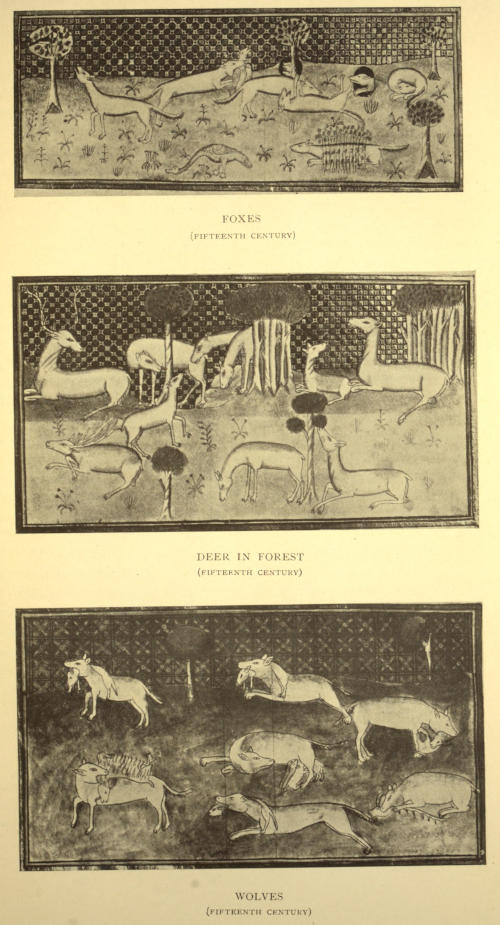
PLATE XVIII
FOXES
(FIFTEENTH CENTURY)
DEER IN FOREST
(FIFTEENTH CENTURY)
WOLVES
(FIFTEENTH CENTURY)
The vert charges of this eyre, particularly those that deal with the wholesale damage of the king’s woods, charged against the respective townships, are of special interest, as enabling us to see in detail that the woodlands were then fairly [165]numerous, although by far the largest portion of the forest area was always clear of every kind of timber. The woods were almost entirely of oak.
Full lists of assarts and purprestures that had occurred since 1261, under the respective bailiffs, were also presented at the 1286 pleas.
As to horses, it was presented that the Queen Consort had a stud of 115 mares and their foals in Campana, to the great injury of the forest, but that many had horses and mares in Campana under cover of their belonging to the queen. Peter de Shatton, forester-of-fee, had eleven horses and mares feeding in Campana, whose pasturage was rated at 2s. Nineteen other foresters had horses or mares in various proportions, all claiming to be part of the queen’s stud. They were all ordered to remove their animals, and had to pay pasturage value, and in addition, fines varying from 1s. to 4s., save in the cases of Adam Gomfrey, John Daniel, and Cecily Foljambe, who were pardoned.
The ordinary vert rolls for such trespasses during the past thirty-five years extended to a great length, embracing over 600 cases. The fines were chiefly 1s., but extended to 2s. 6d., and in one case to 4s. Two of the offenders, Richard le Hunt and Walter Bigg, both of Castleton, were excused any fine on the score of poverty.
The details of the farm stock for the year 1314-15 are particularly full, especially with regard to the sheep, but space prevents them being given here.
There are various references to the milking of ewes in the Peak accounts. It is often forgotten how almost universal throughout England—but more especially in Essex and the eastern counties—was the custom of cheese-making from sheep’s milk from the time of Domesday to the days of Elizabeth. It lingered to a far later date in some districts. The milk of ten ewes was considered equivalent to that of one cow.
The bailiff of the Peak was allowed, within the forest limits, to keep a limited number of sheep in certain defined places, and one or two herds of cattle kept, as a rule, within enclosures, and only occasionally pastured in the open. In later days, as will be presently seen, when the pasturage was farmed out, [166]it became a great temptation to the farmers to increase their stocks, to the serious detriment of the deer. Temporary booths or sheds were erected on the great upland pasture grounds of the forest for the occasional use of the herdsmen of the vaccaries. Particularly was this the case above Edale. This is the explanation of the term “Booth” not infrequently found on the Ordnance Survey maps. Near Edale may be noticed Booth, Barbery Booth, and Upper Booth; above Hollinsclough is another Booth; and elsewhere occur Grindsbrook Booth, Otterbrook Booth, and Netherbrook Booth. On the other hand, Oxhey and Cowhey, on Ronksley Moor, Cowheys, near Ludworth, and Oxhay, near Eyam, speak of definite enclosures for cattle.
The ministers’ accounts of the Duchy of Lancaster, from the reign of Richard II. onwards, supply various interesting particulars as to receipts and expenditure in administering the affairs of the forest and bailiwick of the High Peak. The accounts for 1391-2, when Thomas de Wednesley was receiver and bailiff, include, in addition to rents from towns and wastes, and payments for a summer and winter herbage, for lead ore, mills and fisheries, £6 13s. 4d. for passage and stallage and toll for cows at Chapel-en-le-Frith, 25s. for pannage of pigs, and 37s. 6d. for agistment.
A court (turnus) was held at Tideswell on 1st August, 1398, under Sir John Cokayne as chief steward, when the jury made presentments as to lands of the abbeys of Basingwerk and Lilleshall and the priory of Fenton. John de Sale, boothman (herdsman) of Edale, was presented for receiving two marks for the sale of wood. Other charges were the enclosing of a piece of waste at Whitehall bridge, and the making a weir at Rydale. The foresters also presented several cases of venison trespass.
The main items of the accounts for 1404-5 closely approximate to the one just cited, but there is a fresh sub-heading, namely, “new herbage,” for which £30 was received. This must refer to some extensive new clearing or assart; it was at Stokehill, in the Hopedale ward of the forest, and is described as formerly pertaining to Welbeck abbey, but then to the nuns of Derby. This year the perquisites or fines from the various courts amounted to £56 11s. 2d. Two small but interesting [167]items appear in this year’s accounts, and are often subsequently repeated. One is called Broksylver, or brook-silver, which was a payment made by lead miners who washed their ore in the torrent (torrens) of Tideswell within the fee; the sum for this year was 20s. The other is Wodsylver, or woodsilver, which was a payment for billets of wood (perhaps used for smelting) at 4d. a 100; this year they numbered 500, and the payment was 1s. 8d.
The expenses and salaries of this year amounted to £319 5s. 10½d., which left a balance of £66 12s. 11¾d. A heavy item in the expenses was the building of a new mill at Maynestonfield, £12 4s. 1d. There were also repairs of the mills at Hayfield and Castleton, whilst a pair of millstones for Beard cost 10s. A small item of some interest is 2d. for a key to the door of the toll-booth at Chapel.
The accounts for 1435-6 include rents for lands called “Wynlandes” (spelt “Wynnelandes” and “Wenlandes” in other accounts). From this and subsequent statements it appears that the payments or rents for these Wynlands came from places such as Monyash, Chelmorton, Overhaddon, Bakewell, Ashover, etc., which were on the verge of the forest, and sometimes in other hundreds (Wirksworth and Scarsdale) outside the limits of the High Peak. The word naturally suggests, to forest students, the Venlands of Dartmoor, which were the parts adjacent to the moor proper. The Venland parishes paid a composition to the Duchy of Cornwall to cover the straying of their cattle and stock over the bounds into Dartmoor forests. In like manner these Wynland or Venland districts round the Peak Forest appear to have at this time paid some due or assigned some rents for a like reason to the Duchy of Lancaster. In 1439-40 Sir Richard Vernon (who had been appointed bailiff of the High Peak and master forester in 1422) enters on the back of his accounts proper his receipts as bailiff of the lands called Wynnelandes, which amounted that year to £88 1s.
At a later date, this word appears as “Wydelands” and “Widlands,” and once as “Widelands,” which may be taken to signify the lands wide of the forest centre.
In 1440-1, three hundred shingles were provided at a cost of 16s. 6d. and shingle nails at 18d. for re-roofing the Camera [168]in campana or Chamber in the Forest. In the following year the large sum of £7 0s. 11d. was spent on repairing with specially cut piles the great pond (stagnum) of the Campana. This pond still remains.
In 1448-9 Sir Richard Vernon was still bailiff and master forester. The receipts (including balance) for that year amounted to £445 2s. 5¾d.
Walter Blount was bailiff in 1456-7. The lead ore, together with the market tolls at Tideswell paid by the Sir Sampson Meverell, and the farm of the fishery of the Wye, realised £14 1s. In 1460-1 Walter Blount was still bailiff, but he was at that date knighted.
Sir William Hastings, Sir John Savage, junr., and Thurston Allen were the next successive bailiffs.
A singular appointment was made by Henry VII. in March, 1503, to the joint offices of bailiff, receiver, collector, and barmaster of the High Peak. The person appointed was Thomas Savage, Archbishop of York; of course, he only exercised these not very lucrative offices by deputy; indeed, the patent gives him authority to discharge his duties by deputy in the same way as had been done by his predecessor, Thurston Allen. At the same time Sir Richard Savage was appointed constable of Peak, master forester of Peak Forest, and steward of both castle and forest at a salary of £18 18s. 4d. a year to be paid him by his kinsman, the archbishop, as receiver. In the following year Thomas Babington was appointed sub-steward.
Three years later the different offices were again reassorted and to some extent amalgamated, for Sir Henry Vernon, in November, 1507, was appointed steward, bailiff, and master forester. In the following January, James Worsley was appointed “Boweberer infra forestam de Peke” during pleasure.
Among the Belvoir MSS. is the roll of a swainmote held at Chapel-en-le-Frith, in October, 1497. The foresters made various presentments of venison trespass. In six cases the offenders were charged with killing a “cornilu.”[1]
[169]
An undated complaint, temp. Henry VII., addressed to the chancellor of the duchy, is of much interest as showing the power of the deputy steward of the Peak and the use made of the castle as a prison:—
“To the Right Honorable Sir Reynold Bray, Knyght Chauncelor of the Duchie of Lancastre.
“Mekly compleanayth unto your good maistership your dayly orator Richard Hall of Hop that when your said orator came unto your debite Steward of the high peke John Savage to shew unto hym howe that on of his servauntes called Randall Lee and oon Thomas Slake servaunt to Robert Ayer had apeched ather other of fellony as well for stellyng of horses and mayres as of shep to the entent the said mysdoers myght have ben ponyshed accordyng unto the kynges lawes and pore men’s goodes in the countre to go in pese by them the said John Savage not wyllyng to her the trewyth nor to do justice comyth your said besecher for his seth saying to the Castell of Peke and ther remaned by the space of iii weks and more and wold not suffer his wyfe nor other or his frendes to bryng hym mete nor drynke but caused hym to by it of the Constabill depute to his grete coste and charge. And on this your said besecher axed Surtes of the pece as well of the said Randall Lee as of the said Thomas Slake afore the said John Savage. And he that notwithstandyng suffered them to departe withoute any Surtes fyndyng to the grete juberdy of the lyf of your said besecher withoute a Remedy may be had in that behalfe. And fordermore your said orator offered the said John Savage Surtes to answer to all men that cold lay anything to his charge which he refused saying it was your comandement that he should be comytt to the said Castell and so he was ther withoute Remedy but that it pleasit your good maistership to comaund the said John Savage by your wrytyng to suffer hym to go atte large and to apere afore you atte the octave of seint Martyn and also to bring up all suche persones as cold lay anythyng against your said besecher. And on this Robert Savage and Richard Gresham which is Curte Clarke to the said John Savage syttyng in an Alehouse atte Hope and uppon non curte day but atte ther owen will amersed your said besecher in Cˢ. And for what cause he cane not tell. Besechyng you atte the reverence of God and in way of Charite the premisses tenderly concederyd that as well the said indytements as all other thynges that any man cane lay to his charge may be examined nowe afore you. And yf he be founde in any defaute he wyll submytt hym unto your correction and yf he be note That then those that hath done evyll to hym may be ponnyshed and make hym amends for the [170]grete harmys and wronge exacion that they have done to hym agaynst all right and good concyence and this atte the reverence of God and in way of Charyte. And your said besecher shall ever pray to God for the good preservation of your good maistership long to endure.”[2]
At the same time, Robert Hollingworth, of Bowden, complained to the chancellor that one John Bromall, a servant of John Savage’s, “a myschiefes man and outlawed for dyvers murdores and fellones,” at Savage’s instigation, put out the complainant from his house and lands which he held of the king by chief rent, and threatened to kill him if he tried to claim it. Also that John Shallcross, bailiff of the High Peak, George Bagshawe, and other servants of Savage’s, pulled down the floors of his house, damaged the walls, carried off divers “grete arkes and coffers,” tables, household furniture, and other “erlomes.” He had sought to obtain redress from John Savage, but in vain, and was in danger of his life if he ventured into that part of the country.
Sir John Savage’s answer to this charge is filed. It is to the effect that Hollingworth was attainted of felony, and that Savage, as steward, thereupon seized the house and land and transferred the tenancy to Bromall.[3]
During the reign of Henry VIII. two great courts of attachment for the whole forest were held yearly at Tideswell in August and October, as well as various smaller courts, of which many records are extant. At the great courts all the foresters-of-fee of the three wards had to be present personally or by deputy. At a great court of attachment held in October, 1515, twelve offenders were fined for lopping trees in the woods of Ashop and Edale. One of these, John Marshall, was fined the heavy sum of 6s. 8d.; and another, Edward Barbour, 13s. 4d. The entries are very brief, and the aggravating circumstances concerning these two transgressions are not named.
Smaller courts for the Campana ward were held at Tideswell on 30th November, 1518, and on 27th March, 1519. At the former there were no presentations; at the latter four vert transgressors were fined for lopping in the aggregate sum of 14d.
[171]
The names of the foresters attending a great court of attachment for the whole forest, held at Tideswell on October, 1524, are given in full.
Another great court of attachment was held at Tideswell on 1st August, 1525.
The large number of seventy-four vert offenders were fined in sums varying from 12d. to 2d., yielding a total of 34s. 2d. Among the offenders were Thomas Pursglove, who was fined 8d., and Edward Barber, vicar of Hope.
In the midst of this reign, the evil results of letting out or leasing the herbage of the district, to be farmed by those who were not forest ministers, became apparent, so far as the interests of maintaining a deer forest were concerned. The king, in July, 1526, issued a commission to Sir Thomas Cokayne and three others to inquire into the overstocking of “our Forest of the Champion in the High Peak” more than was ever wont with numbers of “capilles,[4] bestes, and shepe” by Henry Parker, the farmer of the herbage, and his deputies, insomuch that there was no grass left in the forest “for our game of dere,” and that thereby many of the deer are like to perish in the coming winter through lack of meat. The Commissioners were to inquire what number of cattle and sheep the forest could maintain, and whether Parker had more than previous farmers; also as to the number of the deer, and whether they had decreased under Parker. The Commissioners met at the Chamber of the Forest, on 15th September, and heard the following witnesses; Hugh Fretham, 30, deposed that there were five herds of cattle within the forest, whereas aforetime there were but two, and that the five herds numbered 903 beasts last St. Thomas’s Day; that at the same time there were 4,000 sheep and 16 score “capilles.” Roger Wryght, deputy to George Barlowe, one of the foresters-of-fee, said that there used to be but two herds, and now five, and in all other respects confirmed the previous witness. William Bagshawe, 34, Thomas Bewell, 46, Thomas Bagshawe, 26, also confirmed the statement of the first witness.
The Commissioners further reported that they walked through the forest and saw, that same day, 18 score of red deer, including [172]calves; that many of the deer were in very poor condition, and scarcely likely to live over the coming winter; that the grass was much trampled and poor, and that there was no competent sustenance for them; that it would be well if sheep were kept out of the champagne of the forest, as they used to be (for so they were assured by many persons); and that such action, if enjoined on the farmer and those under him, would be of the greatest service to the deer.
The attempts made by the chief forest ministers to keep down the sheep in the interests of the deer brought them into various conflicts with the tenants, the bolder of whom ventured to appeal to the chancellor of the duchy.
In 1529, Allen Sutton, of Overhaddon, lodged a complaint, as one of the duchy tenants, that on 22nd June, about midnight, one Richard Knolls and William Pycroft, with other evilly disposed persons, servants of Richard Savage, steward of Peak Castle, came to a little croft adjoining his house and drove away seventy of his sheep, and also three of his neighbour’s, and kept them to “this day” within the castle; and that he could get no redress from the steward, who maintained these sheep and declined to restore them. To this bill, William Pycroft, bailiff of the High Peak, replied that the matter contained therein was “but feigned, and only intended to put him to vexation and troble”; and that if it were true, instead of being false, Sutton has his remedy at the common law of the land. To this reply Sutton rejoined that his bill of complaint was good and true in every point, and again prayed for restitution of his goods.
Henry VIII., on 4th March, 1531, commissioned Sir Ralph Longford, John Fitzherbert, Thomas Babington, John Agard, and Ralph Agard, to inquire into diverse complaints made against Thomas Brown, William Pycroft, Robert Folowe, and Allen Sutton, for very heinous and seditious matters. Against Robert Folowe it was alleged that he was outlawed for murder, as maintained by the Archbishop of York and others, but yet dwelt in the High Peak; that felons and murderers were taken by Folowe and set in the castle of the Peak, and then for a bribe let go again, of which sixteen examples were given; that in two of these cases he received as much as sixty sheep apiece from two prisoners; and that he found treasure [173]trove to the value of 100 marks and appropriated it. Robert Folowe, in reply to this bill, filed an answer to the effect that he could make no reply to the charge of outlawry, for it was not stated whom he had murdered, nor at what time or place; and that he denied seriatim every one of the charges of releasing prisoners from Peak Castle for bribes, appealing to God and his country.
In his answer to the bill of articles against him, William Pycroft denies felling the king’s wood in Edale, Ashop, or any other place, or lopping the same for his cattle or fire, or killing the king’s deer in the forest of the High Peak. He further stated that he had for some time held the office of bow-bearer of the forest, and through the due discharge of his office had incurred the malice of certain persons, and he explicitly denied that he had ever set under him any who had destroyed the king’s woods or hurt the king’s deer.
Robert Folowe was at this time bailiff of the hundred of the High Peak, and acted as deputy to Richard Savage, the steward of Peak Castle, under Sir George Savage, the custodian. Another charge against Folowe was that he had “withdrawn and taken out of the Castell” and appropriated to his own use much furniture, such as tables, forms, bedsteads, lead and iron vessels, and even “iiij wyndoose.” Some of the evidence taken on behalf of Pycroft before the commission is extant, but the finding of the Commissioners is lacking.
A great court of attachment was held at the Campana lodge on 13th November, 1542. The new forester, Francis, Earl of Shrewsbury, who had succeeded to the confiscated office of the abbot of Basingwerk, was represented by Thomas Johnson. Reginald Pursglove was fined 6d. for lopping green trees, and there were twenty-nine other like offenders. The total of the day’s fines was 14s. 10d.
A great court of attachment and swainmote for the High Peak was held at Tideswell on 30th October, 1559. Hugh Needham, Edward Eyre, and George Woodruff were the foresters who appeared in person; the rest all sent deputies. Twenty-four offenders were fined for lopping trees and carrying off undergrowth in Ashop wood. The first two names were Robert and Lawrence Pursglove. At another like court, held [174]at the same place on 2nd May, 1567, twenty-one persons were fined for similar offences.
The disputes as to the respective rights of deer and sheep became more intensified during the reign of Elizabeth. In 1561 Stephen Bagott, of Hilton, Staffordshire, gentleman, occupier of the “Champyon of the Quenes majesties forest of the Peaké,” by lease under Edward Lord Hastings, of Loughborough, the queen’s farmer, complained to the chancellor (Sir Ambrose Cave) that George Blackwell, Thomas Bagshawe, and other servants of George Earl of Shrewsbury (Justice in Eyre of the Forest and High Steward of the Honor of Tutbury), claimed, as foresters, to have rights of herbage, pasture, turbary, and feeding for deer over the Champyon, which was a part of the forest, “a verie barren country of wood or tynsell,”[5] contrary to all ancient usage. Blackwell and the other foresters, with their servants to the number of nineteen persons, were definitely charged with having on Monday in Easter week, 4 and 5 Philip and Mary, violently and by force of arms taken 400 wethers and 400 ewes, some with lambs, feeding on the Champyon, and impounded them within the castle of the Peak, and kept them there till the following Friday without either meat or water, by reason of which impounding divers of the wethers, ewes, and lambs died, causing damage to Bagott of £20 or more.
A further petition of the same Stephen Bagott complained that, in spite of the orders of the court, Robert Eyre and other foresters continued to molest the horses, mares, colts, and sheep feeding on the Champyon and to impound them in Peak Castle, especially last Easter, with the result of the loss of 500 sheep, in addition to the payment of heavy impounding fees.
The defendants filed a reply to the effect that they were the servants of the Earl of Shrewsbury, Justice in Eyre and High Steward of the Honor of Tutbury, of which the champagne of Peak Forest was a parcel; that this champagne was “the principall parte of the seid forest wherein the Quenes majesties deer hath their onlye feedinge and sustenaunce”; that the earl, riding through the forest on the last 4th of March, perceived a great number of sheep depasturing [175]on the champagne “wherebye the feedinge for the seid dere is utterlye consumed, and therebye allso the said deare forced to flee out of the seid forest for their relyfe whereas they be killed and destroyed,” commanded Robert Eyre to drive these sheep to the castle of the Peak; that this order was carried out without killing, destroying, or hurting any of the sheep; that the sheep were only impounded for half an hour, by which time Bagott’s shepherd and the other owners claimed the same, paying, according to ancient custom, a penny for every score.
Humphrey Barley, William Needham, Thomas Bagshawe, and William Bagshawe, yeomen and foresters-of-fee, who had “charge custodye and looking unto of all the Quenes Majesties games of warren and especially hir game of Redd deare within the same forrest, and to answere for the defaults and negligent kepinge of the same game of dere yf the same should be ympeyned and destroyed,” reported in 1567 “that the game of redd deare in this the forest hath bene much decayed about twoe yeares last past by reason of two extreme wynters in the same yeares, and that through the extremetie of the wether specyallye frost and snowe having no browse to helpe the same dere, for that ytt ys a champion and playne place wherein no wood groweth, manye of the said deare be dead and manye of them be strayed into other foorests and places adjoynyng and are not herto retorned nor to be recovered so that there remayneth not of rede deere in the said forrest of all sortes eyther fallow male or rascall above the nomber of xxx dere in all.” In consequence of this the foresters sent in this statement lest they should be accused of negligence, and prayed the chancellor (Sir Ralph Sadler) that a restraint may be had in hunting or slaying the game by any warrant whatsoever for six years, until the red deer be replenished to their former number, which was about 360, and to signify the same restraint to the Earl of Shrewsbury, the queen’s master of the game of Peak Forest.
A court of attachment held at Tideswell on 22nd October, 1566, and fourteen vert offenders were fined, bringing in the aggregate sum of 4s. 2d. At the next court, held 28th April, 1567, 10s. 2d. was the total of the fines.
In June, 1561 the queen issued a commission of inquiry as to [176]the condition of Peak Castle and Forest. So far as related to the latter, the Commissioners were instructed—
“To view the heighte of one wall erected and made in or about one parcell of one pasture called the Champion within our saide foreste, how brode and depe the Dike in and about the same wall is, whether the same dike be drye or standinge with water for the most parte of the yere, and whether the deare maye easlye enter in and owte to and fro the said pasture notwithstandinge the said walle and dike, and whether the same wall and dyke be noisome or hurtefull to or for our deare and game there, and to thinderance of the grasse for our said deare, or be better for the cherisshinge of our said game and deare there or not.”
They were also to report on the rights of pasturage for beasts and cattle prevailing in the forest; whether the foresters “do diligently use and keepe their walkes aboute the said Foreste,” or whether they use any part of the fines raised at swainmotes for their own purposes; what oxgangs they (the foresters) hold, and what cattle they pasture; whether they use their own authority for excusing trespassers; and whether the pasturing of sheep is not very hurtful to the deer.
One of the main results of this commission was that the Castle of the Peak was spared for a time from demolition, and was put into a certain kind of repair, mainly to enable it to serve as a forest prison; but about the year 1585 the buildings suffered severely from fire. In June, 1589, the queen issued a further commission to William Agard, “our particular receiver of the honor of Tutburie,” and another, reciting that the castle had “by mischance within these five yeres been burned, and by reason thereof become ruinous and decayed that it standeth void of any use ... wherebefore yt was usuallie frequented and used for a prison for offenders there.” The commissioners were directed to repair to the castle without delay, calling to them such artificers and workmen as they thought necessary, and to view all the decayed places, and to report how far it would serve to be made a prison again, and what it would cost to be repaired, and in that event what would the castle and site be worth to be let by the year.
It was about this time that George Earl of Shrewsbury (he had been taken again into favour by the queen in his old age [177]in 1587; he died in 1590), was permitted to purchase part of the Longdendale district of the Peak Forest, which was formally disafforested for the purpose. At this date a large quaint map of the whole forest was prepared, showing great parallelograms painted vermilion where there were pasturage rights, and outline pictures of the towns. This big map was at some unknown date cut up into sections; a part of it is missing, but the three main portions are preserved at the Public Record Office. On the Ashop and Edale section of the forest, five contiguous great patches of vermilion are shown, and by them is written, “The Queenes Majestys farmes are divided into five vacaries.” Near Glossop it is stated on the map that the greater part of the forest there was then held by the Earl of Shrewsbury. A rectangular patch, more to the west of the Longdendale division, is described: “The herbage of Chynly otherwise called Maidstonfeld, God. Bradshawe and others farmes.”
Gilbert, seventh Earl of Shrewsbury, was appointed chief-justice in eyre of the forests north of the Trent by James I. in 1603, an office that gave him oversight of the game. The earl, writing to his uncle, Sir John Manners, from Sheffield Lodge, on 4th July, 1609, says: “I have sent you a note to Mr. Tunsted for a stag in the Peak Forest, but I doubt if there are any fat enough so early in the year.” In June, 1610, the Council sent a letter to the earl, as justice in eyre beyond Trent, to prohibit the inhabitants and borderers of the forests of the Peak from destroying moor fowl and heath poults.
Among memoranda of business to be submitted to the Council in June, 1626, occurs a petition from Francis Tunsted, who held a pension of £50 per annum as bow-bearer in the High Peak and keeper of the moor game; but the pension had not been paid for the last year, and he sought the king’s order for its payment and continuance.
On 20th February, 1639, a warrant was issued to the chancellor of the duchy to appoint fit persons to treat and compound with the freeholders, tenants, and commoner of wastes and commons belonging to the hundred and forest of High Peak, for granting the king’s right and interest of soil. Just a year later a further warrant was issued to the chancellor to compound for disafforesting all lands of the king’s within the honor and forest of the Peak.
[178]
A large proportion of the duchy documents of the latter half of Charles I.’s reign are missing, but from a much later document we are fortunately able to give the true account of this disafforesting process for the first time, and thus to correct a variety of contradictory and erroneous statements that have hitherto been put forth on the subject.
In 1772 an inquiry was made as to the state of the king’s title to timber, mines, and coal within the disafforested forest of the High Peak. The outline history of the forest is correctly given in that report.
In 1635 the landowners and inhabitants within the forest petitioned the king, complaining of the severity, trouble, and rigour of the forest laws, and praying that the deer (which were in sufficient numbers to do considerable damage to crops in the forest and its purlieus) might be destroyed, and asking to be allowed to compound by enclosing and improving the same. Thereupon the king issued a commission of inquiry under the duchy seal, and directed that two juries should be impanelled, appointing a surveyor to assist them. The first jury viewed the whole forest and its purlieus, and presented that the king might improve and enclose one moiety in consideration of his rights, and that the other moiety should be enclosed by the tenants, commoners, and freeholders. The other jury was impanelled to consider the question of the towns within the purlieus, and they presented that the king, in view of the largeness of the commons belonging to the towns of Chelmorton, Flagg, Teddington, and Priestcliffe, might reasonably have for improvement and enclosure one-third, and the remaining two-thirds for the commoners and freeholders. Both Crown and inhabitants were well pleased with the result. The commons were measured, and surveys made that divided the lands into three sorts—best, middle, and worst—and the king’s share was staked, and maps showing the results were drafted. The surveys were not completed until 1640, and all the preliminaries having been adjusted, the king caused all the deer to be destroyed or removed, and since that date the report expressly states that there were never any deer whatever within the High Peak Forest. The extirpation of the deer was almost immediately followed by the beginning of “the troublous times” that preceded the actual outbreak of the Civil [179]War, and hence further proceedings came for a time to an end.
Throughout the Commonwealth, though it had lost its deer, and though the forest laws were upset, the Peak Forest remained as hitherto, and no enclosures were carried out.
“A Survey of the Mannor and Lordship or Liberty of the High Peake with the rights, members, and appurtenances thereof lyeing and being in the county of Derby, late parcell of possessions of Charles Stuart, late King of England in right of the Honor of Tutbury, parcell of his Duchy of Lancaster,” was taken by order of Parliament in July, 1650.
The Commissioners reported that the chief rents due from freeholders, “holding by Harryott Service and paying Harryott and holding in free Socage,” amounted to £72 12s. 2¾d.; chief rents from freeholders, “not Harryottable,” £5 17s. 1d.; rents of assize from copyholders, £3 14s. 7d.; profits of tolls of four fairs at Chapel-en-le-Frith (on Ascension Day, Thursday after Trinity Sunday, 7th of July, and Thursday after Michaelmas Day), with the passage and stallage of these fairs, and also the passage and through toll levied on packs and carriages passing at Hayfield and Whaley Bridge, £7; perquisites and profits of Court Leets and Court Barons, £24; waifs, strays, and felons’ goods and deodands, £5; fisheries, 20s.; fowlings, hawkings, and huntings, 20s.
They further reported that King Charles, in February, 1636, had demised to Walter Vernon all perquisites and amercements of two court leets and fifteen small courts to be held yearly, and all heriots and reliefs for thirty-one years at a rental of £10.
An additional report was made in July 1652, “of all such Remaine of Rents now unsold belonging to ye mannor Lordship Liberty and Hundred of ye High Peake alias the Wapentake of ye High Peake ... commonly called Cheife Rents money, palfry money, Turbary money, Common Fine silver, & Tything silver.” These rents were estimated at £15 6s. 7d. a year; they were proportionate payments from the various townships. A simple payment for palfrey money is entered against all the townships; such are Whitfield and Chisworth, 1s. 10½d.; Hayfield and Dinting, 1s. 3d.; Tideswell, 2s. 6d.; and Hassop, 5s. In addition, Tideswell paid 5s.; Haslebache, [180]2s. 6d.; and Litton and Wardlow, each 3s. 4d. for turbary; whilst Little Hucklow stands alone with 1s. for common silver. The Parliamentary trustees had sold the forest rights named in the previous report to “Capt. David Hurdum, trustee on the behalf of Colonel Hughson’s Regiment.”
It was not until 1674 that the project for disafforesting the Peak Forest, and enclosing the cultivatable or good pasturing portions was completed. The Commissioners appointed for the purpose were Sir John Cassy, Sir John Gell, and fifteen others, including such well-known Peak names as Bagshaw, Eyre, and Shalcross.
[181]
Duffield Frith, or forest, was the name of a considerable expanse of forest land a few miles to the north of the county town. Though one of the smaller of the royal forests, it had a circuit of somewhat over thirty miles, even in the days of Queen Elizabeth, when it had undergone considerable reduction.
Henry de Ferrers, one of the chief favourites of the Conqueror, held no fewer than 114 manors or lordships in Derbyshire, at the time of the Domesday Survey, as well as many others on the borders of the shire. Duffield, on the Derwent, at the entrance of the valley that gave access to the lead mines of Wirksworth, made an admirable centre for the controlling government of the great Norman baron. Here, on a site formerly used both by Romans and Saxons, he erected a most massive fortress, which was demolished temp. Henry III., in consequence of the rebellion of his descendant, Robert Earl Ferrers.
From the time when the forfeited Ferrers’ estates were confirmed by the Crown on Edmund Earl of Lancaster, Duffield and Duffield Frith became part of the honor of Tutbury, and formed a valuable section of the property of the earldom, afterwards the Duchy of Lancaster. The frith was not a true royal forest until Henry Duke of Lancaster came to the throne as Henry IV. in 1399. It had, however, been technically ruled as a royal forest for more than a century before that date; for Edward I., at the beginning of his reign, granted his brother Edmund the right of having justices of the forest, whenever the king appointed such for his own forests, and also granted him and his heirs of the earldom [182]the fines and ransoms that might accrue from the holding of the eyre. After the destruction of Duffield Castle, the castle of Tutbury became the centre of the forest jurisdiction of Duffield Frith and the prison for venison trespassers.
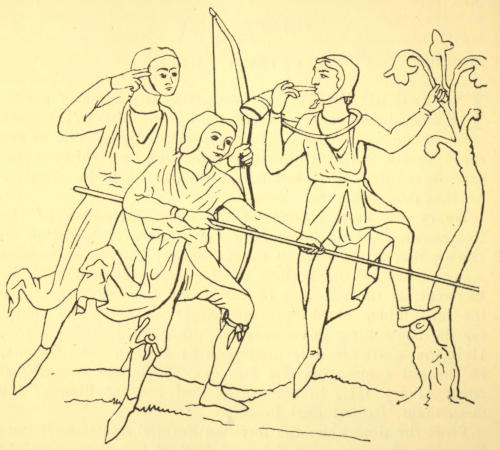
HUNTING COSTUME. THIRTEENTH CENTURY.
Such history as can be given of this forest is very meagre for the earlier period; but at a later date, when the earlier forest legislation was in many respects falling into desuetude, the records of the attachment or swainmote courts—almost invariably termed woodmotes in this forest—as well as particulars as to its customs are unusually full and interesting. They offer considerable contrast in many respects to the records of the Peak Forest. In the Peak the deer, save for a few fallow “chance” deer or strays, and some roe deer in its earlier days, was exclusively red; in Duffield Frith, on the other hand, the deer were exclusively fallow. In the [183]wild Peak district the bounds of the forest were only known from encircling rivers or streams, or from boundary stones and crosses; and there was but one kind of park, namely, the great stone enclosure of Champion or Campana. Contrariwise, Duffield Forest had pales all round it, which the adjacent tenants were bound to keep in repair, and it abounded in a number of separately paled and specially preserved parks.
The Peak Forest was never in any way wooded throughout by far the larger part of its area; but Duffield was wooded almost everywhere when first it came into the hands of the Ferrers. Nevertheless, in the stonier stretches of parts of Duffield and Colebrook wards there must have been much that was always thinly covered with undergrowth, whilst a considerable part of the area had no resemblance to what is now understood as forest by the time that it became part of the earldom of Lancaster.
The singularly full accounts of the opening years of Edward II. show that Duffield Frith not only included within its area a great number of parks, which were the special homes of the deer—though the park fences, whilst excluding cattle, etc., permitted them to wander at will through other parts of the forest—but also cow pastures, small sheep walks, coal mines, and iron forges.
As to the parks, they were thus distributed in the time of Edward I., and remained so (save for the speedily extinguished Champagne park) until the seventeenth century. Ravensdale (where was the central lodge or manor house of the whole forest) and Mansell parks, in Hulland ward; Champagne, Postern, and part of Shottle park, in Duffield ward; Milnhay (not always reckoned as a park, but separately paled) and the larger part of Shottle park, in Colebrook ward; and Lady or Little Belper and Morley parks, in Belper ward.
In an account of Belper ward for 1272-3 occurs the earliest known mention of the chapel adjoining the Belper manor house, which was expressly founded for the use of the foresters. John, the chaplain who celebrated at that chapel, held 7 acres and 1 rood of demesne land in Fishyard, in lieu of rent of nine cottages built on 3 acres of land that had been previously granted to the Belper chaplain.
At a Belper woodmote court of 1304, various offenders presented [184]by the foresters paid 12d. as fines for suffering foals and mares to wander in the ward, and smaller fines for plough-cattle and sheep. At a Duffield ward woodmote of the same year, several vert trespassers were presented for carrying off loads of green oak and of whitethorn.
The accounts of Duffield Forest, as returned to the duchy receiver-general, from Michaelmas, 1313, to Michaelmas, 1314, are exceptionally full and detailed.
For Belper ward William de Simondsley was the receiver, and his receipts, including arrears from previous years of over £8, amounted to £109 11s. 11¾d. Six score hens were sold for 15s. to supply the lord’s table at Donnington, and 3s. 4d. was obtained elsewhere for another score. The winter agistment of plough-cattle throughout the ward realised 7s. 11d., and the summer agistment £4 1s. 3d. The summer agistment fees for Morley park were 51s., and the herbage of a close near the park gate sold for 12d. There were no receipts that year from the little park of Belper. Thirty-four acres of meadow at Belper laund realised 33s. 2d. Not more than twelve acres were mown there for the coming of the lord to Belper; that was, we suppose, to supply the horses of his retinue with fodder. Twenty acres were mown there for storage for the lord at the deer-house, and twenty acres more for a like purpose (i.e. for winter food for the deer) at Bullsmore. Twenty-three acres of meadow grass in Morley park were sold for 18s. 1½d., and the residue was cut and stored for the lord. The fishing of the Derwent was let for 5s., and 4s. was paid by fowlers for licence to catch birds in the ward. There was no honey or wax entered for the year. Wood and bark sales realised 19s. An unclaimed stray ox was sold for 8s., while 6d. was paid to redeem a stray calf, and 2s. to redeem two stirks. The large sum of £13 10s. was obtained for getting coal at “Denebyhuyrum.” The ward woodmote fines and court fees brought in £4 5s. 10d. But far the largest receipts of this ward were for the forges or smithies, for Belper, as early as the beginning of the fourteenth century, had a considerable sale for nails. One forge that was at work for eleven weeks, save four days from Michaelmas to St. Thomas the Apostle’s Day, paid a farm rent or royalty of £7 8s. 10¾d.; whilst two forges that were working twenty-four weeks, save [185]four days, namely, from the Purification to Michaelmas, brought in £63 6s. 8d. It was, doubtless, the presence of coal near the surface round Belper (which was not exhausted till near the end of the eighteenth century) that brought the trade in wrought iron to this part of the forest.
The first item of expenditure entered is 3s. 2d. for Duffield rectorial tithes on the herbage of Morley park, and of a close there. A particularly interesting customary payment, denoting the risk incurred in traversing the roads of Duffield Forest, is 8s. for warding the road of the Cross (via de la rode) on Derby market days, a duty that devolved on the forest officials. The sum of 39s. 11½d. was spent in making 482 pales for the new fencing of Morley park and Belper laund, and 26s. 7½d. in repairing and re-erecting 384 broken or prostrate pales in the same fences. The man who worked for sixty-three days in mending the broken and defective pales, received 5s. 3d., or a wage of 1d. a day. The sum of 3s. 6d. was paid for strewing the deer-browse or loppings in the winter through the ward and in the little park. Thatching the roof of the great larder for the salted venison, adjoining Belper manor house, cost 2s., while 26s. was paid for the salt required that year in the larder. Fourpence was the small sum paid for measuring the pasturage within and without the park. The sum of £90 7s. 8½d. of the receipts was handed over to Nicholas de Shipley through ten tallies. At the end of the year the receiver still owed to the earl £8 0s. 6d.
Of Duffield ward Ralph le Corviser was the receiver; his receipts, including arrears, were £20 18s. 7d. The first entry among the receipts is 12s. 9d. for 102 hens sold for the lord’s table, and 12d. for six hens sold elsewhere. The winter and summer agistment throughout the ward, including the parks of Shottle and Postern and the herbage of “Muxelclif” and Longley, produced no monetary return, for it was all pastured or mown for the lord. The pannage of swine from two persons outside the ward brought in 2s.; the fishing of the Ecclesburn, 12d.; the fishery of the Derwent, 5d.; the sale of wood, bark, and deer-browse, 31s. 8d.; the licensing of fowlers, 2s.; and the woodmote fees and fines, 34s. 2d. The receiver of this ward also accounted for £41 6s. 2½d., paid in pannage pence for swine throughout the whole forest, deducting the tithes of the [186]same payable to the prior of Tutbury, and 55s. for the pannage of small pigs. The outgoings show that this ward, like that of Belper, also paid 8s. a year for guarding the road of the Cross on Derby market days.
The heaviest outgoing was the aggregate sum of £3 2s. 11½d. for renewing and repairing the pale fences and clearing the dykes, particularly round Shottle Park; 4s. 5½d. was also paid for new fencing within that park by the side of the Ecclesburn to protect the meadow land there, and 14d. for making a water gate. There were further small sums for park gates, and for mending a bridge and for the carriage of the timber for these various purposes. The sum of 2s. 4d. was paid for strewing deer-browse in the winter. A pinfold was removed from Hazelwood and carried to Shottle at the small charge of 6d. The most interesting outlay in the accounts of this ward is the expenditure of the sum of 6s. 8d. on mending the road between the parks of Shottle and Postern for the carriage of coal to the lord’s forge, which stood, as we learn from other accounts, on the further side of the Ecclesburn, just beyond Cowhouse Lane. The expenses of the foresters and others in connection with the pannage amounted to 17s. 8d., whilst 14s. 4d. was paid to the clerks of the master forester and the attorney of the prior of Tutbury and the foresters at the pannage court.
Of Colebrook ward, John FitzRalph was the receiver, and his receipts for the year, including the recovery of the large amount of £36 9s. 10½d. of arrears, came to £70 13s. 6½d. The agistment of Milnhay produced 31s. 10½d., and of Shottle park (most of which was in this ward) £15 16s. 7d. The herbage of Schymeed (Shining Cliff) brought in 17s. The townships of Alderwasley, Colebrook, Ashleyhay, Hulland, Newbiggin, and Idridgehay paid a composition of 4s., probably as an acknowledgment from the “outlands” parks. The fishery of the Ecclesburn produced nothing that year, but 6d. was paid for the Derwent fishery rights of this ward. Henry del Hay paid 2s. as composition with the lord’s tenants within the forest. Licences for fowlers in this ward and in Shottle produced 4s. The sale of wood, bark, and boughs realised 17s. 6d. Following this comes an entry that seems to imply an occasional sale of thick oak bark, or cork, for some specific [187]use. The entry runs, De cork nil hoc anno. The word “cork” is derived from the Latin cortex. Reference has already been made to the maple bowls from this ward.
The outgoings begin with a like entry of 8s. to the two wards already mentioned for warding the road of the Cross on Derby market days. The paler for this road and Shottle park received an annual stipend of 5s. for repairs, and in addition he received this year 10s. 10d. for the making of new pales. The strewing of the deer-browse in the severe weather cost 7s. 3d. The considerable sum of 40s. was paid to Peter Bulners for carrying a letter of Lord Robert de Holand directed to the receiver at Tutbury. From the summary at the end of the ward accounts, it seems that the receiver of Colebrook had in hand the great sum of £40 1s. 11d. for the sale of bowl wood for that and the two preceding years, and that he sought instructions how he was to allocate it.
Of the ward of Hulland, John Hulleson was the ward receiver; the receipts for the year, including 66s. 8½d. of arrears, amounted to £29 7s. 2½d. The agistment of the two parks of this ward—Mansell and Ravensdale—realised the respective sums of 35s. 3d. and 36s. 10d. The sale of wood, bark and boughs produced £17 13s. 4d.; 20d. was received in fines for two stray colts, 5s. for the sale of a waif, and £4 1s. 11d. as court fees of the woodmotes. There is an entry of 2s. under the head of cheminage; the way-leave in this case was probably for some exceptional transit during the fence month. The exceptional entry for this ward is 4s. 6d. for “ix. cokschutes.”
The outgoings of this ward begin with the entry of 4s. for warding the Corkley road (via de Corkelegh) on Derby market days. Corkley is the name still borne by an isolated farmhouse about a mile south of Turnditch, on the margin of Hulland ward. The yearly wage of the keeper of Ravensdale park amounted to 63s. 8d. Within this park stood the chief lodge of Duffield Frith, which was the hunting seat of the earls and dukes of Lancaster when in this part of their estates, and which was occasionally honoured by the presence of royalty. Very considerable repairs were done to the lodge and park of Ravensdale during this year. The small sum of [188]7s. 6d. was paid for preparing 1,300 shingles (cendulæ) and 200 boards for roofing the different parts of the manor house; the timber itself would, of course, be provided out of the forest. Painted glass for the windows of the manor chapel only cost 16s., but 18d. was also paid for buying iron and making it into bars for the support of these windows. The renewing of the park pales of Ravensdale and repairing and setting up the old ones cost 17s. 3½d., whilst 4s. 4d. was spent over the park gates towards Corkley and at “Schakesdon.” The making good of eighty-five new pales, and the repairing of upwards of 600 old pales of Mansell park, cost £3 10s. 11d. A new hedge for part of the same park toward Pintclifford cost 13d., and 2s. was spent in mending the deer-leap towards Hough.
Under the head of Venatio de Duffield Frith, full particulars are given of all the venison taken in the forest, and its disposal. The grand total for the year was: one hart, ninety-six bucks, and twenty-five does.
The stock of the forest is next set forth under the heading Instaur’ de Duffield. The account is rendered by Robert Frely and Nicholas Fitz-Giles, the stockmen (instauratores) of Duffield. The sale of thirty-two of the lord’s oxen realised £23 3s. 40d., an exceptionally good price. A bull and sixteen cows in calf sold for £9 13s. The skins and flesh of four cows, the skins of six cows, the skins and flesh of four steers, and the skins of twenty-seven calves sold for 44s. 9d. The milk of eighty-eight cows brought in £9 2s. 6d. There were but few sheep on the outskirts of the forest; the ewes were milked, but the sheep account was annexed to that of Hartington. The rest of the receipts came from mowing and carrying the hay of two tenants.
The payments included 30s. 2d. in wages for those who looked after the cattle and calves in Postern park; 36s. 4d. for mowing, and 18s. 2d. for haymaking and carrying the hay of eighty-seven acres in the same park; and 21s. 6d. for carrying 105 loads of hay from Longley Meadows, Postern park, Morley park, and Bullsmoor to the cowhouses of Postern and Belper. The sum of 3s. 8d. was paid for stubbing up two acres of waste, and hedging it in for the sustenance of calves and colts, and 3s. 2d. for two quarters of oats for sowing the [189]same. The dairy at Postern had 16s. 8s. expended on its various buildings, and 4s. 9d. was spent on mending the road by the Ecclesburn, to permit of the carriage of timber for the work. The sum of 16s. 8¼d. was spent on hedges and ditches round “Maxenclif” and “Mareclos” in the same park, and 4s. in repairing the fence of Bullsmoor. A shilling was expended on drugs for sickly cattle.
The full return of the stock of Duffield Frith for that year was thirty-eight oxen, 157 cows, five bulls, thirty-three heifers, fifty-one steers, and seventy-three cows. Of these there were sold, consumed, or died in the course of the year, thirty oxen, fifty-one cows, two bulls, four steers, and thirty-four calves.
Roger Beler’s accounts for 1322-3, are of some interest, as also are those for 1326-7. The latter mention 32s. paid as the tithe of the mills of Duffield and Belper to the rector of Duffield, which is henceforth an annual entry whenever the accounts are extant. Under Richard de Slope, who was then parker of Ravensdale, considerable repairs were done to the chief lodge of the forest or earl’s manor house within that park, including 22s. 4d. paid to a workman for 134 days’ labour at 2d. a day on the roofs, doors, and windows. The total expenditure on the great house and park was £5 5s. 9d½d., and embraced payment for 1,500 shingles, and 100 spikes, 100 “bordnayles,” and painting and plastering with white clay (plasticando cum argillo).
Among the expenses of the reeve of Belper (Simon Payn) for 1327-8, are some exceptional entries that throw light upon the then condition of that forest town and township. The expenses included £9 worth of lead for the water conduit in the park; 39s. 4½d. for making a wall round the pond there, etc.; 22s. 10d. for roof shingles and for stone for the walls of a garderobe for the lodge; 14s. 1d. for repairing the knights’ lodge (camere militum), and providing it with three garderobes; 17d. for paling and hedging the lord’s garden; 4s. for carriage of venison from the Belper larder to Tutbury; 4s. for the carriage of salt to the larder; and 3s. 8d. for repairing the glass windows of the chapel. There was also a charge in another part of the accounts for a man and a cart carrying six does to the lord at Kenilworth. The receiver from Belper ward had 5s. from Henry Alisson and his companions for [190]licences as fowlers, and 7s. 8d. for five oaks for the garderobe for the camera juxta coquinam. Among the outgoings of Colebrook ward for that year were 27s. 5¼d. as tithe to the rector of Duffield of the agistment of Shottle park, and 12d. for mending the hedge and the deer-leap between the forest and Crich Chase.
On 10th November, 1330, Henry, Earl of Lancaster lessened the area of Duffield Frith by bestowing Champagne park by charter on his beloved valet Robert Foucher and Cicely his wife and their heirs; it had been disafforested and placed in private hands as early as the reign of Edward I.
The records of various courts during the reigns of Edward III. and Richard II. yield evidence of the nature of vert and venison attachments; among the former were many cases of damage to hornbeam trees.
At a woodmote for Duffield Forest held in 1376-7, the foresters presented Ralph Gregory for having killed a doe in Postern park on Monday after the Feast of All Saints, and also a doe in the park of Shottle in the month of September; he was committed to Tutbury.
Many interesting items could also be gleaned from the full duchy accounts that are extant for 1377-8 and later years of that century, but space forbids making even the briefest extracts.
The registers of John, Duke of Lancaster, covering the close of the reign of Edward III. and the beginning of that of Richard II., contain various references to Duffield Frith, which have to be omitted for a like reason.
There was a serious charge of venison trespass at a woodmote held at “Le Cowhouse,” Postern, on 21st July, 1395. This woodmote resulted in a jury inquisition. John de Bradshaw, chief forester, and Henry de Bradburne, and ten others swore that Thomas de Statham and John Helot took a fat buck (damnum de groce) in Colebrook ward with greyhounds on 15th September; that the same two, with others unknown, killed three bucks and a sore in Milnhay in the same ward on 21st September; and further, that the same Thomas and John killed diverse bucks in the water in Colebrook ward. There was another venison presentment against Thomas Jackson and five others for having hunted with greyhounds in Hulland [191]ward. Such offenders as these would be committed to prison, but released on bail, under a pledge of appearing at the next forest pleas held at Tutbury. At the same mote, Goditha de Statham, lady of Morley, the mother of Thomas Statham, the poacher, was presented for having five mares in the park of Shottle.
Henry Duke of Lancaster, son of John of Gaunt, when he came to the throne in 1399, brought Duffield Forest and the rest of the duchy into immediate relationship with the Crown. In September, 1405, the king (Henry IV.) ordered the chief forester to supply twelve timber oaks towards the repair of Duffield church.
Henry V., almost immediately on his coming to the throne in 1413, made a complete change in the personnel of the chief officials of this forest. Sir Philip Leche was appointed master forester, and the following minor appointments were also made to all of which certain fees or perquisites pertained:—
| John Bradshaw, | parker of | Shottle. |
| Henry Bradshaw, | ” | Postern. |
| Thomas Bradfield, | ” | Ravensdale. |
| Richard Baldere, | ” | Mansell. |
| John Gedling, | ” | Belper. |
| Richard Packer, | ” | Morley. |
| Thomas Waterhouse, | forester of | Colebrook. |
| Richard Pilkston, | ” | Hulland. |
| Nicholas Adderley, | ” | Belper. |
The accounts of the manors in the forest and purlieus of Duffield Frith for 1417 mention for the first time stipends for the reeves. The annual stipend of the reeve and “halswayne” of Duffield was 11s.; those of Belper, Alderwasley and Wirksworth, 5s.; Holbrook and Heage, 2s.; and Hulland, Biggin and Idridgehay, 20d.
Among the Harley MSS. of the British Museum (568, 5138) are two transcripts of the customary of the honor of Tutbury, including Duffield Frith and the High Peak, with elaborate accounts of the duties and authorities of the different officers. This customary, which dates from the end of Henry V. or beginning of Henry VI., is chiefly concerned with Tutbury and Medwood forests. Several of the portions that specially [192]relate to Duffield Frith have been cited in the introductory chapters, and most of them have been printed in volume xv. of the Derbyshire Archæological Society’s journal.
A woodmote was held at Belper on 14th May, 1466. In addition to a variety of 2d. fines for small vert offences, several of the tenants in Hulland ward were fined a similar sum for not repairing the border fences according to their tenure. The parkers of Ravensdale and Mansell, as well as Postern, had nothing to present. The foresters of Chevin ward (an alias for Duffield ward) presented Ralph Sacheverell, lately of Snitterton, who came into the ward on 6th March, and without any licence cut down six oaks called “spyres” for repair of two houses. Various other inquiries were presented at this court. John Kniveton, of Mercaston, killed a fawn without warrant in Shottle park; and in the same park William Cook, of Bradley, John Vernon, of Haddon, and John Bradburne, of Heage, each killed a doe, and three others a fawn. In Morley park John Fynedun (also an armiger) killed a doe. Thomas Gresley, who was deputy lieutenant of Duffield Frith, presented William, son of the vicar of Wirksworth, and two others for entering the forest on several occasions with four greyhounds.
At another woodmote held later in the same year at Ravensdale, the foresters of Belper presented that Thomas Gresley, late deputy lieutenant of the chase, on Thursday before the Feast of St. Thomas the Martyr, had killed a buck without warrant, also that in Whitsun week he had killed another buck, and that William Troutbek had committed the like trespass. The keeper of Morley park charged Thomas Gresley with a like offence in that enclosure. At the same court Roger Vernon was presented for having sent Nicholas Bromhall, of Alderwasley, to Shining Cliff within the forest to cut down eight oaks called “spyres.”
The explanation of these outbreaks on the part of the county gentlemen is not far to seek, and they were common at this period throughout the forests of England. It was in the midst of the Wars of the Roses. Advantage was taken of this period of civil commotion; those who favoured York or Lancaster, as the case might be, seem to have readily persuaded themselves that they were entitled to make a raid on the forests of the one or the other whom they chose to regard as a pseudo-king.
[193]
At a woodmote held at Belper on 23rd April, 1472, John Harly, of Crich, yeoman, and two others were charged with having broken into Shottle Park in Easter week, and hunted with greyhounds, though they killed nothing. There were various fines for vert trespasses in Milnhay, Belper ward, and Hulland ward, the total amounting to 14s. 4d. In February, 1480, there was a sale of all the birches with their loppings, and the underwood of Ladyshaw Wood.
Robert Bradshaw was the reeve of Duffield in 1482, with a stipend of 11s. He is described as reeve voc’ haselswayne. William Assheton, who was reeve of both Belper and Heage, received 5s. from each township. John Egginton, reeve of Holbrook, also received 5s. In the forest ward returns of this year there is reference to the making of charcoal in Morley park.
The records are preserved of several appointments of officials of this forest during the reign of Henry VII. In 1485 Ralph Langford had the comprehensive appointments bestowed on him of lieutenant of Duffield Frith and steward of the same and parker of all the parks; but about a month later Nicholas Kniveton was made parker of Ravensdale. Richard Salford was made parker of Belper, and Sir Charles Somerset “Captain of our guard,” parker of Postern in 1487. In 1491 Nicholas Kniveton became parker of Shottle, and in 1493 Humphrey Bradburne became parker of Mansell. In 1503 Roger Vernon was appointed to the custody of Shottle park. In 1504, on the death of John Stafford, Thomas Day, “a valet of our chamber,” was made custodian of Morley park.
There are interesting full returns as to the venison of Duffield Frith, killed both legitimately and illegitimately, for the year 1498, as presented at a woodmote held at Cowhouse. Shottle park: A doe was killed on the Sunday after St. Barnabas’ Day in the Blackbrook, and carried out of the pale and stolen, but the offender was unknown. About the same time a doe was killed and afterwards taken to Thomas Parker’s house. Roger Vernon had a buck from the keeper. The Earl of Shrewsbury killed a buck, eleven sores, and a sorell, and gave them to Sir Harry Willoughby and other squires and gentlemen that were with him. The following were the deer given either by special warrant or by the earl or keeper: [194]Anthony Babington and Henry Sacheverell, each a sore; Thomas Talbot, a sore and a doe; Nicholas Shirley, a sore; Godfrey Foljambe, Thomas Leghe, Master Elton, William Sacheverell, Edward Savage, Master Stokes, Thomas Molyneux, William Gresley, the Abbot of Dale, and John Alsop had each a buck. The keeper himself had 4 bucks and a sore. Also the bailiff of Derby and others of the same town had a buck on the Monday after St. Giles’ Day. Murrain killed 23 “deer of auntelers,” 16 prickets and does, and 32 fawns. Mansell park: Sir Ralph Longford and Sir Henry Willoughby had each a buck; John Montgomery, John Fitzherbert, and John Ireton had each a sore, and Roger Vernon a buck and a doe. A buck, a sorell, 4 does, and 5 fawns died of murrain. Postern park: The Earl of Shrewsbury, Lady Hastings, John Dettrick, Ralph Illingworth, Godfrey Foljambe, Roger Vernon, Humphrey Bradburne, and Sir Henry Willoughby had each a buck. Nicholas Kniveton the younger and Humphrey Bradburne killed a sore by their own authority. The keeper had a sore. “The patent man had a soure for his sute.” A sorell was stolen, by whom unknown. Master Talbot, a buck by his own authority. Sir Ralph Longford, Sir Thomas Gresley, and Sir John Montgomery killed 2 bucks and a doe by their own authority. “A chaunce buk ley out and was hurt in the bak and giffen to John Agard; a buk was hurt on our Ladys own Assumcion and was found dead and was lost.” Three bucks, a sore, 3 sorells, 7 does, and 12 fawns died of murrain. The Lady park of Belper: The auditor, a doe and a fawn. William Pope, a doe. The murrain killed a buck and two does. Morley park: Sir Henry Willoughby, a buck. Master Pole and his daughter, a sore. Master Osmond killed a pricket. Thomas Borow, gentleman, killed a pricket by warrant of Sir Ralph Longford. The keeper had a sore and also “a chaunce stag.” “Nicholas Kniveton and Roger Vernon came into Morley parke and hunted by there own auctorite and kylled no thyng. Item the seid Nicholas brak the pale another tyme as he went to Butterly.” A doe died of the murrain. Hulland Ward: Nicholas Kniveton the elder and Humphrey Bradburne killed a buck “for there sute.” Nicholas Kniveton the younger, Humphrey Bradburne, and Roger Vernon killed a buck by their own authority. “Then [195]the said Nicholas Kniveton the younger caused a buk to be smytten, which Robert Bradshaw sonnes received.” Ravensdale park: The Earl of Shrewsbury killed a buck. Sir Henry Willoughby and the Commission had each a buck. Sir Ralph Longford and Roger Vernon each two bucks. A chance buck and two chance does were disposed of by the keeper.
By the time that great sportsman Henry VIII. came to the throne, the stock of fallow deer had materially decreased throughout this forest, and the disafforesting of most of Colebrook ward, through the king granting so large a part of it to Anthony Lowe, deprived the forest deer of much of their wildest runs. Nevertheless, they must have been fairly abundant in parts as late as 1541, for the Earl of Shrewsbury, the chief forester, wrote to the Earl of Southampton on 6th July hoping that the king, at his coming to Nottingham, would visit his poor house at Wingfield and hunt in Duffield Frith; but before the end of the month the earl was dead.
In 1521 there must have been deer in the parks of Ravensdale and Mansell and generally throughout Hulland ward, for 15s. was spent in those divisions in providing winter deer-browse.
The king, in 1523, granted to Anthony Lowe, who was forester-in-fee of Duffield Frith and keeper of Milnhay, to occupy those offices without rendering any account or paying, as his father Thomas Lowe did, at £3 11s. a year for the exercise of those offices; a water-mill and 200 acres of land in Alderwasley were conferred on Anthony by the same patent.
There are many appointments to patent offices in this forest entered throughout the reign of Henry VIII., such as John Bradshaw, keeper of Postern park; Thomas Doughty, keeper of Morley park; and Thomas Oakemanton, keeper of Ravensdale park in 1510.
Various forest appointments were also made by the Crown in the reign of Edward VI., such as Sir Thomas Cokayne, parker of Ravensdale, in June, 1553.
The leases of the parks of Shottle and Postern, including rights over the deer, show how steadily the old forest customs were deteriorating. At the beginning of Elizabeth’s reign the [196]question was raised whether such leases were not equivalent to disafforesting.
In Michaelmas term, 1559, Thomas Wynston, Esquire, of Windley Hill—claiming the two parks of Shottle and Postern, within Duffield Frith, by a forty years’ lease from Philip and Mary, at a rental of £86, and, for a further sum of £43 12s., full licence to take and use the deer within the two parks at his will and pleasure—complained that Sir John Byron, Francis Curson, Esquire, Edmund Tetlowe, and Richard Kaye last May entered the parks, killed many of the deer, carried away 1,000 loads of underwood, and continued to occupy and hold the parks, and thus hindered the complainant in paying his rent to the duchy.
There is no extant reply to this complaint, but in the following year the question was again raised on another charge.
In 1560 Thomas Wynston, of Windley Hill, complained to the chancellor (Sir Ambrose Cave) that he held a lease on yearly payment of £86 from Philip and Mary of Shottle park, within Duffield Frith, which was a paled enclosure beyond man’s memory, and within which there was “free warren of dere and other game of venerie,” but that John Wigley, yeoman of Wirksworth, on 3rd January, “entered into the said parke and there hunted without lycence and kylled there certin dere as well as of season as note of season, and the same trespas hath combyned by the space of sundrie dayes and after to the utter destruction of the dere and game to the disinheritance of the Quene ... and to the damages of the said Informer one hundred poundes.” To this bill John Wigley made answer that the letters patent of Philip and Mary granting the deer of Shottle park to the complainant had caused the enclosure to be disparked, and that the defendant “claiminge to come by the said parke havinge a brace of greyhounds with hym, the same greyhoundes dyd verie soddenly breake from hym, and havinge a deere in the winde came at the said deer and kylled it”; that he never hunted there again, and that, knowing that the complainant was killing off the deer and disposing of them, was not aware that he had committed any offence against the laws of the realm.
In the following year the Crown confirmed to Thomas [197]Wynston the grant made by Philip and Mary in these two parks of timber sufficient for the repair of houses, lodges, hedges, and all manner of farm gear, as well as for fuel.
An elaborate survey of this forest, giving the exact number of the trees and the condition of the undergrowth in each ward and park, was drawn up in 1560. There is no other known forest return of the sixteenth century which gives nearly such full details. It was printed in full, with other later surveys, in the Derbyshire Archæological Society’s journal for 1903. The large trees were entirely oak. There is not a single mention of an elm. The underwood included white and black thorn, hazel, holly, maple, crabtree, and alder, as well as abundance of birch wood in Belper ward. The totals work out to the large amount of 111,968 trees, of which 59,412 were large oaks, 32,820 small oaks, and 19,736 oaks in more or less state of decay—“dottard oaks,” and only suitable for fuel.
The destruction of timber throughout Duffield Forest was excessive during the whole of Elizabeth’s reign. The contrast between this survey of 1560 and another that was taken in 1587 is most extraordinary. There were at the latter date only 2,764 large oaks and 3,032 small oaks; they are set forth in detail with their estimated worth. The total value of the whole wood was somewhat under £2,000.
The commissions relative to this forest during Elizabeth’s reign were frequent. In 1581 Edward Stanhope, William Agard, and Simon Arden were commissioned to view and report on Duffield Frith. They called before them the woodwards and collectors of the three wards (for Colebrook ward had now disappeared through the appropriation of the Lowe family, and Shottle park was wholly in Duffield ward), as well as divers of the tenants and freeholders, and by their information and their own perambulations arrived at the following conclusions:—That there is a woodward and collector or forester-in-fee of each ward; that these wards were “till of late years replenished with game and fallow deare, and had divers other officers and ministers of chase as foresters-in-fee, bow-bearers, and such like”; that as “the said game is utterlie destroyed” they did not call for sight of such grants; that in Hulland there is a great deal of plain ground as well as [198]of woody and bushy ground; that in Duffield there is much plain ground and also a great deal of thin set wood ground by name of Chevin; that in Belper there is much plain ground and a good deal of wood soil chiefly set with birch underwood; that the tenants of the frith and the copyholders bordering on the same have every third year reasonable hedgebote out of the woods to hedge their common cornfields, and in winter to lop hollies and other undergrowth for relief of the queen’s game when there were deer, and for their own cattle and sheep; that all borderers and strangers taking away any fuel, wood or browse (other than what may be sold by the collectors) are amerced at the woodmote courts; that all the alders throughout the wards had been lately felled and sold for Her Majesty’s use; that all tenants of Duffield, Belper, Makeney, Hazelwood, Windley, Turnditch, Holbrook, Hulland, Idridgehay, Biggin, Ireton Wood, and Heage, and other houses in the precincts of the frith claim and use common of sheep and cattle; that small benefit would accrue to the Crown from the encopsing of the woods, and that it would be prejudicial to the tenants, who are mainly poor and dependent on the relief of pasturage in the frith; that the underwood might with advantage be divided into ten parts or “hagges,” and let on lease, selling every year one part; that the aptest places for setting up “any bloweng mill for the melting of lead ower (the same intended to be a water mill)” is in the Hulland ward at a little brook called Hulland brook, and in Chevin or Duffield ward at Blackbrook, “so that there may be one small overshot mill at eache of them, and will have water to furnish worke one day at thone and an other day at the other, onles it be in the drowght of somer”; that near Hulland brook are “one or two great and auncient heapes of Iron slag or cinders whereby it should seem there hathe ben some water worke there for melting of Iron stone”; and that the same preferment for lead ore should be charged in the manors of the frith as in the Wapentake of Wirksworth, namely, a halfpenny for every load of ore, twelve loads commonly making a fother of lead.
In 1587 the inhabitants and borderers of Duffield Frith, numbering 509 copyholders, freeholders, and ancient cottagers and householders (forming a population of 1,800 with [199]their wives and children) petitioned the queen not to carry out the project of leasing the underwood, as they had from time beyond memory been accustomed to crop and browse of these woods from Martinmas to the end of February for their cattle whenever the weather was severe, paying a price for the same at the end of the winter. If the leasing was carried out, they considered they would be debarred from this, as well as from their customary rights of fuel wood, and wood for the repairs of their houses and hedges, and that they would “be utterly impoverished thereby and constrayned to seek dwellings other where.” This petition was presented in September, 1587, and in June, 1588, Edward Stanhope was appointed by the Council of the duchy to enter into the grievances of these tenants. On 5th July he met seven representatives of the tenants at Nottingham, but after several adjournments they were able to come to no satisfactory compromise.
In 1592 another commission was appointed to secure true measurements of the “woodgrounds” of the frith, but after thrice meeting the commissioners, the local jury declared that it was impossible to execute such a task, giving their reasons at length, which were chiefly because of the various barren and stony places with which the woodlands were interspersed.
The woodmote courts continued to be held and were busily engaged in fining vert trespassers. At the court held at Cowhouse Lane in July, 1593, fifteen offenders who had carried off green wood in Duffield ward were fined in sums varying from 5d. to 6d., thirty-nine in Belper ward, and sixty-four in Hulland ward. The fines amounted to 35s.; a pannage court was held the same day, when a penny each was received for 109 pigs.
At a woodmote held at Hulland on 21st September, 1597, the only business transacted was the imposing two fines of 2s. each for cutting down trees. At the woodmote held at Chevin House, on 11th August, 1598, many vert trespassers were presented. In the Belper ward one offender was charged with removing so many “bigis Anglia sleydfulls” of wood. In other returns of this reign the taking of sledges and drags of woods are mentioned. Thomas Sympson incurred the heavy fine of 3s. 4d. for cutting various birches.
[200]
On 19th December, 1598, another court was held at Chevin House, before Anthony Bradshaw, as deputy steward; the foresters who appeared were John Curzon, William Kniveton, and William Bradburne, esquires, and John Brockshaw, gentleman. The names of agisters, parkers, and ward collectors are also set forth. Henry Butler held the joint sinecure offices of bow-bearer and axe-bearer, while Richard Clark was the ranger. A large number of vert trespassers were fined, chiefly in sums of 4d. and 6d.; in various cases the offenders are described as taking of horseloads, sleighloads, or les backburdens ligni.
At a woodmote held at Chevin House, on 11th March, 1600, by Anthony Bradshaw as deputy steward, John Curzon was present both as lieutenant and forester, and the other foresters were Sir Humphrey Ferrers, William Kniveton, and John Brockshaw. Thomas Johnson, the keeper of the two parks of Manshull and Ravensdale was fined 2s. for absence, and the parker of Morley 1s. for a like offence. No fewer than 123 vert trespassers were fined, in sums varying from 2d. to 12d. “Waynelodes” are mentioned among the amounts of wood taken.
At the next court, held on 8th July, two trees were assigned to the town of Duffield towards the repair of their bridge. Among the fines is the very heavy one of 10s. which had to be paid by Richard Ferne, for he not only cut two cartloads of green wood, but sold them at Derby.
Anthony Bradshaw, fourth son of William Bradshaw, of Bradshaw, the deputy steward of the forest, who did so much to sustain the privileges of the tenants of Duffield Frith, resided at Farley Hall. He was a man of some literary power, and wrote a long curious poem of fifty-four stanzas, early in the reign of James I., entitled “A Frend’s due Commendacion of Duffeld Frith.” It is printed in vol. xxiii. of the Reliquary. He mentions therein the Earl of Shrewsbury as high steward and John Curzon as lieutenant. The six parks of Morley, Belper, Postern, Shottle, Ravensdale, and Mansell are all named, but they were all farmed “and yeald no deare at all,” save Mansell, and that “verie small.” From these rhymes we learn that “Tacke courtes” were held in addition to the woodmote, “at Luke’s day and Martinmas,” and the tack dinner, when [201]each man had a hen in his pie, mentioned in the old customary, was still maintained.
At a woodmote held by Anthony Bradshaw, in 1604, there were nine cases of fines of 12d. each for beating down and collecting acorns; for taking a cartload de le Oller (alder) wood, a man was fined 6d., and the like fine was imposed for taking a load of tynsell wood, or oven fuel; whilst 12d. was paid for removing a load of le Oller poles.
At the court held at Chevinsyde, on July, 1605, Sir Edward Cokayne, keeper of Mansell park, appeared through William Jesson, his deputy. Henry Butler, bow-bearer and axe-bearer did not appear, and pleaded that he ought not to be called to “wood pryses.” Forty-five transgressors were fined on this occasion. The ranger received a perquisite of wood for providing dinner for the officers of the court. This is the latest date at which we have found direct evidence of the presence of deer in the forest. William Jesson, as deputy of Sir Edward Cokayne, swore that there then remained seventy-six deer in Mansell park, and that four or five had died in the last winter.
As matters ripened in Derbyshire against the arbitrary actions of Charles I. and his advisers, the Crown claims over the district of Duffield forest, more particularly in the old ward of Colebrook, were more resisted and became more difficult to establish. A singular agreement was come to between the duchy and one Richard Neville to the effect that he should have such land as by prosecution he could recover for the Crown in Uttoxeter ward, Needwood forest, and in Colebrook ward, Duffield forest, at a rental of 12d. per acre. Neville succeeded in recovering much land in and around Colebrook ward for the crown as part of the old royal frith of Duffield. He was, however, not only put to heavy legal costs, but his attempts to inclose were naturally resisted, leading to many riots and disorders. In December, 1639, Neville petitioned the crown for an abatement of the covenanted rent, as he not only found much of the land barren, but he was still exposed to daily damage and interruption.
On 20th February, 1640, Richard Neville, described as a gentleman of the bedchamber to the prince, obtained a formal grant in fee-farm of the common or waste called “Milshay or [202]Millmore, or Milshayward de Colebrookward,” parcel of Duffield Frith, and other lands recovered by his prosecutions, charged with a rent of £45 3s. per annum; but at the same time 550 acres of Millhay was assigned to Edward Potterell and others as trustees for the commoners and tenants of Alderwasley and Ashleyhay at a rent of 2s. per annum. Probably the Crown, in accordance with the usual disafforesting arrangements of this reign, took one-third of the common, the other two-thirds being reserved for the commoners.
The statements appended to a Parliamentary Survey of this forest give a clear insight into the action of the Crown as to the commoners during this reign.
A survey of the “Royaltye of the late disforrested Forest or Chase called Duffield Frith ... late parcell of the possessions of Charles Stuart late king of England” was made in July, 1650, by order of Parliament. The chief rent due from several adjacent townships for liberty of commonage amounted to 56s. 4d.; the royalty, including waifs, strays, felons’ goods, hawking, and hunting, 40s.; of cottages on encroachments, £24 13s. 2d.; and “the mines delfes or pitts of coale now in use or hereafter to be digged ... with liberty of ruckeing and stackeing of such coales ... and of erecting of cottages for the habitacion of collyers with free passage for horses, carts, and carriages passing to and from the said coale delfes,” £30. The commissioners let the benefits of the royalties and of the coal for a year to John Mundy, of Allestree, and Thomas Newton, of Duffield.
The report cites the grant of 4th September, 1634, when a third part of Belper ward, 561 acres, assigned to the king by the Council of the duchy in the previous year, was transferred to Sir Edward Sydenham at a yearly rent of 21s. 8d. At the same time it was proposed to assign to the king a third part of Chevin ward, to be chosen by lot, the remaining two-thirds to be granted to the commoners at 2s. per acre for all they enclosed, being discharged of their old rent of 56s. 4d.; but only thirty-one commoners agreed to this proposal, upwards of four hundred being opposed to it. Nevertheless, a decree was passed for a division in the duchy chamber, and the king’s commissioners took what part they liked best without any casting of lots, taking in all the places “where the Coale [203]Delfes are now sunke.” In September, 1634, the king granted this third part of Chevin ward to Sir Edward Sydenham, and it was enclosed; and “the inhabitants were compelled by force and terror to submite thereunto.” Nor were the other two parts ever granted to the commoners in fee-farm, although enclosed, nor were any admitted tenants of this enclosed ground, save the small minority who had agreed to the enclosure. Thereupon, in 1643, the inhabitants threw open all the enclosures of this ward, including the king’s third part, and since enjoyed it all in common. “Had not the distraction by the late Warres prevented them, they had all joyned in a Bill of Reveiwe to reverse the Decree made upon soe slender grounds and soe illegally without theire consent.” The commissioners stated that they had had all this testified to them by a jury consisting of “men of qualitye and sufficient abilityes in those partes and neighbours to the place”; that they were convinced that, though a few private persons had been gainers by the enclosure, a far more considerable number had been “damnifyed thereby”; and that therefore they considered the ward to be rightly common.
The affairs of most of Colebrook ward were settled, as we have seen, in 1639-40. Hulland ward was divided at the same time as Belper ward, in 1633-4, the king’s third, consisting of 490 acres valued at 9s. 2d. a year being granted to Sir Edward Sydenham. The successful opposition to enclosure only prevailed in the large ward of Duffield or Chevin, including Shottle park.
All that part of the old forest that was, by violent means, thrown open to the commoners in 1643 remained common until 1786, when 1,500 acres were enclosed by an Act of 26 George III.
[204]
The old ballads of Robin Hood, which were popular rhymes as early as the middle of the fourteenth century, as we know from the Vision of Piers Ploughman, have probably been the chief cause of the undying fame of Sherwood Forest. But these pages have to deal with historic facts, and not with traditions, however substantial may be their basis. The fascinating subject of outlaw life under the greenwood tree of this celebrated forest must, therefore, be passed by; those who desire to know all that can be known of Robin Hood and his ballads had better consult the five scholarly volumes of Mr. F. J. Child, of Boston, Mass., published in 1882, entitled English and Scottish Popular Ballads. The delightful modern ballads of the Rev. R. H. Whitworth, who has for forty years resided, as vicar of Blidworth, in the very centre of ancient Sherwood, are saturated with the true forest spirit, and are eminently worthy of collective publication.
The celebrated forest of Sherwood included within its bounds most of the central part of the county of Nottingham. Its exact bounds were laid down in a perambulation of 1232. Roughly speaking, it was twenty-five miles one way, by nine or ten the other; at one extremity was the county town of Nottingham, and at another was Mansfield, whilst Worksop was close to the northern boundary.
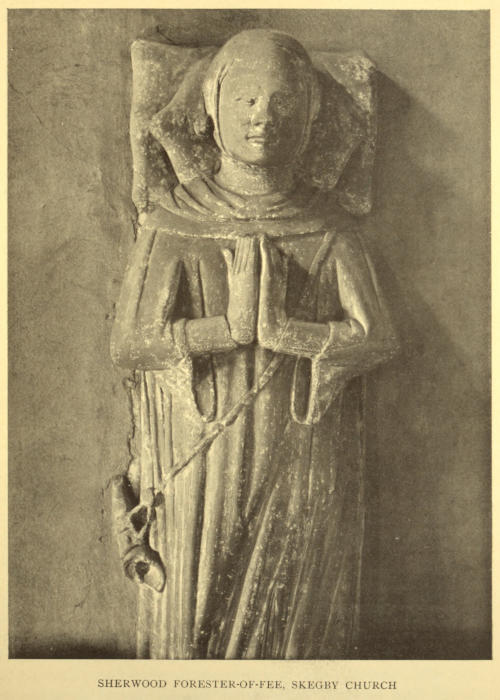
PLATE XIX
SHERWOOD FORESTER-OF-FEE, SKEGBY CHURCH
Many of the places afterwards within the forest are named in the Domesday Survey as members of the king’s great manor of Mansfield, so that the amount of royal demesne in the district made its conversion by the early Norman kings into a large forest a comparatively easy matter. The first exact notice of the forest occurs in the year 1154, when William Peverel, [205]the younger, answered to the forest pleas. He controlled the forest, and held the profits under the Crown. On the forfeiture of the Peverel estates the forest lapsed to the king, and was for some time administered by the sheriffs for the joint counties of Derby and Nottingham.
In the time of Richard I., Matilda de Caux and her husband Ralph Fitz-Stephen, were confirmed in the office of chief foresters of Sherwood. Matilda died in 1223, when she was succeeded as chief forester-of-fee by her son John de Birkin, and he in his turn by his son Thomas de Birkin. In 1231 this hereditary office came to Robert de Everingham in right of his wife Isabel, who was sister of Thomas de Birkin. Adam de Everingham was chief forester or keeper of Sherwood at the beginning of the reign of Edward I., and he was succeeded by his son Robert de Everingham. Soon after this, Robert de Everingham incurred the king’s displeasure, and this office was seized by the Crown as forfeited. This Robert de Everingham, who was keeper in 1284, was the last of hereditary descent. The office was afterwards conferred at will by the Crown upon various persons of high position as a mark of royal favour.
From the Close Rolls of 1286, it would appear that the offence which brought about the downfall of the last hereditary keeper of this forest was certain grievous abuse of his position as guardian of the king’s deer. In November of that month the Crown addressed a letter to the deputy of the forest justice beyond Trent ordering the release from Nottingham gaol of Robert de Everingham, John de Everingham, John the Constable, and eight others, imprisoned for trespass of venison in Sherwood, in bail to twelve men, who were bound to produce them at the next eyre, and on condition that they would not hereafter incur forfeiture in that forest.
The royal grants of oaks from Sherwood Forest were frequent throughout the reign of Henry III. In 1228 four oaks were given to William Avenel, described in the grant as waiting on the King of Scotland; two to the leper hospital of Chesterfield; six to the priory of Bligh; six to the canons of Newark; and three to the priory of Thurgarton. The gifts to religious houses usually specify that the trees were for the works then in progress at the churches or other buildings. [206]Occasionally these gifts from Sherwood consisted of ready-trimmed timber; thus in 1228 the king sent twenty beams (copulas) from the forest to the church of the distant priory of Wormegay, Norfolk, then in progress; and in 1229 forty rafters (chevrones) to the abbot and canons of Croxton. A single oak was also sent in the latter year into Norfolk to one Richard de St. John, chaplain of Henry de Burgs; the bailiff was directed to fell one as near as possible to the river Trent, as it had to reach Norfolk by water carriage. In the same year a single oak was granted to the prior of Bligh to make a door for his hall. In 1231, William Bardulf had a grant from Sherwood Forest of twenty tree trunks suitable for timber (fusta ad maeremium inde faciendum).
Henry III. dealt generously with the fallow deer of Sherwood. Thus in 1229 he gave two does to Beatrice, wife of Walter de Evermuth, constable of Lincoln Castle; ten does and a brocket to John, the constable of Chester, to be placed in his park of Dunyton; ten does and two bucks to Hugh Dispencer to help to stock his park at Loughborough; and twenty does and two bucks for the Bishop of Carlisle’s park at Melburne. In 1230, fifteen more does and five bucks were sent to Hugh Dispencer’s park at Loughborough, whilst a further donation of ten does and two bucks was made to the same park in the next year. The Bishop of Lincoln received twelve Sherwood does and three bucks in 1231 towards the stocking of his park at Stowe.
At the eyre of 1251, held at Nottingham before Geoffrey Langley, chief justice of the forests north of the Trent, an inquisition was held respecting the ministers of Sherwood Forest. It was then reported that there were within the forest three keepings, namely, the first between Leen and Doverbeck, the second the High Forest, and the third Rumewood; and that Robert de Everingham, as chief keeper, ought to have a sworn chief servant (a riding or itinerant forester, as described in other forests), who was to go through all the forest at his own cost to attach transgressors, and to present them before the verderers at the attachment courts. In the first keeping, the chief keeper was to have one riding forester with a servant, two foot foresters, two verderers, and two agisters. In this keeping there were three parks or hays, namely, Bestwood, [207]Lindley, and Welby. In the second keeping, of High Forest, Robert de Everingham was to have two riding foresters with their servants, two foot foresters, two verderers, and two agisters. In this keeping were the two parks of Birkland, with Billahaugh and Clipston, to which pertained two other verderers and two agisters. In the third keeping of Rumewood there was to be one foot forester, two verderers, and two agisters; and also two woodwards, one for Carburton and another for Budley.
It was also declared that Robert de Everingham ought to provide a servant, bearing his bow, to gather cheminage through the forest.
At the same inquisition it was further stated that the abbey of Rufford was entitled, by charter of Henry II., to a liberal measure of vert throughout the forest, for they could have whatever timber they required for the building or repairing not only of their establishment at Rufford, but also for all their granges, whether they were situated within or without the forest; they also held the right of haybote, or whatever they required for their fences. The monks might have a forester or woodward of their own, but he was to do fealty before the king’s justices, and to report at the attachment courts what trees had been taken by the abbey’s orders.
Among the grants of timber from this forest made to religious houses in the earlier part of the reign of Edward I. may be mentioned ten oaks, with their loppings (escætis), for the Carmelite friars of Lincoln (1276); thirty oaks to the prior of Blyth, to repair his house, accidentally burned (1278); four oaks to the Austin friars of Tickhill, for the work of their church, and six to the Franciscan friars of Nottingham for a like purpose (1279); four oaks fit for timber to the Austin friars of Lincoln (1280); twelve oaks to the priory of Shelford (1281); twelve oaks to the same priory, four oaks to the Franciscan friars of Nottingham, and six oaks for timber to the Franciscan friars of Lincoln, together with twelve oaks for roofing shingles. Oaks were also on several occasions in this reign supplied from Bestwood park for the repairs of Nottingham Castle, and of the royal mills below the castle.
The royal warrants at this period for Sherwood venison and deer are fairly frequent. The king kept Easter, 1276, at [208]Lincoln, and orders were issued on 13th March for fifteen does to be supplied for the royal use at that season from Sherwood Forest, in addition to twelve bucks from Galtres Forest. The keeper of Sherwood was ordered in 1277 to cause Richard Folyot to be supplied with two live bucks and ten does to stock his park at Grimston. In 1279, eight live does and four bucks were granted to William de Colwick to help to stock his park of Colwick.
The Close Rolls supply interesting information now and again of merciful royal attention to venison offences. On 2nd March, 1278, the king ordered Geoffrey de Neville, justice of the forest beyond Trent, to deliver John de Cokefeld from prison to twelve men, who were to mainpern to have him before the king in a month from Easter, if the king or any other wished to speak against him; the charge against him was the taking of a stag (red deer) in Sherwood Forest. The same justice was ordered by Edward I., in 1280, to take no action against Eustace de Hacche and six other transgressors for having taken three does and a hind in this forest, as the king had pardoned them. In 1285, the heavy fine of 100 marks on Thomas de Carducis on account of venison trespass in Sherwood was annulled by letters patent.
Edward I. was much attached to the two younger sons of Walter Bek, baron of Eresby, Thomas and Anthony. They were both king’s clerks, and eventually obtained high promotion; their names occur on various occasions in connection with benefits from this great forest. Thomas, the second son, was consecrated Bishop of St. David’s in 1280. On Christmas Day of the following year, Edward I. granted him four live bucks and eight live does to stock his park at Pleasley, on the confines of the forest. On the same day the king sent a letter to the justices next in eyre for pleas of the forest in the county of Nottingham, ordering them not to molest or vex the bishop on account of four bucks taken by him in the previous autumn, when passing through the royal forest of Sherwood, as the king had sanctioned, by word of mouth, his taking four bucks when next he passed through the forest as a royal gift. In 1285 the same bishop was granted twelve good oak trees fit for timber out of these woods. Anthony Bek, the third son, the celebrated Bishop of Durham, was a still greater favourite [209]of Edward I. In 1282, he had twenty good oaks granted him out of Sherwood for the construction of his houses at Somerton, as well as four bucks and eight does to stock his park at Northwell. In the following year he was the recipient of twelve oaks and eight live deer from the like source. The king, as a special mark of his favour, at the time of Anthony’s consecration to the bishopric of Durham, in January, 1284, forwarded to the bishop the largest grant out of Sherwood Forest of which there is record, namely, ten live bucks and twenty live does.
The forest pleas began to be held irregularly in the latter part of Henry III.’s reign, especially north of the Trent. There was an eyre, however, held for Sherwood at Nottingham in 1263, and again in 1267. At the latter date the abbot of Rufford was charged with having taken 483 oaks out of the forest since the last eyre; but he successfully pleaded the charter of Henry II. in justification.
With the advent of Edward I. to the throne, all attempts at regularity in holding the eyres seem to have been abandoned. So far as Sherwood was concerned, an eyre was held in 1287, but nearly half a century elapsed before the forest justices again visited Nottingham, namely, in 1334.
The pleas of the foresters and verderers of Sherwood were held at Nottingham on 14th January, 1287, before Sir William de Vesey, Thomas de Normanville, and Richard de Crepping, justices in eyre of the lord king. The verderers were six in number. Robert de Everingham was the forester-in-fee, and under him were eight sworn foresters.
The following venison presentment, cited by Mr. Turner, may be given as an example:—
“It is presented and proved that on the Wednesday next after the Feast of St. William, Archbishop of York, in the year aforesaid, Robert, the son of Agnes Bode of Edwinstowe, and Richard atte Townsend of the same town, came by night through the middle of the town of Wellow with two fawns of a kind. And the aforesaid Richard was taken with his fawn by men watching in the town of Wellow; and committed to the stocks of Peter de la Barre of the same town. And the same Robert broke his stocks and fled; therefore the aforesaid Peter foond mainpernors to make answer. And the aforesaid Richard came, and being convicted of this is sent to [210]prison (and he is ransomed elsewhere). And it is witnessed that Robert, the son of Agnes, is dead; therefore nothing of him. And the aforesaid Peter dwells in the same county; therefore the sheriff is ordered, etc.”
Sir William de Vesey and his fellow justices finding that the king had sustained many losses since the last eyre held by Robert de Neville and others, arising in many instances from the assize of the forest not being sufficiently observed, it was by them provided:—
That all verderers, in accordance with the charter of the forest, were to assemble every forty days to hold attachments for vert and venison and small pleas.
That they were to present a single roll of vert and venison to the justices in eyre, and not each one a separate roll for his own bailiwick.
That anyone dwelling in the forest found felling a green oak be attached for the next attachment court, there to find pledges till the next eyre, and to pay the price to the verderers; a second offence to be dealt with in like manner; but for a third offence to be imprisoned at Nottingham, and there kept till he be delivered by the king or justice of the forest.
That anyone dwelling outside the forest committing any trespass against the vert, his body is to be committed to prison till he be delivered by the king or justice; for a third offence he is also to lose his horses and cart or his oxen and wagon, or their price, and that price is to be paid at the next attachment to the verderers for the king’s use.
That those dwelling in the forest caught cutting saplings, branches, or drywood from oaks, or hazels, or thorns, or limes, or alders, or hollies, or such-like trees without warrant, are to be attached by two good pledges to come to the next attachment court, there to be amerced for the king; but if it be for a sapling which is of greater price than 4d. or any higher sum, to be attached until the next eyre.
That escapes of beasts of the plough into the forest be pleaded in the attachments, and amends taken for the use of the king.
That no man carry bows or arrows in the forest, outside [211]the king’s highway, save a sworn forester, and on the king’s highway only in accordance with the assize of the forest.
That no man save a sworn forester or other sworn officer attach any one in the future.
That any dweller outside the forest agisting his animals therein is to have such animals taken before the verderers, and the price paid, and to make answer before the justices in eyre.
That the great burden of so many regarders is no longer to be endured, but that in this forest the number be limited to twelve.
And that those taken by night or in the fence month within the forest be dealt with as before.
From the MS. book dealing with the perambulations and pleas of Sherwood in the reigns of Henry III.-Edward III., it appears that the very large number of 350 head of deer (both red and fallow) had fallen victims to the murrain in the year previous to the holding of this eyre.
The attachment rolls of this forest for 1292-3 are chiefly of interest on account of the presentment of vert offences, and the fines assigned. A green oak was valued at 6d., and a dry or leafless oak at 4d. A sapling (bletrum) varied from 1d. to 3d.; and a stub or dry trunk of a pollarded tree at 2d. In one case the same offender was fined 12d. for three dry oaks, 12d. for two green ones, and 2d. for a sapling.
Another survey of the forest was held in 29 Edward I. (1300), when the bounds as fixed by 16 Henry III. were confirmed, but with certain important additions.
In April, 1309, the sheriff was ordered to assemble all the regarders and foresters to make regard or survey therein before the coming of the justices of the forest, and to cause regarders to be elected in the place of those who were dead or infirm, so that they be twelve in number. The foresters were to swear that they would lead twelve knights throughout their whole bailiwicks to view all the trespasses, and to set out the same in writing. The phrase as to the coming of the justices was a mere form; it was repeated in the summons for the regard of Sherwood in 1312, although in neither case was the survey followed by an eyre.
Ample provision of wood from this forest was made on the [212]occasion of the Parliament being held at Lincoln in the early part of 1316. The keeper was ordered to deliver to the sheriff fifty leafless oaks in the wood of Bliorth, within the bounds of Sherwood Forest, belonging to the archbishopric of York, then void and in the king’s hands, for the twofold object of making charcoal and providing boards for dressers or tressle tables; also thirty oaks from the forest near the banks of the Trent for firewood for the king’s hall; and thirty leafless oaks for firewood for the king’s chamber against the ensuing Parliament at Lincoln, to be felled and carried to Lincoln by the sheriff, and there to be delivered by him to the clerk of the king’s scullery.
The oaks of Sherwood Forest were always held in good repute when choice timber was required. An order was made by Edward II., when at Nottingham Castle on 28th December, 1324, that the sheriff of Nottingham was to have the best oak or other timber out of the forest that might be selected by the carpenters as most suitable for the construction of nine springalds. The springald was a kind of catapult weapon for the discharge of stones or great arrows; these nine engines were required as part of the armament for the expedition into the duchy of Acquitaine.
A large bundle of attachment court records from 1317 to 1324 are of interest as showing how often these minor forest courts were at that period being held in Sherwood. They were held at four different centres, namely, Edwinstowe, Mansfield, Lindley, and Calverton. In the year 1317 twenty-two of these courts were held, six each at Edwinstowe and Mansfield, five at Lindley, and four at Calverton. Amongst those presented for vert offences in 1318 were two of the local secular clergy, namely, Nicholas de Nottingham, rector of Clipston, for taking a load of branches, fined 1d., and Robert de Kirkby, rector of Kirkby, who was fined 3d. for appropriating a dry stub. William de Bevercote, one of the prebendaries of Southwell, committed a more serious trespass (probably venison) about this date, for which he was imprisoned at Nottingham. In October, 1319, the king ordered his release to twelve mainpernors, who were to produce him before the justices at the next eyre.
After an interval of nearly fifty years the forest pleas for [213]Sherwood were again held at Nottingham, namely, on 2nd March, 1334, before Ralph de Neville, Richard de Aldborough, and Peter de Middleton. The following is an example of a venison presentment at this eyre, having reference to a trespass that was nine years old:—
“It is presented and proved that Hugh of Wotehall of Woodborough, William Hyend, Wilcock formerly the servant of the parson of Clifton, and Stephen Fleming of Nottingham, on 13 June, 1325, were in the wood of Arnold, in the place which is called Throwys, with bows and arrows. And they shot a hart so that it died. And its flesh was found putrid and devoured by vermin in a place which is called Thweycehilli; and the arrow was found in the said hart, wherewith it was shot. And the aforesaid Hugh came before the justices and is sent to prison. And the aforesaid William and Wilcock are not found. Nor have they anything whereby, etc.; therefore let them be exacted. And the aforesaid Stephen Fleming is dead; therefore nothing of him. And afterwards the aforesaid Hugh is brought out of prison, and is pardoned because he is poor. And the aforesaid William and Wilcock were exacted in the county and did not appear; therefore they are outlawed.”
The number of venison presentments at this eyre was 119, which was not at all large considering the long period since the last of these courts. In several cases there was no definite charge of deer-slaying, or even being seen with dogs or bows and arrows, but simply of trespass. Such trespass would be by strangers at night, or during the fence month. Some of the transgressors were of high position, among them including John, son of Lord John de Grey, who was found in the Bestwood enclosure with bows and six greyhounds, running a herd of hinds (herdum bissarum), of which he killed two; John le Bret, “duc de Wenton,” who killed a hind with four greyhounds; and Henry Curson, of Breadsall, who killed a hind at “Crossedoke,” in Clipston wood.
In one case a hind met with its death in an exceptional manner. John Bot, of Boltby, mower of Allerton, struck a hind with a stone and broke one of its legs; this caused its death, and it was found drowned in the stream of Allerton, by Langwith bridge.
At this eyre the ministers of the forest were asked upon their [214]oath from what person or persons the foresters were wont to receive and have their living. In reply they cited from an inquiry made by writ in 1289, shortly after Edward I. had removed Robert de Everingham from his bailiwick as hereditary keeper or chief forester by reason of his misdeeds, citing the various extensive perquisites and privileges that he had maintained.
In return for these emoluments Robert de Everingham provided foresters at his own charge. It therefore followed that after the keepership was forfeited to the Crown, that the foresters were to continue to be paid by whomsoever the Crown from time to time appointed keeper.
A roll of amercements of persons convicted at the attachment courts of vert trespasses appraised at more than 4d., and which could not be amerced save at the eyre, was presented to the justices. This roll included about 750 trespasses, varying in price of the vert from 6d. for honey found in an oak, for boughs, and for trunks, to 2s. for a single oak. These values had already been paid to the verderers, and the additional fines now imposed by the justices varied from 1s. to 2s. In each case the names of the two pledges for the trespasser’s appearance follow the entry of the offence.
It is not surprising, after all this interval since the last eyre, to find that some of the verderers’ rolls for the different attachment courts of the forest were missing for the years 1288, 1289, 1290, and 1291. The fines imposed upon the verderers of 1334 for these losses amounted to the considerable sum of £20 8s. 2d.
As the justices of the forest so seldom appeared, they seem to have been all the more determined to exact appearances and respect when the eyre was held. The whole of the free tenants of the forest had to put in an appearance. On the first day three of them were absent. John Bardolf successfully pleaded that he had not received his letter of summons; but Adam de Everyngham was fined 15s., and Joan, widow of Ralph de Birton, 6s. 8d. for their absence. The reeves and four-men of every township within the limits had also to be present. On the first day, William Goodrych, and William de Normanton, both of Lenton, were fined collectively 3s. 4d., whilst William Router, the reeve of Basford, had to pay 2s.
[215]
Before the justices left Nottingham, they issued a series of pardons for both venison and vert offences. Amongst the eighteen pardoned were Sir John le Bret, the rector of Annesley, and the vicar of Edwinstowe.
In 1340, the king pardoned John, Bishop of Carlisle, for killing a doe in Sherwood Forest and taking it away.
In the accounts presented by William Latimer, who was then keeper of Sherwood Forest, for the years 1368-9, record is made of the whole of the attachment courts. The return shows that substantial efforts were then made to comply with the forest law by holding attachments every forty days in each district; Edwinstowe was the only centre that fell short of the proper number, having but seven of these forest courts during the twelvemonth; nine each were held at Mansfield, Lindley, and Calverton. There are no special features about the presentments of that year.
The Sherwood exchequer accounts for 1395-6 show that £30 of the forest profits were that year expended upon the royal lodge or manor house of Clipston.
The accounts for 1430-2 give full details of the agistment of the park of Clipston; cows were charged from 6d. to 10d. each, and calves 3d.; the total agistment for 1431 came to 20s. 7d. Particulars are also given of the pannage in Bestwood park; the average charge for each pig at this date was 2d.
From an inspeximus and confirmation granted to the monks of Rufford in 1462, citing all their old royal charters, it appeared that the men of Clipston and Edwinstowe were not allowed to take anything from the abbey woods that were within the forest, and that the monks were at liberty to sell all windfalls within their woods, and to root up dead stumps, and take heather without let or hindrance.
Sir William Hastings, in 1471, was granted for life by the Crown, the offices of constable of Nottingham Castle, together with that of keeper and steward of Sherwood Forest, and the keepership or wardship of all the parks and woods, with every possible privilege of agistment, pannage, cheminage, dog-silver, etc. The abuse of accumulating a great number of distinct forest offices in one man’s hands and allowing all the work to be done by poorly paid underlings or deputies began, [216]so far as Sherwood was concerned, soon after the extinction in Edward I.’s time of the hereditary forestership.
In the reign of Edward IV., and subsequently, various appointments of king’s foresters of Sherwood are entered on the Patent Rolls at a wage of 4d. a day.
A forest session was held at Allerton on 3rd June, 1538. Among the higher officials, Thomas Earl of Rutland is named as master of the game, and Sir John Byron as keeper of Bestwood park and forester of Thorney. Eleven other foresters, thirty-five woodwards, fourteen regarders, three verderers, and the constables and four-men of twenty-eight townships are all specified as being in attendance.
The large majority of the constables and “fower-men” of different towns stated on their corporal oath that they “doth knowe nothing that is to the disturbaunce of the kyng his game or woode within the seide Foreste.” Among the exceptions may be quoted the two following presentments from Mansfield:—
“Item, the Constable and Fower men of the towneshippe of Mannsefelde sayeth that one Cristofer Shutte, Gerves Herdy, and one William Falcherde dothe kepe in their howses moo Fyres then of right they ought to do, wherebye the kyng his woode is destroyed extendyng every yere to three score lodes contrarie the Statute of the Forest.
“Item, that one Richarde Swynesloo, Thomas Clerke, Cristofer Bradeshawe [and five others] dothe staff-hyrde theire shepe of the Kyng his Common the number of twelve score where the Kyng his deare shulde have their peacablie Feadyng.”
The jury of freemen of the town of Nottingham presented the names of four burgesses, each of whom owned a greyhound, but stated that they only kept them for the purpose of hunting hares and foxes in the forest (to which they had a chartered right), and not for the disturbance of the king’s game. The justices accepted their plea as to the motive for keeping the greyhounds. They also made two orders affecting the forest wood—firstly, that no hedgebote nor firebote was to be taken without the deliverance of the woodward, nor any housebote without the deliverance of the keeper as well as the woodward; and secondly, that no one was to fell any of his own wood for [217]any intent “withoute the especiall lycense of the kynge his highnes, or the Justice of the Foreste, and that none from hencesforthe do take aine woode for bleaching.”
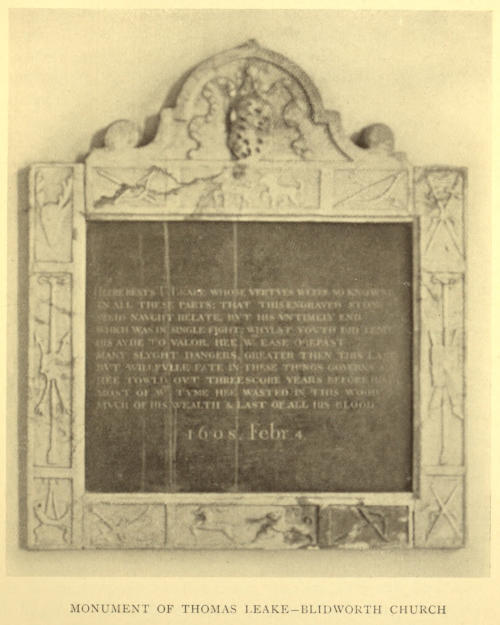
PLATE XX
MONUMENT OF THOMAS LEAKE—BLIDWORTH CHURCH
At the east end of the south aisle of Blidworth church, which stands on a commanding site about the centre of Sherwood Forest, is a mural tablet to the memory of a local Elizabethan worthy, Thomas Leake, who was ranger of Blidworth walk or ward of this forest. The memorial tablet was put up a few years later; round the margin (Plate XX.) are a curious number of hunting trophies, longbows, crossbows, horn, hounds, etc. The epitaph is:—
The date on the slab is that of its erection. The parish registers show that “Thomas Leeke, esquier,” was buried on 4th February, 1597-8. In the churchyard stands a massive cross to his memory. A brass plate affixed to it in 1836 records that the cross was originally erected at the place in the woodlands where this gladiator insignis met with his death, and moved at that date to the churchyard.
A careful survey made in 1609 showed that there were then 21,009 oak trees in Birkland, and 28,900 in Bilhagh, or a total of 49,909, and that the trees in general were, even at that date, past maturity. It may here be mentioned, as showing the steady diminution of timber that went on from that date, through decay, tempest, and felling, that in 1686 the Birkland and Bilhagh trees only totalled 37,316, including a great number of hollow or decayed trees, and that in 1790 they were reduced to 10,117.
A large number of these trees during this period were felled for the navy, particularly under the Commonwealth; but the stock was subject to further reduction on a large scale by [218]exceptional grants that were made from time to time. Thus, about 1680 the inhabitants of Edwinstowe petitioned the Crown for permission to fell 200 oaks to the value of £200, out of the hays of Birkland and Bilhagh, for the repair of their parish church, then in a ruinous condition through the fall of the steeple. The petition was entertained, and on a survey being made for that purpose it was found that “although there were yet standing many thousand trees, few of which there were but what were decaying, and very few useful for the navy.”
As to the red deer of the forest—the fallow deer were confined to the parks—they increased during the eighteenth century. The 1,000 head of 1538 was admittedly only a rough estimate; a more particular survey of 1616 gave the numbers at 1,263, and another of 1635 at 1,367. Out of the latter total, 987 were termed raskall, or out of condition.
In 1708 a representative meeting of the gentlemen of the north of the county was held at Rufford, at which a strongly-worded petition was adopted, addressed to the Crown, complaining of “the grievous and almost intolerable burden we labour under by reason of the numerous increase of the red deer in the forest of Sherwood these late years.” They complained that so many of the woods had been granted or given away by the queen’s predecessors that there was but little harbour left for the deer in the forest, and the deer in consequence were distributed all over the county, eating up the corn and grass; that their tenants had often to watch all night to keep the deer off; that their servants were terrified by several new keepers made by the present deputy-warder, who “threaten them if so much as they do set a little dog at the deer though in the corn”; that not only had they to watch their cornfields, where the deer often lay nine or ten brace together, but they so destroy private woods as to injure them to the extent of from £10 to £50 a year.
At the same time another petition was addressed to the House of Commons with about 400 signatures, wherein it was stated that the number of red deer in the forest, “till very lately, had seldom or never exceeded three hundred, which was as great a number, considering the barrenness of the soil and the great destruction of the woods, as the forest could maintain.” In the light of other evidence this estimate, used for the [219]sake of strengthening the petitioners’ arguments, was probably much below the mark. The petitioners proceeded to state that these deer now numbered more than 900; that they roamed over the whole country to find sustenance, but more particularly that these depredations were chiefly carried on in “the division called Hatfield and the whole district of the Clay; and that these parts of the county were outside the forest limits according to the perambulation and inquisition of Edward I.” The petitioners were not well advised as to the bounds, and had apparently confused the perambulation of Henry III. with that of Edward I. This petition met with no favour, for it was argued, though incorrectly, that the owners had never before been asked to stint the number of deer, and that it was a request to Parliament to take away the queen’s liberty and right without her consent. On a copy of this petition still extant is endorsed:—
“’Tis no doubt but that if there were no more than fifty deer in the whole forest, and if it should happen that they were on any one particular man’s two or three acres of corn or turnips, they would be sure to lessen his crop; yet he bought the land with the incumbrance, and it is past all dispute that the queen has as much right to it as any man has to his own coat.”
At this period the forest was no source of profit to the Crown, but the contrary. £1,000 a year was granted during Anne’s reign to maintain the deer and the new park at Clumber, and to hunt with two huntsmen, forty couple of hounds, eleven horses, and four grooms; there were four “forest keepers” at £25 each, and four “deputy purlieu rangers” at £10 each; the winter hay for the deer averaged £100 a year.
But from 1683 the area of the forest was being constantly curtailed; in that year 1,270 acres, out of the hays of Bilhagh and the White Lodge, were sold to the Duke of Kingston to be enclosed within his park of Thoresby. At the beginning of the next century about 3,000 acres of the previous open forest were impaled to protect the deer, under the auspices of the Duke of Newcastle, who was then keeper; this was called the New Park, and is now known as Clumber Park. Between 1789 and 1796 inclusive, Acts were passed for the enclosure of Arnold Forest, Basford Forest, Sutton in Ashfield, Kirby [220]in Ashfield, and Lenton and Radford, whereby 8,248 acres were brought into cultivation.
When Major Rooke published his interesting Sketch of the Ancient and Present State of Sherwood Forest, in 1799, the part of the forest that still remained to the Crown were the hays of Birkland and Bilhagh, which had a total extent of 1,487 acres.
At that time the ministers of this much restricted forest were the Duke of Portland, lord warden by letters patent; four verderers, Sir F. Molineux, Bart., John Litchfield, E. T. Gould, and W. Sherbrook, Esquires, elected by the freeholders for life; and John Gladwin, Esq., steward, appointed by the lord chief justice in eyre during pleasure. The office of bow-bearer had been vacant since the death of Lord Byron. There were also nine keepers appointed by the verderers during pleasure, with an annual salary of 20s. each, and two annually sworn woodwards for Sutton and Carlton. Each of the verderers received a fee-tree annually out of the king’s hays of Birkland and Bilhagh.
Major Rooke—when writing of the many venerable old oaks of extraordinary size then standing, several of them measuring 34 feet in circumference, and with tops and lateral branches rich in foliage, though hollow in their trunks—tells of the remarkable extent of the woodland as late as the beginning of the eighteenth century:—
“The Revd. Dr. Wylde, Prebend of Southwell and rector of St. Nicholas in Nottingham, assured me he had often heard his father, William Wylde, Esq., of Nettleworth, who died in the year 1780, in the 83rd year of his age, say, that he well remembered one continued wood from Mansfield to Nottingham.”
Major Rooke, in the same pamphlet, gives a remarkable account, with plates, of the curious discovery of ancient tree marks or brands that were found cut and stamped in the bodies of certain trees recently felled in Birkland and Bilhagh, and which denote the reigning king.
“No. 1 has hollow or indented letters I and R for James Rex. No. 2 has the same letters in relief, which filled up the interstices of the letters in No. 1 before the piece was split. It is remarkable that when the bark has been stript off for cutting letters, the wood which grows over the wound never adheres to that part, but separates of [221]itself when the wood is cut in that direction. The piece No. 3 has the letters W. M., with a crown for King William and Queen Mary. No. 4 has the letter I, with an imperfect impression of a blunt radiated crown, resembling those represented in old prints on the head of King John; another piece, cut out of an oak some years ago, had the same kind of crown with I. O. and R. for John Rex. The piece of oak No. 1, with the letters I. and R., was about one foot within the tree and one foot from the centre; it was cut down in the year 1786. That with W. M. and a crown was about nine inches within the tree and three inches from the centre; cut down in 1786. The piece marked I, for John, was eighteen inches within the tree and above a foot from the centre; cut down in 1791.”
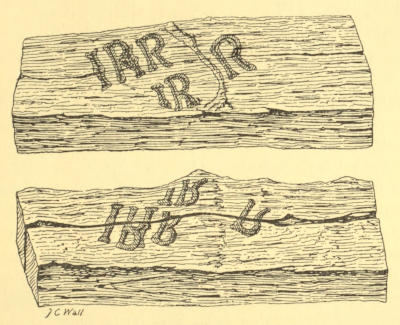
LETTERS IN CENTRE OF OAK
In 1834, Earl Manver’s woodman felled an oak near Ollerton Corner, wherein the initials C. R. were found impressed upon the wood, 15 inches from the surface. It is impossible not to feel sceptical as to the tree branding of the time of King John. The question was discussed, in 1813, in the Beauties of England and Wales (vol. xii., part 2, pp. 62-3). There are interesting references to the subject of the permanence of brands cut on the actual wood of growing trees in Notes and Queries (iv. Series, vols. ix. and x.).
Though the glories of Sherwood as a royal open forest have long ago passed away, the noble private parks of Clumber, [222]Thoresby, Welbeck, Rufford, and Bestwood occupy some of its choicest portions. They not only include much of the ancient timber, but they are well stocked with red and fallow deer, which are in some instances the undoubted descendants of those that used to roam at will through the forest glades in mediæval days.
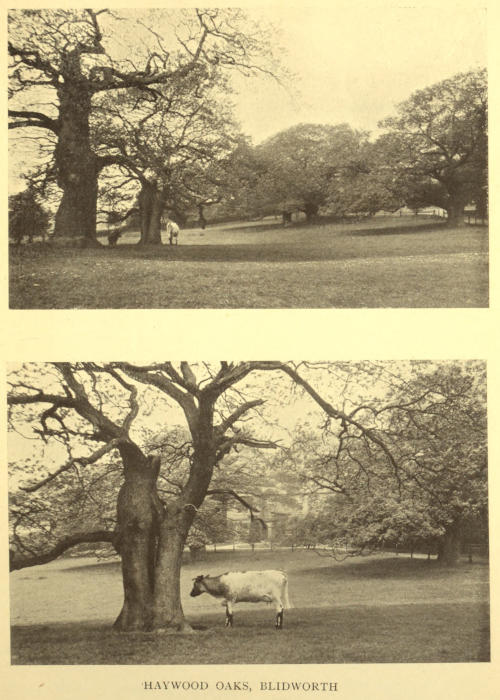
PLATE XXI
HAYWOOD OAKS, BLIDWORTH
A book might readily be written on special historic trees still standing within the bounds of old Sherwood Forest, particularly on the stretches of old forest at Birkland and Bilhagh, and on the less known noble groups of ancient oaks at Haywood (Plate XXI.), near Blidworth. It is only possible, however, to offer a brief paragraph on that Methusaleh of the forest, the Greendale oak, a picture of which, as it appeared at the end of the eighteenth century, is given as a frontispiece. In Evelyn’s days this famous Welbeck oak was 33 feet in circumference at the bottom, and the breadth of the boughs 88 feet. The circumference in 1776 and in 1790 was variously stated at 36 and 35 feet. Having become hollowed through age, the great gap through the centre was enlarged in 1724 by cutting away the decayed wood to such a height and width that a carriage and six, with cocked-hatted coachman on the box, drove through the tree with the bride of the noble owner. Three horsemen riding abreast were able to pass through, a feat often accomplished. In 1727 a series of fine folio plates of this tree, including the passage of the six-horsed coach, were etched on copper by George Vertue, forming a most rare volume. From the wood cut out of the opening for the foolish freak of 1724, a beautiful inlaid cabinet of considerable size was made, which is considered one of the treasures of Welbeck Abbey. The Greendale oak still survives, but only in the form of a shattered propped-up wreck.
[223]
One of the earliest references to a technical forest in Salop is of the year 1204, when King John issued his charter to certify that he “had altogether disafforested his forest of Brewood in all respects partaining to a forest or foresters; wherefore the said forest and the men who dwelt therein and their heirs were to be disafforested for ever, and quit of the king and his heirs in all those same respects.” This district and forest of Brewood was partly in Shropshire and partly in Staffordshire. Notwithstanding, however, the particularly precise terms of the charter of 1204, the inhabitants of Brewood were by no means quit of their fickle and lawless king, for at the forest pleas of 1209, cited by Eyton, the knights and men of Salop and Stafford living in Brewood gave the king 100 marks to be for ever disafforested, so that they of Salop who had hunted or taken beasts in the Salop park of Brewood might bear their share with those of Stafford. From this latter date Brewood seems to have genuinely ceased to be under forest jurisdiction.
But there are other more interesting records in the time of John as to Salop forests. The chief forest district of this time was that long known as Morf Forest. It took its name from the Staffordshire village of Morf, where the break began between that forest and the forest of Kinver. Its northern boundary, afterwards maintained, was determined by the river Worf (passing through Worfield) for several miles before it falls into the Severn a little above Bridgnorth, and from there it stretched south to its name-village. For [224]about the first two centuries of the Norman occupation it was at least eight miles in length and about six in breadth, but it became curtailed by the forest charter of Henry III., and still more so in the days of Edward I., and was wholly in the county of Salop. The bounds are ably dealt with in Eyton’s Salop.
Pleas of the forest were held at Shrewsbury on March 14th, 1209, before Hugh Neville and Peter de Lion. A very curious case was brought before the justices. A certain hart entered the bailey of the castle of Bridgnorth through the postern gate; the guards took it and carried it into the castle. When the forest verderers heard the news, they demanded of Thomas de Erdinton, the sheriff, what had been done with the hart. He acknowledged the offence, and promised that his men should come before the justices, and the town of Bridgnorth was attached for the offence. Thomas de Erdinton was sheriff of both Salop and Staffordshire through most of John’s reign, and a royal favourite; the calling of him to account for such a matter as this by the local verderers is a proof of the stringency of the forest laws at that date.
Another interesting case at this eyre is set forth in the translation given by Mr. Turner, involving the seeking sanctuary in a church.
“Richard of Holton, Wilkin of Eastlegh, Hulle of Hinton, and Hulle Roebuck, the serjeants of the county, found venison in the house of Hugh le Scot. And Hugh fled to the church; and when the foresters and verderers came thither, they demanded of Hugh whence that venison came. And he and a certain other person, Roger of Wellington by name, acknowledged that they had killed a hind from which that venison came. And he refused to leave the church, but lingered there for a month; and afterwards escaped in the guise of a woman. And he is a fugitive; and Roger of Wellington likewise. It is ordered that they be exacted, and unless they come let them be outlawed.”
The sheriff of Salop was ordered, in 1274, to see that all the venison taken for the king’s use in the forest of that county was forwarded without delay to Westminster, to be there delivered to the keeper of the king’s larder.
[225]
In the following year John Fitzhugh, the keeper of the forest, was instructed to permit Roger de Mortimer or his men to take three harts for the king’s use. In 1277 the same keeper was instructed to permit the Bishop of St. Asaph to take all the wood he required for fuel for that year from the wood of the Wrekin, as the king’s gift.
In 1284 the king issued his mandate to the justices and other forest ministers not to molest the Bishop of Bath and Wells, as he had the royal licence to take timber in the king’s demesne lands, hays, and woods within the bounds of the forest of Salop, for the construction of a manor house at Acton Burnell, his native place. Two years later a still wider and exceptional licence was granted to Robert the bishop and to Hugh Burnell, his brother, in consideration of the great services the bishop had rendered the king from his earliest years, to fell and take away to his manor great and small timber, without livery, view, or other impediment in the woods of Candover, Wolstanton, Frodsley, Hope Bowdler, Corston, and Rushbury, within the forest bounds.
Space does not suffice to treat further of the forest of Morf, or, as it was sometimes called, the forest of Bridgnorth, but in connection with this county, rather than Worcestershire, brief attention must be given to Bewdley forest, which, under its more ancient style of Wyre forest, was so vast a district that it gave its name to a whole county; for Wyre-ceastre, or Worcester, was a Roman station in this forest. When the days of Norman forestry arrived, the primeval state of this great woodland district had materially changed. Wyre forest at that period no longer extended in an unbroken sweep along the Severn to Worcester; but though a portion of its southern extremity was in Worcestershire, by far the larger part of it occupied the south of Shropshire. Eyton gives good reasons for supposing that the Shropshire part of Wyre forest, pertaining to the great manors of Cleobury and Kinlet, belonged to the Crown in Saxon days, but that subsequently it went to William Fitz-Osborn, Earl of Hereford, and then to Ralph Mortimer. The forest rule that the Mortimers endeavoured to maintain, together with the persistence in the use of the term “forest” rather than the chace, point strongly to its being originally under sovereign rule. The best summary of the [226]story of Wyre forest is to be found in Eyton’s Shropshire (iv., 276-9), where he tells us that at the time when Prince Edward was embarking for Palestine, in 1270, this forest was fenced for miles to prevent any depredation of the deer in the adjacent cultivated districts. But Roger de Mortimer took occasion of his powerful position to enlarge his rights as though royal, and to level no less than two leagues of this fence, so as to give free transit to the deer to the great havoc of the country. Moreover, Mortimer arrogated to himself a right of free chace, not only in Wyre forest, but in the manor of his tenants at Kinlet and Baveney, and even in those of the king’s tenants of Stottesden and Bardley, as set forth by the jurors of Stottesden in the Hundred Rolls of 1274.
The forest of Clee, somewhat further to the north in this county, also bears witness, by the general maintenance of that name rather than Clee chase, to its former royal rights. The attempts of the Cliffords to re-establish therein quasi-royal forest jurisdiction are also dealt with by Mr. Eyton (v., 196-202).
In early days there was probably no part of England more generally covered with woodland than the district afterwards known as Worcestershire. In the Norman time there were five forest districts within the shire: Wyre, Feckenham, Ombersley, Horewell, and Malvern.
Of Wyre forest mention has just been made under Shropshire. The Crown maintained certain forest rights over the Worcestershire or Bewdley part of this ancient forest as late as the time of Elizabeth, as shown by certificates at the Public Record Office: “Two of her majesty’s regarders or presservators of woods in Bewdley Park and Forest of Wyre” received a warrant in 1587 from the Lord President of Marches for felling 200 loads of firewood for use at Her Majesty’s house called “Tycknell”; and six timber trees were to be supplied for the repair of the west chamber there, called Yew Lodging, and another one for repairs to the stable. Henry Blount, of Bewdley, gentleman, was keeper of Bewdley park, and claimed all the lop and top of these seven timber trees as his fee. The two regarders, or rather woodwards, reported that [227]a hollow timber tree had been set on fire in the park, and that they appealed to Blount to save it; he told them to fell it, which they did, intending it for the lord president, but Blount seized it. They also reported that no person was allowed to take out any dead tree, windfall, rootfall, or stub, “unless the same be first by us vewed and prised and sealed with our sealinge axe.”
Ombersley forest began at the north gate of Worcester and extended along the banks of the Severn; it had originally been part of the great forest of Wyre.
Horewell forest began at the south gate, and extended along the eastern road to Spetchley and across the Avon. Both Horewell and Ombersley ceased to be forest districts under the Forest Charter of Henry III.
Malvern forest, or rather chase, extended from the river Teme in the north towards Gloucestershire in the south, and from the Severn to the top of the Malvern Hills. In Nash’s Worcestershire (i., lxxiv., etc.) there is some interesting information as to the considerable rights pertaining to the lord of the free chase of Malvern, which are discussed by Mr. Turner in his Forest Pleas (cix.-cxiii.), and clearly point to the district having once been royal forest. For instance, the dogs of this extensive chase were lawed twice in seven years. This lawing, locally termed “hombling,” differed somewhat from the method prescribed in true forests by the Forest Charter. All dogs that could not or would not be drawn through a strap of eighteen inches and a barley-corn in length had the further joints of the two middle claws cut away, for which operation the owner was amerced in the sum of 3s. 1d.
Leland, temp. Henry VIII., says: “The Chase of Malvern is biggar than Wire or Feckingham, and occupieth a great part of Malverne Hills. Great Malverne and Little Malverne also is set in the Chase of Malverne. Malverne Chase (as I hear say) is in length in some places twenty miles.” It was granted by Edward I. to Gilbert de Clare, Earl of Gloucester, on his marriage with Jean d’Acres, the king’s daughter. From that date it ceased to be under true forest law, being in the hands of a subject; but down to the reign of Charles I. there were verderers, foresters, and other ministers of the chase.
[228]
The best account of Malvern Chase is that which appeared in volume v. of the Journal of Forestry, by Mr. Edwin Lees.
Feckenham forest, on the east of the county, was of considerable extent. A perambulation of Edward I. shows that it began at the Foregate, Worcester, passed to Beverburn by Stowe to Bordesley, round by Evesham to Spetchley, and so to Sidbury. In the twelfth and thirteenth centuries it was not infrequently termed the forest of Worcester. The following are some of the references to this forest in the Patent and Close Rolls of Edward I.:—
Pardon was granted in 1290 to the Bishop of Worcester, John Gifford, Richard Archer, and Hugh de Aston, for a fine of 500 marks made by the bishop for himself and the others, for venison and vert trespasses in Feckenham forest. A pardon was about the same time granted to the prioress of Westwood for like trespasses. In this year grant was made to Eleanor the king’s consort, who held the forest by Edward’s grant, to hold pleas of vert and other trespasses through her stewards and bailiffs every six weeks, and to take fines due for the same to her own use, save pleas of venison and those which belonged to the regard and agistment of the forest; also all attachments of indicted persons and venison trespassers, provided that all persons indicted of venison were imprisoned at Feckenham, and then bailed against the next eyre of the justices. In the same year Walter de Aylesbury was pardoned all venison trespasses up-to-date, on condition of surrendering his bailiwick in Feckenham forest. A special commission had been appointed to inquire into the venison and vert trespasses said to have been committed both by foresters and other ministers, and this resignation was one of the results.
Edward II., in 1293, granted for life to James Beauchamp liberty of hunting with his own dogs, in all the foreign woods and groves without the great covert of the forest of Feckenham, the hare, fox, badger, and wildcat whenever he will, save in the fence month; provided that he took none of the king’s deer, and did not hunt in the warrens.
Licence was granted in 1294, after inquisition, by John de Selvestrode, keeper of this forest, to Grimbald Pauncefote, who was going to Gascony on the king’s service, to sell wood to [229]the value of 100 marks out of such parts of his wood of Bentley, at the least damage to the forest.
When a perambulation was taken of Feckenham forest in 1300, it was stated there was no forester-of-fee, and no verderer for that part which was within the county of Warwick.
The king made a considerable sojourn at Feckenham in April, 1301; during that visit he granted a pardon to William de Stapelhurst for taking a buck in this forest, and carrying it away.
Feckenham was finally disafforested in 1629.
Early references to the forest of Warwickshire seem to apply to that small part of the Feckenham forest (Worcestershire), which extended into the south-west border of the former county, lying between the river Arrow and the boundary of the two shires, and which was added to Feckenham in the reign of John. The perambulation of 1300 states that there was no forester nor verderer pertaining to the county, and that at the date of the coronation of Henry II. there was no forest anywhere in Warwickshire.
The great woodland district of the Forest of Arden is so closely associated with the north-west of Warwickshire that unless the technical meaning of forest is borne in mind, the assertion of the jurors, in the time of Edward I., as to its absence would seem remarkably strange.
When special forest inquisitions were being held in 1219 and again in 1224, particular instructions were issued with reference to a detailed regard, and mandates were directed to the sheriff and others of Herefordshire with reference to the forest of Hereford. Probably all that was meant by that term was the south-east portion of the county that was included within the bounds and purlieus of Dean forest, Gloucestershire. A large portion of the hundred of Greytree had been made forest under Henry II. and John, but this was duly disafforested by the Forest Charter of Henry III. An entry [230]in the register of Bishop Swinfield shows that when the bishop was at Ross, on a visitation tour, in 1206, his huntsmen killed a young stag in his chase of Penyard, but a dispute arose between the bishop’s servants and the king’s foresters of Dean, whether the place where the stag was caught was not within the forest. An inquest was held at Howl Hill, when the jury declared that it was lawfully caught within the episcopal chase.
[231]
Charnwood forest, a hilly district to the north-west of Leicester, about ten miles in length and six in breadth, of much natural beauty, at once occurs to everyone, who knows anything of the Midlands, as the most attractive part of Leicestershire. But so far as forests technically termed are concerned—that is, districts subject to forest laws—Charnwood has little claim to our attention. Although it so long remained a rough, open tract, there is no reference to it among the extant forest pleas. From what is told us in Nichols’ county history of Leicester—a wonderful work for the time (1799) in which it was produced—and by the more elaborate accounts given in Potter’s Charnwood Forest (1842), it is clear that this district was never in Norman days in royal hands for the purposes of the chase; but its privileges were granted to the Earls of Chester and Leicester and Winchester, etc., and their successors, and to the various religious houses, within its bounds, such as Ulverscroft, Garendon, and Gracedieu.
On three manors of Charnwood Forest, namely, Whitwick, Groby, and Sheepshed, swainmote courts were regularly summoned until the beginning of the seventeenth century, a survival of pre-Norman jurisdiction; they continued to be somewhat fitfully held by the owners of these lordships until about a century ago. The fact of swainmote courts being found at Charnwood and a few other places in England, which were not royal forests in historic times, may be taken as a proof that such districts were royal hunting-grounds in Saxon days.
The document cited by Burton in his Description of Leicestershire [232](1777), with respect to the disafforesting of Leicester forest in 29 Henry III., has no reference whatever to Charnwood as there asserted.
Mr. Monk, in his Agricultural Report for Leicestershire of 1794, stated that Charnwood forest, containing from 15,000 to 16,000 acres, would prove to be useful and valuable land if enclosed over three-fourths of its area. After much opposition from commoners an Act of Inclosure was passed in 1808, and the final account of claim was signed in 1812.
The forest or wood adjoining the town of Leicester, although it eventually came to the Crown, was never a royal forest, as it had no forest courts of any kind. It is named in the Domesday Survey of the borough, wherein it is stated that Hereswood was four miles (leuca) long by one in breadth. This great wood belonged to the Earls of Leicester, who readily granted special privileges therein to the burgesses. These rights are of particular interest, and are fully illustrated in the old borough records which have been recently ably edited by Miss Bateson. This great wood or forest was disafforested in 1628, and the deer killed or given away; but as it was an earl’s forest and not the king’s, its history must be here passed by.
The only true forest—subject, that is, to forest laws—in the county of Leicester, was a not inconsiderable section of the eastern portion of the shire that adjoined to Rutland; and as Oakham was the centre and usual justice seat of this forest, the larger part of which was in the smaller county, it sometimes all went by the name of the forest of Rutland, and at other times as Rutland and Leicester.
The pleas of venison held at Oakham, in March, 1209, were attended by regarders both of Leicester and Rutland. The knights of Rutland gave a verdict to the effect that at the summons of the justices of the forest, all men of Leicestershire ought to come to the pleas who dwell outside the forest as far as two leagues. Several cases were heard at this eyre which pertained to Leicestershire. The entrails and antler of a hart were found under the mill of Robert, the son of Adam of Skeffington. The antler was fractured as though done with an axe. The miller declared he knew nothing about it, but he was taken into custody until inquiries could be made, and the mill [233]was taken into the king’s hands, because it was so far away from the town and so near to the covert of the forest.
The township of Knossington was in mercy because they did not produce those whom they had pledged, namely, Richard and William, who had been found with bows and arrows on the road that led to Rockingham.
The two Leicestershire verderers, Robert Langton and Robert Sampson, were declared in mercy because their statements contradicted the entries on their rolls.
So far as Rutland was concerned, at the same eyre, their two verderers were in mercy because “they did not that which they ought,” and two foresters and four verderers were in like plight for a similar vaguely expressed cause. The town of Oakham was at mercy for not producing Robert, a servant of the Earl of Hereford, for whose appearance they were pledged. The sheriff of Rutland was also liable because he had not the prisoners who had been delivered to him by the foresters to guard.
A special inquisition of the forest of Leicester and Rutland was held at Oakham in 1219. After the great storm of 1222, separate letters were addressed to the foresters and verderers of both Leicester and Rutland as to the disposal of the windfall. Hasculf de Hathelakestan was at that time keeper or warden of this joint forest. The sheriffs of both counties were warned in 1224 to see that a regard was taken of this forest. A yet more important and detailed regard was ordered in 1229.
Forest pleas were held at Oakham in 1256, and again in June, 1269, for the forest of Rutland, but the proceedings show that the term included the Leicestershire division. The principal business that came before the justices on the latter date were the serious charges of extortion and damage made against Peter de Neville, the chief forester, and the foresters and other ministers under him. The verderers, regarders, and other knights and good men of the two counties, testified on oath that since the last eyre—which was held thirteen years before, namely, in 1256—Peter de Neville had continually appropriated to himself nuts, mast, and windfall, together with thorn, hazel, and such-like small vert, and kept dogs and greyhounds on the unlawful pleas of taking hares, foxes, [234]rabbits, and wild cats; that he had appropriated escape of beasts, and received fines for hare and rabbit poaching that ought to have gone to the king; that he had imprisoned men and bound them with iron chains for trifling forest trespasses, and had released them on payment of fines; that he had taken twenty-four marks from Richard of Whitchurch for taking a buck without a warrant, and 100s. from Henry Murdoch for his mastiffs that were found following his ploughman to Deepdale within the forest; that he amerced various townships for offences at his will; that every year, save the year between the battles of Lewes and Evesham, he had his piggery and pigs, sometimes to the number of 300, digging in the forest enclosure to the great injury of the pasturage of the king’s deer; that he had appointed a forester for the last three years to guard the road between Stamford bridge and Casterton, on the outlying part of the forest on the east side, to take cheminage for his own use, charging 4d. on every cart carrying wood or timber from the county of Lincoln to Stamford, an entirely novel charge; that he made a gaol of his own at Allexton (just over the borders in Leicestershire), full of water at the bottom, and there imprisoned unlawfully many men of his bailiwick in the county of Rutland, whereas they ought to be taken to the castle of Oakham. Almost every one of these and other charges were considered proved by the justices, the clauses on the rolls where they are stated ending for the most part with “therefore to judgement with him” (idea ad judicium de eo).
Another charge against Peter de Neville was that he had increased the number of foresters, and put pages under them, to the overburdening of the district. It was proved that five walking foresters, to wit, two for Beaumont bailiwick, two for Braunston bailiwick, and one in the park of Ridlington, together with one riding forester with a page, was the full ancient complement of such officials for the Rutland and Leicester forest; the justices made order that this number was not to be increased.
The whole of this elaborate accusation against the forest keeper is set forth at length in Turner’s Forest Pleas (pp. 43-53), together with the following recital of the forest bounds (1269) taken at the same eyre:—
[235]
“The perambulation of the forest of Rutland begins from that place where the old course of the Little Eye flows into the Welland opposite Cotton; and from thence along the course of the water of the Welland up to the boundary between the counties of Lincoln and Rutland; by metes and bounds as far as Stumpsden; and from thence by metes and bounds as far as Great Casterton bridge; and from that bridge along the course of the water of the Gwash as far as Empingham bridge; and from that bridge along the course of the water as far as Stanbridge; and from Stanbridge through the middle of the park of Barnsdale as far as Twiford; and from Twiford along the course of the water through the middle of the town of Langham; and from thence as far as the park of Overton, and from thence between Flitteris and the wood of Knossington as far as the water of the Gwash, and from thence along the boundaries between the open field of Braunston and Knossington as far as the Wisp; and from thence along the boundaries between the field of Owston and Withcote as far as the door of the castle of Sauvey, and from thence by the rivulet which runs down from Sauvey as far as Harewin’s mill; and from thence to Coptre, and from Coptre as far as the boundaries of Finchford; and from thence by the old course of the Little Eye into the Welland opposite Cotton.”
Space cannot be afforded for following up the story of this forest in detail, but mention must be made of another eyre held more than two centuries subsequent to the one first recorded. By that time this forest of Rutland and Leicester was usually known as Leighfield Forest, and the justice seat was at Uppingham. On September 10th, 1490, pleas of the forest were held at that town by Sir John Ratcliffe and Sir Reginald Gray. Sir Edward Hastings appeared as keeper, Thomas Sapcote as lieutenant, Robert Rokeby as ranger, and Christopher Parker as bow-bearer. There were also present the two foresters of each of the bailiwicks of Braunston and Beaumont, and the one forester of Ridlington park, together with two verderers. The five woodwards who appeared represented respectively the prior of Brook, the Bishop of Lincoln in Stokehern, the Earl of Warwick in Le Haw, Everard Digby in Stokehern, and Robert Mawes in Wardley wood. There were also present fourteen regarders, eleven free tenants, a jury-panel of the king, juries of the hundreds of Martinsley (Rutland) and Goscote (Leicestershire), and of Oakham Soke, [236]together with the reeve and four men from each of the townships of Ayston, Belton, Braunston, Brooke, Caldon, Lyddington, Ridlington, Stokeley, Uppingham, and Wardley. It therefore follows that the actual number of local officials of this comparatively small forest in attendance on the justices exceeded 250.
The claimants of liberties were the Bishop of Lincoln, the abbot of Kenilworth, Sir Edward Hastings, Everard Digby, Maurice Berkeley, John Cheselden, and Robert Mawes. The Bishop of Lincoln, through William his attorney, stated his considerable claims of hunting and agistment within the forest, more particularly with regard to the park of Lyddington and its deer-leaps.
Among the presentments it was stated that Thomas Parker, parker of Redlington, and Robert Rokeby, the sub-parker, had felled three lime trees (Le lynerey trees) worth 6s. 8d. each. They had also killed, since the last eyre, eight deer when training their dogs (pro canibus suis ad arcum castigand).
The master forester or keeper had distributed eight bucks and ten does among the gentlemen of the district; eight bucks and twenty-four raskells had died of murrain.
[237]
The wealth of unused material in connection with all the forests of Northamptonshire, particularly with regard to Rockingham, is so great that it becomes exceedingly embarrassing to know what is the best method to adopt in giving a mere outline sketch of the more salient and interesting features of their history. It is much to be hoped that some capable pen may before long be found to write a monograph on the forests of this shire. Such a history, if thoroughly written, would prove more interesting and valuable than that of any other county, not excluding Hampshire or Essex.
The most important and valuable portion of Mr. Turner’s scholarly work on Select Pleas of the Forest (Selden Society), is concerned with this county. There is also a good deal that is of genuine value regarding Rockingham forest in Bridge’s history of the county, and in Baker’s later work with regard to Whittlewood forest; nor must Mr. Wise’s Rockingham Castle and the Watsons (1891) be omitted from mention; but practically their story is as yet unwritten.
The frequent presence of the Norman kings at their castles of Rockingham and Northampton was one of the chief causes for the appropriation of such large tracts of this county for royal forest sport. Apart from parks of early formation, the largest and chief forest tracts were—(1) Rockingham forest in the north, which was mainly in the Corby and Willowbrook hundreds; (2) Whittlebury forest in the south-east, in the Cleley, Norton, and Towcester hundreds; and (3) Salcey forest, nearer the centre of the county, in the Cleley and Wimersley hundreds. The whole of the Nassaburgh hundred, north of Rockingham, was under forest laws in the early Norman days, but it was disforested in the time of John.
[238]
As the Conqueror built Rockingham castle, it is practically certain that, at the same time, he afforested the district around, and probably included within its then vast bounds the whole of the Nassaburgh hundred.
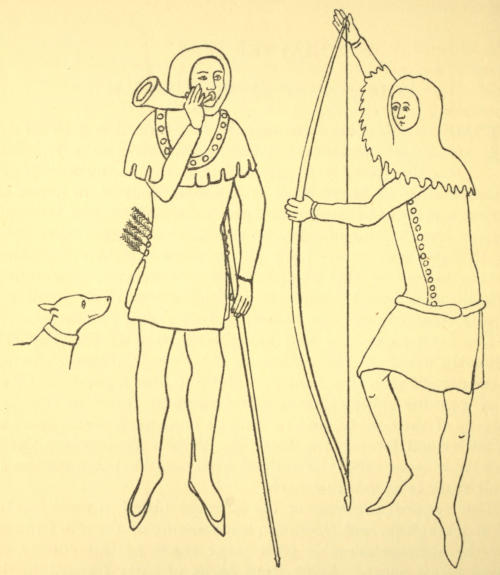
HUNTING COSTUME. FOURTEENTH CENTURY
The earliest known record of forest pleas, which is among the “Treasury of Receipt Forest Proceedings” of the Public Record Office, pertains to this county, and has been given in extenso by Mr. Turner; it relates to the pleas held at Northampton on 20th February, 1209. The proceedings are full of interest. The following are some examples of the cases brought [239]before the justices. Roger Grim, the harvestman (messarius, i.e. the foreman of the harvest labourers) of the abbot of Peterborough, was caught following four hinds with his dogs; he was delivered to the custody of Geoffrey Gilbewin, the abbot’s steward. Geoffrey failed to bring him before the justices, whereupon the steward himself was delivered to the custody of the sheriff to be imprisoned. William of Barton was proved to have falsely and through hatred charged Stephen de Pin, a clerk, with having feasted upon two fawns; the sheriff was ordered to imprison him until levy had been made for a fine upon his chattels at Barnact. The whole township of Newton was in mercy because of the flight of Richard Gelet, their harvestman, accused of shooting a doe in Nassington wood, for which Henry, the son of Benselin, was taken. The foresters found a doe with its throat cut in Nassington wood, and Henry concealed in a bush near by. They put him in prison, but on his appearing at the forest pleas, Henry stoutly denied the offence, saying he had only gone into the wood to seek his horse. Thereupon the justices inquired of the foresters and verderers whether they now thought him guilty. They replied in the negative, adding that they thought Richard the harvestman was the culprit, for he fled as soon as he heard of Henry being taken. Because Henry had taken the Cross and is not suspected and had lain long in prison, the justices granted him that he might make his pilgrimage, but he was to start before Whitsunday; if he lived to return, and could find pledges for his fealty, he might afterwards remain in the forest.
Thomas Inkel, forester of Cliff, found in the wood of Siberton a certain place wet with blood, and he traced the blood in the snow as far as the house of Ralph Red of Siberton; and forthwith he sent for the verderers and good men. They searched his house, and in it they found the flesh of a certain doe, and they took Ralph himself and put him in prison at Northampton, where he died. But before his death, when he was in prison, he appealed Robert Sturdi of Siberton and Roger Tock, of the same town, because they were evil-doers to the forest together with him. The foresters and verderers searched the house of the aforesaid Robert, and in it found the bones of deer, and they took him and sent him to [240]prison; also in the house of Roger Tock they found ears and bones of deer. The latter was taken and imprisoned. Robert Sturdi came before the justice and said that the dogs of Walter of Preston used to be kennelled at his house, and that Walter’s hunters ate the venison whence came the bones; and Robert vouched the aforesaid Walter to warranty of this, whereupon Walter is ordered to appear on the morrow. Walter came and warranted him, saying that his dogs were kennelled in his house for fifteen days while he was hunting bucks. Roger Tock also appeared and denied everything; and the verderers and foresters witnessed that the ears and bones were those of the deer which Walter’s hunters had taken. As Roger had lain long in prison, so that he was nearly dead (quod fere mortuus est), the justices permitted him to go quit, but henceforth he was to live outside the forest.
Rockingham forest in the time of Henry III. was divided into the three divisions or bailiwicks of Rockingham, Brigstock, and Cliff (Kingscliff), each of which had its own ministers. This division lasted until the time of disafforesting.
The keepership of the forest of Rockingham, with Cliff, Geddington, and Brigstock, was conferred by Henry III. on Hugh de Neville in June, 1219. In the following month he was instructed to permit Walter de Preston to hunt these forests, and others in the county, in order to secure forty bucks for the royal larder. In the following year the same huntsman had orders to take twenty bucks in Rockingham forest, and Richard de Waterville the same number for a like purpose. In the same year Hugh Bigod had royal permission to take six bucks in this forest, and others a smaller number. In September, 1225, the king gave leave to the Bishop of Ely to have ten bucks and two harts caught for him in the forests of Essex. But there was so much difficulty and delay in catching them (apparently alive for stocking purposes) in Essex, that the order was transferred to Rockingham. In December of the same year William de Cantilupe obtained a grant of twenty does and two bucks from this forest for stocking his park at Aston. The supply of venison must have been exceptionally good, for at the same time Martin de Tattishall was permitted to take ten does in Rockingham forest.
[241]
The Close Rolls of 1228 mention royal grants of seven does; of 1229, two bucks and eight does; and of 1231, six bucks and seven does.
The orders for wood out of this forest in the time of Henry III. and later were very scanty in comparison with other royal forests, and hardly ever included grants to outsiders; this seems to be a proof that well-grown timber was a rarity. In December, 1224, Walter the Miller, warden of Rockingham bridge, received one of the forest oaks for the repair of the bridge. In 1226 Hugh de Neville was ordered by the Crown to supply Ralph de Trubleville with sufficient timber in a convenient place, and where it would be of least detriment to the forest, for the repair of a section of the royal preserve (vivarium) and houses at Brigstock. In the same year further timber was granted for the repair of the chapel and other parts of Rockingham castle.
There is an important series of forest inquisitions on Rockingham rolls from 30 to 39 Henry III. From these Mr. Turner has taken a variety of transcripts. The following is the first that he cites, giving full and interesting particulars relative to a serious poaching affray:—
“It happened on Wednesday the morrow of the apostles Phillip and James, in the thirtieth year of the reign of King Henry, that when William of Northampton and Roger of Tingewick were on their way from the pleas of Stanion (within Rockingham forest) to the pleas of Salcey, they were given to understand that poachers were in the laund of Benefield with greyhounds for the purpose of doing evil to the venison of the lord king. And when they had reached the laund and were waiting there in ambush, James of Thurlbear, forester of the same bailiwick, and Mathew, his brother, forester in the park of Brigstock, came with the walking foresters on the order sent by the aforesaid William of Northampton. And they saw five greyhounds, of which one was white, another black, the third fallow, a fourth black covered, hunting beasts, which greyhounds the said William and Roger took. But the fifth greyhound, which was tawny, escaped. And when they returned to the forest, after taking the greyhounds, they lay in ambush and saw five poachers in the lord king’s demesne of Wydehawe, one with a crossbow and four with bows and arrows standing at their trees. And when the foresters perceived them they hailed and pursued them. And the aforesaid [242]malefactors standing at their trees turned in defence and shot arrows at the foresters, so that they wounded Mathew, the forester of the park of Brigstock, with two Welsh arrows, to wit with one arrow under the left breast, to the depth of one hand slantwise, and with the second arrow in the left arm to the depth of two fingers, so that it was despaired of the life of the said Mathew. And the foresters pursued the aforesaid malefactors so vigorously that they turned and fled into the thickness of the wood. And the foresters on account of the darkness could follow them no more. And thereupon an inquisition was made at Benefield before William of Northampton, then bailiff of the forest, and the foresters and verderers of the country on the day of the Invention of the Holy Cross, in the same year, by four townships neighbouring on the laund of Benefield, to wit, by Stoke, Carlton, Great Oakley, and Corby.
“Stoke comes, and being sworn says that it knows nothing thereof except only that the foresters attacked the malefactors with hue and cry until the darkness of the night came, and that one of the foresters was wounded. And it does not know whose were the greyhounds. Carlton comes, and being sworn says the same. Corby comes, and being sworn says the same. Great Oakley comes and, being sworn, says that it saw four men and one tawny greyhound following them, to wit, one with a crossbow and three with bows and arrows, and it hailed them and followed them with the foresters until the darkness of night came, so that on account of the darkness of night and the thickness of the wood it knew not what became of them.”
Pledges were taken of the four townships to appear at the next pleas. The arrows with which Mathew was wounded were delivered to Sir Robert Basset and John Lovet, the verderers, and the greyhounds were sent to Sir Robert Passelewe, then justice of the forest.
Another inquisition of 13th January, 1347, is well worth giving in full:—
“It happened on the Sunday next after the Epiphany, in the thirty-first year of the reign of King Henry, that when Maurice de Meht, who said that he was with Sir Robert Passelewe, passed in the morning with two horses through the town of Sudborough, he saw three men carrying a sack. And when he saw them he suspected them, and followed them as far as the town of Sudborough with his bow stretched. And when the three men saw him following them, they threw away the sack and fled. And Maurice took the sack and [243]found in it a doe, which had been flayed, and a snare, with which the beast was taken. And when he had done this he went to the church of Sudborough, and made known to the whole township what had happened. And when he had done this he returned again to the sack, and carried away the skin of the doe. And the township of Sudborough sent after the verderers and foresters, who came and found all the things, just as aforesaid. And upon this an inquisition was made at Sudborough on the Monday next following before the verderers and foresters of the county by the four neighbouring townships, to wit, Sudborough, Lowick, Brigstock, and Lyveden.
“Sudborough comes and, being sworn, says that Ralph the son of Mabel of Sudborough was one of those men who fled, and he delivered that venison to William the son of Henry of Benefield. And the third was Robert of Grafton, who a short time before was with Agnes Cornet, and he fled and is not yet found. But the said Agnes Cornet pledges on her behalf of the said Robert of his being before the justices of the forest, to wit, Hugh the son of Roger, and Peter the son of Roger. And the aforesaid Ralph the son of Mabel, and William the son of Henry, were taken and sent to Northampton to be imprisoned; and they were delivered to Sir Alan of Maidwell, then the sheriff of Northampton.
“The flesh of the doe was given to the lepers of Thrapston. And the snare with which the said doe was taken was delivered to Robert the son of Luke of Lyveden, and Ralph the son of Quenyl of the same town, to keep until the coming of the justices of the forest.
“The township of Sudborough finds pledges of being before the justices of the forest, because it allowed Maurice de Meht to carry away the skin of the doe. The chattels of Ralph the son of Mabel were taken into the hand of the lord king, and appraised by the verderers and foresters at nine shillings, and they were delivered in bail to Thomas of Grafton, who dwells in Sudborough. Robert of Grafton, the fugitive, and William the son of Henry had no chattels. Maurice de Meht was not taken because he said that he was with Sir Robert Passelewe, then justice of the forest.”
On the same rolls were entries of the Rockingham venison given by the lord king. In 1247 these royal gifts included two bucks for Nicholas de Criel, ten bucks for the Countess of Leicester, two bucks for Sir Geoffrey Langley, one buck for Robert de Mares, and ten bucks for Aymar de Lusignan. In the following year Richard Earl of Cornwall, who held a general hunting warrant, took deer in the park and without it [244]about 15th August, and the same in the following month, on his return from the north. About August, Sir Simon de Montfort had twelve bucks out of Rockingham bailiwick of the king’s gift, and at Michaelmas the Bishop of Carlisle had a present of three bucks. In 1248-9 Henry III. hunted in person at two different seasons, namely, about the Feast of St. Katherine (25th November) and about the Feast of St. Peter’s Chains (1st August), taking deer at his pleasure. Among the royal gifts of 1249 were five live bucks and ten live does for the Earl of Derby, and eight does for the abbot of Westminster.
When an archbishop, bishop, earl, or baron passed through a royal forest, he was entitled, under the Forest Charter of 1217, to take one or two heads of game, but only in the sight of the forester, and not furtively. Among those who availed themselves of this privilege about this period were the Bishop of Lincoln, a hind and a doe, in 1245; the abbot of Westminster, a buck and a buck’s pricket, in 1246; Henry, the son of the Earl of Leicester, a buck’s pricket; the Count d’Aumale a doe, and the Bishop of Carlisle a buck in 1247.
The pleas of the forest were held on 25th June, 1255, at Rockingham, before William le Breton, Nicholas de Romsey, and two other justices in eyre. Ten years had elapsed since the last eyre, and several cases brought before justices were about ten years old. About thirty-five cases of venison trespass were presented and proved. Among the offenders was Simon the parson of Old, who took a roe in 1249. He did not appear, and order was sent to the Bishop of Lincoln to cause him to attend. Before the court rose he was fined in the heavy sum of £5.
In June, 1254, a deer was taken beneath Rockingham castle wall by the men of the parson of Easton. The foresters lay in ambush through the night, and at daybreak they saw three men and three greyhounds, of whom they took one man and two greyhounds. The man was sent to prison at Northampton, and died there. As the men and hounds were with Robert Bacon, the rector of Easton, order was sent to the bishop to cause Robert to appear on the 10th of July.
The next forest pleas for Rockingham were held in August, 1272, after an interval of seventeen years. The justices were [245]Matthew de Colombieres, Nicholas de Romsey, and Reginald de Acle. The following serious poaching offence, aggravated by contemptuous action, then came before the justices; we venture again to avail ourselves of Mr. Turner’s translation:—
“It is presented and proved that Simon the son of William Tuluse, Richard of Ewyas, the page of William Tuluse, William of Wootton, Ralph of Drayton, the chaplain at Wootton, Simon of Hanslope, the page of the aforesaid Simon, Alan the son of Hugh of Lowick, the woodward of Robert de Nowers of his wood of Bulax, John Messias of Lowick, Robert Pette of Lowick, Ralph Iuelhering of the same town, Robert of Grafton, Henry of Drayton and others of their company, whose names are to be ascertained, entered the forest aforesaid on Wednesday, the feast of St. Bartholomew in the fifty-sixth year, with bows and arrows; and they were shooting in the same forest during the whole of the day aforesaid and killed three deer without warrant, and they cut off the head of a buck and put it on a stake in the middle of a certain clearing, which is called Harleruding, placing in the mouth of the aforesaid head a certain spindle; and they made the mouth gape towards the sun, in great contempt of the lord king and of his foresters. And the foresters, when they were at last perceived by them, hailed them; and the evil-doers shot at them against the peace of the lord king. And the foresters, after raising the hue upon them, fled and could not resist them. The aforesaid Richard of Ewyas, Alan, Ralph, Robert, and Henry came; and being convicted of this they are detained in prison. And the aforesaid Simon Tuluse and Simon his page did not come; therefore an order is sent to the sheriff of Berks that he cause them to come on Monday next before the feast of the apostles Simon and Jude. As to the aforesaid William of Wootton an order is given above. And as to the aforesaid Ralph the chaplain an order is sent to the Bishop of Lincoln that he cause him to come on the feast of the apostles Simon and Jude. And the aforesaid Robert Pette and John Messias are not found; therefore let them be exacted etc. And because the aforesaid Alan, the sworn woodward, was an evil-doer with respect to the venison, therefore, by the assize of the forest, let the aforesaid wood of Bulax, which he had in custody, be taken into the hands of the lord king.
“Afterwards an inquisition is held and it is proved by all the verderers of all the forest of Northampton that Ralph of Heyes the bailiff of the Earl of Warwick at Hanslope, who has lands at Binsted near Alton in the county of Southampton, Roger, Ralph [246]and Thurstan the sons of John the son of John of Hanslope; Henry the son of the parson of Blisworth, William Wolfrich of Wick, the man of Simon Tuluse, Walter the man of William Tuluse, and Thomas who was the son of the chaplain of Blisworth, with all the above-mentioned persons, by the provision, counsel, order, and assent of William Tuluse entered the forest of Rockingham on the aforesaid Wednesday the feast of St. Bartholomew and during the two preceding days and killed eight deer at least, and a doe, as is aforesaid, whose head the aforesaid Simon Tuluse cut off and put on a stake. And the aforesaid Richard of Ewyas put a billet in its throat. And the venison of the aforesaid eight deer was carried from the forest in the cart of Ralph Iuelhering as far as Stanwick; and it rested there for one night at the house of Geoffrey Russell, he himself not being at home, nor knowing anything thereof; and from thence it was carried to Hanslope to the house of the aforesaid William Tuluse and Simon his son, who had caused all this to be done; and there the aforesaid venison was divided and eaten. And it is proved that while the aforesaid evil-doers were in the forest obtaining the aforesaid venison during the three days above mentioned, they were harboured at the houses of Alan le Gaunter of Cotes and Robert of Lindsay in Lowick, who were privy to this. And afterwards Robert de Nowers came and made fine for having his wood again by one mark; his pledges were Simon of Waterville and Robert Grenleng. Afterwards Alan le Gaunter came, and was detained in prison. Afterwards Henry the son of the parson of Blisworth came and was detained in prison. And the aforesaid Thomas the son of the chaplain came and was detained in prison.”
Gifts of Rockingham venison continued to be made by Edward I.; it would be tedious to detail them even if there were abundance of space. The grants of timber were but rare.
The king often directly interfered to secure the release on bail of venison trespassers. On 30th July, 1280, Edward I. ordered the release of Matilda de Braundeston from imprisonment at Rockingham for a venison trespass to twelve mainpernors to have her before the forest pleas. In the following year the king instructed his steward or keeper, Richard de Holbrok, to order an inquisition on oath of foresters, verderers, and others, whether one William Genn, imprisoned at Rockingham for a trespass in Rutland forest, was guilty or not, and if not guilty to deliver him to twelve mainpernors [247]to produce at the forest pleas if anyone had aught further to say against him. In the same year the steward had like order to release on bail another trespass prisoner, unless he had been used to offend in the forest. In 1282 two prisoners were released on bail by the king’s orders, and in 1283 eleven more venison trespassers, one of whom, Roger Acle, was a clerk.
A perambulation of 1286, ordered by Edward I., bears witness to the vast extent of the technical forest of Rockingham at that date; it extended from the south bridge of Northampton to the bridge of Stamford, a distance of thirty-three miles, and from the river Nene on the east to the Welland and the Maidwell stream on the north-west, yielding an average breadth of between seven and eight miles. But when Edward I. formally confirmed the Great Charter in 1299, the forest bounds were more carefully investigated, and the limits of the 1286 perambulation were a good deal reduced, the new afforesting of Henry II. in several directions being struck out. The land that was then disafforested became purlieu.
It may be well to refer to just a few of the many incidents affecting this forest during the long reign of Edward III.
In 1331, Nicholas, abbot of the Cistercian house of Pipewell, with two of his monks and another offender, were imprisoned at Rockingham for trespasses of both vert and venison; they obtained letters from Edward III. to the keeper of the forest to release them on bail until the next eyre was held. This order had to be strongly repeated, the keeper being accused of keeping the abbot and others in prison to satisfy his malice; eventually they were released on bail in chancery.
In 1342 the keeper and other ministers of the forest of Rockingham were ordered to permit the provost and chaplains of the college or chantry of Cotterstock to have the tenths of assarts and wastes within the forest. In accordance with the king’s letters to them, Edward II. had granted to John Gifford, his clerk, right of common for all his animals and cattle within the forest, and subsequently power to assign this grant to the provost and chaplains of this new foundation. The grant of the tenths was to cover various newly-made assarts.
The ministers’ accounts for 1461-2 show that Robert Roos had succeeded to the keepership of the castle and forest, on [248]the death of Humphrey Duke of Gloucester. This office was held on the annual payment to the king of £65 10s., with the addition of £16 10s. for the custody of the herbage and pannage of Brigstock park. The hedging in of sixty acres in the great park of Brigstock, and of forty acres in the lesser park for hay, cost 66s. 8d., whilst 20s. was paid for the carriage of the hay in winter for the sustenance of the deer; considerable repairs were done to the lodges of Brigstock and Benefield.
The accounts of 1437 show that William Prostagne was at that date constable of Rockingham, keeper of the forest, and ranger of the bailiwick. Payments were made in the Rockingham bailiwick for rights of sheep-folding, called faldage, from the different townships; thus Corby paid 7d. a year, Great Oakley 3d., Little Oakley 2d., and Carlton 12d. For the escapement of horses and mares payment was made by the townships at the rate of 7s. 4d. a year. The fence month payments amounted to 9s. 4d., Cottingham and Middleton paying jointly 3s. 4d., Corby 2s., and Great Oakley 2s. The lawing of dogs was known at this time as houndsilver. The total of houndsilver was 27s., namely, 6d. for each man having a dog; the township of Gretton paid 14s., whilst Corby and Little Oakley only paid 3s. each. The total receipts exceeded £100, by far the largest items being the rents for different manors. For instance, the abbot of Peterborough paid £12 yearly for the manor of Cottingham. The expenses amounted to £13 9s. 0½d. The clerk who enrolled the accounts had a wage of 7s. 6d., and the parchment used for the accounts and for the swainmote roll cost 8d.
Pleas of the forest were held at Rockingham on 7th September, 1490, before Sir John Ratcliffe and Sir Reginald Gray, when Thomas Haslewood was sheriff. Juries from the hundreds of Willybrook, Hamfordshoe, Polebrook, Rothwell, and Corby; in each case twelve in number were in attendance. There were also present Viscount John Welles, the master forester and keeper; Edmund Malpas, Esq., his lieutenant for the baily of Rockingham; Thomas Digby, his lieutenant for the baily of Brigstock: and John Pylton and William Lynne, rangers, riding foresters, and agisters for the king.
The full total of the foresters, woodwards, parkers, “palesters,” launders, constables, and four-men, and other ministers [249]in attendance as officials at this eyre amounted to the considerable number of 221.
Those who put in their claims to their respective liberties in the forest were the abbots of Peterborough, Pipewell, and Croyland; the prior of Fineshead; the prioress of St. Michael of Stamford; and the master of the College of Fotheringhay; together with a variety of claims from lay-folk, mostly of a small character.
The venison presentments at this court, covering the period of the first five years of the reign, made by the foresters, verderers, and regarders were considerable, and included the legal distributions made by the master forester as keeper. They also presented many others, knights and esquires, for killing ninety-nine deer, during the same period, with dogs and bows and arrows contra statutum et assisum foreste; probably some of these changes were in the main covered by some real or imaginary permit or right; but they are mostly endorsed on the margin Coram Rege, and must therefore have been referred for the decision of the ordinary justices of the Crown. Separate presentments were made, under a different heading, of eighteen charges of deer-slaying against yeomen and husbandmen, several of which were by night, and may be considered as ordinary poaching charges. In all these cases the sheriff was ordered to apprehend the offenders and to deliver them at Westminster for trial. There were also certain charges against the foresters themselves, and in these cases the offenders were admitted to bail.
In the vert pleas, presentments were also made of the authorised cases of felling timber for specific purposes, or in compliance with letters and warrants; of cases of officials acting against the assize of the forest with regard to cutting down trees or clearing coppices, which were referred Coram Rege; and also of upwards of fifty cases of the alleged illegal removal of trees and underwood, etc., by foresters and other transgressors.
An interesting case of encroachment and enclosure came before the court. John Zouch had enclosed with “dykes, quyksettes, and clausures” certain common ground and pasture at Cokendale and Wrenstye adjoining the forest, against which action the king’s tenants and farmers of the lordships of [250]Brigstock and Stanion within the forest protested. The court gave judgment in favour of the tenants, and instructed David Malpas, lieutenant of the forest, to take with him a sufficiency of the king’s servants to cast down, if necessary, the ditches and hedges, and to see that the tenants had sufficient and easy ways of approach to the common; but he was in the first instance to call upon John Zouch and “such other gentelmen” as might be concerned in the encroachment, to themselves remove the fences, and in no case was he to suffer the actually aggrieved tenants to take part in the work of demolition.
Viscount Welles, as master forester, was entitled to twelve bucks and twenty-four does annually throughout all the bailies, and these are all duly entered for each of the five years. There seem to have been at this period far more deer in the baily of Cliff than in the other two bailies. John Nightingale, yeoman, lately deceased, who had been keeper of Cliff park for a long period, had killed therein 340 deer during the reigns of Henry VI., Edward IV., and Richard III. The murrain during the same period had been terribly severe, for 1,400 head of game had died of disease. In Moorhay and Westhay (in Cliff baily), during the first five years of Henry VII.’s reign, the foresters killed twenty deer with dogs and bows and arrows. Two were allowed to be killed yearly by the foresters in each of these subdivisions for the training of their young dogs. In the same two districts of the forest, Viscount Welles and Sir Grey Wolston, the lieutenant of Cliff, killed in the first year thirty-one does and fourteen bucks; in the second year, twenty-five does and twelve bucks; in the third, twenty-nine and thirteen; in the fourth, twenty-three and sixteen; and in the fifth, fifteen and ten. The deaths from murrain during these five years amounted to 282. During the same period David Philip, Esquire, who was constable of Fotheringhay castle, and who had succeeded Nightingale as keeper of Cliff park, killed five bucks and eight does. The Earl of Wiltshire killed a buck and a doe; and 100 died of murrain. Those killed by David Philip and Lord Welles in Moorhay and Westhay were for distribution among the county gentlemen to secure their goodwill—inter generosos patrie pro meliore securitate et utilitate domini foreste.
Sulehay and Shortwood formed another division of the baily [251]of Cliff. During the five years Lord Welles had killed therein sixteen bucks and twenty-eight does for distribution among gentlemen, and David Philip five bucks and eight does for distribution among the inhabitants.
These pleas were largely concerned with vert. John Nightingale was presented by the regarders as cutting both wood and underwood in Cliff park, of which he was the keeper, without due warrant. A like charge was made against Robert Isham, Esquire; but in both these cases the proceedings were rendered nugatory through the death of the alleged offenders. Thomas Scarbrough was charged with carrying off twelve trees called “stubbes,” and David Philip with removing a large number of “spires,” a word in use in some forests to denote upstanding young timber. Philip was also reported for the removal of many spires in Moorhay and Westhay and Totenhoe; but much of the timber that he took was used in the repair of Fotheringhay castle, for which there was ancient precedent. Richard Sownd was charged with felling twelve spires, five other trees, five principal trees called “bordur” (boundary) trees, and taking twelve loads of underwood, all without warrant.
In Rockingham forest, as elsewhere, it was customary to lop the twigs of the oaks and other trees to afford sustenance for the deer in the winter. Here it passed under the name of “derefal wode.” The amount depended on the season. Thus in 1488 Lord Welles had twenty-six loads of derefal cut in Cliff park, but only sixteen loads in 1489.
In addition to ordinary fuel wood (usually eight loads of windfall, valued at 8d. a load), each forester had other vert perquisites. They claimed yearly on the recurrence of the fence month additional timber in recompense for their extra trouble. Thus John Wade, forester of Totenhoe, cut down and removed two stubbs, valued at 5s., pro le fence stubbe; another year he is entered as removing a tree, voc’ a fense stubbe, valued at 2s. 8d.; and there are like entries for other foresters.
Special fence timber for foresters occurs in some other counties, but nowhere save Rockingham have we met with entries of “fox trees.” John Holcot, forester of Moorhay, in 1485, removed a tree called a “foxtre” for his own use, value [252]2s., and in the following year he had a stubb of like value under a similar term. William and Nicholas Smythe, foresters of Moorhay, had four stubbs called “fence stubbes” and two stubbs called “fox stubbes.” Another entry for a different part of the forest clears up the difficulty, where record is made of “fox et varmint trees.” It seems obvious that this timber was a recognition of the foresters’ industry in keeping down the number of foxes and other vermin.
Among incidental references to timber may be mentioned the felling of spires for the repair of lodges, and for providing rails round the laund of Moorhay. In 1488, Richard Watkinson, forester, felled four stubbs worth 2s. 6d. for the men-at-arms who were going with the king to northern parts.
The particulars furnished for this eyre by the verderers and the paid officials of the bailies of Rockingham and Brigstock are almost as detailed as the return of Cliff baily. The keeper of Geddington wood had six stubbs allowed yearly for fuel. As fox and vermin trees, he had received twelve stubbs during the five years, and ten more as fence stubbs during the like period. Four trees from this wood were used in the construction of a pinfold. In Fermyng wood, by Lord Welles’ orders, eighty loads of derefal wood were cut in the first year of Henry VII., and ten loads of fuel wood and one stubb were taken for his hearth. Robert Johnson, keeper of the wood, and John Salmon, the ranger, had each a like supply for their hearths, whilst the deputies each received four loads. There was a similar return for all the five years.
Amongst a great variety of details pertaining to this eyre that have to be omitted, there is one that should not be passed over. It was then put on record that twelve acres of wood and underwood had been cleared in the coppice of Hamorton Dale, and the proceeds, together with those of other clearings, given by Henry VI. to the repairs and rebuilding of the church of Kingscliff and of the mill of the same town.
A variety of cases that came before the justices at the forest pleas which opened in September, 1490, showed the prevalent use of crossbows throughout the district. In 1493 Sir Reginald Gray held a court at Collyweston for the sole purpose of restraining their use, at which all crossbow owners were required to be present and produce recognisances.
[253]
“These be the names of personnes,” as is stated on a forest role, “yt carrie crossebowes within the forest of Rokyngham of whom Recognisaunce was taken as foloweth.” The list is headed by David Malpas, Esquire, and John Zouch, Esquire, of Bulwick, followed by twenty-eight more names who are chiefly described as yeomen. Richard Lownde, of Brigstock, had two crossbows. The recognisances provided that anyone found bearing a crossbow within the forest after 8th October, 1493, should be mulcted in the sum of £10 to the Crown for every such offence, and the weapon forfeited to the lord keeper of the forest.
Ten years later than this, namely in 1493, a general Act was passed forbidding the use of a crossbow by any man save under the king’s licence, unless he was lord or had 200 marks in land. In 1514 a much severer statute was enacted, raising the property qualification to 300 marks, and imposing a £10 fine for every use of such weapon.
Notwithstanding, however, the registering of crossbows at Collyweston, this weapon, so much more fatal in comparatively unskilled hands than the longbow, continued to be used illicitly. At a court held at Brigstock, on 11th September, 1494, before Richard Empson, acting as deputy justice of the forest by command of Sir Reginald Gray, and which was in reality an adjournment of the pleas of 1490, there were several cases presented of the killing of deer (sores and prickets) with crossbows, particularly in the Little Park.
There is an elaborate account book at the Public Record Office (96 pp.) of the wood sales and expenses of 1555-6 in Rockingham and other Northamptonshire forests. The parcels of wood sold to different persons out of the woods of Apethorpe, Bulwick, Oundle, Polbrook, Newton, Fotheringhay, etc., amounted to £117 16s. Hedging was paid for at the rate of 2s. 8d. the acre; this was the rate of pay assigned to Greye and his company for hedging eighteen acres. An entry like this probably refers to the temporary enclosing with rails and thorns of a piece of laund for hay for the deer. £5 4s. 0½d. was expended this year on the repairs required by the various lodges and launds.
In the same year (2 and 3 Philip and Mary) forest pleas were held for Rockingham.
[254]
The personal expenses of the justices of the forest eyre on this occasion are set out in detail:—
“Mr. Attornay and others appoynted to be there” had for supper at Stamford, on 27th July, 1556, “Chickens 11d., rost muton 17d., pidgeons 5d., bread and ale 3s. 6d., taille (teal) 8d., buskyetts and carawayes 5d., and wynne and suker 20d.” On Monday at breakfast they consumed: “Chickens 6d., eggs and butter 3d., boiled meat 10d., a peace of beffe 8d., a pece more of befe 12d., rost beefe 6d., a conye 4d., a dishe of pike 3d., bread and beare 3s. 4d., wynne and suker 6d.” For dinner on the same day they had: “Boylled meate 3s. 4d., vealle 5s. 4d., lamb 2s. 6d., pigs 2s. 6d., befe 2s. 4d., pyes 6s. 8d., roste moutton 3s., rappetes 2s., bakynge of venyson 20d., peper 2s. 8d., paist 2s. 6d., butter 6d., for payns and charges in the dressyng of the same 3s. 4d., wynne and suker 7s., breade and beare 11s.” The same day at supper they began with “pig brothe,” followed by an abundance of beef, mutton, chickens, and rabbits, etc.
“Horsemeate for Mr. Attornay his horses for on day and on nyght” amounted to 14s.; the sheriff’s man received 3s. 4d. for “settyng upp of a tente for the Judges to sytt in and other Implements for the same”; two poor men had a shilling each for fetching two bucks from the sheriff.
The charges for the Justice Seat at Oundle, on July 27th, was on a higher scale; 40s. 6d. was spent in beer ale, and 39s. 6d. in wine. The horsemeat of the judges’ 32 horses cost 14s. 4d.; the horsemeat for Mr. Attornay and the commissioners’ horses cost an additional 18s. Half a mark was spent at Oundle in setting up benches in the Guildhall for the judges and their clerk.
On the last day of August of the same year a Justice Seat was held at Weldon. The eating and drinking was on much the same scale; “the swillers in the kytching” cost 16d.
A certificate of the regarders of Rockingham for 1577-8, presented by Robert Ewarde and Rowland Slade, shows that wood was sold that year to the value of £231 1s. 8d. Mention is made in the sales of “wrassel okes,” a term not found by us in dictionaries, or usually met with in forest accounts; it was probably an equivalent for the dotard oaks, or those whose upper boughs were barkless and withered. The [255]winter store of “derefal” wood is at this date called “derebrouse.”
In 1638 the chief justice in eyre issued his commission to Edward Sawyer, of Kettering, Esq., giving him full power and authority to inquire from time to time of all such persons as are known and suspected of unlawfully keeping and using dogs, nets, crossbows, guns, and other engines for the destruction of the game in Rockingham forest. He was commissioned to employ a constable or head borough to search for dogs, etc., within five miles of Kettering, and to take into custody suspected persons and keep them till further instructed.
On the last occasion when a great store of venison was brought to Whitehall, “against Christmas,” for Charles I., then (1640) on the threshold of his troubles, twenty-four does came from Rockingham; this was by far the largest number out of those supplied by nineteen different forests or parks; the only other two that reached double figures were Whittlewood and New Forest, each of which supplied twelve.
The commissioners appointed by the 1786 Act for inquiring into the state of woods and forests belonging to the Crown issued an elaborate report on Rockingham in 1792. It then consisted, as of old, of the three separate districts or bailiwicks of Rockingham, Brigstock, and Cliff, each of which were divided into two or more walks. In Rockingham were Benefield Laund, Vert Walk, and the woods of Gretton, Little Weldon, Weedhaw, Thornhaw, and Corby; in Brigstock were the woods of Eddington and Farning; and in Cliff those of Westhay, Moorhay, Sulehay, and Shortwood. It is there stated that all the bailiwicks were formerly under one warden or master forester, an office granted by James I., in 1603, to Lord Burleigh for three lives; but Charles I. abolished the office, and gave, in 1629, the master forestership of Rockingham, with Geddington woods, to Edward Lord Montague, for three lives, and that of Cliff to trustees for Mildmay, Earl of Westmoreland, for three lives. In 1674 the wardenship of Farning wood was granted to Sir John Robinson for three lives. The commissioners of 1792 found that Mr. George Finch Hatton was warden of Rockingham, the Earl of Ossory of Farning wood, the Earl of Exeter [256]of Westhay, and the Earl of Westmoreland of Moorhay, Sulehay, and Shortwood; whilst Geddington woods, which had been disafforested in 1676, had been granted to Lord Montague and his heirs for ever.
The actual woodlands then included in the forest were 9,482 acres; namely, Rockingham 3,500, Brigstock 1,400, and Cliff 4,582; but most of them were private, though subject to certain forest rights and burdens. The number of deer must have been very considerable, for upwards of 100 bucks and a larger number of does were annually killed.
The two swainmote courts that used to be held, the one for Rockingham and Brigstock, and the other for Cliff, had long since come to an end, together with the whole array of minor forest ministers, and the forest had remained chiefly under the care of the hereditary keepers or master foresters. In 1702 it was found that the Crown could claim the oak timber in Sulehay woods, and over 2,000 trees were sold between 1704 and 1736, yielding a net revenue of £3,623.
The commissioners came to the conclusion that:—
“A forest in a situation so distant from any residence of the royal family, with an establishment of officers, either granted in perpetuity or esteemed of little value by those who possess them, and in which so little of the right to timber has been preserved, can neither contribute much to the amusement of the king, the dignity or profit of the crown, or the advantage of the public.”
They therefore recommended disafforestation, and the sale to the owners of the wood of any rights to the timber that the Crown might possess. The commissioners’ recommendations were carried into law by Acts of 1795 and 1796.
Lack of space compels the entire omission of the accounts which had been prepared of Salcey and Whittlewood forests in this county.
[257]
Oxfordshire from the earliest days was exceptionally well wooded. The whole county was in the main woodland down to the twelfth and thirteenth centuries. On the north of Oxford lay the chase of Woodstock, which merged on the forest of Wychwood to the west; on the north-east, near Bicester, was the forest of Bernwood, a considerable section of which was in this county; on the east were the adjacent forests of Shotover and Stowood; on the south-east were the wild stretches and dense backwoods of the Chilterns; whilst on the south the woods of Cumnor and Bagley completed the circle. It was doubtless the great preponderance of hunting ground, at a comparatively short distance from London, that made this shire so favourite a resort of our Norman kings. Henry I., in order to secure good accommodation when indulging in the pleasures of the chase, built himself an important house at Beaumont on the north side of Oxford, as well as a hunting-lodge at Woodstock. This royal lodge was surrounded by a park enclosed within a stone wall seven miles in circuit, and is said to have been the first English park enclosed with this material. Here, according to William of Malmesbury, the king established a menagerie of foreign beasts. “He was extremely fond of the wonders of distant countries, begging with great delight from foreign kings, lions, leopards, lynxes, or camels. He had a park called Woodstock wherein he used to foster favourites of this kind; he had placed there also a creature called a porcupine, sent to him by William of Montpelier.”
Camden, writing in Elizabethan days, was much impressed with “the great store of woods” that covered the hills of [258]Oxfordshire; but Plot, in his Natural History of the county, written shortly after the Civil War, described it as sadly shorn during those troublous times of its ancient glory.
Oxfordshire, strange to say, is destitute of a county history, and the story of its woods and forests is as yet unwritten. The material for an interesting monograph on this subject is fairly abundant; all that can here be attempted is to give a few facts, for the most part hitherto unchronicled, respecting the two royal forests of Wychwood and Shotover with Stowood, together with an incidental reference or two to Bernwood forest, which lay chiefly in the county of Buckingham.
The Close Rolls of the beginning of Henry III.’s reign supply a good deal of fragmentary information about the two forests of Wychwood and Shotover. Thomas de Langley was at that time master forester-of-fee for Wychwood. In 1216 he received the king’s command to permit the abbot of the Cistercian house of Bruern to take a third load of wood out of the forest, in addition to the two loads already granted him. In the following year Langley was instructed to allow William de Brewere to take ten wild boars and ten trees. In 1218 order was made for the perambulation of the forest, in order that its ancient bounds might be established and recent additions disafforested. The Crown interfered in 1221 in order that there might be due agistment of pigs, and that the owners of swine within the forest without warrant might be presented; these instructions were issued to the verderers, the forester-of-fee, and the agisters. Wychwood was one of the royal forests, to the verderers and keepers of which special orders were sent by letters patent as to the extensive windfall after the great storm of 1222. Robert Arsic had permission from the Crown in 1223 to hunt the fox and the hare with hounds throughout the forest of Wychwood. In the same year Thomas de Langley was instructed to take two wild boars (porcos silvestres), and to transfer them to the royal park of Havering, in Essex. About the like date the keeper was ordered to deliver four good dry roers, two of which were to be suitable for fuel, to the prior of Lanthony. In 1226 Ernald de Bosco was granted two does and a buck, and ten loads of dry underwood for fuel were bestowed upon the hospital of St. John Baptist at Burford. Ralph Fitz-Nicholas [259]obtained three oaks in 1229 towards the building of his houses at Eston. In the following year Earl Ferrers received fifteen oaks in aid of his manor house at Stamford, which was then being rebuilt, and a little later he had a grant of five does from the same forest.
On 7th February of this year, Thomas de Langley, the forester-of-fee, paid the exceedingly heavy fine of £100 to the king that he might be quit of the results of forest trespasses, of which he had been convicted a few days earlier, namely, on the Feast of the Purification, before John de Monemue and his associates, justices of the forest pleas, when four acres of land in Wychwood, given him by King John, had been resumed by the Crown.
At the time when these pleas were being held, the king commanded John de Monemue to give to the prior of Cold Norton ten dry roers for his hearth. Two years later it was found that the prior had never received this wood, and a renewed order to the same effect was issued to Peter de Rivallis, chief justice of the forests.
About this period a large supply of fuel wood was granted to the Dominicans of Oxford and to the hospital of St. John Baptist, Oxford, and five oaks to John de Beauchamp.
The nuns of Godstowe obtained from Henry III., in 1231, the tithe of all deer taken in this forest, whether by the king hunting in person or otherwise.
As to Shotover forest, orders were issued to the keeper and verderers in 1222, to suffer the hospital of St. Bartholomew, Oxford, to take one hundred horseloads of dry wood for fuel. In the following year twenty tie-beams (copulas) were ordered to be supplied out of Shotover forest to William, the chaplain of the Bishop of Winchester, towards the repair of the church of St. Budoc, Oxford, beneath the castle; it had been thrown down for strategic purposes during the recent war. In the same year, 1223, the necessary timber for constructing a gaol at Oxford and for repairing the castle was obtained from Shotover. In 1229, when Peter Mimekan was bailiff of Shotover forest, George de Crancumbe obtained four dry leafless roers for fuel. In 1230 there was an order which throws a little light on the vexed question of the nature of the roer or robur; at all events, this entry on the Close Rolls seems to show that [260]there was a distinct recognition of the difference between robur and quercus, even when both were merely intended for fuel purposes. Nicholas de Farnham had had a grant from the Crown of four roers out of Shotover forest for firing, and on 6th April, 1230, Henry III. ordered that, if this grant had not been executed, four oaks for fuel (ad focum suum) should be substituted for the roers. Fuel wood was granted from Shotover in the same year to the hospital of St. John Baptist at Oxford. The Bishop of Chichester obtained a grant in the next year of four dry roers for his hearth at Oxford. Another interesting grant of 1231 was that of eleven loads of fence timber to Elias, chaplain of the Earl of Cornwall, to enclose his church of Horsepath.
On 26th June, 1231, the king, at the instance of Ralph Archdeacon of Chester, Richard Archdeacon of Leicester, William de Thany Archdeacon of the East Riding, and of the Chancellor of Oxford, and the whole University, granted that Thomas de Compton, Henry de Kinneton, and three others, who had been found in the forest of Shotover with bows and arrows, and had for that trespass been arrested and detained in the king’s prison at Oxford, should be set at liberty, and issued his mandate to the sheriff of Oxford to that effect.
At a later date in the same year, thirteen Shotover trees were supplied to the Dominicans of Oxford for fuel purposes.
An eyre for forest pleas was held at Oxford, before William le Breton and three other itinerant justices, which opened on 24th January, 1256. At this eyre the pleas of the forest of Wychwood and Shotover were heard, as well as of that part of the forest of Bernwood which lay in Oxfordshire.
The Close Rolls of Edward I. record various royal gifts from the Oxfordshire forests. In 1276, Philip Mimekan, keeper of Shotover, was ordered to supply Sir Francis de Bononia, LL.D., with eight oaks and their loppings for his fire; and at the same time the keeper of Bernwood received the remarkable order to supply Sir Francis with two young bucks and four young does, together with four live hares and six live rabbits, to be placed in the king’s garden at Oxford, in accordance with a verbal promise made by the king to the doctor. The keeper of Wychwood was directed, in 1277, to supply both the [261]Archbishop of Canterbury and the abbot of Bruern with six roers a piece for fuel. In the following year four bucks were sent from Shotover, as the king’s gift to Bartholomew de Sutlegh; in 1279, the abbot of Bruern had twelve oaks with their strippings, from the wood of Cornbury, in Wychwood forest.
In 1280, six live does were sent to the Earl of Lincoln from Wychwood to help to stock his park at Middleton; and in 1284, eight live does and four bucks were granted to Thomas de Charlcote towards stocking his park at Hasele. In 1281, six bucks were given from this forest to the Earl of Warwick; in 1282, six bucks apiece to the Bishop of Worcester and to John Lovel; and in 1286, twelve more bucks to John Lovel. From Shotover forest, six bucks were given in 1281 to James de Ispannia, nephew of Queen Eleanor, the king’s consort; and six bucks in 1283 to Geoffrey de Lucy. In 1288, James de Ispannia obtained three bucks from Wychwood, and three from Bernwood.
Among the timber grants from Wychwood may be mentioned fuel trees for the Dominican friars in 1281; eighty cartloads of brushwood for the king’s fuel in 1282; fuel trees for Alphonsus de Ispannia, another of the queen’s kinsmen, then at the schools at Oxford, in 1285; and timber for the building of the church of the Carmelite friars at Oxford, in 1286.
The Patent Rolls of Edward I. also supply various incidental references to the Oxfordshire forest. In 1279, the king pardoned Walter de Hanborough for taking a buck in Wychwood forest, on paying a mark as a fine. In 1281, the farm of this forest, valued at £7 a year, was assigned as part of the dower of Queen Eleanor, the king’s mother. In the same year there was a commission to deliver Oxford gaol of certain young scholars, who were in custody there for forest trespasses in Shotover.
Licence was granted in 1282 to Richard de Wyliamescote, to hold, during the minority of the heir of Thomas de Langley, deceased, the custody of the forest of Wychwood.
Mandate was issued to the king’s foresters, in 1283, not to implead Edward Earl of Cornwall, the king’s kinsman, touching thirty-eight bucks, and two harts, lately taken by him with the king’s licence, to wit, in the forest of Wychwood [262]seven bucks, in the forest of Shotover and Stowood seven bucks and two harts, in the forest of Bernwood thirteen bucks, and in the forest of Whittlewood eleven bucks. Ela, Countess of Warwick, obtained leave in 1290, to have a cartload of dry wood daily, by view of the foresters, out of the forests of either Wychwood or Bernwood.
Mandate was issued to the sheriff of Oxford on 28th June, 1290, not to molest the Bishop of Winchester, or his minister, Philip de Hoyvill, and Master William, parson of the church of Witney, or other ministers of his, under pretext of a former writ as to venison and assart trespasses in the bishop’s chases of Witney within the precinct of the forest of Wychwood; for at that time those who held the inquest were ignorant of the king’s charter giving the bishop and his ministers licence to take venison in his chases, and to assart wood within the metes of the forest.
John de Langley, bailiff of the forest of Wychwood, in consideration of a fine of twenty marks made by him before Hugh le Despenser, justice of the forest, in the presence of the treasurer and barons of the Exchequer, was pardoned in 1305 of all trespasses committed by him in his bailiwick within the forest; the bailiwick, which had been taken by the justice into the king’s hands, was at the same time restored to him.
Licence, after inquisition held by Hugh le Despenser, justice of the forest, and in consideration of a fine of 100 marks, made by the abbot, was granted in 1307 to the abbey of Eynsham to hold the woods of Eynsham and Charlbury, within the forest of Wychwood, and also the wood of Eton within Shotover forest, quit of regard, on condition that the venison was well kept, and the covert of the wood of Eton was not destroyed. The keepers appointed by the abbey were to take oath not to commit venison offences, and all such trespassers were to be attached by the king’s ministers of the forest.
Did space permit, a great variety of references to foresters-of-fee, to official appointments, to Crown gifts, and to summons for regards and forest pleas could be cited throughout the fourteenth and fifteenth centuries, and at later periods, relative to the Oxfordshire forests, chiefly from the Patent and Close Rolls; but we are not aware of any detailed proceedings relative to eyres or forest pleas that are extant.
[263]
There is a fragment at the Public Record Office relative to pleas held at Headington on 8th August, 1465, before H. Bourchier, itinerant forest justice for the forests of Shotover and Stowood. All that is extant is the claim made by Sir Edmund Rede to be keeper of these forests, in company with extensive right and privileges.
In 1468 Edward Hardegill, a Crown yeoman, was appointed ranger of Wychwood, at a wage of 6d. a day.
Oxfordshire affords a striking example of the attempt to revive strict forest jurisdiction in the time of Charles I.
A court was held at Headington for the forests of Shotover and Stowood on 9th June, 1636, before the foresters, verderers, agisters, regarders, and other ministers of the forest. Henry Lord Holland was keeper; Michael Molines, Esquire, lieutenant; Sir John Crooke, chief ranger; and Sir Henry Crooke and Unton Crooke, Esquire, verderers. There were three foresters, one for the Old Lodge walk in Shotover, one for the New Lodge walk in Shotover, and the third for Stowood. Edward Whistler was woodward for the whole forest. The twelve regarders have all “gen” appended to their names. There were also present two gentlemen keepers (preservatores), two agisters, five sub-foresters, two wardens of the coppices, and two pages. The reeves and four men of eleven neighbouring townships were in attendance as well as a large number of free tenants.
At the head of the presentments of 1636 appears the conviction of William Willoughby, shipwright, for having on 20th June felled fifty oaks, each of the value of 20s., and exposed them for sale contrary to the laws and assize of the forest; for this offence the very substantial fine of £2,000 was imposed. The same delinquent was further presented and convicted for having, on 23rd June, got up the roots of these oaks, each valued at 5s.; for this offence Willoughby was fined in the further sum of £20. The next presentment and conviction was against two husbandmen of Marston, who had felled and removed an oak tree worth 3s. on June 3rd; the fine in this case was £5. Another delinquent was fined 40s. for taking an ash worth 6d. The fine for removing three cartloads of ash, worth 20s., was £10. There were several fines of 20s. for taking green wood to the value of 4d.
[264]
Among the venison trespasses, the most serious was that of Roger Gardiner, who for killing two does and two bucks was fined £100. For killing a doe with a dog called “a Maungrell,” John Symondes of Headington was fined £5. William Willoughby, the much-fined shipwright, incurred a further fine of £10 for having caught a fawn in a sawpit. John Wheston was fined in the heavy sum of £20 for netting hares.
There were also various heavy fines, the lowest being 20s., for agistment trespasses.
In twenty-five cases offenders (one of whom was John Symondes of Headington) were released at the close of the court on finding recognisances to appear at the next pleas. The first of these was Ellis Mercer, husbandman, who found two sureties, one in £20 and the other in £10: “The condition is That if the said Ellis Mercer do appeare at the next Inter Foreste or Justice Seate for this Forest to bee houlden, and there make aunsweares to all such matters as on his Majesties behalf shal bee objected against him and shall not departe the said Courte without Lycense, and in the meane tyme bee of good behaviour to his Majesties game Virt and Venison of the same forest, That then the said Recognisances to bee void, otherwise be rendyred in full force.”
The tenth report of the Commissioners of Woods and Forests, issued in 1792, is chiefly concerned with the forest of Wychwood. Its boundaries at that date were the same as those given at a perambulation taken in October, 1665, in pursuance of an Act of Parliament of the previous year, when the forest area was very greatly restricted. The Commissioners found the forest enclosed within a stone wall. The undergrowth, divided into eighteen coppices, enclosed for a limited time after each cutting, had an area of 1,841 acres; the lodges with their launds, 127 acres; and the open ridings, woods, and unenclosed waste lands 1,741 acres—giving a total acreage of 3,709. Many of the surrounding parishes and hamlets had rights of pasture. The offices for the forest government were a ranger, a launder (to take care of the launds), four keepers, two verderers, and a woodward. There were then about a 1,000 head of deer, all fallow; the numbers annually killed were 61 bucks and 42 does, of which 6 bucks [265]and 6 does were sent to the king’s larder. The red deer had become extinct about ten years previously. The Duke of Marlborough was the ranger. The trees were chiefly oak and ash, with a small admixture of elm, beech, sycamore, lime, and horse-chestnut. The browse wood cut for the deer in the winter was in the main of thorn, maple, ash, holly, and ivy.
At the time of this commission, through jobbery and recklessness, almost the whole of the fine timber of old Wychwood forest had disappeared. The Commissioners were only able to mention 173 oaks as fit for navy purposes. In 1800, when Young rode through the district, he found “many very beautiful scenes, particularly where the nut fair is held, a glen by Mr. Dacre’s lodge, and others approaching Blandford Park, with vales of the finest turf, but not one very fine tree of navy oak in a ride of sixteen or seventeen miles.” Wychwood was not finally enclosed until 1862.
[266]
It is generally stated that there was never any forest in Berkshire save that of Windsor, which, with its purlieus, occupied so large a portion of the eastern section of the county. But the fact is that almost the whole county was forest, that is, under forest laws, in the earlier part of Henry III.’s reign. In 1219, when there was a general summons of forest ministers for a special inquisition, the foresters and verderers of the forest of Berkshire were ordered to meet at Reading. In 1221 the king granted custody of the forest of Berks to the knights and free tenants residing within its bounds, up to the date of his coming of age, on condition of their appointing two knights who were to answer in all things pertaining to the forest the chief justice of the king’s forests, according to the customary assize, both in vert and venison, as well as other attachments, and in verderers’ presentments. They were also to see to a regard being taken every third year. The bounds of the forest of Berks are at the same time set forth; they began at Reading at the place where the Kennet falls into the Thames; thence almost due west by the Kennet to the place (above Padworth) where the Emborne, or Auburn, then spelt “Aleburn,” falls into the Kennet; thence by the Emborne, which forms the boundary between Herts and Hants, to Woodhay, and on to Inkpen; from Inkpen by a green road to Chilton Foliat; from Chilton Foliat along the boundary between Berks and Wilts to the river “Lenta”; and thence by the banks of the Lenta to the place where that stream falls into the Thames; and thence by [267]the Thames, round the Oxfordshire borders of Berks, back again to the inflow of the Kennet at Reading.
Maps and records of all kinds have been consulted in vain in the endeavour to identify the name Lenta; but it seems practically certain that it was an early name for the river or stream long known as the Cole, which forms for several miles the boundary between Berks and Wilts, passing by Coleshill; it falls into the Thames near Inglesham at the extreme north-west of the county. It thus follows that practically the whole of Berks was at this time under forest jurisdiction; for the part to the east of Reading and the Kennet came within the forest district of Windsor, or, as it was then occasionally called, the forest of Oakingham or Wokingham.
All of Berkshire save the Windsor district was soon afterwards disafforested.
The western part of the county was occupied by part of the forest of Bernwood, on the confines of Oxfordshire, whilst part of the Northamptonshire forests of Whittlewood and Salcey overlapped its northern boundary. Early in Henry III.’s reign mention is made on several occasions of the forest of Buckinghamshire; but it was evidently the term used for those parts of the county attached to the forests just named.
King John gave to the canons of the abbey of Nutley the right to use freely two carts to obtain firewood throughout the forest of Bernwood between Easter and All Saints, save during the fence month, and this right was confirmed by Henry III. in 1228 and in 1230. In 1229 Ralph Briton obtained the royal licence to hunt with running dogs the hare and the fox throughout the whole forest bailiwick of Hugh de Neville, in the counties of Bucks and Northants. The forest of Brill, though generally known in the twelfth and thirteenth centuries by the separate title, was more usually considered part of the forest of Bernwood. It was part of the demesnes of the Crown, and tradition has it that Brill was a residence of Edward the Confessor. Henry II. held his court here in 1160, and Henry III. in 1224. Brill forest was well supplied with fallow deer; fourteen does from here were amongst the king’s venison gifts in 1229. Out of this forest, in 1231, Henry III. [268]gave fourteen dead trees for fuel to the Friars Minor of Oxford.
Forest pleas were held in 1229, when Bucks was associated for that purpose with Hunts. In November, 1255, four forest justices held pleas at Buckingham for the parts of the forests of Bernwood and Whittlewood which were in that county. In the following January the same justices were at Oxford, hearing the pleas for that part of Bernwood which lay in Oxfordshire, together with the forests of Wychwood and Shotover.
In August, 1266, as set forth by Mr. Turner in Forest Pleas, an inquisition was held at Hartley, in Bernwood forest, concerning the bailiwick of John the son of Nigel, which he held in that forest by hereditary right, as the king wished to be certified as to his rights, customs, and services. The jury certified that he held by hereditary right the bailiwick of this forest from the Stonyford as far as a certain water, called the “Burne,” running between Steeple Claydon and Padbury; and that he had the rights of cheminage, of after pannage, of all nuts, of dead wood, and of the loppings and roots of all trees given or sold or taken for his own use by the king. Two other rights are sufficiently interesting to be set forth in detail.
“He has and he ought of hereditary right to have throughout the aforesaid bailiwick trees felled by the wind, which is called cablish (chableis), and that in the form underwritten, to wit, that if the wind fells ten trees in one night and one day, the lord king will have them all; but if the wind fells less than ten trees in one night and one day, the aforesaid John the son of Nigel will have them all.”
“Also this same John has of right by reason of the same bailiwick all attachments and issues of attachments made of small thorns, to wit, of such a thorn as cannot be perforated by an augur (tarrera) which is called ‘Restnauegar.’”
The last clause of the verdict of this inquest was to the effect that John had to guard the bailiwick of all the forest in return for these privileges, and also to make an annual payment to the king of 40s.
In the early Norman days the greater part of Huntingdonshire was under forest law, but this was restricted, even in [269]Henry II.’s time, to the districts west and north of the county town, generally known as the forest or forests of Weybridge and Sapley. Mr. Turner, in Pleas of the Forest (74-9), has reproduced interesting matter relative to Huntingdonshire forest inquisitions of the years 1248-53, with regard to cases of venison trespass presented by the foresters and verderers of Weybridge and Sapley.
Pleas of the forest were also held in June, 1255, before William le Breton, Nicholas de Romsey, Geoffrey de Lewknor, and Simon de Thorpe, justices in eyre. The roll of this eyre is of special interest, and has been reproduced and translated by Mr. Turner (Pleas of the Forest, 11-26). The following is one of the more striking cases:—
“It is presented by the foresters and verderers that it is proved by an inquisition of the towns of Alconbury, Weston, Great Stukeley and Little Stukeley, that a certain Gervais a man of John of Crakehall was seen at night in the forest, for the purpose of evil doing with unknown evil doers, with greyhounds, bows and arrows. And afterwards the same Gervais was found carrying the harness of his lord, John of Crakehall, within the court of the granges of the priory of Huntingdon, and was there taken by the foresters and put in the prison of Huntingdon. And upon this came Walter, the vicar of the church of St. Mary of Huntingdon, and other chaplains of the same town, whose names are not known, and William of Leicester, a servant of the bishop of Lincoln. And they took the said Gervais from prison as a clerk, and led him away with them. And now the same Gervais does not come; and therefore Master Roger of Raveningham, archdeacon of Huntingdon, who is present, is ordered to have the said Walter the vicar and the others before the justices on Sunday etc. At that day came the said Master Roger, and brought Walter the vicar, who says that when the said Gervais was taken and imprisoned as aforesaid, he came with his fellow chaplains and admonished them that they should deliver the same Gervais from prison, and restore him to holy Church on the ground that he was a clerk. And the foresters, fearing excommunication, permitted him to depart and did nothing else. And the said Walter was told that he took out of prison, and carried away the aforesaid Gervais against the peace and by force. And, being asked how he wished to acquit himself, he says that he will not answer in this court; therefore the foresters and verderers are asked whether the said Walter and the others carried away the same Gervais from the prison or whether [270]the foresters, fearing an ecclesiastical sentence, of their own will permitted him to depart. They say, that William of Leicester and Walter and the others came to the foresters with books and candles meaning to excommunicate them if they did not deliver the aforesaid Gervais from prison, and they said they had not power to deliver him. And then William and the others went to the prison and dragged out and carried away the same Gervais. And Master Roger comes and demands the said Walter as his chaplain, and he was delivered to him convicted of the aforesaid deed. And afterwards comes the said Gervais; and it is proved by the foresters and verderers, that he is an evil doer to the venison. And the aforesaid Master Roger demands him as a clerk; and he is delivered to him as a manifest evil doer, and one convicted of this. And because John of Crakehall harboured this Gervais after that deed, and he still stands by him, therefore he is in mercy.”
Another venison case at this eyre was that of Michael of Debenham, who killed a buck in a field with an axe, was taken by the forest steward to the sheriff, and imprisoned at Huntingdon. The sheriff was called to judgment for the escape, but he was dead. When Michael escaped from prison, John of Debenham harboured him, therefore John was in mercy. Also Richard of Stilton saw Michael kill the buck and did not raise the hue; he was attached under pledges, but he is dead. And because the townships of Yoxley, Folksworth, Stilton, and Morborne did not make inquisition, therefore they were in mercy.
There was also a curious case of clerical trespass before the justices. A chaplain and seven clerks were found on the king’s road in the forest with bows and arrows. They were taken on suspicion by the foresters before the steward, who retained them for a time in prison, and then handed them over to the sheriff, who imprisoned them at Cambridge. Afterwards they were delivered by the justices in eyre at Huntingdon to the Bishop of Lincoln, as clerks. Simon of Houghton, then sheriff, neglected to inform the justices that the clerks were arrested for an evil deed and trespass, therefore the justices of 1255 pronounced him in mercy; and the verderer to whom the bows and arrows were delivered to take them before the justices was also in mercy because he then had them not.
There were also various other instances of men apprehended [271]with greyhounds in the forest; but the most serious case before this eyre was that of Richard Weston, a servant of the abbot of Waltham, and William and Bartholomew Turkil, of Whittlesey, men of the homage of the prior of Ely, who, with five other unknown men, took forty roe deer in the marsh of Kings Delph, on 17th December, 1254, by order of brother Gervais of Arlesay, of the abbey of Waltham, who harboured them.
At a swainmote held at Weybridge at Michaelmas, 1451, before John Collam and Richard Est, verderers, John Ilger, John Roper, and William Mernyk, foresters, said on their oath that they had no presentments to make. There was a like result to the swainmote held at the following Martinmas. In the following year there was only a single presentment at the Midsummer swainmote, when a husbandman was convicted of killing a fawn with a noose (cordulo); whilst at the Michaelmas swainmote there was again only one presentment, namely, of another husbandman who had killed a doe with a “curdogge.” The two next swainmotes were virgin sessions. At Michaelmas, 1454, it was reported, as the sole business, that an unknown person had killed a fawn with a greyhound. The swainmote of Midsummer, 1455, affords an instance of a rough method of night poaching adopted in this forest. Three husbandmen were convicted of having placed at night a cartrope and two small cords above the cartrope in such a position as to take the wild beasts of the king; the foresters confiscated the ropes. The actual words are—unum cartrope cum duobus cordulis vocatis guarys super eundem cartrope. The word guarys was probably a local pronunciation of the term gear, implying small ropes used as a rough kind of harness. A snare of this kind most likely consisted of a strong rope stretched near the ground in a deer path to cause the deer to trip, with nooses suspended above to catch their heads.
At this last swainmote the foresters reported before the verderers that the beasts of the king (deer) were dying every day of the murrain, and that about sixty fawns, by a careful estimate, had been killed by foxes and other vermin since the previous court which had been held at Martinmas.
On the back of the membrane recording these Weybridge swainmotes, diverse warrants for the delivery of timber [272]addressed in English to the verderers are cited. They were issued by Richard Devyle, Esquire, supervisor of the forest of Weybridge, and on the margin is written, “By the Quene.” The following is an example:—
“Welebelovyᵈ, we Wil and charge yowe that on to oure welebelovyᵈ William Prudde yᵉ delyver a Oak to be takyn within oure forest of Wabryg of our geft and these oure lettres shal be unto you sufficiant Warrant geven under oure signet at Wyndesore the xxix day of Juyn the yere of my lord xxxii.”
The like form is used for the delivery of deer. Of the eight warrants of this year, one was issued immediately by the queen, and begins “Margarite by the grace of Godde Quene of Ingland and of Fraunse and lady of Irland, daughter of the kyng of Sicile and Jerusalem to the kepers of our forest of Wabryg.”
The rolls of the swainmote court held at Weybridge in Easter term, 1503, include the following memorandum:—
“Mᵈ that it is said that there was felled and sold this last yere past by Gerard Stukeley 400 tymbre trees of the grettist and best that were in the said forest by what Warrant it is unknowen.
“Also it is said that there was sold the said yere an huge nombre of loodes of fyrewood about 400 by estimation and without warrant as is said.”
“There had bene gret sale made this yere past in the Forest of Sapley to the som of Twenty pounds or xxxˡⁱ by estimation and rather above.
“Also it is said that there shalbe a sale made in Sapley this yere next comeyng by the said Gerard withoute a Restraynt be had.”
Gerard Stukeley’s reply to these charges was to the effect that the king’s lodge of the forest of Weybridge was “ruynous and in grete decay”; that the verderers assigned 48 trees to him for its repair to the value of £4; that Sir John Sapcotes, deceased, the late warden, to whom the underwood belonged by reason of his office, ordered him during his lifetime to cut and dispose of it, which he did to the extent of under 100 loads; that since the king had been pleased, “at the speciall instance of the noble pryncesse moder to our seid sovereigne lord,” to appoint him warden of Sapley, he had [273]caused the underwood to be felled “accordyng to the auncient custom there used oute of tyme of mynde.”
Information was at the same time laid against John Stukeley, son of the keeper of Weybridge, that he had felled trees to the value of £40, without warrant or authority, as well as underwood to the value of £20. In his answer, John Stukeley stated that he had neither felled nor sold any forest trees, save (on the warrant of Gerard Stukeley) those assigned to himself and other keepers as their wages and fees, and those required by the verderers for the repair of the lodge; and that as to underwood he neither felled nor sold any, save “certeyn browsyng-wode felled for the kinges deer there this last hard wynter for the salvation of the kinges game there, which said browsyng-wode belongeth to the master forester as in ryght of hys office.”
[274]
The history of this important forest has received far more attention at the hands of local historians than has usually been the case with the ancient wastes of other counties. In Atkyn’s Ancient and Present State of Gloucestershire (1768), it is accounted the third in size of the forty-eight ancient forests of England, and a fair outline of its history is given. This account is materially supplemented in Rudder’s New History of Gloucestershire (1779), and was further followed up in Bigland’s Historical Collections (1741). The third report (115 folio pages) of the Commissioners of Woods and Forests, 1783-97, is almost wholly given up to the consideration of Dean Forest. Many of these facts are to be found in Fosbroke’s Record of Gloucestershire (1807). The Rev. H. G. Nicholls, in 1858, published an An Historical and Descriptive Account of the Forest of Dean, which covered 286 pages, and to this he added, in 1863, a supplementary volume on The Personalities of the Forest of Dean, containing much fresh information.
There is still, however, so large an amount of unused material extant with regard to the history of this forest, that a monograph, which promises to be of an exhaustive character, is now (1905) in course of preparation. All that can be here attempted is to give a very brief outline of the forest annals, citing a variety of information that has not hitherto been published.
The forest of Dean forms a considerable division in the west of Gloucestershire, and comprises about 30,000 acres between the rivers Severn and Wye. Of its great dimensions Michael Drayton thus sings in his Polyolbion:—
[275]
It derives its name from Dean, the old market town of that name within the forest bounds. The tithes of the forest venison were granted by Henry I. to the abbey of Gloucester. Henry II. granted to the abbey of Flaxley, founded in 1140, the right to have two forges for the making of iron in the forest, one stationary and the other itinerant. For the feeding of these forges the abbey was allowed two trees every week. The keepership of the forest was usually associated with the custody of the castle of St. Briavel, which is said to have been built by Milo, Earl of Hereford, in the reign of Henry I.
The restless King John, as is shown from his itinerary, was frequently sojourning in the forest between the years 1207 and 1214, doubtless for purposes of the chase; he generally stopped a day or two both at the abbey of Flaxley and the castle of St. Briavel during his visits. In February, 1215, when staying at Marlborough, he directed Hugh de Nevill to permit William de Cliff to take four hinds in the forest of Dean, and John de Monmouth and Walter de Lasey three each. In June, 1216, the king appointed John de Monmouth to the custody of the castle of St. Briavel and to the keepership of the forest, and directed the verderers, foresters, and other officials to submit themselves to him as the king’s bailiff. Two months later John instructed the newly-appointed keeper to find everything that was necessary for Alberic, his huntsman, with twelve dogs, two horses, two grooms, and a berner.
On 30th September, 1216, John wrote from Lincoln to the constable of St. Briavel, ordering that cattle were only to be agisted on the fringes of the forest, and not in the forest itself, nor in those places frequented by the wild boars (porci silvestres).
The Close Rolls of Henry III. abound in references to this great Gloucestershire waste, but lack of space prevents the majority of these cases being cited here.
Boar hunting at this period was sufficiently important for Henry III. to grant in 1226 a tithe of the boars thus killed to [276]the abbey of Gloucester. In December of that year the king was hunting here in person, and he instructed Roger de Clifford to hand over to the sheriff of Gloucester, for due conveyance, five great boars, fifteen hinds, and the rest of the results of the royal hunt. In the summer of the following year the king was supplied with ten harts from this forest. In July, 1231, when John, the huntsman, was taking harts for the king’s use at Dean, he was ordered to dispatch a hart without delay to Eleanor, the king’s cousin. From these and many later entries it is quite clear that the red deer largely predominated in Dean forest during the first half of the thirteenth century, though there was a small admixture of fallow deer; but the proportions were reversed before the time Edward I. came to the throne.
The regulations with regard to the forges of this forest for iron-making were frequent, stringent, and changeable. The necessity for limiting them arose from the quantity of fuel they required. The manor of Cantelupe had early chartered right to an itinerant forge, and endeavours were made from time to time to confine its consumption to dry or windfallen wood. In 1228 the king gave orders that there were not to be more than three itinerant forges worked by the royal servants. In the following year the abbot of Faxley was ordered to confine his itinerant forge to the thorn thickets (spissitudinibus) on the confines of the forest. So much difficulty arose from the abbey’s insistence on its old chartered rights to two forges, that in 1244 the Crown compromised the matter by the handsome grant of 872 acres of woodland in exchange for the charter’s surrender.
In 1225 Henry III. granted a recluse, or hermit, named Panye de Lench, four acres of land in the forest and two oaks wherewith to build himself a house.
It is stated in Nicholls’ history of this forest that the first recorded perambulation took place in the reign of Edward I., but this is an error. A perambulation was undertaken by an inquest of twelve knights in 1228, with the result that the bounds were declared to be the same as in the days of Henry II. The forest occupied the whole peninsula ground between the Wye and the Severn, proceeding north-east as far as Newent, and north as far as Ross, save that the Bishop [277]of Hereford had a chase in the wood of Laxpeniard, and the Earl Marshal a warren at Tudenham.
Forest pleas were held in 1258 and again in 1270. The next eyre was in 10 Edward I., when the bounds of 28 Henry III. were confirmed. At that date there were nine bailiwicks in the forest, each under the charge of an hereditary forester-in-fee, and all subordinate to the constable of St. Briavel, who was the keeper, or master forester, of the whole. He also had the special charge of the tenth bailiwick of Rywardyn. The nine other bailiwicks and their respective foresters were Abbenhalle, under Ralph de Abbenhalle; Blakeney, under Walter de Astune; Bleythe, under Ralph Hatheway; Berse, under William Wodeard; Bicknoure, under Cecilia de Michegros; the Lea, under Nicholas de Lacu; Great Dean, then in the hands of the king; Little Dean, under Ralph de Abbenhalle; and Stauntene, under Richard de la More. The verderers were four in number, and elected, as elsewhere, by the freeholders for life, but removable by the Crown.
Of these pleas of the forest of Dean, which were held at Gloucester in the octave of St. Hilary, 1282, before Luke de Thany, Adam Gurdon, Richard de Crepping, and Peter de Lench, justices, exceptionally long details are extant. The first membrane is taken up with twenty-seven essoins de morte, established in each case by the appearance of the heir, near relative, or some other responsible person; and with the names of fifty-eight persons who surrendered themselves on the first day of the session for venison trespasses, ten for vert trespasses, and two for heath-burning. Fines, varying from 12d. to 40d. were imposed on upwards of seventy persons for non-appearance. Among the vert presentments were charges of taking timber for sale by boat to Bristol, and a few cases of charcoal burning.
The presentments of venison trespasses were very numerous; they cover both sides of eight long membranes. They are arranged chronologically, beginning in 1271, after the last eyre, when the Earl of Warwick was keeper of the forest, and continuing through the keepership of Philip Wyther and Walter de Snape up to the year of the eyre.
The great majority of the cases are concerned with fallow deer, but in a few cases the killing of red deer, and in two [278]instances roe deer are recorded. Boats on the river were much used by venison as well as vert trespassers.
The regard of the forest, which had been taken in preparation for the eyre, is set forth in great detail on six membranes—the old and new assarts, the old and new purprestures, and the survey and destruction of woods. In the last case it was presented that the wood of chestnuts had much deteriorated since the last eyre, through the bad custody of Ralph Abbenhall, the forester-in-fee of the baily of Abbenhall. The regarders found there thirty-four stumps of chestnuts that had recently been felled, of which Roger de Clifford, the justice, had had two for making tables. A wood of sweet chestnuts was a great rarity in England, and evidently much prized. When Henry II. founded Flaxley abbey, he gave the monks the tithes of the chestnuts of Dean. The old name for Flaxley, as mentioned in the foundation charter, was the valley of Castiard, a place-name probably derived from the presence of the chestnut trees. The vert presentments of this eyre show that the chestnut, from its rarity, was about three times the value of the oak, namely, 8s. a tree.
The regarders also reported as to the boats owned by the tenants, which were so often used for the illegal exporting of wood and timber. The regarders estimated the damage done to the king by each boat in sums varying from half a mark to forty shillings. These sums, with a usual additional fine of 12d., were exacted by the justices.
This highly interesting roll of forest pleas, one of the fullest extant, which specially deserves being printed in extenso, concludes with long lists of mainpernors or the givers of bail, and with statements of claims to liberties and the names of the attorneys by whom they were supported.
At the time of this eyre there were found to be, according to Nicholls, no fewer than seventy-two of the itinerary or movable forges within the forest; the Crown received for licensing them 7s. each a year.
Mr. Nicholls has printed much concerning the receipts and expenditure of this Crown forest, from the Pipe Rolls of 1130 downwards, and this could easily be supplemented by further particulars, especially of the reign of Edward II. Throughout the fourteenth century the forest of Dean was frequently called [279]upon to furnish considerable contingents of archers and miners to serve in the wars with Scotland and France. In 1316 the men of the forest also took a prominent part in the suppression of Welsh disturbances. Three commissioners of array were appointed in February for the purpose of raising a force of 1,000 foot soldiers in the forest of Dean and elsewhere in the county of Gloucester, who were to be marched, at the king’s wages, against Llewellyn Bren and his followers.
In 1316, tithes to the value of £10 issuing from the iron mines in the parish of Newland were granted to the Bishop of Llandaff; but this assignment met with great opposition at the hands of the Dean and Chapter of Hereford, who sent their servants to use forcible resistance. In the following reign this dispute was settled in favour of the bishop, who also obtained the great tithes of Newland and the advowson of the vicarage. In 1324 the Earl of Pembroke was ordered to cause his ministers to desist from hindering the abbot of Gloucester from felling wood for his houses and for fuel in the woods of Bridewode and Hopemaloysel within the forest bounds, as he held an ancient chartered privilege.
Edward III., in 1329, granted to Guy de Brien, the farmer and keeper of the forest, the cutting of all the underwood, to find wages for four foresters. In the same year Gilbert Talbot was licensed to impark and hold in fee-simple a plot called Haygrove, parcel of his manor of Lynton, Herefordshire, containing one hundred acres of land and fifteen acres of wood, which was within the metes of the forest in the time of Edward II., but had by perambulation been then placed outside the forest.
Notwithstanding their bravery and skill as soldiers, the inhabitants of some parts of the forest had an evil reputation as wreckers. Thus in 1344 a special commission was issued to deal with the persons who had attacked a ship of Majorca, laden with goods and wares, which had been driven ashore by stress of weather in the parts of the forest of Dean, and had plundered the master and mariners of the ship and others deputed to guard the goods, and this at a time when the king had entered into truces with his adversaries on every side.
Richard II., in 1391, granted the castle of St. Briavel and the forest of Dean, to the value of £80 a year, with assarts, [280]purprestures, rents, advowsons, liberties, etc., to his uncle Thomas, Duke of Gloucester, in part satisfaction of the sum of £1,000 a year granted to him to maintain his ducal rank.
In the days of Henry VI. the character of the miners and tenants of the forest had grown worse. The men of Tewkesbury, in a petition to Parliament of 1430, charged them with attacking their vessels, by which they conveyed goods down the river to Bristol, “with great ryot and strengthe in manner of warre,” despoiling them of their merchandise and their wheat, malt, and flour, sinking their boats and drowning those who resisted them.
The Crown was continuously appointing, during the latter part of the fifteenth century, to various offices in this forest, the duties of which were generally discharged by deputy, or granting charges on the receipts to their servants. Thus in 1480, Edward IV. granted to Robert Mutton, “gentilman,” the office of porter of St. Brivel and receiver of the forest of Dean; to William Sclatter, the king’s servant, in 1481, the parkership of Whightmede park and 4d. daily from the forest issues; and to John Grenehill, one of the Crown yeomen, in the same year, 6d. daily from the issues of the king’s mines. Richard III., in 1484-5, granted to George Hyett the office of riding forester, together with that of “ale cunner” in the parish of Newland; and to John Peke the life office of one of the rangerships.
The suppression of the monasteries brought about much confusion in this and other forests. Dean forest was more especially effected by the dissolution of the abbeys of Flaxley and Tintern. The Kingstons, father and son, to whom much of the monastic properties and forest privileges were granted, were insistent on their rights, but failed to discharge the obligations that had been fulfilled by the religious houses.
It has been stated both by Fuller and Evelyn that the Spaniards so fully recognised the great value of Dean forest, as supplying the best timber for England’s navy, that special instructions were given to the admirals of the Armada, to accomplish the devastation of these woods, even if they were not able to subdue the nation and make good their conquest.
A grant was made to William Earl of Pembroke, in 1611, of the castle of St. Briavel and of the forest, with all its appurtenances, save the timber, for forty years at a rental of £83 13s. 4d. [281]A survey of 1638 returned that the forest contained 105,557 trees, containing 61,928 tons of timber, in addition to 153,209 cords of underwood. An entire sale was thereupon made by the Crown to Sir John Wintour of all woods, mines, quarries, etc., within the forest in consideration of £106,000, to be paid by instalments, and a fee-farm rent of £1,950 12s. 8d. for ever. The commissioners and commoners agreed at this time to the disafforesting and enclosure of 18,000 acres.
Sir John Wintour, on entering into possession, made many enclosures, and grubbed up much timber and underwood; but the outbreak of the Civil War checked his proceedings, and the inhabitants threw down all the enclosures. For a time it seemed as if general lawlessness would bring about the destruction of all the woods, but Cromwell and the Parliament took vigorous measures for their preservation in 1648. An Act was passed in 1656 by which Wintour’s grant was declared void, and the whole forest was vested in the Protector for the use of the Commonwealth.
At the Restoration, however, Wintour again entered into possession, and began to re-enclose. The inhabitants offered strenuous resistance, and the matter was referred to a commission to survey and report. It was found that there were 25,929 oaks and 4,204 beeches, “as good timber as any in the world.” A new treaty was entered into with Wintour in 1661, by which he surrendered his former patent, and agreed to preserve 11,335 tons of shipping timber. It was, however, reported to the House in 1663 that Wintour had 500 cutters at work, and that the woods would all speedily disappear unless there was further interference. The work of destruction went merrily on until 1668, when it was decided by Act of Parliament that 11,000 acres might be enclosed by the Crown; that all the wood and timber on the remaining 13,000 acres was to be vested absolutely in the Crown and reafforested; that the deer on that waste were never to exceed 800; and that the winter heyning and fence month, when no kind of cattle were to be agisted, was to extend from St. Martin’s Day to St. George’s Day in April, and for fifteen days before and fifteen days after Midsummer.
Into the question of the pulling down of the king’s iron works in the forest, in 1674, and the establishment and continuance [282]of the Mine Law Court, space prohibits us to enter. The more recent development of coal and iron industries in this beautiful district is also foreign to our purpose.
As to the deer, which seem to have been almost entirely fallow after the Restoration, they became much reduced in number by the end of the eighteenth century, although a most elaborate and costly staff of forest officials were maintained. The commission of 1788 found that there was a warden, six deputy wardens, four verderers, a steward of the swainmote court (which never sat), nine foresters-in-fee, nine woodwards, and six keepers! Mr. Charles Edwin, chief forester-of-fee and bow-bearer, told the commissioners that he was entitled to the right shoulder of all bucks and does killed in the forest, and to ten fee-bucks and ten fee-does annually; and that as bow-bearer it was his duty to attend the king with bow and arrow and with six men clothed in green whenever His Majesty might be pleased to hunt in the forest. But though receiving all his venison perquisites, this chief forester-of-fee was so ignorant of any corresponding duties, that he could not tell the commissioners the number of deer or anything as to venison warrants executed in the forest. From the six keepers the commissioners gained the vague information that they believed there were about 500 “of all sort” in the forest. The deer were finally all destroyed or removed from the forest in 1850, as the result of Lord Duncan’s committee of the previous year, to the number of about 150 bucks and 300 does. The general feeling at that time was that their presence had a demoralising effect as an inducement to poaching.
[283]
Although the forest of Essex was one of the most important in England, not only in extent, but in consequence of its nearness to the metropolis, the chapter concerning it will be about the briefest in the book. The reason for this is that Mr. Fisher, in 1887, published a learned and almost exhaustive work on The Forest of Essex, based on researches among a great variety of original documents and authorities. Moreover, Mr. E. N. Buxton has written a most admirable handbook to that “superb fragment of natural forest,” of which under its new rule he is the verderer—the forest of Epping.
The forest of Essex was known from the beginning of the fourteenth century as the forest of Waltham. It is only in comparatively modern days that it has taken its name—now that its area is so much more restricted—from the little town of Epping. It was the custom in this county not only to call the whole forest by the names of principal places, such as Waltham and afterwards Epping, but also to write of the outlying parts, such as Kingswood, Writtle, and Hatfield, as well as integral portions such as Theydon, Loughton, Chingford, Havering, and Hainault, as though they were independent forests. But they were all ancient Crown demesnes, under the same forest regulations, and administered by the same chief officers. The whole, as late as Henry III.’s reign, was, more usually, rightly spoken of as the forest of Essex.
The whole county was brought under forest law, save perhaps a portion on the north-west beyond the great Roman road, by the Conqueror and his immediate successors. A small amount of disafforesting was carried out by Henry II. [284]and by John. The perambulations of Essex forests, a necessary sequel of the Forest Charter of 1217, were completed in 1225, and the result was that about three-fourths of the county were ruled to be outside forest jurisdiction, because it had been formally afforested after the coronation of Henry II. in 1154. The part that remained forest was in the south-west corner, round Waltham and Romford, with the adjacent Crown demesne of Havering. However, Henry III. audaciously upset this disafforesting in 1228, alleging that the perambulating knights had blundered, the disafforested parts being old forest of the time of Henry I., which had lost its rights in the disturbances of Stephen’s days, and had been only restored as forest by Henry II. The group of Essex venison inquisitions for 1238-40 (the earliest extant of any county), cited by Mr. Turner in Forest Pleas, show that forest law was then in active operation even in extreme parts of the county north of Colchester, on the borders of Suffolk.
Various perambulations were made in the time of Edward I. confirming the extended area; but in 1300, when he was sore pressed for money, the commons made a fresh and definite perambulation of the forests a condition of their grant. The result of the 1301 examination of forest boundaries and their authorities was on broad lines the same as that of 1225. The forest area was restricted to the Waltham and Havering corner of the county, with the addition of the vills, or small districts immediately round the towns of Colchester, Writtle, Hatfield Regis, and Felsted, as they were all ancient royal demesne.
In 1630 boundaries were again laid down which practically agreed with those of 1301. Four years later much indignation was aroused by the Crown officials attempting to raise money by extending the area of Waltham forest. Failing in this, an attempt, also futile, was made to secure its disafforestation and sale. This resulted in an Act being passed, during the first session of the Long Parliament, to fix the boundaries, and a perambulation showed that Waltham forest comprised about 60,000 acres.
The chief duty of the reeves of the forest parishes was to mark the cattle of their respective parishes which were entitled to forest agistment with a special brand. The mark consisted of a letter surmounted by a crown, the letters running consecutively from A to R. Many of the old branding irons, with letters about eight inches high, are still extant, and impressions are given in Mr. Fisher’s volume, from which those on the accompanying illustration are taken.
[285]
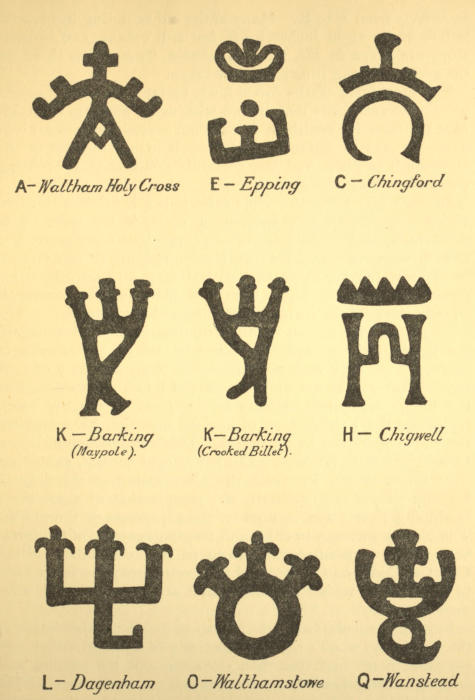
CATTLE BRANDS. ESSEX FOREST
[286]
The machinery of the forest laws, so far as the local courts were concerned, was maintained with some measure of strictness far later in Waltham forest than elsewhere in the kingdom. It was in active operation until nearly the end of the eighteenth century, and was certainly effective in preventing encroachments.
In 1812 Mr. Wellesley Pole (afterwards Lord Mornington) became hereditary lord warden in right of his wife. This gentleman, as Mr. Buxton puts it, “saw that more profit was to be made in breaking his trust than in keeping it”; he refused to support the authority of the verderers, and did all in his power to bring the forest laws and customs into contempt. Finally, he sold the rights he was appointed to guard.
In the middle of last century wholesale enclosures began, resulting in the complete destruction of the woodlands of Hainault in 1851 and its conversion into arable land. A manufacturer of steam ploughs entered into a contract to clear the land. Attaching anchors to the roots of the old oaks, including the Fairlop Oak of ancient memory, he completed the whole operation in six weeks. This ruthless action began to bring about a reaction, and after a legal contest, extending over fifteen years, in which the Corporation of the City of London played a great part, the preservation of 5,500 acres of Epping Forest was secured for the enjoyment of the public. The victory was won in 1874, and the management of the forest vested in a committee, consisting of twelve members of the Court of Common Council and four verderers; the latter have to be resident within the forest, and are elected by the commoners.
For full particulars as to the history of the deer of this forest, of the woods and wood’s rights—especially of lopping, which was practised more in Essex than elsewhere—of the pasture and pannage customs, of the enclosures and encroachments, and of the verderers, foresters, and king’s woodwards, the reader is referred to Mr. Fisher’s comprehensive work.
[287]
The forest of Windsor was at one time of immense extent, having a circumference of about 120 miles. It included a part of Buckinghamshire, a small portion of Middlesex, the south-east side of Berkshire as far as Hungerford, and a very large part of Surrey. In the early part of its history almost the whole of Surrey was technically within the bounds of Windsor forest, and subject to forest law; whilst for several centuries the rights of Windsor forest on the Surrey side included Cobham and Chertsey, and extended along the side of the Wey as far as Guildford. But it gradually dwindled in extent through encroachments and grants, so that when Norden made his detailed survey in the time of James I., the circuit, exclusive of the Buckingham liberties, was only 77½ miles. At the time of its enclosure in 1813, the circuit had been still further reduced to 56 miles.
There is a noteworthy reference in the Close Rolls at the end of John’s reign to the deer of this great forest. On 9th January, 1215, the king gave orders for no fewer than sixty-four deer to be supplied out of Windsor forest for the great feast at the consecration of the bishop-elect of Coventry. This feast took place at Reading, for William Cornhill was consecrated Bishop of Coventry and Lichfield, and Richard le Poor Bishop of Chichester, on 25th January, in the infirmary chapel of the Benedictine abbey of that town.
The references to royal grants made by Henry III. out of Windsor forest are numerous and interesting, but for these search must be made in the printed calendars of both Close and Patent Rolls.
The grants of timber in Henry III.’s reign out of Windsor [288]forest were not nearly so numerous as those from royal forests in Northamptonshire, Wiltshire, Hampshire, or Essex; in fact, there were exceptionally large tracts of open common and waste in this widespread forest district, where even bushes were exceptional. The donations that were made were chiefly to the religious, to the friars of Oxford, Reading, and London, to the abbeys of Chertsey and Westminster, to the priories of Ankirk and Merton, and particularly to the nunnery of Bromhall, within the forest.
Among the more interesting grants of timber for specific purposes are those relative to ships and boats. In 1221 a grant of beechwood was made to William Earl of Salisbury for building a ship; the trees selected were to be those growing near the banks of the Thames, as the timber was to be taken down to London. The constable of Windsor was directed, in 1224, to supply the chaplain of the chapel of St. Mary of Faversham with timber for making a boat (batellum) so that poor people and others might be able to cross the Thames to Faversham and back. Again, at a little later date, a good oak was supplied wherewith to make a boat for the conveyance of poor folk over the water of Cavresham.
The ancient mitred abbey of Chertsey, founded in the seventh century, had many liberties and rights within this forest, particularly on the Surrey side. William II. granted the abbey leave to take wood for their necessary uses out of the Surrey forests, and to hunt therein hare and fox. Henry II., in a further charter, added to this general free warren liberty to hunt the wild cat and to take pheasants, to impale parks at Ebisham and Coveham, to have all the game in them free from molestation by the king’s foresters, and that none of the forest justices or other ministers were to disturb them in their four manors of Chertsey, Egham, Thorpe, and Chobham, or even to enter therein. The venison privileges were limited by charter of Richard I. and John, but their manorial powers were increased.
The pleas of the forest were held at Guildford in 1256, but the earliest eyre within Windsor forest of which there are any details was that held at Guildford on 8th July, 1270, before Justices Roger de Clifford, Matthew de Colombieres, Nicholas de Romsey, and Reginald de Acle. It was then presented [289]and proved by the verderers and by twenty-four good men of the town of Guildford and its vicinity, as well as by many sworn townships, that Walter Walerund, William his brother, and three others who were all dead, as well as Thomas de Bois, a survivor, were all habitual evil-doers to the venison of the king and to his conies in Guildford park; that sometimes they were harboured at the house of Alan de Slyfield, and sometimes at the house of John atte Hook, who were privy to their offences; and that all these persons, on Whitsunday, 1267, took in the park, without warrant, a buck, a doe, and thirteen conies, and that Robert de Ford was their harbourer and privy to it. Ralph, Alan, and John appeared, and were convicted and imprisoned. The sheriff was ordered to produce Thomas and Robert at the court on 18th July. When Thomas de Bois appeared he was imprisoned, but before the pleas were ended he was released on payment of a mark. Ralph, Alan, and John were also released on payment of half a mark. The next presentment was against five persons who entered the same park on 22nd July, 1263, with bow and arrows and greyhounds, to do evil to the king’s venison. Three of the offenders were dead, and the other two were ordered to attend the court day by day. It was afterwards proved that two more persons of this poaching party had entered the park seven years previously; one of these was then living at Farnborough, and the justice sent an order to the sheriff of Hampshire to arrest him and keep him safely in prison until the eyre was held at Winchester.
The information as to the agisting of the park, presented at this eyre, is of interest. In 1257 the park was agisted with ten horses and a hundred cattle for eight weeks, from Hockday to the Nativity of St. John Baptist, at a charge of 1d. a head. After 24th June there remained on the park herbage twenty plough-beasts at ¾d. a week. In the same year the park was agisted for 156 pigs, and there was given in the name of pannage for the king every third pig, or 52 pigs in all, each worth 2s. Particulars, approximately the same, save that there was no pannage, follow on the roll for the next two years. In 1260 there was no agistment of herbage in consequence of the war, but the park was agisted with 240 pigs for mast, 4d. being paid for each pig. In 1261 and in 1262 the [290]park was not agisted, neither for herbage nor pannage. In 1263 there were 100 pigs for mast at 4d. a pig. In 1264 there was no agistment for pigs through lack of mast, but it was agisted for a month with 56 plough-beasts. Fifty oaks were felled this year for the king’s house-building works at Guildford.
The bounds of the Surrey part of Windsor forest at this eyre were given as: through Ham as far as Guildford bridge along the bank of the Wey; from Guildford bridge along the “Copledecroche” (Hog’s Back) as far as the “Malloesot” bridge; by the Woodbrook as far as “Brodesford” bridge (Blackwater bridge); and so far by the king’s highway to Herpesford; and so by the little river from Herpesford as far as Chertsey; and so by the Thames to Ham.
The Close Rolls of 1275 show that the keeper of this forest received a considerable salary. Geoffrey de Picheford, constable of the castle, was ordered in that year to pay 12d. daily to Robert de Say, whom the king had appointed chief forester and minister of the forest during good behaviour, in place of John Inglehard, deceased, for his expenses about that custody. In that year the foresters and verderers were busy in selecting oaks and beeches throughout the forest to be used for the impaling of Windsor park and the king’s other works. A little later in the reign oaks were felled to be used in the making of a great barge for the king’s ferry at Datchet. In 1276 the constable of the Tower of London obtained thirty Windsor oaks to burn lime with for the works of the Tower.
The impaling of the new park of Windsor seems to have been completed in 1278. In November of that year the keeper of Chute forest, Wilts, was informed by the king that he was sending one of his yeomen to take in that forest live deer to stock his park at Windsor, and that he was to permit as many to be taken as could be without damage to Chute forest. In the previous year the Close Rolls also supply the information that there were then wild (silvestres) bulls and cows in Windsor park; the constable was ordered to effect their capture and sale, and to use the money towards the expenses of the king’s children then staying at the castle.
The keeper of Windsor forest received orders from Edward I. on 20th May, 1286, when the king was just about [291]to cross the seas, to admit Edmund, Earl of Cornwall, his kinsman, to chase in that forest at pleasure, and to permit him to take deer, and to aid and counsel him in so doing. A record was to be kept of the number of the deer thus taken.
The forest perambulations of 1299-1300 yield the following as to the Surrey side of this forest:—
“The perambulation of the forest of Windsor, in the county of Surrey, made on the Saturday next before the feast of St. Gregory the Pope, in the twenty-eighth year of the reign of king Edward, at Lambeth before Roger Brabancon, John of Berwick, Ralph of Hingham, William Inge, and John of Croxley, in the presence of Phillip de Sai, clerk of the justice of the forest, the foresters and verderers of the forest aforesaid, by the oath of William Aumbesas, John of Burstow, Robert of Bekwell, knights, Robert le Dol, Robert of Walton, William of Northwood, John Prodhomme, Robert att Send, Nicholas of Weston, Richard of Horton, Edmund of Utworth, and John of Farnham, who say upon their oath that the whole county of Surrey was forest in the time of king Henry, the great-grandfather of the king who now is, and the same king Henry died seised of it; and so it remained forest until the fourth day of December in the first year of the reign of king Richard, who then disafforested a certain part of the same county by certain metes, which are contained in the charter of the same king Richard made concerning them, to wit, between Kent and the water which is called the Wey, and from the hill of Guild Down as far as the county of Surrey extends towards the south; and the rest of the county aforesaid, to wit, beginning at the water of the Wey, as far as the county of Surrey extends, to the north of the hill of Guild Down, remained and is forest. And after that charter was made nothing was afforested or occupied by king Richard or by king John or by anybody else.
“They say also that they do not know that any part of the county aforesaid was afforested by the aforesaid Henry, the great-grandfather of the king who now is.”
There was a good deal of fickleness shown by Edward III. and his advisers with regard to the Surrey part of the forest at the beginning of his reign, as shown by the entries on the Patent and Close Rolls. On 27th December, 1327, the recent perambulation of the Surrey forest was confirmed. The perambulation began at “Waymuthe,” and thence along the Thames to “Ladenlakeshacehe,” where the three counties of [292]Surrey, Berks, and Bucks met; thence to the eastern corner of Windsor Park, to the mill of Harpsford, to Thornhill, ... and thence to Bridford, where the three counties of Surrey, Berks, and Hants met. This ratification concluded with the assertion that the whole county of Surrey was without the forest, and was so in the time of Henry, the king’s great-grandfather.
At the same time a mandate was issued to the sheriff to have the king’s letters patent read in full county court, the proclamation publicly proclaimed, and to cause it to be observed; but saving to the king forty days from that date to chase the deer into his forest in places which, according to the perambulation, are without the forest. Another mandate of the like date was issued to the constable of Windsor Castle to use all diligence in chasing all such deer in Surrey into the king’s forest within the forty days.
The sheriff of Surrey was instructed on 15th October, 1329, to make summons for an eyre of forest pleas for that county at Guildford, on Monday after St. Andrew’s Day.
On 4th August, 1333, the Surrey disafforesting of six years earlier date, apparently based on hasty and insufficient information, was annulled. Order was then issued to obtain full information as to the bounds of the Surrey forests in the time of the late king, and to cause them henceforth to be guarded by the like boundaries, and this notwithstanding the grant of 1527; for the king had understood that divers woods and open spaces in Surrey ought to be afforested, as was fully proved by divers inquisitions and memoranda in the treasury, and that the said woods and places under colour of the late grant had been disafforested to the king’s manifest harm.
The forest justices (Sir John Ratcliffe and Sir Reginald Gray) sat at Guildford on 8th August, 1488. The keepers of the parks who were present were Sir Reginald Gray for the parks of Guildford and Henley; Richard Pigot, for Poltenhall; and William Mitchell, for Bagshot.
Sir Thomas Bourchier was the keeper, with Sir William Norris, lieutenant, and William Orchard his deputy. One of the foresters was lately dead, but two foresters and one deputy were present. Henry Stokton and William Bantrum, the late [293]verderers, were in attendance, as well as their successors, Henry Slyfeld and John Westbrook.
The regarders numbered eighteen; two of them were described as gentlemen. There were seven woodwards, each of whom returned omnia bene. The reeves and four-men of the townships of Ash, Byfleet, Chertsey, Egham, Frimley, Horsell, Pirbright, Thorpe, Windesham, Woking, and Worplesdon were in attendance, as well as thirteen free tenants.
Among the offences dealt with at this eyre were the cutting down without licence of forty oaks within the forest at Pirbright; killing a great buck at Crowford bridge; the killing of a hind calf with greyhounds by Thomas Forde of Pirbright, who was one of the foresters of the forest of Windsor; the felling and removing of 400 oaks and 300 beeches by Thomas Abbot of Chertsey, without licence; killing a stag with greyhounds at Wanburgh; and various instances of shooting at deer, or slaying them with bows and arrows, and setting nets for their capture. Ralph Baggley was fined 100s. for being a common destroyer of pheasants and partridges and a taker of birds. Another transgressor had slain six pheasants with a hawk.
The reeve and four-men of Chobham presented John Wode for following the craft of a tanner within the forest, and he was fined 12d. They also presented another man for having a warren, and he was mulcted in the like sum.
The following particulars were supplied to the justices respecting the deer of Guildford park during Henry VII.’s reign:—
“The sum of the Dere slayn by our Sovereyn lorde the kynge in the parke of Gylforde att the feste of Seynt Mychaell the fyrste yere of hys Reygne.
- Imprimis slayn of Dere of Auntyller xvj.
- Item the same season lx doys.
- Item iij fones.
- Item ij prykettes.
- Item the same yere my lord Madurface iij doys and a prykett.
- Item Syr John Arundell a Doo.
- Item Master Bowchere ij Doys.
- Item Syr Thomas Mylborne a Dowe.
- Item my lady of Lyncolne a Doo.
- [294]Item Syr my lord Awdley a Doo.
- Item Syr Jamys Awdley ij Doys.
- Item ther dyede in moren xli doys and prykettys.
- Item ther dyede the same yere Cxxxv of fones.
- Item xj dere of Auntuller.
- Item the kynge killede in Som xxiij dere of Auntuller.
- Item my lord Grey Codnore a Bukke.
- Item my lorde madurface a Bukke.
- Item Syr John Arundell a Bukke.
- Item Master Bowchere and Syr John Wynfelde a Bukke.
- Item the Abbot of Westminster a Bukke.”
In the second of his reign Henry VII. killed in this park, between Michaelmas and All Saints, by his “oon persone” ten does and a fawn. Two does were sent to the king at Westminster on the Feast of All Saints. Six does were sent “to the Coronation of the Quene.” Twenty does, eight bucks, and three sores were sent out as gifts during the year.
A presentment was also made as to the park of Henley-in-the-Heath:—
“The Parke of Henley.
“Thees bene the dere that have bene ded in moreyn and that hath bene slayn seyn the begynnyng of the Reigne of the Kinges grase that nowe is Kyng Henry the vijᵗʰ.
“Fyrst the Kynges grase kylled hymselff in the seyd parke of Henley wyth his Bowe and his bukhundes in the Fyrst yere of his Reigne. iiij bukken.
“Item by his servauntes the same tyme the kyng being in the seid parke. vj male dere.
“Item to the abbot of Westminster the same year j bukke.
“Item sent to the Court by the Kynges Waraunt the fyrst yere of his Reygne in Wynter ij does.
“Item delyvered to the abbot of Westminster the second yere of the Kynges grace—j bukke.
“Item delyvered to my Lord Prynce lyvynge at Farnham, the second year of the kynges grase in Wynter iij does.
“Item delyvered to the seid abbot the thyrd yere of the kynges grase j Bukke.
“Thees bene the morens in the seid parke.
“In the fyrst yere of the Kynges grase dyed in moreyn in the seyd parke of Henley—iiij fawyns, j doe, and a pryker.
“Item in the second yere folowyng, j pryker, and ij faunes.
[295]
“Item in the thyrd yere now last past, a soure and tegge.
“Item now in faunsumtyᵉ dyed in fawnyng. ij does.
“Item delyvered to Master Bourghchyer for ij yere, ij Bukken.
“Item Master John of Stanley killed in the seid parke j Bukke.
“Item my lord of Derby servauntes killed in the seid parke j Tegge.”
The same justices, before they came to Guildford, had held the forest pleas for the Berkshire division of Windsor forest, at New Windsor, on 4th August, 1488. Sir Thomas Bourchier and Sir William Norris were respectively keeper and lieutenant, as in the Guildford division. There were also present bailiffs and deputies of the bailiwicks of Fenie Wood and Finchampstead, and bailiffs of the respective liberties of the bishops of Salisbury and Winchester, the bailiff of Elizabeth the Queen; representative burgesses of Windsor; the late and present verderers; twelve regarders, six of whom were esquires; and jurors for the hundreds of Bray, Cookham, and Sonning.
Those that claimed at this eyre special liberties in the actual forest of Windsor were Elizabeth, Queen of England; the bishops of Winchester and Salisbury; the abbots of Reading, Abingdon, Waltham, Westminster, Stratford Langthorn, Cirencester, and Chertsey; the priors of Hurley, Bisham, and Merton; the prioresses of Bromehall and Ankerwyke, the dean and canons of Windsor, the provost and college of Eton, the dean and chapter of Salisbury, the mayor and citizens of New Windsor, the duchess of Norfolk, and two laymen.
A singular case to come under any kind of forest court was that of John Pomfreth, the tenant of a mill-race (gurges), at a place called Hornedroare; he was fined 12d. for not supplying drink to the inhabitants when making their Rogation-tide perambulation, according to custom.
Henry VIII. was passionately fond of the chase and of sport in all its forms, so that it is not surprising to find various references to his experiences in this royal forest throughout the papers of his reign. His chief sporting companion was Sir William Fitzwilliam, and on him he conferred the keepership of the Surrey side of the forest. Richard Weston was another of the hunting set, and on him, in 1511, the king conferred the lieutenancy of the castle and forest of Windsor, together with the office of bow-bearer. Another of his boon [296]companions was made bailiff of Finchampstead, within the forest, which was then well supplied with red deer. Business was by him usually sacrificed to pleasure. At the end of July, 1526, Fitzwilliam writes from Guildford: “I received a packet of letters addressed to the king, which I took to His Majesty immediately; but as he was going out to have a shot at a stag, he asked me to keep them until the evening.”
In August, 1528, Sir Thomas Heneage, in a letter to Wolsey, from Easthampstead, said that the king on the previous day had taken great pains with his hunting, from nine in the morning till seven at night, but only obtained one deer—the greatest red deer killed by him or any of his hunters that year—which he sent as a present to the Cardinal. Fitzwilliam, writing to Cromwell in August, 1534, having arrived that night at the Great Park, mentioned that he was in much comfort, as his keepers promised that the king should have great sport, and asked Cromwell to bring his greyhounds with him when he came to either Chertsey or Guildford. In January of the following year, Lord Sandys writes to Cromwell, in sore dread of the king’s wrath, for young Trapnell had killed twenty of the king’s deer on the borders of Windsor forest.
Towards the end of his reign, Henry VIII. made the last royal attempt to afforest a new district. But even his tyrannical disposition was restrained by statute, for he could afforest no man’s estate against his will, and he therefore had to make private arrangements with owners to effect his purpose. When he was established at Hampton Court, the king desired to have a nearer hunting-ground than that adjoining Windsor or Guildford, and therefore he resolved to make forest, if possible, of all the country between Hampton and his new palace of Nonsuch, near Epsom. Partly by new statute and partly by his own headstrong will, he effected most of his purpose. In 1539 he conferred on the district forest rights and privileges, and called it the Honor of Hampton Court. In the following year he obtained from Parliament two Acts, the one “for the uniting of divers lordships and manors to the castle of Windsor,” and the other “for the uniting of the manor of Nonsuch and divers other manors to the Honor of Hampton Court.” But shortly after Henry’s death this newly [297]created honor was dechased, and the deer removed to Windsor forest.
Of Queen Mary it is stated that on the Tuesday after her marriage, when she was at Windsor, a novel method of “sport” was introduced. Toils were raised in the forest four miles in length, when a great number of deer, driven therein by the hounds and huntsmen, were slaughtered.
Elizabeth was much more of a sportswoman than her sister. Under the guidance of her favourite, Sir Henry Neville, the queen frequently hunted in this forest. She remained keenly attached to this royal sport to the end of her days. In January, 1699, Elizabeth wrote to Neville instructing him to give orders for restraint of killing game and deer in Mote and Sunninghill parks in Windsor forest during his absence as resident ambassador in France. As late as 1602 she shot “a great and fat stag” at Windsor with her own hand, which was sent as a present to Archbishop Parker.
The chief matter pertaining to Windsor forest under James I. was the elaborate and careful survey drawn up by John Norden, which was finished in 1607. There is a good abstract of this survey, with a reproduction of that part of his map (at the British Museum) relative to the Great Park, in Mr. Menzies’ fine work on that part of the forest. Norden thus defines the limits of the forest: “This forest lyeth in Berkshire, Oxfordshire, Buckinghamshire, and Middlesex. The Tamis bounds it north, the Loddon weste, Brodforde river and Guldowne south, and the Waye river east.” The Great Park had then a circumference of 10¼ miles, and contained 3,650 acres within the counties of Berks and Surrey, whilst his estimate of the extent of the open forest was 24,000 acres.
James raised the wrath of the residents by attempting, soon after his coming to England, to close the Little Park and Cranborne Chase against all comers; but “the squires and better sort,” says Dixon, in Royal Windsor, “made private keys and entered like gentlemen of the highest quality; the locks were exchanged, and they broke the fences with as little scruple as the tramps.”
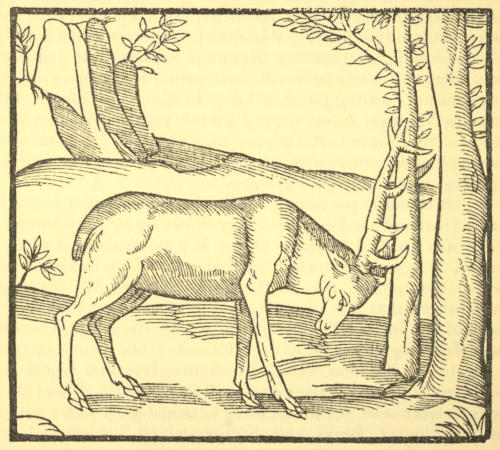
THE HART (TURBERVILE)
Charles I. hunted here frequently at the beginning of his reign. In 1632 Noy, the king’s attorney-general, styled by Carlyle “that invincible heap of learned rubbish,” revived [298]the forest pleas, and justice-seats were held both at Bagshot and Windsor. Every old formality was strictly observed; at the opening each forester had to present his horn on bended knee to the chief justice in eyre, and each woodward his hatchet; and these insignia of office were not returned until a fine of half a mark had been rendered. The revival of forest pleas in Surrey was bitterly resented. No part of Surrey had been treated as forest until Henry II.’s time, when almost the whole county was by degrees afforested. Richard I. found himself obliged to throw open again all eastward of the Wey, save the royal park and manor of Guildford, leaving the rest of the county to be attached to Windsor, under the title of the bailiwick of Surrey. But from that time onwards there had been more or less resistance to any Surrey afforesting outside the parks, and various sovereigns, particularly Elizabeth, had made important concessions. From 1632 to 1642 many of the gentlemen [299]of Surrey encouraged rather than checked outbreaks of daylight poaching, hunting in companies of eighty or a hundred; at the latter date the exemption from forest law of the whole of Surrey, save Guildford park, was definitely accepted.
In 1640, the grand jury of the county of Berks complained as to “the innumerable red deer in the forest (Windsor), which if they go on so for a few years more, will neither leave food nor room for any other creature in the forest.” They also protested against the rigid enactment of the forest laws and the inordinate fees exacted by some of the forest ministers. In the following year a great tumult arose; the people round the New Lodge, in a riotous fashion, killed 100 fallow deer, in addition to some red deer, and threatened to pull down the pales of that park. The Earl of Holland was then constable of park and forest, and he obtained authority for the sheriff of Berks to raise the power of the county to apprehend the persons engaged in this riot. But in 1642 the Long Parliament took possession of Windsor.
It is in Windsor Park, says Mr. Menzies, that “the oldest authenticated regular plantation in England can be shown.” In 1625, Richard Daye wrote to Secretary Conway, mentioning a proposal that he had previously made for “sowing convenient places in Windsor forest with acorns, which had been favourably received by the late king,” and asking that the project might be laid before Charles I. To this letter he attached a statement to the effect that, in 1580, by order of Lord Burleigh, thirteen acres within Cranborne Walk had been impaled and sown with acorns, which had by that time (after forty-five years’ growth) become “a wood of some thousands of tall young oaks, bearing acorns, and giving shelter to cattle, and likely to prove as good timber as any in the kingdom.” It has been assumed, on excellent grounds, that the plantation here referred to is the large group of oaks at the back of the park bailiff’s house in the direction of Cranborne.
Under the Commonwealth, although Sir Bulstrode Whitelock, constable of the castle and keeper of the forest, was himself a sportsman, the deer disappeared from the Great Park, and only a few remained in the forest. Much of the finest timber was felled, but chiefly for navy purposes. At the Restoration, Charles II., as has been already seen, took some [300]trouble to restock many of the royal parks and forests with both red and fallow deer. In this Windsor had its full share.
In November, 1731, the deer of Windsor forest numbered 1,300; in 1806 they had dwindled to 318. In 1813 came the disafforesting Act for Windsor, and in the following year a troop of the Horse Guards and a detachment of the 5th Infantry were employed for two days in sweeping through the wild heaths and dells that were about to be enclosed, and driving thence the deer into the parks; but in this rough process many were slaughtered.
At the present day the acreage of the Great Park is about 3,000 acres, and it contains, in round numbers, 1,000 fallow and 100 red deer. Cranborne Park, though part of the Great Park, has a pale of its own, and contains a small herd of white red-deer!
[301]
In early historic days, almost the whole of Sussex, together with considerable parts of Kent and Surrey, formed one great forest, called by the Britons Coit Andred, from its vast extent. The Saxons called it Andredes-weald, which was doubtless adapted from the Anderida Silva of the Roman Itineraries. The Saxon Chronicle, under date 893, gives its extent as 120 miles long from east to west, and thirty miles in breadth. That considerable part of the county which remained forest or open till much later days—some, indeed, until the present time—was known as the Forest Ridge; it formed the elevated district of the north-eastern part of the county, and stretched in a north-westerly direction along the borders of Surrey. The principal sections of this are still known as the forests of St. Leonard and of Ashdown.
Young, in his Agricultural Survey, at the end of the eighteenth century, said: “A great proportion of these hills is nothing better than the poorest barren sand, the vegetable covering consisting of ferns, heath, etc. St. Leonard’s Forest contains 10,000 acres of it, and Ashdown 18,000 more, besides many thousand acres in various other parts of the county.”
Ashdown forest is described by Mr. Turner, in a good paper contributed to the collections of the Sussex Archæological Society (vol. xiv.), as consisting of about 10,000 acres, situated in the parishes of Maresfield, Fletching, East Grinstead, Hartfield, Withyham, and Buxted. It formed part of the honor of Pevensey, and from 53 Henry III. was invested in the Crown in perpetuity, and hence was a technical forest under forest law, a position that it did not lose when it came to John of Gaunt in 44 Edward III. It reverted to the Crown, with [302]the rest of the Duchy of Lancaster, until the time of Charles II., when it was formally disafforested, and found its way into the hands of speculators in waste lands. Various Tudor commissions show that the timber suffered severely from the inroads made on it to supply charcoal for the iron foundries.
In the early part of Edward I.’s reign, the free chace and warren of Ashdown were held by the king’s mother. Proceedings were taken in 1283 against divers persons for hunting and carrying away deer and rabbits from her park at Maresfield. In 1297, Edward I. granted Thomas Paynel licence for life to hunt with his own dogs, the fox, hare, cat, and badger in the king’s forest of Ashdown except during fence month; it was also specially stipulated that he did not take deer, nor course in the king’s warrens. On 30th July of that year, the king appointed Walter Waldeshef to the bailiwick of the forestership of Ashdown, on condition that he answered for the same in like manner as his predecessors. Ashdown was a favourite hunting resort of James I., and it was well stocked with deer. The Parliamentary Survey of its seven wards is extant, as well as a great variety of papers of earlier date. The history of this and the other forests of Sussex yet remains to be written, though certain contributions in that direction were made by Mr. W. S. Ellis in his Parks and Forests of Sussex, published in 1885.
St. Leonards Forest lies north-east of Horsham, and forms part of the great parish of Beeching. It would be more correct to speak of St. Leonards Chace; the whole body of the forest law never prevailed here, as it was granted in early days by the Crown to the Braose family. An entry in the Patent Rolls of 1st September, 1295, relative to a raid in this district on deer, hares, rabbits, pheasants, herons, and fish, when the owner was absent on the king’s service in Wales, styles it the free chace of William Braose, called the forest of St. Leonards (liberam chaciam Willelmi de Brewosa que vocatur foresta sancti Leonardi). Four years later a like entry on the same rolls relative to deer poaching describes it as the free chace of William Braose at St. Leonards.
The forest of Arundel, though of limited extent, was well stocked, and formed an important adjunct of the honor of Arundel. The forest pertained to the earls of Arundel, as is [303]stated in the Close Rolls of 1206, but during a long minority in the time of Henry III., and again in the time of Edward I., came under the control of the Crown. The chief point of interest in its history is the disputes that arose as to the deer between the earls and the archbishops of Canterbury, who claimed the hunting. There was an appeal to Rome on the subject in 1238, and it was not until 1258 that the renewed disputes were finally settled by an agreement that the archbishop might, on giving notice to the forest ministers, hunt once a year when going to or returning from his manor of Slindon, with six greyhounds, but with no other kind of dogs, nor with bows; and that if more than one beast was taken by the party, the remainder were to be handed over to the earl. It was also stipulated that the earl and his heirs should annually deliver thirteen bucks and thirteen does to the archbishop at the proper season.
[304]
SO much that is good of its kind has been printed concerning the beautiful district of the New Forest, that only two or three pages are allotted to it in this work. Mr. Wise’s admirable The New Forest, its History and Scenery (1863) long remained the standard book on the subject; but two more recent works have corrected some errors and given much fresh information. One of these is the joint article of over sixty large pages, by the Hon. G. W. Lascelles and Mr. Nisbet, on Forestry and the New Forest in vol. ii. of the Victoria History of Hampshire (1903); and the other is the wholly delightful and thorough book, rich in illustrations, by Mr. Horace G. Hutchinson, which was published in 1904. To this may be added the mention of a good article, with plans, descriptive of the changing area of the forest, with its laws and customs, by the late Mr. Moens, which appeared in the Archæological Journal for March, 1903.
The New Forest may be described, in broad terms, as the south-western corner of Hants, bounded by the Southampton water and the Solent on the east and south, and by the Dorset and Wilts borders on the west and north. Its extreme length is twenty-one miles, and its greatest width twelve miles; it covers 92,365 acres, which include 27,620 acres of private property. Put in other words, this means that the Crown or public lands of the New Forest consist of about 100 square miles, whilst the private lands occupy about forty square miles. Within this, notwithstanding the considerable extent of the woods, are several great stretching heaths and many an untimbered glade.
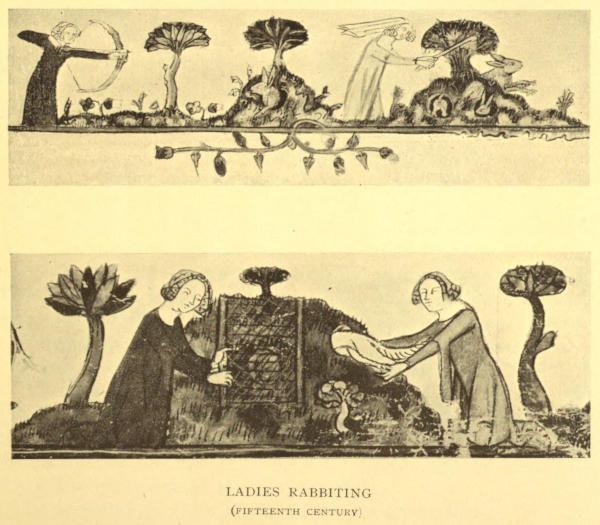
PLATE XXII
LADIES RABBITING
(FIFTEENTH CENTURY)
[305]
In Hampshire, as elsewhere, the Saxon kings reserved large tracts of country, well supplied as a rule with woods and thickets, for the purpose of sport and hunting, whilst at the same time they realised the importance of preserving the woodlands for the pannage of the swine. Under the Conqueror, the New Forest increased in area, and had its special bounds assigned; but stories set on foot by early chroniclers as to William’s reckless cruelty in destroying scores of churches and burning out villages for the sake of hunting, can readily be shown to be gross and absurd exaggerations. The later story of this forest, as set forth by Messrs. Wise, Lascelles, and Hutchinson, is a tale of continued aggression by private owners and by squatters, of grievous jobbery by forest officials, of Crown mortgages, of much destruction of timber and deer, and finally of various parliamentary inquiries in 1831, 1850, 1875, and at yet more recent dates. The forest is at present governed by the Act of 1877. Scotch firs and pines that now abound were first planted here in 1776.
The red deer, the fallow deer, and the roe deer are all still present in the New Forest, but in very much reduced numbers; the last-named are strays that first found their way here from Milton, Dorset, in 1870. In the days when Gilpin wrote his delightful volumes on Forest Scenery (1790) there was a semi-wild breed of bristly pigs in parts of the forest, which were supposed to be hybrid descendants of the wild boar (Plate VII.).
Although there has been so much good writing on the history of the New Forest, there are sources of further interesting and original history at the Public Record Office which no one has hitherto tapped. Space can be found for only a few instances of such information.
The accounts of John Randolf, keeper of the forest, for 1306, show that there was much of pasturage in various parts of the forest, irrespective of general rights of agistment. There was, for instance, considerable sale of corn and hay from the manor of Lyndhurst in the centre of the forest; eight oxen of that manor were sold for 56s. Iron used in repair of the farm carts of the manor cost 2s. 10d., two iron plough-shoes (for tipping the wooden shares) cost 8d., and the shoeing of two cart-horses 18d. The full accounts for this year are beautifully written and in [306]most excellent condition; no antiquary would grudge the wage of the keeper’s clerk, which is entered as one mark, “according to ancient custom.” The keeper himself received a salary of £10. The forest tithe, payable to the church of Salisbury, was £4 3s. The most interesting entry of that year is the sum of £8 15s. 8d., which was expended in repairing the court house, or manor house of Lyndhurst, against the coming of the king—ut patet per particul’—but unfortunately the particulars are lacking. The manor house of Ringwood was at the same time put in order to be ready for the royal advent; among the items is the entry of a supply of plaster of Paris.
Forest pleas for the New Forest were held at Southampton on Monday next after the Translation of St. Thomas the Martyr, 1330, before John Mantravers. On the first day of the session, which extended over twenty-one days, no fewer than ninety-seven essoins or excuses for non-attendance were put in for the substantial reason of death. In each of these cases appearance had to be made by some relative or other qualified person who testified to the death. The first five names stand thus:—
The venison pleas of the New Forest were presented by Sir William de Beauchamp, keeper of the forest, for the term of six years, in conjunction with Andrew de Camerton, his lieutenant, and John de Romsey, John de Brymore, Richard atte Hanger, and John Niernuyt, verderers. The venison presentations were concerned with the death of 22 does, 10 bucks, 3 hinds, 2 harts, and 6 fawns, in addition to several cases in which the numbers of the head of game taken off were unknown. The fines imposed for these venison trespasses by the justices varied from 12d. to 20s. The number of such cases is by no means excessive, considering that the oldest offence went back to 1284. It must also be remembered that [307]there must have been numerous cases struck out, because the delinquent or delinquents were dead. One of the more exceptional and interesting cases is that of two poachers who, in July, 1325, hunted in the New Forest with nine greyhounds and a mastiff, killing two does and a fawn; they loaded them on a white mare, when they were attached by the foresters and committed, together with the mare, which was of the value of 5s., to the custody of Simon de Wynton, the sheriff of the county. When the eyre was held Simon was called upon not only to account for his prisoners, but for the 5s., the value of the mare. But Sheriff Simon was dead, and Sir Richard de Wynton, who held his lands, had to put in an appearance and hand over the value of the white mare to the justices.
The list of presentments of vert trespassers is a very long one, covering both sides of four membranes. It opens with two cases, in one of which three beeches, worth 3s., had been felled, and in the other two oaks, worth 2s.; in each instance, the offender had to pay 12d. fine, the value having previously been paid at the local woodmote court. The usual value put on oaks, roers, and beeches was 1s. each. Occasionally the oaks must have been of considerable size; in one case an oak was valued at 2s., and in another at 3s. 4d. A cartload of green wood of white thorn was valued at 6d.
The following is a copy of a warrant for timber from Beaulieu, addressed by Henry VII. to the Earl of Arundel, the keeper of the New Forest:—
“By the king
“We wil and charge you that unto our trusty and right welbeloved Cousin the erl of Ormond or unto the bringer herof in his name ye deliver or doo to be delivered twelf Okes convenable for tymbre to be taken within our Baiffship of Bewley in oure Forest called the New Forest or in such places within the same Forest as oure said Cousin shall thinke moost metely and convenient for him, and these oure lettres shalbe yor Warrant. Geven undre oure signet at oure Citie of Winchestere the xix dey of October the second yere of oure Reign.
“To oʳ Right trusty and right welbeloved Cousin Therl of Arundell warden of our Newe Forest in our Countie of Suth’ton and to his Lieutenant and keepers there.”
[308]
KING AND QUEEN OAKS
Among the presentments at an eyre temp. Henry VII. are the following:—
“The bayly of goddyshell shewyth that John Colend the bayly of Godshyll Kellyd a bukke in Somer in the viijᵗʰ yere of Kyng Henry the vijᵗʰ and a doo the same somer wyth a Arrowe and caryed awaye the Flesshe wythowte lycens of ony keper. Item the same John Colend kylled a hert in the sayd baylywekke with an Arrowe in the yere aforesayd and caryed away the flesshe withowte lycens of ony keper.
“In the viijᵗʰ yere of yᵉ regne of Kyng Henry the vijᵗʰ yᵉ xijᵗʰ day of Junii Rychard Carter yoman of Bewly come into the Este bayly and there he toke a rede dere and caryed it away.
“Inᵈ that Sʳ Wylliam Holmes, prest of Sarum, come into the bayly at Fytcham the Monday next aftyr holy Rode day the viijᵗʰ yere of Kyng Henry the vijᵗʰ and there wyth hys greyhundys kellyd a Sowre wythowte leve of ony keper.
“Also Rychard Kymbrege of Mychwood kylled ij hyndes calves wyth hys howndys wyth owte leve of ony keper in the vijᵗʰ yere of Kyng henry.
“Inᵈ that Sr Edward Wellyby, prest, came into the bayly at Fyrtham the Satyrday next after Saynt Bartylmewes day the viijᵗʰ yere of Kyng Henry the vijᵗʰ and there wyth hys grehowyds [309]kylled iij bukkys, a preket and a doo wyth owte ony lycens or autoryte of ony keper.
“Presentyd by a offycer that one Robart Dyer otherwise called Robart Foster the xvᵗʰ day of October the viijᵗʰ yere of Kyng Henry the vijᵗʰ come into the Newe Forest that is to say to Fette Thurnes within the bayly of Battramsley and there fellyd and caryed away the nowmbyr of xij lode of grene thurnes. The said prisoner appered and deposed the contrary ... and put in plege for his fyne.”
The last of these extracts refers to a hard case when Charles I. was attempting to revive forest law.
In November, 1639, Henry Earl of Holland, chief justice in eyre, reduced on petition the fine of £30 for a venison offence in the New Forest in the case of one Harmon Rogers to £5, and ordered his release from prison on giving sureties to be of good behaviour towards the forest. The petition set forth that Harmon was
“a miserable poore man in lamentable distresse, hath a poore wife and vij small children, had great losse by fire, one of his children is a creeple, hath a blind man to his father that wholly lyeth upon him, hath been twice imprisoned for this one fault, and in his present durance is ready to starve for want of food and so are his children at home, at this present 30 li in debt, and hath no meanes in the world to releive himself his blind father wife and vij childrene but his painfull labour and never did or will, as God shall help him, commit any fault or offense against his Majesties game but onely one.”
In addition to the New Forest, Hampshire had two other large forest areas—Alice Holt and Woolmer, and the forest of Bere.
Alice Holt, a comparatively modern and unfortunate corruption of Axisholt, and Woolmer, though apparently always separated by a small strip of non-forest land, were practically one, and formed a considerable stretch of country, chiefly woodland, on the borders of Surrey and Sussex. They were almost invariably under the same general control, though having their separate minor forest ministers. Thus, in 1217, Axisholt and Wulvemar formed one bailiwick in the charge of Robert de Venoit, and again, in the beginning of Edward I.’s [310]reign, both Alice Holt and Woolmer forests were under the same keeper, Adam Gurdon. They seem to have been well stocked with both red and fallow deer, and also heavily timbered. Adam Gurdon, in 1273, had to deliver two bucks at Windsor Castle, as the king’s children were staying there. In 1276 and 1277 the same keeper was instructed to give facilities to a royal huntsman who was sent down with his dogs to take harts for the king’s household in the forests of Alice Holt and Woolmer; and in the following year he had to dispatch thirty oaks fit for timber towards the rebuilding of Winchester Castle.
The sixth report of the woods and forests commission, issued in 1790, devotes eighty-eight folio pages to these two Hampshire forests. The commissioners cite the perambulation of this joint forest made in 1300 as reduced from the wider limits of earlier reigns. A perambulation of 11 Charles I. gives practically the same bounds. The whole area within the forest is returned as 15,493 acres, but of that quantity 6,799 acres were in private hands. Reference is made to a justice seat held 11 Charles I., and to swainmote courts in the reigns of James I. and Charles I. The administration and customs of the forest corresponded with the general use. Since the year 1777 the timber had been very largely used for the navy; it was taken by road, about ten miles, to Godalming, where the river Wey was navigable, and thence to the dockyards on the Thames. The lieutenant of the forest (Lord Stawell) considered the deer his own. There were then about 800 fallow deer in Alice Holt; the red deer used to be found in Woolmer Forest, but the latter were removed to Windsor about 1760. In the appendix there is a list of the lieutenants or keepers of the forest from 45 Elizabeth, and very full particulars as to the sale, extent, and value of the timber. All kinds of cattle were admitted to pasture save sheep.
The forest of Bere extended northwards from the Portsdown Hills. According to a perambulation made in 1688, it included about 16,000 acres. The southern ward, in early days, often went by the name of Porchester forest.
[311]
When pleas of this forest were held in September, 1490, at Winchester, it was returned that Sir George Nevill was keeper; Sir James Awdley, lieutenant; Ralph Shorter, forester, and John Wilton, his deputy; William Knight, ranger; and William Froste and John Hamond, verderers. William Mody and his fellows were present as regarders, and there were two juries sworn of the men of the hundreds of Somborne and Buddlesgate.
For fee timber Richard Curson, as deputy of the justices, received six beeches; the keeper, two roers, and his deputy, a beech; the lieutenant, a roer; the ranger, a beech; each verderer, an oak and a beech; the regarders, two beeches and and a roer; the two sessional clerks, four beeches; and the under-sheriff, a roer. Richard Curson also received a buck.
At a swainmote of West Bere, held on 5th June, 1475, before John Whitehede and John Hamond, the verderers, Robert Bailly, forester, presented that John Ewerby, lord of Farley, claimed to have the right to deer that escaped into his lordship, and that he had killed several head at Hambledon and Queentree.
At another swainmote, held on 1st June, 1488, before William Frost and John Hamond, verderers, Robert Bailly, the forester, again presented the lord of Farley for having killed several does and fawns in the previous August in the woods of West Bere. He also presented Richard Mathew, lately parish chaplain of Sparsholt, and then living at Crawley, for having killed a doe with bow and arrows. A more serious charge was preferred against a yeoman and a miller of Winchester, who with a large number of disorderly persons hunted the forest with greyhounds and two other kinds of dogs, namely “rachys et kenettes,” to the grave destruction of the deer.
The woods and forests commissioners’ thirteenth report, issued in 1792, is devoted to this forest. It is described as in the south-east part of the county and within eight miles of Portsmouth. The perambulation of 1300 is printed in the appendix. The forest was then divided into two walks, the East and the West. Following the boundaries laid down in 1688, the commissioners estimated the area as at least twenty-five square miles, about a third of which was enclosed, and [312]the rest open forest land. The parishes within the forest and certain neighbouring ones turned out horses, horned cattle, and ringed swine at all times of the year, but no sheep. The officers were a warden-in-fee by Crown grant; four verderers, chosen by the county freeholders; a ranger, a steward of the swainmote court, and two keepers for each walk, all appointed by the warden during pleasure; twelve regarders chosen, if required by the county freeholders; and two agisters appointed annually, at the swainmote court. There were about 200 fallow deer in the East Walk, and about fifty in the West Walk. A court book was extant from the year 1685, but no court had been held since 1769, when it could not be opened as no verderers attended. Extensive encroachments were being made, and the timber and underwood of the Crown lands comparatively unguarded. The commissioners strongly urged that the district should be disafforested. The underkeeper of the West Walk testified that until recently the deer were regularly browsed with “holly, ivy, and the tops of thorn bushes, when the season required it.”
Reference is made in the general section on later forest history to the great chase or park that pertained to the Bishops of Winchester at Waltham.
[313]
There is clear evidence that the forest of Clarendon, Wilts, formed part of the royal demesne in pre-Norman days. The nuns of Wilton, at the time of the Domesday Survey, had a customary right in the wood of Milchet to fourscore loads of firewood, pannage for fourscore swine, together with as much timber as was requisite for keeping their houses and fences in repair. The parks of Milchet and Buckholt and the forest of Panshet were original members of Clarendon forest according to the thirteenth-century Hundred Rolls. In the interesting account given in Hoare’s county history, it is stated that the earliest general view of this forest is to be found in these rolls of the end of Henry III. and beginning of Edward I. But this is scarcely correct, for the Close Rolls of the early part of the reign of Henry III. abound in references to the forest and its component members, as might naturally be expected from the fact of Clarendon being such a favourite residence of our kings in the thirteenth century.
The timber of the forest was a great boon to the district, and freely granted by the king for ecclesiastical and other purposes. Six oaks were granted in 1222 to Gilbert de Lacy for building a chapel in his court at Britford; in 1223, fourteen large pieces of timber (vj postes iiij pannas et iiij solivas) from the rootfallen or cablish trees to make a granary at Eblebourn; in 1224, all the cablish timber, not yet sold, for the fabric of the cathedral church of New Sarum, which had been begun four years before; in 1230, three oaks to the prioress of Amesbury for making the nuns’ stalls, and five oaks to help the Franciscan friars in building their house at Salisbury; and in 1231, five good oaks out of Milchet wood [314]for the abbess of Romsey to make planks for the dormitory, and two oaks for the prioress of Amesbury to mend the quire stalls. As to wood for fuel, the Bishop of Salisbury obtained a grant of forty loads in 1224; Walter Fitz-Peter obtained three dead trees (tria bona sicca robora folia non ferentia) for his hearth, in 1230; and the nuns of Amesbury five loads of firewood in 1233, in addition to their customary privilege of estover.
During the like period the orders for timber from this forest for the works at the palace and park of Clarendon were numerous, and in 1223, after the great gale, the large sum of £40 from the sale of the rootfallen trees of this forest was appropriated to the works at Winchester Castle.
Among the grants of deer from this forest, may be mentioned a grant in 1223 of hunting ten bucks to the Earl of Salisbury, and a gift of four does to the Bishop of Salisbury in the following year. In 1228 one Savory de Malo Leone had a royal grant from Clarendon of five live does; and in 1229 William Earl of Pembroke obtained twenty Clarendon does towards stocking his park at Hampstead. The supply of fallow deer was evidently considerable in this forest, but there is no record of red deer.
At an inquisition of the hundred of Alderbury, in 1255, the jurors returned that the forest of Clarendon was well warded, but that the park of Milchet was then waste through the king’s frequent gifts and sales, and through supplying the works at Clarendon and Salisbury. The jurors of 1275 returned that the king held this forest in his own hands. John de Grymstede held the manor of Plaitford by serjeanty of warding the park of Milchet; Jordan de Laverstoke held land at Laverstoke, and Edmund de Milford at Milford by finding respectively a forester for Clarendon; and Henry de Heyraz by finding a keeper for the king’s running hounds (canes heyricii).
The royal gifts and orders as to wood from Clarendon forest were almost as profuse in Edward I.’s time as in that of his predecessor, particularly at the beginning of his reign. In 1275, the king granted four oaks to the priory of Mottisfont, and six oaks to one William de Fennes, as well as ordering twenty oaks out of Milchet wood for joists (gistas) and eight [315]oaks for shingles (cindulas) for the works at Clarendon. In 1276, the bailiff of Clarendon forest had orders to supply the sheriff of Wilts with four oaks fit for timber, to enable him to rebuild the king’s mill under the castle of Old Sarum, which had been thrown down by the force of the river; thirty oaks were granted to the abbess of Wilton towards the building of her church, and ten cartloads of brushwood to the Dominicans of Wilton. In the same year orders were given for supplying forty oaks for shingles for roofing the new works at Clarendon, and also sixty beams of timber to make rafters (chevrones), for Queen Eleanor, to be used in the buildings at Lyndhurst. In 1277, the queen had a further grant of twenty oaks out of Milchet park to make laths (latas) for the use of her manor house of Lyndhurst, of the king’s gift. It is curious to find timber being imported into the centre of the New Forest; it seems to imply that there was at that date very little wood suitable for timber in the great Hampshire forest.
The grants of timber were not so numerous in the reign of Edward II. Among them may be mentioned orders to the keeper of Clarendon forest, in 1320-1, to deliver to the sheriff for the repair of the king’s water-mills below the castle of Old Sarum thirty oaks and twenty beeches. The beeches were to be felled in Buckholt wood, and as there are other references to the beeches of Buckholt in the reigns of Richard II., Edward IV., and Henry VII., it seems likely that Buckholt was almost if not entirely a wood of beeches.
The adjacent small forest of Groveley was attached to that of Clarendon early in the fourteenth century. A return of the sales of the underwood for the last four years is entered on the Great Roll at Michaelmas, 1333. It was evidently the habit to clear out the undergrowth of a certain number of acres, representing different sized coppices each year. The following is a table of the sales and average. The total for the four years is £116 15s. 10½d.:—
| Clarendon Park. | Groveley Forest. | |||||||||||
|---|---|---|---|---|---|---|---|---|---|---|---|---|
| £ | s. | d. | £ | s. | d. | |||||||
| 1330 | 25 | acres | 20 | 19 | 8 | 8 | acres | 1 | 8 | 0 | ||
| 1331 | 27 | ” | 21 | 5 | 0 | 24 | ” | 1r. | 7 | 5 | 6 | |
| 1332 | 30 | ” | 22 | 19 | 8 | 12 | ” | 3r. | 2 | 17 | 4½ | |
| 1333 | 40 | ” | 1r. | 33 | 15 | 8 | 23 | ” | 3r. | 6 | 5 | 0 |
[316]
The yearly sale of this undergrowth must have been a boon to the neighbourhood, for where particular records of sales exist, as they do among the Exchequer accounts for most of the reign of Edward III., it is found that the wood was purchased as a rule in quite small lots. Thus, in 1346, when the wood of the coppice by Canonpath, close to the small priory of Ivychurch, which stood within the forest, was sold for £17 7s. 1d., there were forty-three purchases, the largest sum being 26s. 8d.
An indenture made at the market of Salisbury in 1360, between Robert Russel, lieutenant of Roger Earl March, keeper of the forest and park of Clarendon, and the two verderers of the same, with regard to the sale of oak and beech at Buckholt, mention is made of the foresters who had to be maintained. They were eight in number, namely, two each for the forests of Buckholt and Groveley, one for the park of Milchet, and three for the park of Clarendon; their pay was to be at the rate of 2d. a day. There were also two labourers at 1½d. a day, whose chief duty it was to keep the pales or park fence in order. In one document of this date these men are termed “palyers,” and at a later date “palers.” It is stipulated that all these men were to be paid by the verderers at the rate of 365 days to the year; that is to say, their wages were due for Sundays and holy days as well as on working days. Several accounts of the reigns of Edward III. and Richard II. show a large expenditure on hay for the sustenance of the deer during the winter. This was quite an exceptional forest expense, and only resorted to for the game in forests or parks frequented by royalty. For the most part their winter food consisted of the deer-browse or clippings from the forest trees.
The dean and chapter of Salisbury had the tithe of the venison of this forest granted to them by charter of Henry II., confirmed by several subsequent kings. There is an entry among the chapter records of the arrival of fifteen deer for the cathedral clergy in one year of Richard II.’s reign, when the capture of deer had amounted to 150.
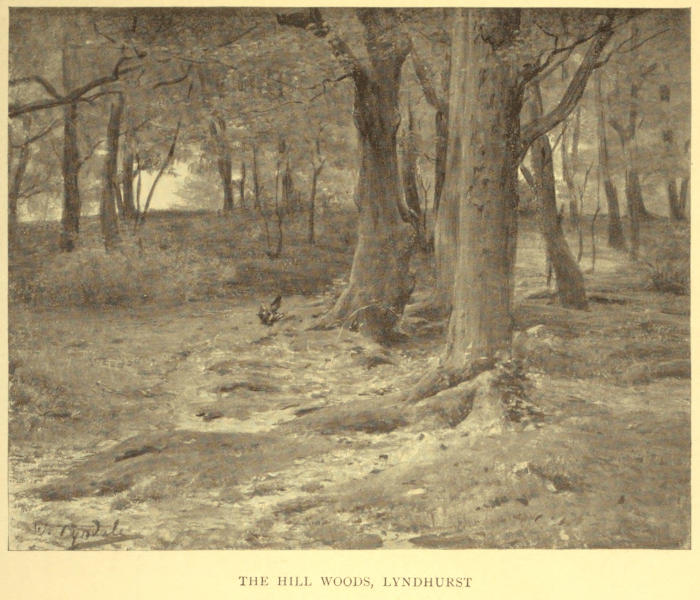
PLATE XXIII
THE HILL WOODS, LYNDHURST
The records of several large forests, where they must have abounded, are destitute of any reference to conies or rabbits. But in the case of Clarendon they were repeatedly mentioned [317]in the fourteenth and fifteenth centuries, and once or twice in the thirteenth century. In the time of Edward III. the warrens seem to have been the perquisite of the chief keeper. In 1495 the sum of £100 received of the “Fermour of the Coneys in Clarendon” was an item of the revenue assigned for the expenses of the king’s household. In the time of Charles I. the warrens were worth upwards of £200 a year.
Parliament was petitioned in 1388 by the commonalty and inhabitants of Salisbury complaining that the forest officials of Clarendon had of late years appointed certain of the citizens to act as vendors of the underwood, to their great damage and annoyance, and praying relief. A favourable reply was given, to the effect that such duties were never to be imposed on those living outside the forest bounds, save by the king’s special mandate.
Detailed accounts are extant for the year 1442 of the wood sales at Buckholt and Milchet. They were sent up to London in a leather bag or wallet, in which they still remain in excellent condition (Accts. Exch., Q. R. 140/9). Richard Ambros and William Colyn were this year instructed to fell 400 beeches in Buckholt and 200 oaks in Milchet for the repairs of the manor houses, lodges, and park pales. Sir John Stourton was at that time lieutenant to the Duke of Gloucester, who was keeper. The schedule shows that the beeches realised from 2s. to 2s. 6d. each; two selling for 5s., four for 8s., six for 14s., ten for 20s., another ten for 25s., one for 2s. 4d., etc. The oaks were sold in larger lots, five in all; three lots of sixty each all realised £4 10s., whilst two lots of ten were sold for a total of 30s.
A warrant to the sheriff of Wilts of 1 Richard III. (1483) charged him to pay to the seven keepers of the forests and parks of Clarendon, Buckholt, Milchet, and Groveley 2d. a day, and to the two parkers of the park of Clarendon 1d. a day for their wages. The sheriff was also to buy yearly in the summer season “as moche haye as shall amounte unto the some of xli or within,” which was to be stored for winter use in the barn of the park.
Clarendon swainmotes held during the year 1487 include presentments for carrying off iiij palebordys de la Parke pale de Clarendon; pasturing six pigs; killing a doe and fawn with [318]greyhounds; and for being a common hunter both by day and night with ferrets and snares. Among the officials present at the Clarendon swainmotes were two palers (palatiarii), who were responsible for the due upholding of the park fence.
On 21st August, 1487, the forest pleas for this forest and its members was held at New Sarum before Justices Ratcliffe and Grey.
An interval of eighteen years had elapsed since the pleas had been held, for the last justice seat was in 9 Edward IV. (1469). The attendance of officials of Clarendon forest or park was considerable: Thomas Arundell, the keeper; Sir T. Milborne, the lieutenant, and Walter Parker his deputy; Roger Holes, the ranger, and John Mue his deputy; John Shotter, the launder, and William Foster his deputy; the four foresters, one for each of the four bailies; the two verderers, Roger Bulkeley and Druce Mompesson, both entered as esquires; four woodwards; and twelve regarders.
For the forest or park of Milchet there were a separate set of officials: Edmund Earl of Arundel was the keeper, and there were also a deputy lieutenant, two verderers, two rangers and a forester, as well as woodwards and regarders.
There were also present woodwards of three outlying districts, and one for the forest of Groveley, together with the bailiffs of five different hundreds wherein parts of the forests of Clarendon and Milchet were situated. The whole list was signed by Sir John Turbervyle, the sheriff, who was, of course, bound to meet the justices.
The customary perquisites of the officials were enumerated. The keeper of Clarendon was entitled each year to one roer and two bucks, and each forester and ranger to a roer and two oaks. For Milchet the verderers had two roers and a buck, the forester one roer and his deputy the same, the ranger one roer, the regarders a buck and a roer to be divided among them, and the clerk of the iter two roers.
The Austin priory of Ivychurch, founded by Henry II. within the forest of Clarendon, appears to have been established for the twofold object of providing a spiritual centre for the denizens of the forest, and for the needs of the royal household at their Clarendon seat. Various early charters provide for the canons being held responsible for the religious [319]services in the several Clarendon chapels. In addition to early general grants of pasturage which the canons enjoyed throughout the forest, Henry III., in 1252, provided that they should have in every year that the forest was agisted twenty swine with their litters to feed on the mast, free of pannage charges, provided they were ringed; but there were to be no pigs allowed in the forest during those years when it was not agisted. Four years later the king granted them a piece of ground of considerable size adjoining their priory, known by the unattractive name of Filthycroft, with leave to enclose it with ditch and hedge, but only in accord with the fixed custom of the forest that permitted of the entrance and return of a deer and her fawns at due seasons. Edward II., in 1317, granted the priory right of pasturage in the forest for forty bulls and cows at a rental of 56s.
The following interesting memorandum of warrant venison and vert since the last iter was presented to the justices at the 1487 pleas by the lieutenant of the forest:—
Mᵈ of waruntes shewed by the leuetenaunte of Claryngdon for veneson and verde in Claryngdon
by waruntes of King Edward [iv]
- j buk the xᵗʰ yere of his reygne
- ij bukkes the xiiij ”
- xij doyn the xvj ”
- ij bukkes the xvij ”
- iij bukkes the xviij ”
- j buk yᵉ xxᵗʰ ”
- ij bukes the same yere
- iiij bukkes the same yer
- j buk the same yere
- XX/iij (60) quicke dere ye xxjᵗʰ yere
- xix doyn the same yere
- M/ij ccix (2209) ded in moreyn the same yere
- A buk by warante wᵗout date
- vj lodes of quicke dere the xxijᵗʰ yere
- ij bukkes the xxjᵗʰ yere
- xx doys the xxij yere
- j herte and ij bukkes yᵉ xiiijᵗʰ yere
[320]
By warant of the Erle of Essex, Justice of Forest in Claryngdon and the members to yᵉ same
- xij Rowers by severall warrantes ye xvij yere of K. E.
- j warante for the home copis in Claryngdon Aᵒ xviij
- j warante for the old parke Aᵒ xxi
- j warante for xˡⁱ of trees in Claryngdon Aᵒ xxij
- j warante for viij marke of trees in Claryngdon Aᵒ xix
- j warante for vjˡⁱ [worth of trees] Bukholte Aᵒ xiiij
By warant of William Erle of Arundell, Justice of Foreste
- j warante for Calumhill copis Aᵒ prᵒ Ric tercij
- j warante for ye logiis of Assheldy and Cheveley Aᵒ ij R.
- j warante for xˡⁱ of trees in Claryndon Aᵒ ij H. vij
- j warante for yᵉ copis of vij Rales in Claryngdon Aᵒ ij H. vij
By warantey of Kyng Richard.
- xx doys the ijᵈ yere of his reigne
- c trees for to make Salte peter and Gunepowder
By warantes of Kyng Harry the vijᵗʰ
- xij doys the firste yere of his reigne
- xviij doys the same yer
- xx doys the iijᵈ yer of his reigne
- As many trees as drawith to xxˡⁱ
The Crown, in 1576, called upon the regarders of Milchet, Richard Bacon and Thomas Gauntlett, to return certificates in reply to articles of interrogation which had been forwarded to them. The following are their answers, the more important or interesting parts being cited verbatim:—
“We do saye that ther ys remaynynge in the Custody of one of us one Sealynge axe withe a peculye mark and one Bagge wheryn the Same Axe ys Kepte.
“That Richard Audley Esquire, the Keeper of the Forest of Milchet, claims the windfall, and hath also taken five ‘rotefall’ trees, about 12 loads in all; that he hath taken the rotefall trees without any marking with the sealing axe; and that he hath also taken several dead oak trees similarly unmarked.
“That the Keeper caused an oak to be fallen to make ‘dogge stakes for the Savegarde of the deere,’ which oak was fallen and carried befor any view consideration or allowance of us the regarders, the stem of which oak we have marked with the sealing axe.
[321]
“That none were sworn for the falling of deer brouse last winter, though the Keeper had promised that one of his men should come before us the regarders to be duly sworne; and yet did appoint three men who never appeared before us to ‘cutte deere brouse of the bowes of okes in the Queenes Wooddes in the Forest of Mylchett where they dyd cutte and fall the bowes of okes of greter quantyte and bygger then a bucke was able to turne over with his hedde in Wynter and that they did cutt very lyttle other Woodde of the Queenes for deere browse but of the bowes of okes whereas ther ys hasell bysche, wethy, maple, and thorne.’
“That in our judgement 33 loads of brouse and fire wood were cut.
“That no cattle hath been put into the Queen’s coppice, but 11 swine the which we impounded.
“That we have a book wherin we write offences in the Queens woods if any be committed.”
James I., by letters patent dated 13th December, 1606, granted to William, Earl of Pembroke, the whole of the offices of keeper, warden, lieutenant, and bailiff of the forest and park of Clarendon, with all its members, together with the appointment of all foresters, rangers, launders, palers, and stewards of courts of swainmote. By this comprehensive patent the earl obtained the most absolute control that probably any one subject ever possessed over a royal forest. As chief ranger of Clarendon Park, he was entitled to the whole of the herbage and pannage, stocking it either with his own cattle or letting the agistment to others; at the felling of any of the twenty-one coppices of this park the ranger had two acres of the best wood for his own use, which was worth, on an average, £20 per annum; the farming of the “conie berryes” in the park realised £200 a year. Moreover, the patent gave the earl all the Clarendon lodges, with their houses, offices, and barns; there were six of these, five termed “Innelodges” and one an “Outlodge.” The chief lodge, with its fees and profits, was worth £140 a year. The four keepers of the other inlodges, such keeperships being now vested in the earl, who need only put in deputies, had rights of grazing cows and horses, which with venison fees, wages, firewood, and lodgings, brought the total annual amount of the four to £358. The keepership of the outlodge was worth £42 11s. 8d. a year. Then, also, as bow-bearer the earl was entitled to various [322]other fees and forest rights worth £49 13s. 4d. a year. And the whole of this was in addition to the venison and rootfallen, windfallen, and dead timber and general lop and crop that pertained to the general office of chief keeper or warden of a royal forest. Trees, coppice wood, and game still technically belonged to the king, but the Crown value was much reduced by this exceptionally generous patent.
An elaborate survey of Clarendon park was taken by the Commonwealth in 1650, which is cited in full by Hoare. The impaled ground of this park then included 4,293 acres, and was said to be worth £1,806 7s. 1d. per annum. It was divided into five parts of about equal value, the bounds of each of which are duly set forth. The names of the five divisions were the Ranger’s, Theobald’s, Fussell’s, Palmer’s, and Hunt’s. In addition to these divisions, which were in the parishes of Alderbury, St. Martin’s, Salisbury, and Laverstock, there was also a survey taken at the same time of the Outlodge district, on the east side of Clarendon park, in the parish of Pitton; it is described by the commissioners as being within “the disafforested forest of Pannsett, alias Panshett,” and no part of Clarendon Park.
The deer of the park, distributed about the five divisions, numbered 500 “or thereabouts,” and were valued at 20s. apiece. The timber trees, in addition to saplings, numbered 14,919; they appear to have been all oaks. Many had been recently cut down and marked for the navy. The undergrowth was chiefly maple and thorn.
After the Restoration, in 1665, Charles II. granted Clarendon park to George Monk, Duke of Albemarle.
The forest district nearest to the centre of the county was that of Melksham, which was about equally distant from Chippenham, Devizes, Calne, Trowbridge, and Cossham. During the later part of its history it was frequently termed the forest of Melksham and Pewsham, Pewsham being an extra-parochial district south of Chippenham, which is now included in the new parish of Derry Hill. But the more usual title in the reign of Henry III. was the forest of Melksham and Chippenham, Chippenham occasionally coming first.
[323]
In 1217, John Marshall, the keeper of the Melksham and Chippenham forest, was superseded by Richard de Samford, but the former was appointed constable of Devizes Castle, and the profits assigned for the upkeep of the castle. In 1219 Philip de Albiny was appointed by the Crown forest keeper and also constable of the castle. At the time of the general order as to cablish, after the great storm of 1222, the two appointments were also in the same hands. It was but very rarely that forest appointments were in clerical hands, but in 1225 the Crown nominated the Bishop of Salisbury to this forest keepership at pleasure.
The men of Melksham obtained certain pasture rights in the forest in 1229, when Richard de Gray was keeper and constable of Devizes. Chippenham and Melksham, though under the same rule, and probably united without any break of forest jurisdiction, were evidently regarded as two great wards of the same forest. There were several royal orders in Henry III.’s reign for so many oaks out of Chippenham and so many out of Melksham, made simultaneously, and addressed to the keeper of the two.
Forest pleas for Melksham and Pewsham were held at Devizes on 31st August, 1490. The officials present were: Sir Richard Beauchamp, keeper of the forest; Thomas Long, Esq., lieutenant; Walter Wrothesley, ranger; John, George and Thomas Barbour, foresters; Thomas Unwin and John Blake, esquires, verderers; thirteen regarders, five of whom are styled esquires; five woodwards, and the reeves and four-men of each of the five townships of Chippenham, Studley, Stanley, Melksham, and Stroud. A place is left in the schedule for agisters, but the return is nulli. There were also present a grand jury of seventeen, headed by William Bourchier, sen., Esq., and twenty-five jurymen from each of the hundreds of Chippenham and Melksham. Of the five woodwards, one was appointed by and represented the interests of the abbot of Stanley, another the abbess of Lacock, and a third Cecilia, Duchess of York. It was declared that the keeper was entitled to an oak from each baily; the lieutenant and ranger to an oak each; the forester and verderers to a roer each; the company of regarders to a roer and a buck between them; Richard Curson, the justices’ deputy, to six oaks and a male deer called [324]a pricket; William Heyden and his assistants, for clerical labour and attendance at the sessions, to four roers; and Thomas Unwin, as sheriff of Wilts, a buck. The claims to liberties of the abbot of Stanley, the prioress of Ambresbury, the abbess of Lacock, the priors of Farley and Brodenstoke, the Bishop of Salisbury, the Duchess of York, the Countess of Warwick, and three others were enrolled.
The army of officials, however, reported omnia bene, and as the various claims were all of long standing, it may be said that the whole business was nil, save that the findings of the swainmote court held on the previous 9th of June were duly enrolled, recording the conviction of several transgressors for venison offences.
It was also recorded that in the first year of Henry VII.’s reign 82 deer died of murrain, namely, 27 bucks, 35 does, and 20 fawns; and in the second year the great number of 340, namely, 140 male, 200 female; and in the third year 140, of which number 50 were male and the rest female. There seem to have been no red deer in this forest at that date.
Most of this forest was disafforested in the days of James I., but the Crown at that time retained the liberty of Bowood, adjacent to Calne, which was part of Pewsham forest. This was one of the best timbered districts of the forest, and in 1649 the Commonwealth caused a great number of the finest trees to be felled to pay the expenses of the army, under the authority of an Act of the Parliament. Fortunately, however, under the administration of the famous John Pym, who was for many years a representative of the borough of Calne, the destruction was stayed. In 1653, Bowood, “late parcel of the possessions of Charles Stewart late King of England,” was surveyed, when it was found to consist of 958 acres, bearing 10,921 trees. At the Restoration, Bowood reverted to the Crown, but Charles II. sold it to Sir Orlando Bridgman, and thus the last remnant of this once great forest jurisdiction came to an end.
Bowood, which is now the seat and property of the Marquis of Lansdowne, still preserves large tracts of wood and finely timbered lands outside the immediate park. The park of 254 acres has a herd of 200 fallow deer, and has many well-grown trees—beech, oak, elm, and chestnut. To the immediate south [325]of Bowood is Captain Spicer’s fine park of 500 acres, with a herd of 300 fallow deer. It consists of beautiful rough, broken ground, and is also within the old forest area, and but little changed in appearance from its condition in medieval days.
In the extreme north of the county, a little to the south of Cricklade, stretched the considerable forest of Braden, which was anciently of great extent and abounding in both red and fallow deer. It was entirely separate from the other Wilts forests, and is named second in the list when orders relative to the cablish of all English tree-bearing forests were sent to the foresters and verderers in 1222. Its keeper at that date was Hugh de Samford. Warner de Samford had been the keeper in the previous year. In 1231, when Henry III. was at Marlborough early in March, Hugh, the keeper, was ordered to supply Isabel, the king’s sister, with two hinds against Easter, as the lady was tarrying at Marlborough. In the same year Thomas de Samford, one of the royal chaplains, was made warden of Cricklade hospital, and the king bestowed on him and his successors full way-leave without any interference from foresters or verderers throughout the whole forest for horses and carts to obtain fuel whenever needed for the brethren and poor of the hospital. In August of the same year Henry III. sent his huntsman, John the Fool, with his companions, to hunt Braden forest with dogs, and to take thence for the royal use ten harts and fifteen bucks.
There are various rolls extant of swainmote courts held in this forest in the reign of James I. The records of the swainmote held on 6th July, 1609, before Edmund Lough, esquire, verderer, and Richard Digge, esquire, steward, mentions Thomas Howard, Earl of Suffolk, as keeper, and Henry Baynton, esquire, as ranger. There were present 4 foresters, 11 regarders, 41 agisters, 14 woodwards, 2 herdsmen of Ashton, and many jurymen. The foresters presented the taking of 16 bucks, 12 does, 1 soare, and 1 tegge, all by due licence. Among the regarders’ presentments were the cutting down of a green oak, value 4s., by an unknown person. It was stated that thirty load of deer-browse ought to be cut yearly for relief [326]of the king’s game in winter, but “many yeres heretofore no deer Browse hath been allowed or cattle for releafe of the deare, whereby they have been forced in dead tyme of winter to forsake the Foreste, and to seeke their releife in the Borderers house groundes to the dammage and spoyle of his Matʸᵉˢ game.”
Braden was disafforested in the time of Charles II.
The important Wiltshire forest of Savernake lay to the south of Marlborough, and was divided into two bailiwicks, the one in the hundred of Selkley, and the other in the hundred of Kinwardstone.
The references to this forest in the rolls of Henry III. and subsequent reigns, concerning royal gifts therefrom of deer, roe deer, and timber, as well as appointments of keepers, foresters, verderers, etc., are of very frequent occurrence. Much, too, can be gleaned from the forest pleas and other forest rolls. The following instances are reproduced as examples of twenty-nine presentments of venison trespasses before the forest justices, temp Henry VII, chiefly against the Wroughton and Darrell families. The pleas were held at Amesbury on 25th August, 1490:—
“William Tailor vnderkeper of the verme bayle presentith that John Wroughton esquier Thomas Wroughton John Perot William Belson David Welshman John Barowe John Longden with other the Thursday next after the feast of the Trinite the first yere of our sovraigne Lord Kyng Henry the VIIᵗʰ hunted Cobham Fryth Holt Lese and the Lityll ffrithe and there kylled a Sower with bowys and arowes.
“Thomas Kyng vnderforster of Iwode presentith that Sir Edward Darell Knyght John Baynton gent John Cradeley David Walsman John a Wood and John Langden with other of his servantes the morowe after the feast of Seint John Baptiste the vᵗʰ yere of our seid sovraign Lord out of Monttisfonte Copys a Doo and a fawne kylled in the cheif of the fense monyth and their houndes thorough ranne the forest to the great distrucion of the Kynge peace.”
An interesting portion of the old forest of Savernake, about 4,000 acres, containing much fine old timber, has been preserved, [327]as it forms the noble park round Tottenham House, the seat of the Marquis of Ailesbury. Outside the actual deer park, on the east, is a considerable extent of heavily timbered open ground.
Chute forest lay to the south-west of that of Savernake, and extended some distance into Hampshire, though always considered to be in the main a Wiltshire forest. In early days it seemed to have joined Savernake forest, and was at times under the same chief keepership. The entries as to royal gifts from this forest by Henry III. are numerous. Red deer (both harts and hinds) were presented to royal favourites, and also dispatched hence for the king’s table; oaks were bestowed, inter alia, on the abbess of St. Mary’s, Winchester, and on the prioress of Amesbury for building purposes, and on the Countess of Pembroke for repairing the mills at Newbury.
The original records relative to this forest, temp. Edward IV. and Henry VII., are numerous. The presentments at the swainmote courts of 1485-6 include one for creating “a pyggyshouse” by the boundary oak within the forest. The forester of the west baily reported the death, through murrain, during that year, of two bucks, four does, and a sorrel, whilst the forester of the east baily returned the death, through a like cause, of three bucks, one sore, eight does, and three fawns. Sir Nicholas Lysle was the warden or keeper, and under him were three foresters for the respective wards of the west baily, the east baily, and Hippingscomb, as well as one riding or itinerant forester. The ministers also included two verderers and two agisters.
These forest pleas for Chute were heard at Andover by Justices Ratcliffe and Gray, on 4th September, 1490. Sir Nicholas Lysle, “warden by olde inheritaunce of ye Forest of Chutte,” petitioned the king, complaining of interruption of his privileges by the forest justices. Among his vert claims were an acre with its bear of the coppice wood set to sale, and all wood felled and not carried away before the fence month, which had hitherto been always allowed to him and his ancestors for the guarding and safe keeping of the forest; [328]he asked for privy seal confirming his claims to be directed to the justices itinerant.
The verderers and regarders presented at this eyre that Nicholas, the warden, had killed, since the last iter, twenty deer, male and female; also that William Colwych, one of the foresters, had taken within his baily two stalls of bees with their wax, of the value of 5s.
Various forest offences alleged against the warden at this eyre were held by the justices to be proved, and he was removed from his office. In 1497 various trespasses and hurts to the forest done by Sir Nicholas were presented before Roger Cheyne (late lieutenant of the forest) who had succeeded him as warden, and the verderers, when he was charged with killing the deer at Christmas.
“Item the said Sir Nicholas, abbot of Misrule, came into the said forest on New Yeres Eve and there made chase and rechase and kylled ij dere, and also servauntes of the said Sir Nicholas Lyles commyth dayly into the forest and makyth chase and rechase that the dere may not lye in rest.”
In a further statement to the king, Sir Nicholas claimed that his ancestors had for a long time held the wardenship of Chute forest on payment of a rent of 10s., and finding seven foresters at his own cost to walk and keep the forest; that all the time there had been a forest lodge for the petitioner to rest and live in for sure keeping until lately, when Sir William Sandes entered upon it, and he prayed to be restored to it or have a new one built; and that the charges against him had been made by malicious and evil-disposed persons.
The king’s lodge here referred to was at “Fyckele” or “Fynkeley” within the forest. It underwent considerable repair at the beginning of this reign. For the new roofing 7,000 shingles were provided at a cost of 20s., and 500 shingle nails at 8d.
On payment of certain fines, Sir Nicholas Lysle was at length, in 1501, granted a royal pardon and restored to his wardenship.
The Wiltshire forest of Groveley was half in the hundred of Cadworth and half in the hundred of Branch and Dole. [329]It was divided into north and south bailiwicks under a single keeper. Documentary evidence from the beginning of Henry III.’s reign is abundant with regard to this forest. The perambulation temp. Edward I. and certain later particulars are set forth in Hoare’s Wilts (iv. 183-190).
The ancient forest of Selwood covered the south-western confines of Wiltshire at the extremity of the hundred of Westbury, together with a large portion of East Somersetshire, and extended itself southward from Frome just across the borders into Dorsetshire. Collinson (Somerset, ii. 195-6) gives a list of keepers of this forest from John to Henry VI. Special privileges in this forest were granted to the house of leprous women of Maiden Bradley in the thirteenth century. The material for its history, as yet unwritten, is abundant. It was disafforested in the time of Charles I.
[330]
The county of Dorset had three royal forests at the time of the granting of the Forest Charter of Henry III.—Gillingham, Blackmore, and Poorstock.
Gillingham was the most important of the three, in the extreme north of the county; it was originally one of the divisions of the great Somersetshire forest of Selwood. Leland gives its dimensions, in the time of Henry VIII., as four miles long by one broad. Material for the history of this and the other forests of the county is abundant. In the third edition of Hutchins’ History of Dorset, the boundaries of several perambulations of Gillingham forest, from Henry III. to Elizabeth, are set forth, as well as abstracts of the proceedings relative to its disafforestation (ii. 620-4, 649). It was disafforested and the deer removed in 1625.
The wood sale accounts of Richard Cressebien and Mathew Vynyng of the forest of Gillingham for 1402-3 are extant, still enclosed in the leather pouch in which they were forwarded to London. Mention is made in these accounts of the sale of many “rothers,” varying in price from 8s. to 16d.; this term was a variant for roers or robora. Many details are given of the expenses occurred in repairing lodges.
Pleas of the forest of Gillingham were held at Shaftesbury on 2nd September, 1490, before Sir Reginald Gray, Edward Chaderton, clerk, and Richard Empson, as justices of the forest of Elizabeth, Queen of England, on both sides the Trent. Those appearing were Sir John Luttrell, sheriff of the county; William Twynyho, esquire, lieutenant of the forest; William Goodwyn, ranger; Gilbert Thomson, forester-of-fee; [331]two other foresters, the launder, the servant of the lieutenant, the bailiff and his fellows of the hundred of Redlane, and also of the manor of Gillingham, the two verderers, eight regarders, and the reeves and “four-men” of each of the townships of Gillingham, Motcombe, and Brayton.
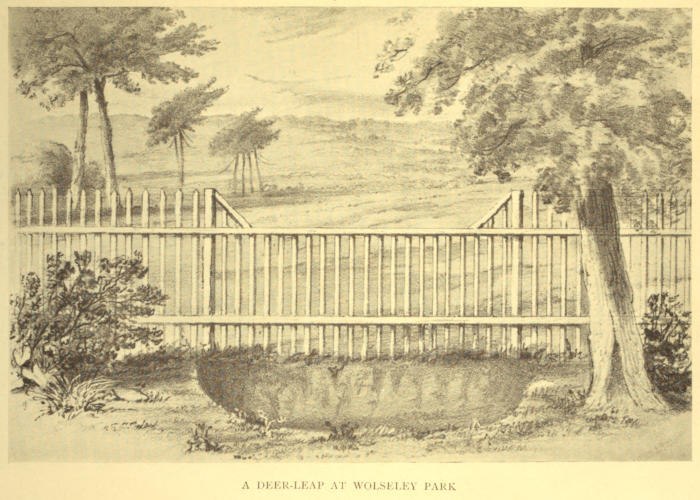
PLATE XXIV
A DEER-LEAP AT WOLSELEY PARK
The business transacted chiefly consisted in assigning the perquisites of oaks, roers, and bucks to the officials, and the registering of liberty claims within the forest. The jury of the hundred of Redlane presented a list of various persons who had felled oaks, but in almost each instance they knew not the number nor the warrant.
One of the questions discussed at these pleas was the right to a deer-leap, which formed part of the fence of a small park three miles distant from the bounds of Gillingham Forest. The nature of the saltatorium, or deer-leap, has been explained in the sixth chapter. In this case the justices ordered its removal, as a jury, after an inquest, decided that it had been erected since the last eyre, and without any licence.
A large tract of the north and western parts of the county, comprising several hundreds, known as the vale or forest of Blackmore, was all forest in early Norman days; but much of it passed from under the forest laws in the time of Henry II., and still more through the Forest Charter of Henry III. Nevertheless, a considerable district remained forest, and was known as Blackmore forest until a much later period. The Close Rolls, etc., of Henry III. show that the king made many gifts of red, fallow, and roe deer out of this forest, as well as timber. In 1230 an oak was granted for the repair of the bridge of Corfe Castle. In the same year the forest bailiff was instructed to supply the distant Bishop of Durham with seven does against Christmas; and in the following year to furnish the Bishop of Exeter with ten does towards stocking a park. Camden says that it used to be known as the White Hart Forest, and gives the following story to account for the name. Henry III., when hunting here, ran down several deer, and finding a beautiful white hart amongst them, caused its life to be spared. Shortly afterwards a neighbouring gentleman, [332]one Thomas de la Linde, with his companions, hunted this hart and killed it at a bridge, thence called Kingstag bridge, in the parish of Pulham. The king, in his wrath, not only punished the offenders by imprisonment and fine, but severely taxed all their lands, “the owners of which yearly, ever since to this day, pay a sum of money, by way of fine or amercement, into the Exchequer, called White Hart Silver, in memory of which this county needeth no better remembrance than this annual payment.” Leland says: “This forest streatchid from Ivelle unto the quarters of Shaftesbyri, and touchid with Gillingham Forest that is nere Shaftesbyri.” The ancient bounds and a few other particulars are set forth in the third edition of Hutchins’ Dorset (iv. 516-19).
In the parish of Poorstock (between Beminster and Bridport) and the adjacent country was the old royal forest of Poorstock. John de la Lynde held the bailiwick of this forest in the time of Henry III. It was of comparatively small extent; the perambulation of 1300 shows that it had one forester-of-fee, Walter de la Lynde, and one verderer, Robert de Byngham. This perambulation is set forth in Hutchins’ Dorset (ii. 317).
[333]
The county of Somerset was possessed of five considerable forests, namely, Mendip, Selwood, North Petherton, Neroche, and Exmoor, the last of which stretched a little distance into the county of Devon. Though these forests lay wide apart from one another, more than fifty miles as the crow flies separating Exmoor in the north-west of the county from Mendip in the north-east, the whole of the Somersetshire forests were under the general control of one chief warden or keeper. William du Plessis was hereditary keeper or master forester of the five Somerset forests in the middle of the thirteenth century, and Sabine Pecche, his descendant, in 1300.
The forest pleas that were held for this county in 1257 show a remarkable exception as to the beasts of the forest in the case of the warren of Somerton. Within the bounds of this warren the king preserved the hare as a beast of the forest. At that eyre Philip the Knight and Robert Sinclair, the two verderers, presented, before William le Breton and his fellow-justices, that, on 7th December, 1255, Richard le Rus and his fellows, whose names were unknown, took four hares in Somerton warren. The verderers further presented that in Christmas week, 1256, a certain hare was found dead. An inquisition was therefore made by the four townships of Somerton, Kingston, Pitney, and Wearne, who returned that the hare died of murrain. There is no like record affecting the hare in any other known forest proceedings throughout the kingdom, and it was probably peculiar to this comparatively small warren. To compel the four adjacent townships to hold an inquest on every hare found dead or wounded—in accordance with the laws pertaining to beasts of the forest—throughout [334]the length and breadth of the vast area under forest law in the thirteenth century would have been impossible to execute and absurd to attempt.
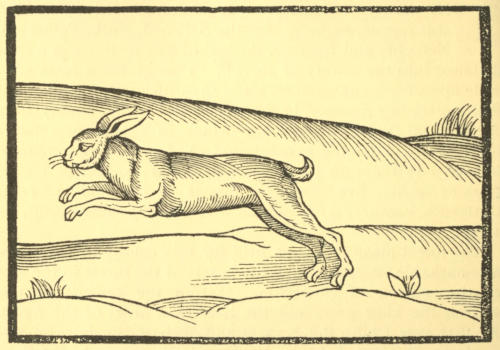
THE HARE (TURBERVILE)
Another interesting point about the Somerset eyre of 1257 is the presentment of the woodwards of wood owners. It appears that at that period the presentment of such officials before the justices was obligatory. Thus John Syward, the woodward of the Bishop of Bath and Wells for the wood of Cheddar, had been presented by the bishop’s steward to William de Plessis, the hereditary keeper, but not before the forest justice; whereupon the bishop was declared in mercy and the wood taken into the king’s hands. Before, however, the eyre closed, the bishop’s steward appeared, made fine for the wood, and presented Syward to the justices, who took the necessary oaths. Thereupon the wood was restored to the bishop. Like procedure was taken with regard to another of the bishop’s woodwards, as well as a woodward of the abbot of St. Augustine’s, Bristol. At the same pleas, the abbess of Shaftesbury and two laymen duly presented their respective woodwards.
Pleas of the forest were again held for Somerset in May, [335]1270, when the verderers of Somerton warren again presented, before the justices at Ilchester, several delinquents for hare trespass.
More careful attention is given to forest history in Collinson’s History of Somerset (three vols., 1791) than in any of our other old county histories. He cites in full from the Wells registers the perambulations undertaken of all the forests of the county in 1289, in order to reduce them to their ancient and lawful bounds, in pursuance of the ratification of the forest charter granted that year. With respect to the forest of Roche or Neroche, the commissioners reported in favour of the disafforesting of various villages, lands, and woods, which had been afforested by King John to the great detriment of the tenants. Almost equally great reductions of hunting-ground, which had been illegally made forest by Henry II., Richard I., and John in the other Somerset forests, were at the same time condemned and declared disafforested.
The master forestership or general keepership of all the county forests passed from the Peche family, in the reign of Edward III., to Roger Mortimer, Earl of March, in whose descendants, earls of March, and in their heirs the dukes of York, it continued until the time of Edward VI., when it became united to the Crown. Collinson sets forth the period of the respective disafforesting of North Petherton, Mendip, Neroche, and Selwood; but space prevents us giving particular attention to any Somersetshire forest save that of Exmoor, to which a few pages ought to be devoted.
The printed information about Exmoor Forest is exceptionally full. In addition to that which can be gleaned from Collinson’s county history, and from Savage’s History of Carhampton Hundred (1830), Mr. Rawle, in his Annals of the Ancient Royal Forest of Exmoor (1893), has published most of the information that can be gained from the original forest documents at the Public Record Office, or from MSS. at the British Museum.
Exmoor, exclusive of the part pertaining to Devonshire, was the largest and by far the wildest of the Somersetshire forests. This great expanse of hilly, open country, constituting for the most part a bleak table-land of moor, surrounded by a fringe of well-wooded combes, was bounded on the north by the Bristol Channel, extended some twelve or thirteen miles [336]inland, and was about twenty-five miles in length from east to west. That Exmoor was a hunting-ground before the Conquest is made manifest by the fact that Withypool, according to the Domesday Survey, was held by three foresters in the days of Edward the Confessor. Whatever may have been the area of Exmoor forest in the time of the Conqueror—Mr. Rawle believes it to have been above 60,000 acres—it was considerably increased by the encroachments of later Norman kings, particularly of John.
A perambulation of 1279, at the Public Record Office, gives a circuit of about fifty miles, and included within the forest area almost the whole of the parish of Oare, portions of Culbone, Dulverton, Exford, Porlock, and Winsford, and the whole of Hawkridge and Withypool, together with the modern parish of Exmoor. The perambulation stated that King John had added to the original forest a considerable number of adjacent parishes and manors, to an aggregate of about 20,000 additional acres, which included East and West Luccombe, Doverhay, Stoke Pero, Woodcockleigh, Bossington, Holnicote, Withycombe, etc. As a consequence of the 1298 perambulation for the whole county of Somerset, all the additions made by John to the forest of Exmoor were disafforested, and the ancient bounds as then laid down remained unaltered for several centuries.
The justices in eyre appointed to hear the Somerset forest pleas are known to have held their courts at Ilchester, Langport, Somerton, Taunton, and Wells. Taunton, the nearest of these court towns, was over thirty miles distant from the nearest part of Exmoor, whilst the other towns were all upwards of fifty—a distance that could not fail to considerably impede the course of justice and increase its expense. At the eyre held at Ilchester in 1257 by William le Briton and his colleagues, twenty-six vert trespassers were presented from Exmoor; the highest fine was 5s., which was inflicted on a clerk, William de Bagel; in another case the fine was 2s.; the remainder were mulcted in 12d. The few cases of venison trespass show that there were both red deer and roebucks on Exmoor; but there is no mention of fallow deer in this or subsequent pleas and inquisitions. At this eyre there were various presentments for encroachments and for sowing land with wheat, rye, or oats [337](not “beans,” as Mr. Rawle has it). Several offenders were also fined half a mark for waste of wood.
At the eyre held at Ilchester in 1270, there were upwards of fifty vert trespassers presented. In a few cases the fine was 2s., but in general it was 12d.; the justices imposed no fine in five instances in consequence of the poverty of the offender. The venison trespassers presented by the foresters and by Philip de Luccombe and Richard de Bradley, the verderers, were not numerous, considering that thirteen years had elapsed since the last eyre. Simon, the miller of Dulverton, Ralph Bulbe, and John de Reygny caught a stag on St. George’s Day, 1259, and carried it to the house of William de Reygny. Simon made no appearance, and a writ was addressed to the sheriff of Devon. Ralph could not be found, and a writ of exigent was issued. John and William de Reygny were committed to prison, but released on the payment of ten marks and finding pledges for their future behaviour. In another case, Thomas le Shetten and William Wyne were charged with entering the forest on Easter Eve, 1267, with bows and arrows, with the intent of wrong-doing to the king’s venison. They hunted a hind, and chased her into the wood of Longcombe, without the forest bounds, and there caught her, and carried her away to their houses at Molland. The same two men were charged with often entering the forest with evil intent, when they were harboured in the house of John, then chaplain of Hawkridge. The chaplain came to the eyre and was put in prison, but the other two made no appearance, and a writ for their arrest was directed to the sheriff of Devon. Before the court was dissolved, John the chaplain was pardoned for the sake of the king’s soul (pro anima Regis).
At an inquisition held at Langport before a deputy justice of the forest, in 1333, in addition to two cases of venison trespass, Richard le Webbe and two others of Moulton were convicted of burning the heath of 1,000 acres on the hills of the forest, to the damage of the king and to the injury of his deer. At the same time, William Cobbel, rector of Oare, was convicted of felling saplings in the wood of Oare, and carrying them off for his own purpose.
Various other inquisitions as to the state of Exmoor, held before forest justices or their deputies at Somerton, Taunton, [338]and Wells during the latter part of the reign of Edward III., are set forth in detail by Mr. Rawle.
Mr. Rawle has, however, overlooked several entries on the Patent and Close Rolls pertaining to Exmoor, several of which have been already cited in earlier chapters.
In 1324, John Everard, the escheator of the four western counties, was ordered to deliver to Eleanor, widow of Ralph de Gorges, and mother of Ralph his heir, aged 15, two parts of a third of the manor of Brampton, co. Devon, as the king learnt by inquisition that Ralph held at his death a third of that manor of the king in chief, by service of finding the king an arrow when the king came or sent to Exmoor to take venison there, the arrow to be delivered to the king’s huntsman.
In November, 1377, Richard II. granted Baldwin Badyngton, king’s esquire, and Matilda his wife, to enclose at pleasure, notwithstanding the assize of the forest, all their demesne lands in Somerset within the metes of the forests of Exmoor and Petherton, which had been wasted and destroyed year by year by the deer, so as to prevent the deer from entering, and thus to hold these premises for their lives.
Peter de Courtenay obtained in 1382, during the minority of the heir, the custody of the forest of Exmoor, which was in the king’s hands since the death of Edmund, Earl of March.
Edward IV., in 1462, granted for life to William Bourgchier, of Fitzwaren, knight, the master forestership of Exmoor, receiving the usual fees in the same manner as Thomas Courtenay, late Earl of Devon. Six years later the king granted the same office for life to Humphrey Stafford, knight, on the death of William Bourgchier. In 1470, John Dynham obtained from the Crown the grant for life of the custody of the king’s forests of Exmoor and Neroche, with the herbage and pannage and the courts of swainmote, rendering yearly to the king forty marks.
Henry VII., when he came to the throne in 1485, seems to have put the control of the venison of Exmoor into the hands of his chamberlain, Lord Daubeny.
On the marriage of Henry VIII. with Catherine of Aragon, Exmoor was settled on the queen as part of her jointure. In 1520 Sir Thomas Boleyn covenanted with the Earl of Devonshire to give up certain forests, offices, etc., which he held of [339]Queen Catherine at a yearly rent of £46 13s. 4d., saving and reserving 100 deer to remain in the forest of Exmoor. The forest was afterwards held by Henry’s third wife, Jane Seymour.
In 1598 Hugh Pollard was ranger of the forest, and kept a pack of hounds at Simonsbath. James I. granted Exmoor forest to his queen, Anne of Denmark. Charles I., on coming to the throne, granted a lease for 22½ years to the Earl of Pembroke of “the Forest and Chace of Exmore in the counties of Devon and Somerset, and of the manor of Exmore for fourteen years ... with a further clause of liberty to him to build a lodge in the forest at his chardges, and to enclose and lay one hundred acres of land thereunto.”
In 1630 the king was petitioned to disafforest Exmoor in favour of an influential applicant. The petition was granted, but further action was not taken. In the royal library at Windsor is a warrant, dated 5th August, 1637, under the sign manual of Charles I., directing the ranger of Exmoor to deliver to Mr. Wyndham “one fatt stagg”; a facsimile of this document forms the frontispiece to Mr. Rawle’s volume.
Within a few months of his accession, Charles II. granted a lease of Exmoor for 39 years to James Butler, Marquis of Ormonde.
In 1784 a lease of the forest and chase of Exmoor, with the courts and royalties, was granted to Sir Thomas Dyke Acland, Bart. This was the last lease granted by the Crown.
In 1815 an Act of Parliament was passed for the disafforesting and enclosing of Exmoor. The extent of the forest was then found to be only 18,810 acres, which were thus allotted: A little more than one-half to the king; one-eighth to Sir T. D. Acland in lieu of the tithes of the whole forest, which he held; and the remainder to “owners of certain estates, to which free suits were attached, and to several other persons in respect of old enclosed tenements lying in various parishes bordering on the forest.” The king’s portion was at once offered for sale, and his 10,000 acres were purchased by Mr. John Knight for £50,000.
Thus ended the royal rights over the ancient forest of Exmoor, which had their origin in days prior to the Norman Conquest.
[340]
Whilst far too little has hitherto been printed about many of England’s forests, the reverse is true with regard to Dartmoor. The mere list of books and publications relating to Dartmoor, its history, scenery, antiquities, and convicts, covers twelve pages of the last edition of Rowe’s Perambulation. Much of this is, however, of an ephemeral character, and the only two books that give serious information as to the history of the forest or chase are J. S. W. Page’s Exploration of Dartmoor (1889), and the one just named. The Perambulation of Dartmoor, by Samuel Rowe, vicar of Crediton, a good antiquary of his day, was first published in 1848; it was reprinted in 1856, and in 1896 brought out again in a much extended and corrected form by J. Brooking Rowe, F.S.A. This last admirable volume gives in extenso a variety of historical documents from a charter of John in 1199 down to an interesting presentment of the jurors of a court of survey in 1786. Nevertheless, a continuous history of this forest or chase yet remains to be written.
In the following brief remarks a mere bare outline of the general run of such a history is all that is attempted; whilst the additional documentary evidence cited has, to the best of our belief, never before been printed.
The whole forest of Dartmoor lies within the old parish of Lydford, by far the largest parish in all England. The wild table-land of the forest in the centre of the shire, with its adjacent common lands, hardly distinguishable from the forest proper, covers some 100,000 acres, whilst the actual forest has, [341]in round numbers, an acreage of 60,000. The district is about twenty-eight miles long from north to south, and about twenty-six miles wide from east to west. The nature of this granite table-land makes it certain that Dartmoor was never covered to any considerable extent with timber, although there was doubtless more underwood in places, diversified by occasional growth of oak, alder, and willow in the more sheltered glades.
By a charter of John, 18th May, 1204, all lands in Devonshire, save the forests of Dartmoor and Exmoor, were disafforested, thus anticipating the great charter of 1215, so far as this county was concerned.
In 1222 Henry III. directed the bailiffs of the once important borough of Lydford to permit the tinners of Devon to take peat from his moor of Dartmoor for the use of the stannary.
Henry III., in 1228, granted to Adam Esturney certain lands, which Roger Mirabel had held of the king in chief, in Skerradon and Shapelegh, by the service of two barbed arrows when the king came to hunt in his chase of Dartmoor. The manor of Woodbury was held in chief of the king by the service of three barbed arrows and an oat cake of the price of half a farthing, when the king should come to Dartmoor for hunting in his chase. The ancient tenure of the manor of Druscombe also shows that royal hunting over this waste, then so well stocked with deer, was anticipated, for the lord had to present a bow and three arrows to the king when hunting on the moor.
In 1236, the king granted the tithe of the herbage or agistment of Dartmoor to the chaplain serving the church of St. Petrock at Lydford.
In 1240, the sheriff was directed to summon a jury to determine, by perambulation, the bounds of Dartmoor Forest. Of this perambulation there are several early copies. An ancient quaint map of the forest, of which a photograph is given by Mr. Brooking Rowe, is extant that has generally been supposed to be coeval with this perambulation, but it is probably two centuries later in date.
An entry on the Close Rolls, dated 23rd January, 1251, shows that the very rare privilege of having a justice in eyre for [342]forest pleas, for a forest that was not strictly royal, was granted to Richard Earl of Cornwall, to whom the castle, manor, borough of Lydford and the forest of Dartmoor had been granted.
Geoffrey of Langley, justice of the forest, was at that date ordered by the king, as a concession to the Earl of Cornwall, when he had finished the eyre then being held in the county of Nottingham, to proceed to Dartmoor for a like purpose.
Mr. Brooking Rowe prints a rendering of the ministers’ accounts of Edmund Earl of Cornwall relative to Dartmoor for the years 1296-7. The items are arranged under the heads of the borough and manor Lydford, including the fee-farm rent, and profits arising from water-mill, fairs, toll-tin, and stray cattle; and the forest, including profits from water-mill, from township fines for pasturing cattle, from peat-diggers, from the agistment of 2,442 cattle at 1½d. a head, from 487 horses at 2d. each horse, and from pannage, etc. There were various court fines chiefly for straying cattle, but two for trespass during the fence month show that some care was taken of the red deer. Under the head of allowances, 60s. is entered as paid to the parson of Lydford, and 42s. for the stipends and drink money (poutura) of the foresters, with 22s. for their expenses in the fence month, and stipends and drink money for twelve herdsmen from 3rd May to 15th August, 76s. 6d. There was a clear balance on the whole account for the Earl of Cornwall of £44 2s.
That the deer were well warded, in addition to the cattle, is shown by the supplies of salted venison that were sent to Edward I. and Edward II. from this forest.
From the reign of Edward III. to that of James I. there are various ministers’ accounts and court rolls among the duchy muniments at the Public Record Office. The forest was divided into four quarters or wards, known from the points of the compass as East, West, North, and South, and the accounts of each were kept separately. The accounts of Robert de Cleford, the keeper and receiver of the moneys for turves, agistments, etc., for the years 1354-5, show the following particulars for the first three wards, that for the South being mutilated:—
[343]
East.—2,641 cattle and 198 horses agisted, and five peat-cutters licensed—producing £34 7s. 5d.
West.—1,408 cattle and thirty-seven horses agisted, and twenty-two folds and twelve peat-cutters licensed—producing £10 2s. 9½d.
North.—298 cattle, 163 horses, fourteen folds, and thirty-one peat-cutters—producing £5 1s. 6½d.
The charge right through these accounts for a long period was 1½d. a head for cattle and 2d. a head for horses, 2d. for each fold, and 5d. from each peat-digger. Those who dug peat for fuel are termed carbonarii, which has been absurdly translated colliers, and mention of early coal-getting on Dartmoor has been more than once printed. But the geological formation makes such an idea impossible.
Ralph Houle was the receiver in 1370-1, and his accounts for two wards yield the following particulars.
East Ward.—2,762 cattle agisted within the forest, and 1,762 without the forest; five horses agisted within the forest, and twenty-nine without. This agistment, in addition to the payments of thirteen peat-cutters, 58s. 10d. in rents, gave a total of £29 15s. 11d.
West Ward.—952 cattle and twelve horses agisted, whilst thirty-eight men paid for folds and thirteen to cut peat. This, with 11s. 11d. rents, made a total of £9 9s. 10½d. Among the outgoings were the 60s. of tithe, which appears in every account, 6s. 8d. to the clerk who drew up the returns, and the stipends of two foresters.
The court rolls of 1381-2 have the heading de venatione infra forestam several times, but no entry follows.
The accounts for 1387-8 give John Copleston as the king’s steward in Devonshire. John Prik was the forester-bailiff of the West forest; the money wages for two foresters was only 13s. 4d., but they each received an additional 6d. a week during the four weeks of the deer-calving time, or fence month. For the North forest, Robert Colleshull was forester-bailiff, and Ralph Brante for the East forest; in both cases the wages were the same as in the West ward. Much of this roll is illegible.
The ministers’ accounts for 1403-4 give Henry Burgeye as receiver, and he accounts for the borough of Lydford. William [344]Wykes was forester for North Dartmoor; 1,307 cattle, ninety-one horses, forty-two peat-cutters, and twenty-four folds. Aver Wonstan was forester for East Dartmoor; 1,693 cattle, 133 horses, twenty-one peat-cutters, and twelve folds. William Ysabel was forester for South Dartmoor; 1,600 cattle, forty-nine horses, sixteen peat-cutters, and twelve folds. William Kelly was forester for West Dartmoor; 1,780 cattle, ninety-seven horses, sixteen peat-cutters, and twelve folds.
A bundle of court rolls of the beginning of Henry V.’s reign, 1399-1405, contain many interesting forest details. At a court for East Dartmoor held at Lydford on St. Luke’s Day, there were various fines for unwarranted agistment, and one charge of hunting with greyhounds at Myrepitte on Christmas Day. Though not so styled, there were evidently the regular swainmote courts held in forests every forty days, for courts were also held, for the year 1399-1400, in February, on the Feast of St. David, at Easter, Sts. Philip and James, Whitsuntide, St. John Baptist, St. Mark, and the Assumption—nine in all.
There were also eight courts held for West Dartmoor, on days quite apart from those for the east ward, including St. Clement’s, Christmas, St. Valentine’s, and St. Gregory’s Days. There is a full list for 1399-1400 of those who turned their cattle (averia) out in East Dartmoor. The contrast is considerable between the rich John Abraham—(was he of Jewish descent?)—who turned out 300 head, and Walter atte Heade who had only a single beast. The total of the cattle is 1,970, and the agistment money came to £19 6s. 3d.
The ministers’ accounts for 1403-4 show a still large number of agisted cattle on East Dartmoor, namely, 3,159, in addition to twenty-nine horses; the peat-cutters numbered thirty. Richard Wyte was the bailiff-forester. The wages for two foresters stand as in earlier accounts, and there is also 10s. paid for a warden of the cattle collected at the pound of Dunbryge, and for a clerk writing out the list and aiding in impounding them. In Rowe’s Perambulation there are several references to Dunbridge, or Dunnabridge, pound, usually called the duchy pound, of a much later date. The sum of 3s. 4d. was paid this year for parchment on which to write the East Dartmoor agistment lists. The bailiff-forester for West Dartmoor for [345]that year was Alfred Wonstan; he returned 1,430 cattle, thirty-two horses, and twenty-one peat-cutters, but no fold money (faldagium); for this ward there were also two paid foresters with an assistant herdsman for the Dunbridge pound. South Dartmoor (John Grendon) had 2,012 cattle, thirty-six horses, and seventeen peat-cutters; whilst North Dartmoor (John Wyke) had 1,401 cattle, eighty-nine horses, and thirty-three peat-cutters. These two wards also each paid for two foresters and an assistant for the Dunbridge pound. This great pound, between Two Bridges and Dartmeet, is a large enclosure measuring 350 feet from east to west, and 330 feet from north to south. Rowe describes the wall as nearly 6 feet high where perfect.
The ministers’ accounts for 1451-2 yield the following agistment returns:—
| East | West | South | North | |
|---|---|---|---|---|
| Cattle | 1,208 | 1,248 | 1,696 | 1,045 |
| Horses | 42 | 21 | 40 | 26 |
This shows a considerable falling off from the returns of half a century earlier date.
The agistment entries more than a century later, in the court rolls for the forest of 1571-2, give the numbers of the cattle on North Dartmoor as 1,224; they belonged to fifty-four owners: Thomas Whyte owned 208, Thomas Ware 150, and Stephen Knight forty-eight, whilst some only owned one beast. Under Nomina delinquent’ infra forest’ are the names of Stephen Knight and thirty others who were each fined 3s. for agistment offences. There were only thirteen horses. Agistment of sheep (bidentes) now appear on the rolls; of these there were twenty-one owners, and their flocks on the moor varied from 300 to 10; the total number of the sheep was 830, and their agistment fees amounted to 25s. 11d. The cattle on South Dartmoor numbered 1,043, and the horses nine; whilst twelve persons turned out 346 sheep for 10s. 7½d. On West Dartmoor the cattle numbered 1,619, and the horses twenty, but there were no sheep. On East Dartmoor there were 2,079 cattle, twenty horses, and 100 sheep. Five persons each turned out a score, and paid the aggregate sum of 3s. 1½d., so the charge for sheep was 7½d. the score. In each ward there [346]were a number of delinquents who paid 3s. fines. The total of the peat-cutters, who still paid 5d. each, on the whole moor was thirty-five.
The court rolls for some twenty years later, namely, for 1595-6, show that the sheep were increasing. There were 843 in the north quarter, 110 in the east, and 246 in the west; the return for the south quarter is missing.
In the reign of James the sheep on the whole materially increased, at the expense of the cattle. The proportions for the north quarter in 1609-10 were 746 cattle, thirteen horses, and 1,560 sheep; but they fluctuated much, for in 1617-19 the cattle of the same quarter numbered 640, the horses seven, and the sheep 600.
The introduction of sheep on Dartmoor probably showed a diminution in the deer, or, at all events, less attention to their interests; for although red deer, where they roam widely, are not nearly so much affected by sheep pasturage as fallow deer, still it was always the principle to restrict sheep very narrowly in royal forests even when tenanted by the larger deer.
Towards the end of the eighteenth century the red deer had become so plentiful on Dartmoor that the farmers bitterly complained, and at last they were exterminated by the staghounds of the Duke of Bedford, sent down from Woburn for that purpose. It has been said that “Tavistock was so glutted with venison that only the haunches of the animals killed were saved, the rest being given to the hounds,” but this is obviously a somewhat ridiculous exaggeration. Of late years red deer occasionally find their way to Dartmoor, straying thither from Exmoor, although its nearest point is over forty miles distant.
The return of the jurors of the court of survey of the manor of Lydford and the forest of Dartmoor on 13th October, 1786, as parcel of the possessions of the Duchy of Cornwall, is cited in full by Mr. Rowe. It supplies interesting particulars as to the then obligation of the tenants to assist the foresters of the east, south, and west quarters to make a winter drift for the colts at their own charge, and to drive them to Dunnabridge pound and keep them there for two days and three nights, and thence to the Prince’s pound at Lydford, all at their own charge save the taking from the forester one halfpenny white [347]loaf of bread apiece; also to help in the three summer drifts of cattle between Midsummer and Lammas after like fashion, under pain of 6s. 8d.
A further presentation by the jurors was with regard to divers towns or villages abutting on the forest and within the purlieu, whose cattle did daily escape into the forest. Such offenders were subject to fine, which fine was turned into a rent called Fines Villarum, hence those who dwell in these townships and pay these rents are called Venvillemen. They further presented that Venvillemen, in return for the rent, may keep as many cattle as they can winter on their tenements in the forest, and may cut turf for their own use.
The Venville parishes number twenty-one. When the drifts were made, Venvillemen could recover their cattle or colts without paying any fine or charge, but the other remained pounded till the due fee had been discharged. The drift was summoned by the sound of a horn.
Every parish of the county has a right to send cattle to this moor save Barnstaple and Totnes.
The duchy now lets the four quarters of Dartmoor to the moormen, who in return charge a small fee for every sheep, bullock, or horse turned out not belonging to a Venvilleman, and this fee includes, as it did of old, a pledge of protection.
None of our English forests have so many of their original boundary or ancient guide stones remaining as that of Dartmoor, and the reason is sufficiently obvious, namely, the imperishable character of the granite that abounds throughout the district. Such stones almost naturally assumed the shape of a cross in the days of the simple vivid faith of our forefathers. The old grey cross standing up on the bare moor would not only tell the moormen or the Venvillemen of the bounds of their respective rights, or point out the path to be taken by the wayfarer, but would serve to keep in remembrance the Saviour of mankind. In one of the earliest printed English books, by Wynken de Word, in the fifteenth century, occur these words:—
“For this reason ben Crosses by ye waye, that whan folke passynge see the Crosses, they sholde thynke on Hym that dyed on the Corss, and worshyppe Hym above all thynge.”
[348]
Notwithstanding the mischief that has been done to these Dartmoor forest crosses, by wanton ignorance or Puritan malevolence, upwards of thirty still remain. They are admirably described and illustrated by Mr. William Crossing, in his Ancient Crosses of Dartmoor (1887).
[1] This word, though the assistance of some of our ablest philologists has been asked and courteously given, remains uncertain in its meaning. The probabilities on the whole favour the idea that it was a local name for some kind of horned deer. Possibly it may have been the roebuck. Compare leucoryx, the name for a white antelope.
[2] Duchy Depositions, I. H. 10.
[3] Ibid., 10a.
[4] Capille, capulle, or capul, is an old English term for a horse, chiefly north country. It is used in Piers Ploughman and the Canterbury Tales.
[5] Tynsell, or tinsel, was small dry wood, such as was collected for heating ovens.
[349]
PLYMOUTH: WILLIAM BRENDON AND SON, LTD.
PRINTERS
Messrs. Methuen have commenced the issue of a series of volumes dealing with various branches of English Antiquities.
It is confidently hoped that these books will prove to be comprehensive and popular, as well as accurate and scholarly; so that they may be of service to the general reader, and at the same time helpful and trustworthy books of reference to the antiquary or student. The writers will make every endeavour to avail themselves of the most recent research.
The series is edited by the well-known antiquary, J. Charles Cox, LL.D., F.S.A., Member of the Royal Archæological Institute, and Corresponding Member of the British Archæological Association. Each book will be entrusted to an expert in the selected subject, and the publishers are fortunate in having secured the services of distinguished writers.
A special feature is made of the illustrations, which will vary, according to the requirement of the subjects, from 50 to 150. Some will be in colour. The type is large and clear, the length of each volume is about 320 pages, and the size is demy 8vo. The volumes are issued at the price of 7s. 6d. net.
THE FIRST VOLUMES ARE
ENGLISH MONASTIC LIFE
“The ‘Antiquary’s Books’ makes an excellent commencement in the first volume, entitled ‘English Monastic Life,’ and written by Dom Aidan Gasquet. It is in outward respects a shapely demy octavo in scarlet cloth, well printed, illustrated with thirty or forty plates, and supplemented with a lengthy list of ancient religious houses in England.”—Pall Mall Gazette.
“The publishers have been fortunate in securing the services of the Rev. Dr. Cox, one of the most learned and painstaking of antiquaries, as general editor of the series, and they have been equally fortunate that a subject such as monastic life should have been dealt with by Abbot Gasquet, than whom there is no greater authority. Antiquarian books too often are as dry as matchwood, but there is no reason why they should be so, and the present volume abundantly testifies to this. The learned abbot has throughout written his history in a popular and attractive manner. He is never wearisome, but, on the contrary, invariably entertaining, and, what is of more consequence, always informing.”—Birmingham Post.
“This delightful book, so full of quaint learning, is like a painted window, through which, if one looks, one may see the old world of the Middle Ages as that world must have shown itself to a monk.”—Daily News.
“Curiously interesting and highly instructive.”—Punch.
“An extremely interesting summary of the laws which governed the religious and domestic life in the great monasteries.”—Yorkshire Post.
REMAINS OF THE PREHISTORIC AGE IN ENGLAND
“It gives a tabulated list of such remains; divided into counties, and subdivided into earthworks, barrows, camps, dykes, megalithic monuments, and so on, with detailed explanations; to these are added a list of museums in which specimens of prehistoric remains are preserved. Confining himself almost entirely to accepted facts in the science of archæology, the Professor devotes no more space to what he describes as theory spinning about the dates of various epochs than is necessary to present the subject with completeness, especially on its geological side. Mrs. Windle’s excellent illustrations throughout the volume add greatly to its value.”—Yorkshire Post.
“The whole forms an adequate introduction to a most fascinating subject.”—Westminster Gazette.
“A comprehensive account of the material relics of the prehistoric period in England.”—Manchester Guardian.
“The book offers a valuable digest of ascertained facts in relation to the subject treated of. It is well up to date, and the author has generally confined himself to fairly recognised facts rather than allow himself to indulge in theorising.”—Yorkshire Observer.
OLD SERVICE BOOKS OF THE ENGLISH CHURCH
“It is infinitely more than a fascinating book on the treasures of past ages. It is the history of the making of a great and living book. The illustrations are most beautifully reproduced.”—St. James’s Gazette.
“The third of the promising series of ‘Antiquary’s Books’ is certain to be much appreciated. Scholars will find that its pages are thoroughly trustworthy. The introduction yields a great deal of unusual knowledge pertaining to the subject. The illustrations are exceptionally numerous and creditable in execution for a book of moderate price, and are reproductions in facsimile from English originals. All save two are, we believe, given here for the first time.”—Athenæum.
“The subject is discussed and explained in these pages in the true spirit of antiquarian tenderness; and an admirable assortment of illustrations, some of them in colours, adds a vivid note of life and actuality to the learned authors’ work.”—Academy.
CELTIC ART IN PAGAN AND CHRISTIAN TIMES
“Unquestionably the greatest living authority on the Celtic Archæology of Great Britain and Ireland, he writes as only a master of his subject can. An admirable piece of work.”—St. James’s Gazette.
“The letterpress and pictures are remarkably good throughout: both author and publishers are to be congratulated on the issue of so attractive and useful a book.”—Athenæum.
“A luminously written record, with excellently well drawn and selected illustrations.”—Manchester Guardian.
“An admirable summary of a large field illustrated with a series of beautiful plates.”—Spectator.
SHRINES OF BRITISH SAINTS
“Shrines of British Saints” deals with a class of monuments which, throughout the Middle Ages, was of magnetic attraction, largely governing the social and religious life of the nation, but which has all but ceased to exist in the British Isles. From illumined page and fragmentary sculpture the style and structure of shrines is here set forth. The art bestowed upon them, the influence they had upon the designs of cathedrals and great churches, and the legends surrounding them, form a subject of no mean value in the life of Englishmen.
ARCHÆOLOGY AND FALSE ANTIQUITIES
The main object of this work is to show how modern methods of Comparative Archæology may be utilised as a means of detecting erroneous conclusions, whether founded on imperfect observations, false statements, or the actual forgery of objects. A brief account is given of a number of discoveries in various parts of the world which have become the subject of controversy, as well as some notable forgeries. Then follows a criticism of the so-called “idols,” “totems,” “churingas,” etc., recently found in the Clyde valley, which are still the subject of acute controversy. The concluding chapter deals with the lessons to be derived from the above narrative of the results of ignorance, fraud, and imposture.
THE MANOR AND MANORIAL RECORDS
The reader is here presented with a graphic picture of the Manor as it existed in England from an early period till the social changes of the seventeenth century. The manor-house and the manorial estate are fully described. The relations between the lord and his tenants, the customs of the manor, the duties of officers and servants, the routine of work, and the ancient system of husbandry, rights of common and inclosures are each in turn dealt with. Examples of the various classes of Manorial Records, as Court Rolls, Bailiff’s Accounts and Extents, are given from original sources. A list of existing Court Rolls with their place of deposit and a Bibliography of Manorial literature form an Appendix to the volume, which is illustrated by facsimiles, plans, and views.
SEALS
This manual traces the evolution of the seal in England in a series of sections. The principal of these deal with seals of the sovereign and those of royal courts, etc.; the seals of archbishops; courts ecclesiastical; those of the peers of the realm; and ladies of rank; seals of the bishops and clergy; those of county families, knights, and squires. The second main division covers seals of corporations, monastic houses, universities, trading gilds, towns, schools, and so forth. Under these sections the seals of individuals are grouped as far as possible in types, and it is hoped that the volume will form a useful guide to the age, artistic merit, etc., of these beautiful works of art, which have been far too much neglected. No work of the kind has hitherto been produced, and it will be seen from it how the seal engraver’s art is a reflex of the opinion of the time. The power of the sovereign, his style and titles, the progress of religious thought, the rise and development of the science of heraldry, and of Gothic art, are all seen, so that the study is not one that can be lightly put aside by workers in the by-paths of history, theology, or art. The illustrations have been specially drawn from the original seals by Mr. Constance Canning, and are very carefully and finely executed.
THE ROYAL FORESTS OF ENGLAND
The object of these pages is to set forth both the general and particular history of the wastes preserved for royal sport throughout England which were under forest law. Short accounts of all these forests are given, and in certain cases, such as Sherwood Forest, the Forest of the High Peak, Needwood Forest, Cranborne Chase, the forests of Northamptonshire, Cheshire, and Oxfordshire, Windsor Forest, Clarendon Forest, Dartmoor, and Pickering Lythe, much of their story is told in detail. It will be found that by far the larger portion of the book deals with original material, chiefly culled from the stores of the Public Record Office. The introductory chapters give an outline description of the laws, courts, and ministers of the forests, together with considerable fresh information as to red, fallow, and roe deer, wild boar, wolf, and other beasts of the chase or warren. The punishment inflicted by forest courts for “vert,” as well as “venison” offences, together with accounts of wood sales, bring to light much that pertains to the earlier tree-lore of England. The book is illustrated by a variety of reproductions from old MSS. and early printed books, as well as by old plans, foresters’ gravestones, and ancient trees.
CHURCH FURNITURE
In these pages far fuller accounts than have yet been attempted are given, from the earliest examples down to the end of the seventeenth century, of such extant objects as altars, altar-stones, holy tables, altar rails, sedilia, aumbries, piscinas, holy water stoups, Easter sepulchres, gospel lecterns, pulpits, both of wood and stone, hour-glasses, candlesticks, chests, and poor-boxes. Particular attention has been bestowed upon screens, stalls, bench-ends, and seats. Fonts and font covers are treated with considerable fulness. A short account is given of altar-plate, including pyxes, censors, and paxes. Among the exceptional curiosities of later days, the several instances of those remarkable instruments, the “vamping horns,” are set forth, and various noteworthy examples of early royal arms and Tables of Commandments are specified. Tentative lists, classified according to date, are given of the known examples of these different objects of church furniture throughout England. The illustrations are numerous, and for the most part original, or specially drawn for this work.
THESE VOLUMES WILL FOLLOW
FOLK-LORE IN EARLY BRITISH HISTORY
THE ROMAN OCCUPATION
CASTLES AND WALLED TOWNS OF ENGLAND
THE DOMESDAY SURVEY
THE BRASSES OF ENGLAND
ENGLISH HERALDRY
MEDIÆVAL CHURCH LIFE IN ENGLAND
VILLAGE GEOGRAPHY
Other Volumes are in course of arrangement.
METHUEN & CO., 36 ESSEX STREET, STRAND, W.C.